The Tesla Model 3 Standard Range Plus (SR+) remains one of the most popular entry points into EV ownership. Whether you own a 2021–2023 SR+ or are shopping the used market, understanding exactly how to charge this car — at home, on the road, and at what cost — is the single most important factor in daily satisfaction. This guide breaks down every charging scenario with exact numbers, real-world caveats, and the equipment you need.
Quick note on terminology: Throughout this guide, kW (kilowatts) refers to power — how fast energy flows into the car. kWh (kilowatt-hours) refers to energy — the total capacity of the battery. Confusing the two is the most common EV mistake; think of kW as the speed of water from a hose and kWh as the size of the bucket.
Model 3 SR+ Battery and Charging Specs at a Glance
Before plugging in anywhere, you need the baseline numbers. The Model 3 Standard Range Plus was sold in the US from 2019 through early 2023 (replaced by the refreshed Model 3 RWD). Most SR+ units on the road use an LFP (lithium iron phosphate) battery in later model years (2021–2023) or an NMC pack in earlier ones.
| Spec | Value |
|---|---|
| Usable battery capacity | ~50–55 kWh (LFP), ~50 kWh (earlier NMC) |
| EPA range | 263–272 miles (varies by model year) |
| Max DC fast-charge rate | 170 kW peak (LFP models) |
| 10–80% DC fast charge time | ~25–30 minutes (at a V3 Supercharger or equivalent 150+ kW station) |
| Onboard AC charger (Level 2) | 11.5 kW max (48A) |
| Level 1 (120V) charge rate | ~1.0–1.4 kW |
| Connector | NACS (Tesla proprietary, native Supercharger access) |
| Real-world highway range (70 mph, moderate temps) | ~220–245 miles |
| Real-world cold-weather range (20°F) | ~180–210 miles |
Charging Levels Explained: How Fast Will Each Add Range?
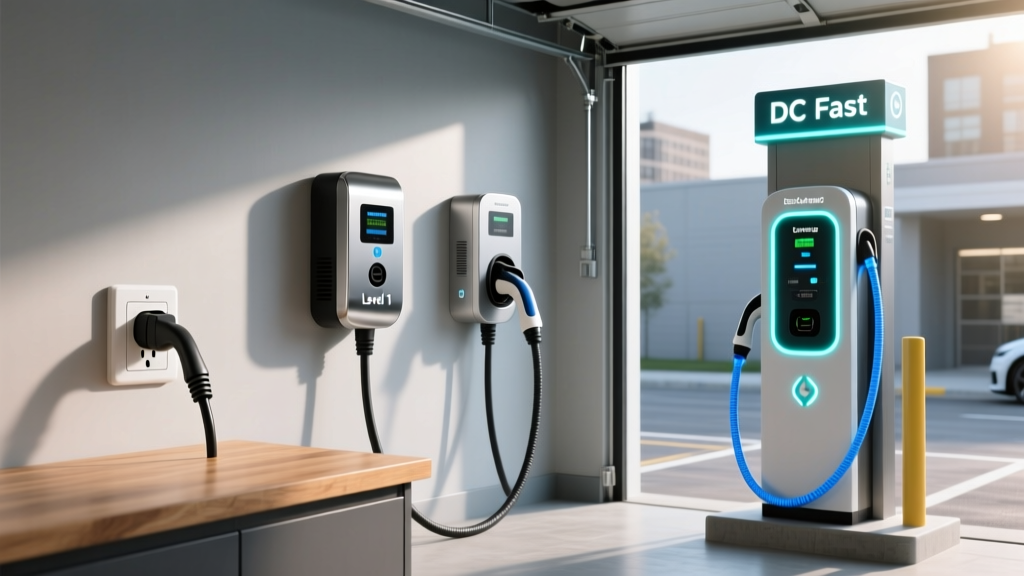
EV charging falls into three tiers. Here is how each performs on the Model 3 SR+ specifically.
| Level | Voltage / Power | Range Added per Hour | Best Use Case |
|---|---|---|---|
| Level 1 (Standard outlet) | 120V / 1.0–1.4 kW | ~3–5 miles | Overnight top-ups, emergency backup, low-mileage drivers |
| Level 2 (Home / workplace) | 240V / 7.7–11.5 kW | ~25–44 miles | Daily primary charging at home or work |
| DC Fast Charging | 250–500V / up to 170 kW (SR+) | ~150–320 miles per 30 min | Road trips, quick top-ups away from home |
The charge curve matters. The Model 3 SR+ will accept peak power (up to 170 kW on LFP models) only between roughly 10–50% state of charge. Above 80%, the rate tapers significantly — often dropping below 30 kW. This is why manufacturers quote 10–80% times rather than 0–100%. Charging to 100% at a DC fast charger is wasteful and time-consuming; save full charges for overnight Level 2 sessions.
LFP battery advantage: If your SR+ has the LFP pack (2021+ models), Tesla recommends charging to 100% at least once a week on Level 2. LFP chemistry tolerates full charges better than NMC, and doing so helps the BMS recalibrate for accurate range estimation. NMC owners should target 80–90% daily and save 100% for road trips.
Home Charger Installation: Requirements, Costs, and Gotchas
Installing a dedicated Level 2 home charger is the single biggest quality-of-life upgrade for Model 3 ownership. Here is what the process actually involves and what it costs.
Electrical Requirements
The Model 3's onboard charger accepts up to 11.5 kW (48 amps). To deliver that, you need a 240V circuit rated for 60 amps (EV chargers are considered continuous loads under NEC Article 625, so the circuit must be rated 125% above the charger's max draw — 48A × 1.25 = 60A breaker).
If your electrical panel doesn't have 60A of spare capacity, you can install a lower-amperage charger. A 40A circuit (32A continuous) still delivers 7.7 kW — enough to add ~30 miles per hour, which fully replenishes the SR+ battery overnight.
Panel Upgrade: The Cost Nobody Talks About
Homes built before 2000 often have 100A or 150A main panels that are already near capacity. Adding a 60A EV circuit may require a panel upgrade to 200A, which typically costs $1,500–$3,000 on top of the charger installation. Always get a licensed electrician to perform a load calculation before committing to a charger amperage.
Installation Cost Breakdown
| Component | Simple Install (panel nearby, no upgrade) | Complex Install (long run, panel upgrade) |
|---|---|---|
| Level 2 charger (hardware) | $400–$700 | $400–$700 |
| Electrician labor (wiring, conduit, breaker) | $500–$1,200 | $1,500–$3,500 |
| Electrical permit | $50–$200 | $50–$200 |
| Panel upgrade (if needed) | $0 | $1,500–$3,000 |
| Total estimated range | $950–$2,100 | $3,450–$7,400 |
Some utilities offer rebates of $250–$500 for installing a smart Level 2 charger, and the federal Residential Clean Energy Credit (as extended and modified through recent legislation — verify current-year eligibility on IRS.gov) may cover a portion of installation costs. Check with your local utility and a tax professional for details specific to your jurisdiction.
Safety and Code Considerations
- Dedicated circuit: Your EV charger must have its own dedicated breaker — never share a circuit with other large appliances.
- GFCI protection: NEC 2020+ requires GFCI protection for outdoor receptacles; hardwired chargers may bypass this requirement depending on local code.
- Outdoor rating: If installing outside, ensure the charger carries a NEMA 4 or NEMA 4X rating for weather resistance.
- Cable management: Choose a charger with at least 18–24 feet of cable to reach your charge port regardless of parking orientation.
Connector Compatibility: NACS, CCS, and Adapters
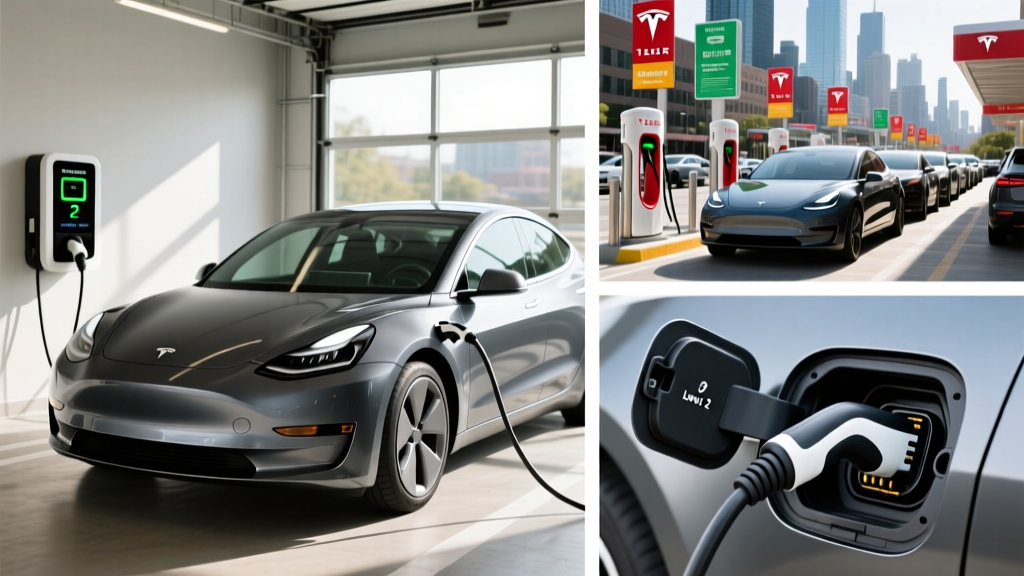
The Model 3 SR+ uses Tesla's proprietary NACS (North American Charging Standard) connector natively. This gives you direct access to the Tesla Supercharger network — still the most reliable DC fast-charging network in North America. Here is how compatibility breaks down.
| Connector Type | Native Compatibility? | Adapter Needed? | Notes |
|---|---|---|---|
| NACS (Tesla) | Yes — native | None | Full Supercharger access (V2 and V3 stalls) |
| CCS1 | No | Tesla CCS Adapter (~$175–$250) | Enables Electrify America, EVgo, and other CCS networks; limited to ~150 kW via adapter on SR+ |
| CHAdeMO | No | Third-party adapter (rare, ~$400+) | Largely legacy; not worth purchasing for most owners |
| J1772 (Level 2 public) | No | Tesla J1772 adapter (included with car) | Works at public Level 2 stations; limited to 11.5 kW |
Practical tip: Every Model 3 ships with a J1772 adapter in the glovebox or frunk. If you bought used and it's missing, replacements cost ~$50 from Tesla. The CCS adapter is a worthwhile $175–$250 purchase if you plan road trips through areas with limited Supercharger coverage.
Equipment Recommendations: Best Level 2 Chargers for the Model 3 SR+
You have two paths: a Tesla Wall Connector (NACS native, no adapter needed) or a third-party J1772 charger (requires the included adapter). Here are top picks.
Tesla Wall Connector (Gen 3)
- Power output: Up to 11.5 kW (48A)
- Connector: NACS — plugs directly into Model 3
- Cable length: 24 feet
- Smart features: Wi-Fi for OTA updates, power sharing between two units, load management
- Price: ~$475
- Best for: Tesla-only households wanting the cleanest setup
ChargePoint Home Flex
- Power output: Up to 12 kW (50A), configurable from 16A–50A
- Connector: J1772 (use Tesla adapter) or NACS version available
- Cable length: 23 feet
- Smart features: Wi-Fi, app-based scheduling, Alexa integration, amperage adjustable to match your panel
- Price: ~$550–$700
- Best for: Multi-EV households or those wanting flexible amperage settings
Emporia Level 2 EV Charger
- Power output: Up to 11.5 kW (48A)
- Connector: J1772 (NACS version announced)
- Cable length: 24 feet
- Smart features: Wi-Fi, solar integration, energy monitoring, scheduling
- Price: ~$400
- Best for: Budget-conscious buyers or homes with solar panels
All three chargers are NEMA 4 rated for outdoor use and UL-listed. The Tesla Wall Connector is the most seamless choice since it eliminates the adapter step, but the ChargePoint Home Flex's adjustable amperage is invaluable if your panel can't support a full 60A circuit.
Cost to Charge: Home vs. Public vs. Gas
One of the strongest arguments for the Model 3 SR+ is its low running cost. Let's quantify it.
| Scenario | Rate ($/kWh) | Cost for 10–80% (~37 kWh) | Cost per Mile |
|---|---|---|---|
| Home — off-peak utility rate | $0.08–$0.12 | $2.96–$4.44 | $0.02–$0.03 |
| Home — standard residential rate | $0.13–$0.18 | $4.81–$6.66 | $0.03–$0.04 |
| Public Level 2 (ChargePoint, etc.) | $0.20–$0.35 | $7.40–$12.95 | $0.05–$0.08 |
| Tesla Supercharger (V3) | $0.28–$0.42 | $10.36–$15.54 | $0.07–$0.10 |
| Non-Tesla DC fast charger | $0.35–$0.55 | $12.95–$20.35 | $0.08–$0.13 |
Gas comparison: A comparable compact gas sedan averaging 30 MPG combined at $3.50/gallon costs roughly $0.12 per mile in fuel alone. Home-charging the Model 3 SR+ at standard rates costs $0.03–$0.04 per mile — a savings of approximately 70%. Even exclusive Supercharger use at $0.35/kWh undercuts gas by 15–20%.
According to fueleconomy.gov, the Model 3 achieves 132–142 MPGe combined depending on model year, making it one of the most energy-efficient EVs on the road. That efficiency is what keeps per-mile costs so low even when public charging rates are high.
Public Charging and Road-Trip Strategy
The Model 3 SR+ has a built-in advantage: native access to the Tesla Supercharger network, which as of 2026 includes over 6,000 stations and 60,000+ stalls in North America. The car's navigation system automatically preconditions the battery when you navigate to a Supercharger, warming it to optimize charge speed — a critical feature that non-Tesla EVs still struggle to match seamlessly.
Road-trip charging strategy for the SR+:
- Plan stops at 170–190 mile intervals to avoid running the battery below 10%.
- Charge to 80% at each stop — the 10–80% session takes ~25–30 minutes at a V3 Supercharger.
- Above 80%, the charge curve tapers sharply. Charging from 80–100% at a DC fast charger can take as long as 10–80% did.
- In cold weather (below 32°F), expect 10–80% times to stretch to 30–35 minutes due to slower battery chemistry, even with preconditioning.
CCS adapter for redundancy: While Superchargers cover most major highways, rural areas and some national parks have better coverage from Electrify America or EVgo. The Tesla CCS adapter (purchased separately) opens up these networks, though you may see slightly lower peak charge rates (~150 kW vs. the SR+'s native 170 kW) due to adapter protocol overhead.
Frequently Asked Questions
How much does it cost to install a home EV charger for the Model 3 SR+?
A straightforward Level 2 installation with a nearby 240V panel typically costs $950–$2,100 all-in (charger + electrician + permit). If your home needs a panel upgrade or a long conduit run, expect $3,450–$7,400. Always get a load calculation from a licensed electrician before choosing charger amperage.
How fast will each charging level add range to my Model 3 SR+?
Level 1 (120V) adds roughly 3–5 miles per hour. Level 2 (240V, 48A) adds about 37–44 miles per hour — enough to fully recharge overnight. DC fast charging at a V3 Supercharger adds up to 175 miles in 15 minutes at peak rate, though the charge curve tapers significantly above 80%.
Which connector and charger are compatible with my Model 3 SR+?
The Model 3 SR+ uses NACS natively, giving direct Supercharger access. For public J1772 Level 2 stations, use the included Tesla J1772 adapter. For non-Tesla DC fast chargers (Electrify America, EVgo), purchase the optional Tesla CCS adapter (~$175–$250). CHAdeMO is effectively obsolete and not worth pursuing.
How much does charging cost per mile compared to gas?
Home charging at standard residential rates ($0.13–$0.18/kWh) costs roughly $0.03–$0.04 per mile. A comparable 30-MPG gas sedan at $3.50/gallon costs about $0.12 per mile. Even exclusive Supercharger use at $0.35/kWh costs ~$0.08–$0.10 per mile, still cheaper than gas.
What electrical upgrades might I need for a home charger?
You need a dedicated 240V circuit — ideally 60A to support the Model 3's full 48A draw. Homes with older 100A or 150A panels may need a panel upgrade to 200A ($1,500–$3,000). A lower-amperage setup (40A circuit / 32A continuous) is a viable alternative that avoids panel upgrades while still delivering 7.7 kW — plenty for overnight charging of the SR+'s ~53 kWh battery.
Should I charge my LFP Model 3 SR+ to 100%?
Yes. Tesla recommends LFP owners charge to 100% at least once per week. LFP chemistry handles full charges well, and doing so keeps the battery management system calibrated for accurate range readings. Set your daily limit to 100% and plug in whenever convenient.
Does cold weather affect charging speed?
Yes. Below 32°F, expect 10–80% DC fast charge times to increase by 15–30% even with battery preconditioning. Range also drops 15–25% in cold weather. The Model 3's heat pump (standard on 2021+ models) helps mitigate cabin-heating energy draw, but battery chemistry limitations remain a physical constraint.
Sources: fueleconomy.gov (EPA range and MPGe data), Tesla Home Charger Installation Guide, IRS Residential Clean Energy Credit. Tax credit and incentive rules vary by jurisdiction and model year — consult a tax professional for your specific eligibility.