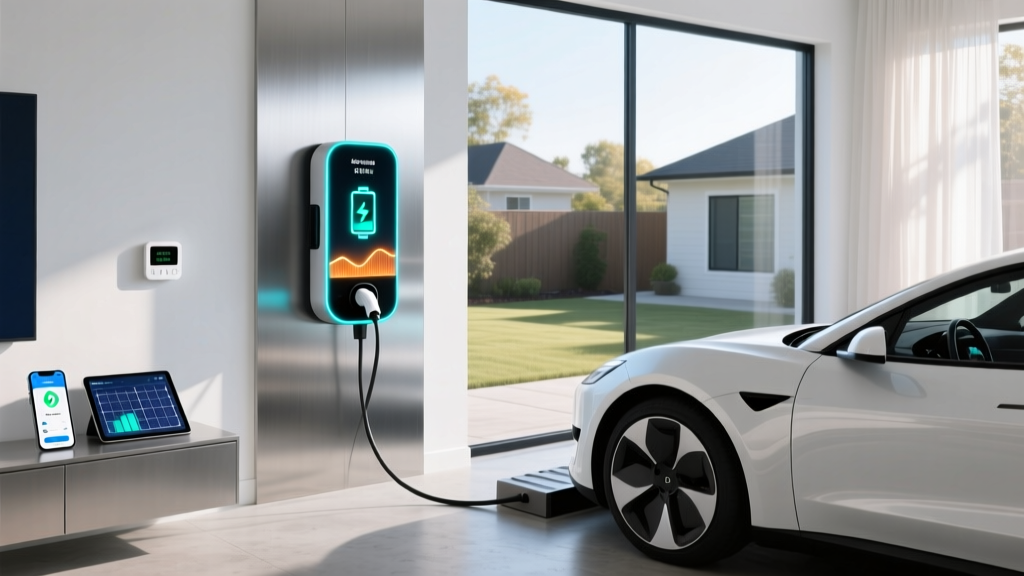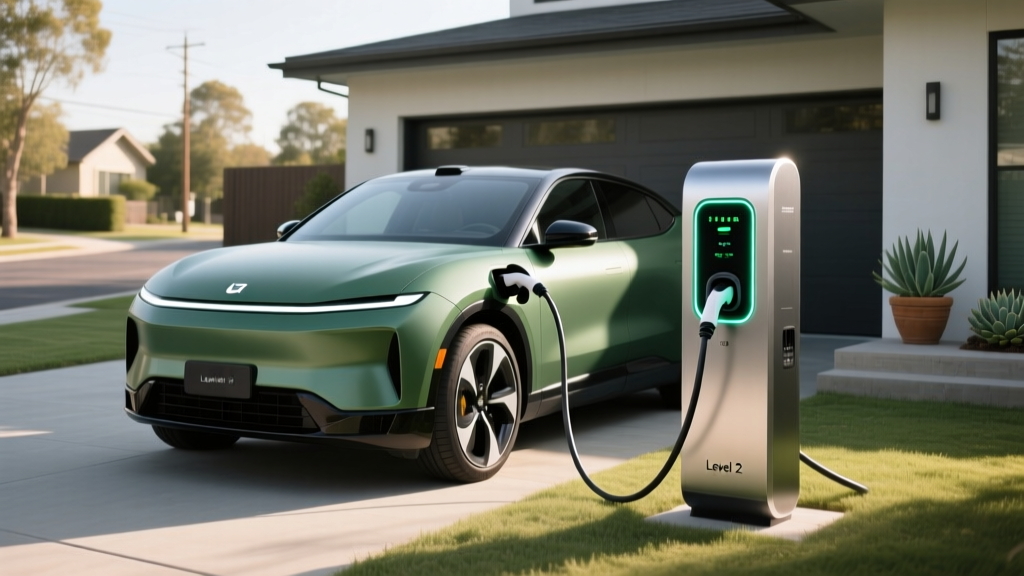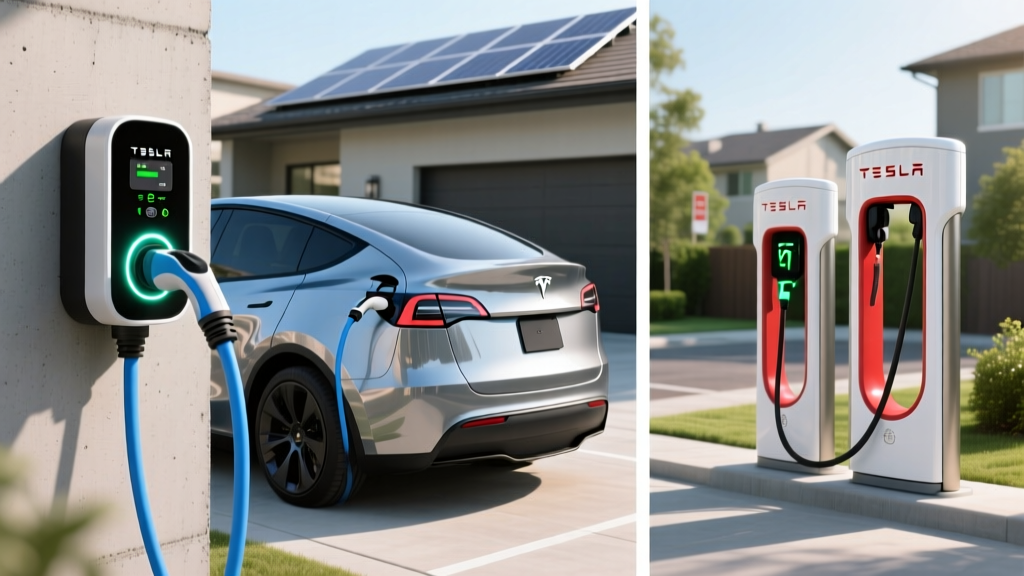
What the Tesla Charging Limit Actually Means
When owners search for the "Tesla charging limit," they're usually asking one of three questions: How fast can my Tesla charge at home? What's the maximum DC fast-charge rate on the road? And why does charging slow down past 80%? The answer depends on which charging level you're using, which Tesla model you own, and the electrical infrastructure feeding the car.
Every Tesla sold today — from the Model 3 Standard Range to the Model X Plaid — has an onboard charger that caps Level 2 AC charging at 11.5 kW (48 amps on a 60-amp circuit). For DC fast charging, most current Tesla models peak between 170 kW and 250 kW, depending on battery size and chemistry. But peak rate is not sustained rate: the charge curve tapers significantly above 50–60% state of charge (SoC), meaning your average charging speed over a 10–80% session is considerably lower than the headline number.
This guide breaks down the Tesla charging limit across all three levels, what it costs to install a home charger, which connectors and adapters you need, and how charging cost per mile compares to gas. We'll also recommend specific Level 2 equipment with real specs and prices.
Charging Levels Explained: Speeds, kW, and Miles Per Hour
Before we talk numbers, a critical distinction: kW (kilowatts) measures power — the rate at which energy flows into your car. kWh (kilowatt-hours) measures energy — the total capacity of your battery. Think of kW as the speed of water flowing through a hose, and kWh as the size of the bucket. You'll see both in this guide, and they are never interchangeable.
Here's how each level performs with a Tesla, using the Model 3 Long Range (82 kWh usable battery, ~341 miles EPA) as our reference vehicle:
| Level | Voltage / Amps | Max Power (kW) | Miles of Range Added Per Hour | Typical Use Case |
|---|---|---|---|---|
| Level 1 (120V) | 120V / 12A | ~1.4 kW | ~3–5 mi/hr | Emergency / overnight trickle |
| Level 2 (240V) — Mobile Connector | 240V / 32A | ~7.7 kW | ~25–30 mi/hr | Budget home charging (NEMA 14-50 outlet) |
| Level 2 (240V) — Wall Connector | 240V / 48A | ~11.5 kW | ~38–44 mi/hr | Optimal home charging (hardwired 60A circuit) |
| DC Fast (Supercharger V3) | 400V+ DC | Up to 250 kW | Up to ~1,000 mi/hr (peak) | Road trips, 10–80% in ~25–30 min |
| DC Fast (Supercharger V4) | 800V+ DC | Up to 350 kW (future models) | Higher rates for Cybertruck/next-gen | Rolling out at select stations |
Real-world caveat: Those Level 2 "miles per hour" figures assume you're charging in the battery's sweet spot (20–60% SoC) at moderate temperatures. In freezing weather, a cold-soaked battery that hasn't preconditioned may accept Level 2 power at reduced rates until it warms up — cutting your effective overnight charge by 10–20%.
Home Charger Installation: Electrical Requirements and Costs
Most Tesla owners' real "charging limit" isn't the car — it's their home's electrical panel. Installing a Level 2 charger that delivers the full 11.5 kW your Tesla can accept requires a dedicated 240-volt, 60-amp circuit with a hardwired connection. Here's what that entails:
Electrical Requirements
- Circuit: 60-amp dedicated breaker (for 48A continuous draw — the National Electrical Code requires circuits rated at 125% of continuous load)
- Wire: 6 AWG copper (or 4 AWG aluminum) for runs up to ~50 feet; thicker gauge for longer runs to limit voltage drop
- Panel capacity: You need at least 60 amps of spare capacity on your main panel. A 200-amp panel with heavy existing loads (electric range, dryer, HVAC) may be maxed out
- Alternative: A NEMA 14-50 outlet on a 50-amp circuit delivers up to 40A continuous (9.6 kW) — sufficient for most overnight charging needs and avoids hardwiring
Panel Upgrade: The Hidden Cost
If your home has a 100-amp main panel — common in houses built before the 1990s — you'll likely need a panel upgrade to 200 amps before adding a 60-amp EV circuit. This is the single biggest variable in home charger installation cost. A panel upgrade typically runs $1,500 to $3,500 depending on your utility's requirements, whether a new meter base is needed, and local permit fees.
| Component | Low End | High End | Notes |
|---|---|---|---|
| Level 2 Charger (Equipment) | $350 | $700 | Tesla Wall Connector ~$475; third-party smart chargers $400–$700 |
| Electrician Labor (standard install) | $500 | $1,500 | Depends on run length from panel to garage/driveway |
| Electrical Materials (wire, conduit, breaker) | $150 | $500 | Longer runs and underground conduit increase cost |
| Permit & Inspection | $50 | $300 | Varies by municipality; some waive EV permit fees |
| Panel Upgrade (if needed) | $1,500 | $3,500 | Required for 100A panels; not needed for 200A+ panels with spare capacity |
| Total (no panel upgrade) | $1,050 | $3,000 | Typical for homes with adequate panel capacity |
| Total (with panel upgrade) | $2,550 | $6,500 | Older homes or those with heavy existing loads |
Federal incentive: The Residential Clean Energy Credit (IRS §25D) covers 30% of home EV charger equipment and installation costs up to $1,000 through 2032. This is separate from the §30D vehicle tax credit. Check IRS guidelines for eligibility, as the charger must be installed at your primary or secondary US residence. Some states and utilities stack additional rebates on top — consult your local utility and AFDC's state incentive database for specifics.
Connector Compatibility: NACS, CCS, and Adapters
Tesla uses the North American Charging Standard (NACS) connector — a compact plug that handles both AC Level 2 and DC fast charging through a single port. As of 2026, nearly every major automaker has adopted NACS for new EVs, and Tesla Supercharger stations are open to non-Tesla vehicles with NACS ports.
But if you own a non-Tesla EV with a CCS1 port and want to use Tesla Superchargers, or if you're a Tesla owner who needs to use a CCS public charger, you'll need an adapter:
| Your EV Port | Tesla Supercharger (NACS) | CCS1 Public DC Charger | J1772 Public Level 2 | CHAdeMO |
|---|---|---|---|---|
| Tesla (NACS native) | Direct plug-in ✓ | Tesla CCS Adapter (~$175) required | Tesla J1772 Adapter (included with car) ✓ | No adapter available; network retiring |
| Non-Tesla NACS (2025+ Ford, GM, Rivian, etc.) | Direct plug-in ✓ | CCS1 native ✓ | J1772 native ✓ | No adapter available |
| CCS1 (older Ford, Hyundai, VW, etc.) | CCS-to-NACS adapter (~$200–$300) required | Direct plug-in ✓ | J1772 native ✓ | CHAdeMO-to-CCS adapter (limited availability) |
Practical note: Tesla's CCS adapter allows Tesla vehicles to charge at Electrify America, EVgo, and other CCS networks — essential for road trips through areas with sparse Supercharger coverage. Third-party CCS-to-NACS adapters from brands like A2Z and Lectron now allow CCS-equipped EVs to access Superchargers, but always verify your specific vehicle's compatibility before purchasing.
Cost to Charge: Home vs. Public vs. Gas
The economics of EV charging depend entirely on where you charge. Home electricity rates vary widely across the US, but the gap between home charging and DC fast charging is dramatic.
| Scenario | Rate ($/kWh) | Cost Per Mile | Full Charge (10–80%, ~57 kWh) | Gas Equivalent (30 MPG @ $3.50/gal) |
|---|---|---|---|---|
| Home Off-Peak (Time-of-Use) | $0.08–$0.12 | $0.023–$0.034 | $4.56–$6.84 | $0.117/mile |
| Home Standard Rate | $0.14–$0.18 | $0.040–$0.051 | $7.98–$10.26 | $0.117/mile |
| Tesla Supercharger (V3) | $0.28–$0.40 | $0.080–$0.114 | $15.96–$22.80 | $0.117/mile |
| Electrify America / EVgo DC | $0.35–$0.55 | $0.100–$0.157 | $19.95–$31.35 | $0.117/mile |
The takeaway: If you charge at home on off-peak rates, your Tesla costs roughly $0.03 per mile — about one-quarter the fuel cost of a 30 MPG gas car at $3.50/gallon. But if you rely exclusively on public DC fast charging at $0.40+/kWh, your per-mile cost approaches or exceeds gas. This is why home charging access is the single most important factor in EV ownership economics.
Charging Time Examples: 10–80% by Battery Size
Here's where the Tesla charging limit becomes most practical. The charge curve — the rate at which your battery accepts power at different states of charge — means that a "250 kW peak" doesn't mean 250 kW sustained. In practice, a Tesla Model 3 Long Range at a V3 Supercharger will peak near 250 kW around 10–20% SoC, taper to ~150 kW by 50%, and drop below 75 kW past 70%.
10–80% Charging Times (Typical Conditions, Preconditioned Battery)
- Model 3 Standard Range (~60 kWh LFP battery, 170 kW peak): ~28–32 minutes on V3 Supercharger; ~6.5 hours at 11.5 kW Level 2
- Model 3/Y Long Range (~82 kWh NMC battery, 250 kW peak): ~25–30 minutes on V3 Supercharger; ~8 hours at 11.5 kW Level 2
- Model S/X (100 kWh NMC, 250 kW peak): ~30–35 minutes on V3 Supercharger; ~9.5 hours at 11.5 kW Level 2
- Cybertruck AWD (~123 kWh NMC, 250 kW peak): ~35–40 minutes on V3 Supercharger; ~11.5 hours at 11.5 kW Level 2
Cold weather impact: In sub-30°F conditions without preconditioning, expect 10–80% DC fast-charge times to increase by 30–50%. Always navigate to a Supercharger using your Tesla's built-in navigation — this triggers automatic battery preconditioning, warming the pack to optimal temperature before you arrive.
Recommended Level 2 Home Chargers for Tesla Owners
While the Tesla Wall Connector is the obvious default, several third-party chargers offer features Tesla doesn't — like energy monitoring, solar integration, and universal connector compatibility. Here are three proven options:
Tesla Wall Connector (Gen 3)
- Power Output: Up to 11.5 kW (48A)
- Connector: NACS (native Tesla)
- Cable Length: 24 ft
- Smart Features: Wi-Fi for OTA updates, load sharing between multiple units, access control
- Price: ~$475
- Best For: Tesla-only households wanting the cleanest integration
ChargePoint Home Flex
- Power Output: Up to 12 kW (50A, adjustable down to 16A)
- Connector: NACS or J1772 (configurable); NACS version available 2025+
- Cable Length: 23 ft
- Smart Features: App scheduling, energy tracking, Alexa integration, flexible amperage for older panels
- Price: ~$550–$650
- Best For: Multi-EV households or homes needing adjustable amperage to avoid panel upgrades
Emporia Vue Level 2 Charger
- Power Output: Up to 11.5 kW (48A)
- Connector: NACS or J1772
- Cable Length: 24 ft
- Smart Features: Solar-aware charging (pairs with Emporia Vue energy monitor), time-of-use scheduling, detailed energy dashboard
- Price: ~$400–$500
- Best For: Solar-panel owners who want to charge exclusively on excess solar production
Pro tip: If your electrical panel is tight on capacity, the ChargePoint Home Flex's adjustable amperage (down to 16A / 3.8 kW on a 20-amp circuit) lets you install a Level 2 charger without a panel upgrade. You'll add ~13 miles of range per hour instead of 44 — but for overnight charging on a 10-hour window, that's 130 miles, which covers most daily driving.
Safety, Code, and Outdoor Installation Considerations
Level 2 EV charging draws significant continuous current — more than most household appliances. Cutting corners on installation is both dangerous and a code violation. Here's what to require from your electrician:
- Dedicated circuit: Your EV charger must be on its own breaker — never shared with other outlets or appliances
- GFCI protection: NEC 2023 and later require GFCI (ground-fault circuit interrupter) protection for all EV charging outlets. Hardwired chargers like the Tesla Wall Connector have built-in ground-fault protection and typically don't require a separate GFCI breaker
- Outdoor rating: If your charger is installed outdoors, both the unit and the connection must carry a NEMA 4 (or IP65+) weatherproof rating. The Tesla Wall Connector and ChargePoint Home Flex are both rated for outdoor use
- Permit and inspection: Most jurisdictions require an electrical permit for new 240V circuits. Your electrician should pull this — unpermitted work can void home insurance and cause issues at sale
- Cable management: For outdoor installs, specify a charger with an integrated cable holster or install a wall-mount hook to keep the cable off the ground and protected from weather and vehicle damage
Frequently Asked Questions
How much does it cost to install a home EV charger?
A standard Level 2 installation on an existing 200-amp panel typically costs $1,050 to $3,000 all-in (equipment, electrician, materials, permit). If your home needs a panel upgrade from 100A to 200A, add $1,500–$3,500, bringing the total to $2,550–$6,500. The federal §25D credit covers 30% of equipment and installation up to $1,000.
How fast will each charging level add range?
Level 1 (120V) adds roughly 3–5 miles per hour. Level 2 (240V) adds 25–44 miles per hour depending on amperage (32A vs. 48A). DC fast charging on a Tesla V3 Supercharger adds up to ~200 miles in 15 minutes at peak rate, though the charge curve tapers significantly above 60% SoC.
Which connector and charger is compatible with my EV?
All Tesla vehicles use the NACS connector natively and plug directly into Tesla Wall Connectors and Superchargers. For non-Tesla public Level 2 chargers (J1772), Tesla includes a J1772 adapter with every vehicle. For CCS public fast chargers, Tesla sells a CCS adapter (~$175). Non-Tesla EVs with CCS ports need a CCS-to-NACS adapter (~$200–$300) to access Superchargers.
How much does charging cost per mile vs. gas?
Home charging on off-peak electricity costs roughly $0.03/mile for a Tesla Model 3 — about 75% less than a 30 MPG gas car at $3.50/gallon ($0.12/mile). Public DC fast charging at $0.35–$0.55/kWh costs $0.10–$0.16/mile, comparable to or slightly above gas. The economics strongly favor home charging.
What electrical upgrades might I need?
The most common upgrade is a panel capacity increase from 100A to 200A ($1,500–$3,500). If your panel has capacity but you want to avoid a new 60A circuit, you can install a lower-amperage charger (e.g., 32A on a 40A circuit for 7.7 kW) or use a smart load-management device that dynamically reduces charger draw when other appliances are running. Consult a licensed electrician for a load calculation specific to your home.
Why does my Tesla's charging speed slow down above 80%?
This is the charge curve taper, and it's a physical limitation of lithium-ion batteries. As the battery fills, internal resistance increases, and the battery management system (BMS) reduces current to prevent lithium plating and heat damage. Above 80% SoC, a Tesla on a V3 Supercharger may drop from 250 kW to under 50 kW. This is why Tesla's navigation defaults to 80% charge at Superchargers — the last 20% takes nearly as long as the first 60%.