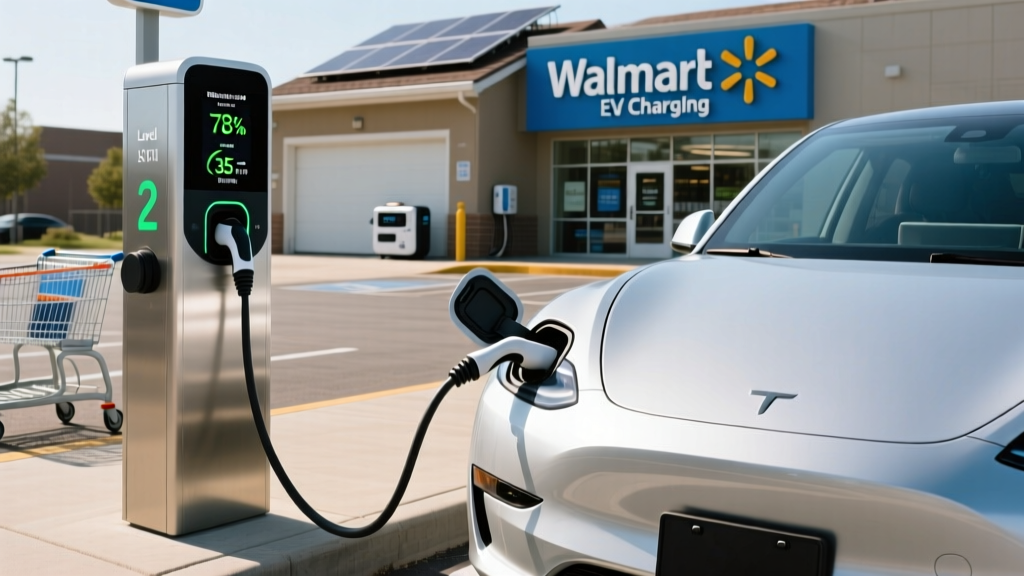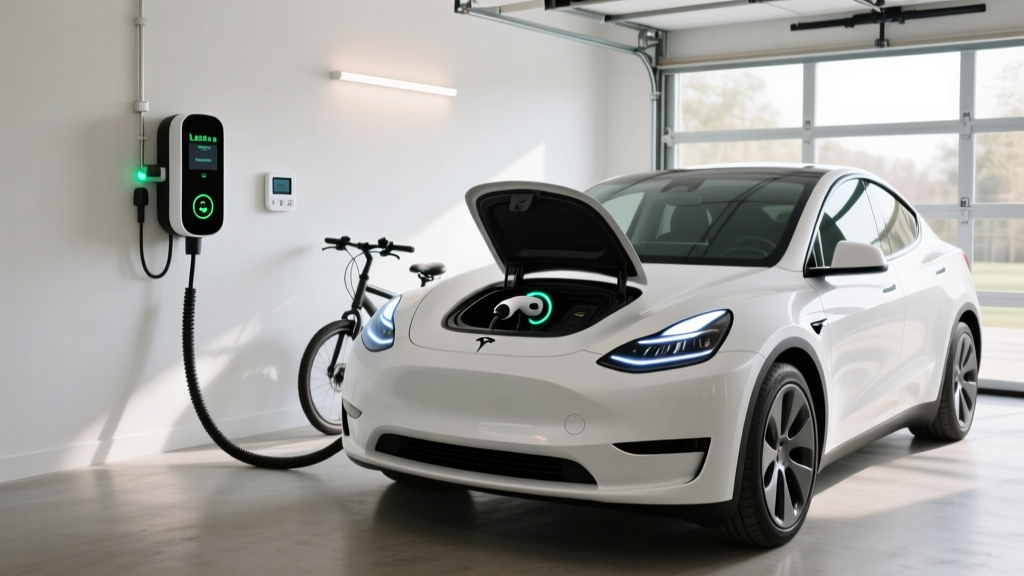
For most Tesla owners, the majority of charging happens at home. Plug in overnight, wake up to a full battery, and skip the gas station entirely. But setting up Tesla charging at home involves more than just plugging into a wall outlet — you need the right electrical circuit, the correct equipment, and a clear understanding of what it will cost and how fast it will charge.
This guide covers every decision you'll make: which charging level fits your driving habits, what your electrical panel can handle, exactly what installation costs, and which chargers are worth buying in 2026. Whether you own a Model 3, Model Y, Model S, Model X, or the newer Cybertruck, the fundamentals are the same.
Before going further, lock in this distinction — it's the single most common source of EV confusion.
kW (kilowatts) = power, or the rate at which electricity flows. Think of it like the diameter of a water hose.
kWh (kilowatt-hours) = energy, or the total amount stored or delivered. Think of it like gallons in a bucket.
A 75 kWh battery charged at 11.5 kW takes roughly 6.5 hours from empty. A 150 kW DC fast charger fills that same battery much faster — but only up to a point (more on charge-curve taper below).
Charging Levels Explained: How Fast Will Each Add Range?
Every Tesla sold in North America supports three charging tiers. The speed difference between them is enormous — and understanding the exact numbers helps you decide whether a simple outlet is enough or whether a Level 2 installation is worth the investment.
| Level | Voltage / Amperage | Power (kW) | Miles of Range Per Hour | Typical Use |
|---|---|---|---|---|
| Level 1 | 120V / 12A | ~1.4 kW | 3–5 mi/hr | Emergency / low-mileage top-ups |
| Level 2 | 240V / 32A–48A | 7.7–11.5 kW | 25–44 mi/hr | Primary home charging |
| DC Fast (Supercharger) | 400V+ / 250–350 kW peak | Up to 250–350 kW | ~1,000+ mi/hr (peak) | Road trips, rapid fills |
Real-world context: A Tesla Model Y Long Range has a usable battery of approximately 75 kWh and an EPA range of 310 miles. On Level 1 (120V), charging from 20% to 80% would take roughly 50+ hours — impractical as a daily routine. On Level 2 at 11.5 kW (48A, 240V), that same 20–80% session takes about 4 hours, easily completed overnight. At a V3 Supercharger (250 kW peak), 10–80% takes approximately 20–25 minutes, though the charge curve tapers significantly above 80% to protect battery health.
Connector Compatibility: NACS and the Tesla Ecosystem
All Tesla vehicles sold in North America use the NACS (North American Charging Standard) connector — a compact, proprietary design that Tesla opened to the industry in late 2022. By 2026, NACS has become the dominant EV connector in the US, adopted by Ford, GM, Rivian, Hyundai, and most major automakers.
| Connector | Used By | Tesla Compatibility |
|---|---|---|
| NACS (J3400) | Tesla (native), Ford, GM, Rivian, Hyundai, Volvo, and more (2025+) | Native — no adapter needed |
| CCS1 | Older non-Tesla EVs (pre-NACS adoption) | Requires Tesla CCS adapter (~$175) for non-Tesla DC chargers |
| CHAdeMO | Nissan Leaf, Mitsubishi (legacy) | Not compatible — adapter discontinued |
| J1772 | Level 2 public stations (non-Tesla) | Tesla includes J1772 adapter with every vehicle |
What this means for home charging: If you're buying a Level 2 home charger specifically for a Tesla, you want one with a native NACS plug. If you buy a J1772 charger, you'll use the included adapter every session — functional, but an extra step. Most new chargers in 2026 ship with NACS as the default or offer it as a configuration option.
Electrical Requirements: What Your Home Actually Needs
Level 2 home charging requires a 240-volt dedicated circuit — the same voltage your electric dryer or oven uses. The amperage of that circuit determines your charging speed, and your home's electrical panel determines whether you can support it.
Circuit and amperage basics:
- 32A circuit (requires 40A breaker): Delivers 7.7 kW. Adds ~25–30 miles of range per hour. Sufficient for most daily drivers covering under 60 miles/day.
- 40A circuit (requires 50A breaker): Delivers 9.6 kW. Adds ~30–35 mi/hr. The most common home install.
- 48A circuit (requires 60A breaker): Delivers 11.5 kW. Adds ~40–44 mi/hr. Maximum onboard charger capacity for most Teslas.
- 60A circuit (requires 70–80A breaker): Some chargers like the Tesla Wall Connector support up to 48A draw on a 60A breaker. The vehicle's onboard charger caps at 48A (11.5 kW) for Model 3/Y and up to 48A for Model S/X.
Electrical panel capacity: Most modern homes have a 200-amp service panel, which typically supports a 40A–60A dedicated EV circuit without issue. Older homes with 100-amp panels may need a panel upgrade (also called a "heavy-up"), which costs between $1,500 and $3,000 depending on your area and utility requirements. An electrician will perform a load calculation per NEC Article 220 to determine if your panel has headroom.
The 80% rule (NEC 210.20): EV chargers are considered "continuous loads" under the National Electrical Code. This means the circuit must be rated for 125% of the charger's maximum draw. A 48A charger requires a 60A breaker. A 32A charger requires a 40A breaker. Never install a charger that exceeds 80% of the circuit rating.
How Much Does It Cost to Install a Home EV Charger?
Installation costs vary dramatically based on your home's electrical layout, the distance from your panel to the charging location, and whether upgrades are needed. Here's a realistic breakdown based on 2026 national averages:
| Component | Simple Install (panel nearby) | Complex Install (long run / upgrades) |
|---|---|---|
| Level 2 Charger (equipment) | $400–$600 | $400–$700 |
| Electrician labor (2–4 hrs simple / 6–10 hrs complex) | $300–$600 | $800–$2,000 |
| Electrical permit | $50–$150 | $50–$200 |
| Conduit, wiring, mounting hardware | $50–$150 | $200–$500 |
| Panel upgrade (if needed) | N/A | $1,500–$3,000 |
| TOTAL | $800–$1,500 | $2,950–$6,400 |
Cost-saving tips:
- Many utilities offer rebates of $250–$500 for Level 2 charger installation — check with your local provider before starting work.
- The federal Alternative Fuel Vehicle Refueling Property Credit (IRS Form 8911) can cover up to 30% of home charging equipment and installation costs, capped at $1,000, subject to census-tract eligibility. See IRS.gov for current rules.
- Install the charger as close to your electrical panel as possible — long conduit runs are the biggest driver of labor costs.
- Get at least three quotes from licensed electricians. Ask specifically about their experience with EV charger circuits and NEC 625 (the article governing EV charging equipment).
Cost to Charge: Home Electricity vs Gas Per Mile
One of the strongest financial arguments for Tesla ownership is the per-mile fuel cost. Let's compare real numbers using a Tesla Model Y Long Range (approximately 3.5 miles per kWh efficiency) and a comparable gas SUV getting 25 MPG combined.
| Scenario | Rate | Cost Per Mile (Tesla) | Cost Per Mile (Gas) |
|---|---|---|---|
| Home — off-peak utility rate | $0.10/kWh | $0.029 | $0.136 (at $3.40/gal) |
| Home — national avg rate | $0.16/kWh | $0.046 | $0.136 |
| Home — high-cost state (CA/MA) | $0.28/kWh | $0.080 | $0.136 |
| Public Level 2 (ChargePoint, etc.) | $0.25–$0.40/kWh | $0.071–$0.114 | $0.136 |
| Tesla Supercharger (V3/V4) | $0.28–$0.40/kWh | $0.080–$0.114 | $0.136 |
The takeaway: Home charging at off-peak rates costs roughly $0.03 per mile — about 4–5× cheaper than gasoline. Even at the highest residential rates, home charging undercuts gas. Public DC fast charging approaches gas-car costs per mile, which is why it's best reserved for road trips rather than daily use.
Time-of-Use (TOU) rates: Many utilities offer TOU plans where electricity drops to $0.06–$0.10/kWh between midnight and 6 AM. Set your Tesla's scheduled charging feature to start at midnight, and you'll maximize savings. A full 75 kWh charge at $0.08/kWh costs just $6.00 — roughly 310 miles of EPA range.
Best Home Chargers for Tesla in 2026
Here are three chargers that consistently earn top marks for Tesla home charging, based on power output, build quality, smart features, and connector compatibility.
Tesla Wall Connector (Gen 3)
- Power output: Up to 11.5 kW (48A on a 60A circuit)
- Connector: Native NACS — no adapter needed
- Cable length: 24 feet
- Smart features: Wi-Fi for OTA updates, power-sharing with a second Wall Connector on the same circuit, load management, access control
- Price: ~$475
- Best for: Tesla-only households. Seamless integration with the Tesla app. Power-sharing is ideal for two-Tesla garages on a single 60A circuit.
ChargePoint Home Flex
- Power output: Up to 12 kW (50A on a 60A circuit, configurable down to 16A)
- Connector: Available with native NACS plug (2025+ models) or J1772 with adapter
- Cable length: 23 feet
- Smart features: ChargePoint app with scheduling, energy tracking, Alexa integration, flexible amperage configuration to match your circuit
- Price: ~$550–$650
- Best for: Multi-EV households (Tesla + non-Tesla). The adjustable amperage means you can install it on a 20A–60A circuit and configure it to match — future-proof if you move or upgrade your panel later.
Emporia Vue Level 2 Charger
- Power output: Up to 11.5 kW (48A on a 60A circuit)
- Connector: NACS available; J1772 also offered
- Cable length: 24 feet
- Smart features: Integrates with Emporia Vue home energy monitor for real-time solar and grid tracking, EV-only circuit monitoring, scheduling, load management
- Price: ~$400–$500
- Best for: Solar-panel households wanting to track exactly how much charging is powered by rooftop generation. The energy monitoring integration is unmatched.
Safety, Code, and Installation Best Practices
EV charging is a continuous, high-draw electrical load. Cutting corners on installation creates fire risk and may void your homeowner's insurance. Here's what matters:
- Dedicated circuit: Your Level 2 charger must be on its own dedicated circuit — never shared with other appliances. NEC Article 625 governs EV charging equipment specifically.
- GFCI protection: NEC 2020 and later require GFCI (Ground Fault Circuit Interrupter) protection for all EV charging outlets rated 60A or less. Hardwired chargers (like the Tesla Wall Connector) often have built-in ground-fault protection, but confirm with your electrician. Note: some jurisdictions have issued clarifications on GFCI nuisance-tripping with hardwired EVSEs — your electrician will know local code interpretations.
- Outdoor rating: If your charger is installed outside (driveway, carport, exterior wall), ensure it carries a NEMA 4 or NEMA 4X rating for weather resistance. The Tesla Wall Connector and ChargePoint Home Flex are both rated for outdoor use.
- Hardwired vs plug: Hardwired installations (no plug, direct wire connection) are preferred for 48A+ chargers. A NEMA 14-50 outlet is common for 40A circuits and allows you to unplug and take the charger when you move — but the receptacle must be high-quality (Hubbell or Bryant industrial grade, not a cheap big-box store unit, which have been linked to melting under continuous EV load).
- Permit and inspection: Most jurisdictions require an electrical permit for EV charger installation. The inspection ensures the work meets code and protects you in case of an insurance claim. A licensed electrician will handle the permit — never skip this step.
- Wi-Fi signal: Smart chargers rely on Wi-Fi for scheduling, OTA updates, and energy monitoring. Check your signal strength at the installation point. A weak signal can be solved with a Wi-Fi extender or mesh node in the garage.
Tesla Charging at Home: Frequently Asked Questions
Can I charge my Tesla from a regular 120V outlet?
Yes, but slowly. A standard household outlet (120V, 12A) delivers about 1.4 kW, adding roughly 3–5 miles of range per hour. For a Tesla Model Y with a 75 kWh battery, a full charge from empty would take over 50 hours. Level 1 is fine for overnight top-ups if you drive less than 40 miles per day, but most owners find it insufficient as a primary charging method. Tesla includes a Mobile Connector with every vehicle that works with a standard 120V outlet.
How much does it cost to install a home EV charger?
A straightforward Level 2 installation (panel within 10–20 feet of the charger location, no upgrades needed) typically costs $800–$1,500 total, including equipment, electrician labor, permit, and materials. Complex installations involving long conduit runs, trenching, or a panel upgrade can range from $2,500–$6,400+. Always get multiple quotes and confirm the electrician is experienced with NEC Article 625.
Do I need to upgrade my electrical panel?
Not always. A licensed electrician will perform a load calculation to determine if your existing panel has capacity for a 40A–60A dedicated circuit. Homes with 200-amp service typically have enough headroom. Homes with 100-amp service, older wiring, or many existing high-draw circuits (electric heat, AC, dryer, oven) may require a panel upgrade costing $1,500–$3,000. This is the single biggest variable in installation cost.
How fast will each charging level add range to my Tesla?
Level 1 (120V): approximately 3–5 miles per hour. Level 2 (240V, 40A–48A): approximately 25–44 miles per hour depending on amperage. DC Fast Charging at a Tesla Supercharger: up to 200 miles added in 15 minutes at peak rates (V3/V4 stations). For daily driving, Level 2 is the sweet spot — an overnight session of 6–8 hours easily replenishes a full day's driving.
Which connector and charger is compatible with my Tesla?
All Tesla vehicles in North America use the NACS connector natively. For home Level 2 charging, the Tesla Wall Connector with its native NACS plug is the simplest option — no adapter needed. Third-party chargers with NACS plugs (ChargePoint Home Flex, Emporia Vue) also work natively. If you use a J1772 charger, Tesla includes a J1772-to-NACS adapter with every vehicle. For DC fast charging at non-Tesla public stations with CCS1 connectors, you'll need Tesla's CCS adapter (sold separately, ~$175).
How much does charging cost per mile compared to gas?
At home on an off-peak utility rate of $0.10/kWh, a Tesla Model Y costs about $0.03 per mile to charge — roughly 4–5× cheaper than a 25 MPG gas SUV at $3.40/gallon ($0.14/mile). Even at higher residential rates ($0.25–$0.28/kWh), home charging remains cheaper than gas. Public DC fast charging at $0.30–$0.40/kWh approaches gas-car cost per mile, which is why maximizing home charging is the key to EV savings.
What electrical upgrades might I need for a Tesla home charger?
The most common upgrades are: a new 40A–60A dedicated circuit with appropriately sized wiring (6 AWG copper for 60A); a new breaker in your panel; and a NEMA 14-50 receptacle or hardwired connection. Less common but more expensive: a panel upgrade from 100A to 200A service if your panel is at capacity; a sub-panel installation if your main panel is full; or trenching and conduit if the charger is far from the panel (e.g., a detached garage). Your electrician's load calculation will determine exactly what's required.
Should I get a NEMA 14-50 outlet or hardwire my charger?
Both work, but they have trade-offs. A NEMA 14-50 outlet (on a 50A breaker, supporting up to 40A continuous draw / 9.6 kW) gives you portability — you can unplug and take the charger when you move, and it doubles as an outlet for other 240V equipment. A hardwired connection (on a 60A breaker, supporting up to 48A / 11.5 kW) delivers maximum charging speed and avoids the potential for outlet overheating that has been documented with lower-quality 14-50 receptacles under continuous EV load. For maximum speed and safety, hardwired is preferred. For flexibility, 14-50 is fine — just use an industrial-grade Hubbell or Bryant receptacle.
Sources: EPA efficiency data from fueleconomy.gov; federal charging equipment tax credit rules from IRS.gov; Tesla Wall Connector specifications from Tesla.com. Installation costs reflect 2026 national averages and vary by region. Always consult a licensed electrician for your specific home's requirements and local code compliance.