Why Walmart EV Charging Matters in 2026
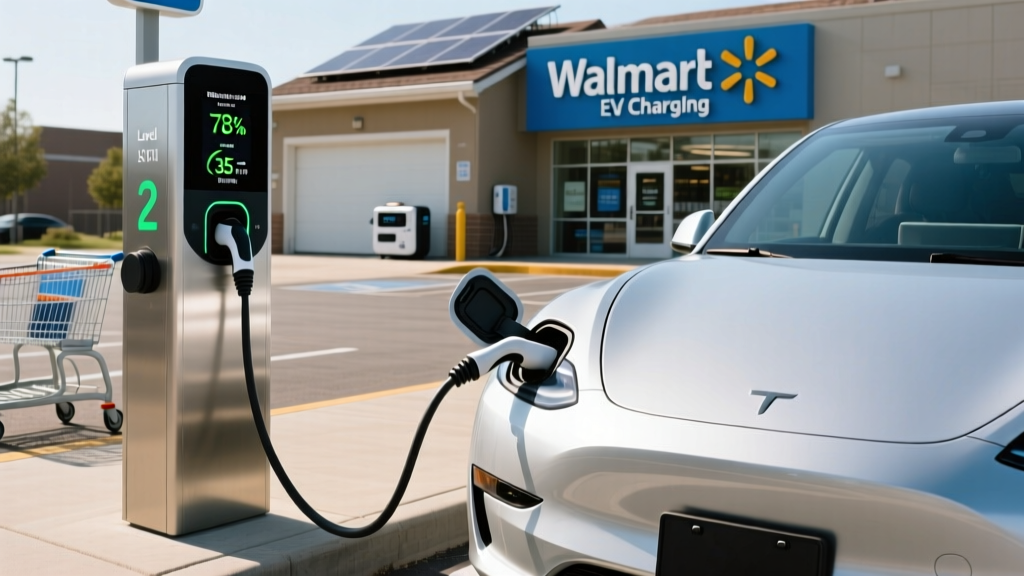
Walmart has quietly built one of the largest retail EV charging footprints in the United States. As of early 2026, Electrify America and other networks operate DC fast chargers at hundreds of Walmart and Sam's Club locations nationwide, making the big-box parking lot a de facto highway charging hub for road-tripping EV owners. If you're shopping for an EV or planning a long drive, understanding what Walmart EV charging actually delivers — in speed, cost, and connector availability — is essential trip-planning knowledge.
But public DC fast charging is only one piece of the puzzle. Most daily charging happens at home on a Level 2 circuit, which costs a fraction of what you'll pay at a Walmart stall. This guide breaks down the Walmart public-charging experience alongside a complete home-installation walkthrough, so you can budget accurately and charge efficiently.
Charging Levels Explained: Speeds in kW and Miles Per Hour
Before we compare Walmart stations to your garage, let's nail down the three charging levels and what they actually deliver. Power is measured in kW (kilowatts) — that's the rate of energy flow. Energy stored in your battery is measured in kWh (kilowatt-hours) — that's the total capacity. Confusing these two is the single most common EV mistake; keep them separate and everything else clicks into place.
| Level | Voltage | Power (kW) | Miles of Range Added Per Hour | Typical Use Case |
|---|---|---|---|---|
| Level 1 | 120V AC | 1.0–1.4 kW | 3–5 miles | Overnight top-up, PHEVs, low-mileage drivers |
| Level 2 | 240V AC | 3.3–19.2 kW | 12–75 miles | Daily home and workplace charging |
| DC Fast Charging | 400–800V DC | 50–350 kW | 150–1,200+ miles (equivalent) | Road trips, highway corridors, Walmart stations |
At a Walmart Electrify America station, you'll typically find 150 kW and 350 kW CCS1 chargers, with an increasing number of NACS (Tesla-style) connectors being added through 2025–2026 network upgrades. A 350 kW stall can add roughly 200 miles of range in 15 minutes to a vehicle with an 800V architecture like the Hyundai Ioniq 5 or Kia EV6 — but only if the vehicle's onboard charge curve supports that peak rate.
Walmart EV Charging: Real-World Speeds and Costs
Most Walmart EV charging stations are operated by Electrify America, though some locations host ChargePoint or EVgo equipment. Here's what to expect in practice:
- 150 kW CCS1 chargers: Expect 10–80% in roughly 25–35 minutes for a 77 kWh battery pack (e.g., Ford Mustang Mach-E Extended Range). Sustained rates average 80–110 kW after the initial peak.
- 350 kW chargers: With a compatible 800V vehicle (Hyundai Ioniq 5, Kia EV6, Genesis GV60), expect 10–80% in approximately 18 minutes. Vehicles limited to 400V architectures will peak around 150–230 kW even on a 350 kW stall.
- NACS connectors: Tesla Superchargers at select Walmart locations deliver up to 250 kW. Non-Tesla EVs with built-in NACS ports (Ford F-150 Lightning, Rivian R1T/R1S from 2025+) or using a CCS-to-NACS adapter can access these stalls.
Cost per kWh at Walmart Chargers
Electrify America pricing in 2026 averages $0.43–$0.56 per kWh depending on the state and time of day, with some locations offering off-peak discounts through the Pass+ subscription ($4/month for reduced rates). Guest (non-subscriber) rates can reach $0.64/kWh in high-cost states like California.
| Charging Scenario | Cost per kWh | Cost per Mile (3 mi/kWh vehicle) | Equivalent Gas Cost (30 MPG, $3.50/gal) |
|---|---|---|---|
| Home Level 2 (national avg electricity) | $0.16 | $0.053 | $0.117 |
| Home Level 2 (off-peak TOU rate) | $0.09 | $0.030 | $0.117 |
| Walmart EA (Pass+ subscriber) | $0.43 | $0.143 | $0.117 |
| Walmart EA (guest rate, high-cost state) | $0.64 | $0.213 | $0.117 |
The math is clear: home charging on an off-peak rate costs roughly one-quarter what you'll pay at a Walmart DC fast charger per mile. Public fast charging is a road-trip convenience, not a daily fueling strategy if you want to maximize savings.
Home Level 2 Installation: Costs, Electrical Requirements, and Panel Upgrades
If you're relying on Walmart or other public DC fast chargers for daily needs, you're overpaying by a factor of three to four. A home Level 2 setup is the single highest-ROI investment an EV owner can make. Here's what's involved.
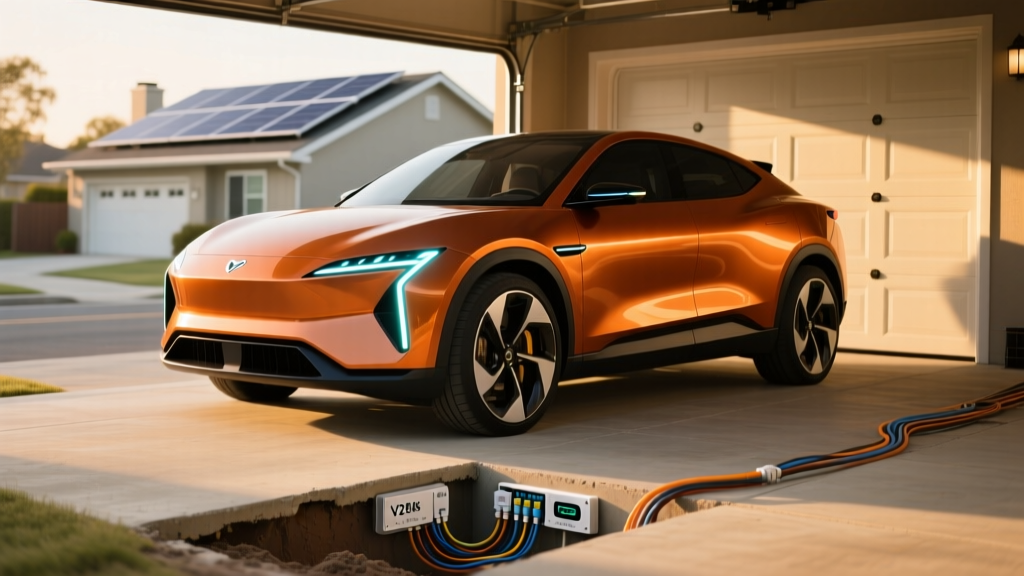
Electrical Requirements
A typical home Level 2 charger requires a 240V dedicated circuit, identical in concept to what powers your electric dryer or oven. The most common configurations:
- 40-amp circuit / 32A continuous (NEMA 14-50 outlet or hardwired): Delivers 7.7 kW on a 240V line — the sweet spot for most homes. Adds ~25–30 miles of range per hour to a mid-size SUV.
- 50-amp circuit / 40A continuous (NEMA 14-50): Delivers 9.6 kW — ideal for larger-battery vehicles like the Ford F-150 Lightning (131 kWh extended range).
- 60-amp circuit / 48A continuous (hardwired only): Delivers 11.5 kW — requires a panel with sufficient spare capacity.
Important code note: The National Electrical Code (NEC) requires EV circuits to be rated at 125% of the continuous load. A charger drawing 32A continuously requires a 40A breaker. Never undersize the breaker.
Do You Need a Panel Upgrade?
This is the variable that can double your installation cost. Homes built before 1990 often have 100-amp main panels with limited spare breaker slots. Adding a 40A or 50A EV circuit may push total calculated load beyond the panel's rating, requiring an upgrade to 200A service.
| Cost Component | Low Estimate | High Estimate | Notes |
|---|---|---|---|
| Level 2 charger equipment | $350 | $750 | Varies by brand, power output, smart features |
| Electrician labor (standard install, panel to garage <30 ft) | $400 | $1,200 | Conduit run length and wall type affect cost |
| Electrical permit | $50 | $200 | Varies by municipality |
| Panel upgrade (if needed: 100A → 200A) | $1,500 | $3,500 | Older homes, utility coordination required |
| Total (no panel upgrade) | $800 | $2,150 | Most newer homes with 200A service |
| Total (with panel upgrade) | $2,300 | $5,650 | Common in pre-1990 construction |
Always get a licensed electrician to perform a load calculation before committing. Some utilities offer free or subsidized panel assessments. The federal IRS §30D vehicle credit does not cover charger installation, but the separate §30C Alternative Fuel Vehicle Refueling Property Credit covers up to 30% of home charging equipment and installation costs (capped at $1,000), subject to income and census-tract eligibility — consult a tax professional for your situation.
Connector Compatibility: NACS, CCS1, and CHAdeMO
The connector landscape shifted dramatically between 2023 and 2026. Here's where things stand for Walmart and other public chargers:
| Connector | Brands Using It (2026 Models) | Walmart Availability | Adapter Needed? |
|---|---|---|---|
| NACS (Tesla standard) | Tesla, Ford, Rivian, GM, Volvo, Polestar, Hyundai (2025+) | Growing — Tesla Superchargers and new EA NACS stalls | CCS→NACS adapter (~$200) for older CCS vehicles |
| CCS1 | VW, BMW, older Ford/GM/Hyundai models, most pre-2025 EVs | Widely available — majority of EA stalls at Walmart | N/A — native on most non-Tesla EVs |
| CHAdeMO | Nissan Leaf (discontinued), Mitsubishi Outlander PHEV (legacy) | Rare and declining — few Walmart locations | No adapter available; use CHAdeMO-specific stations |
If you're buying a new EV in 2026, NACS is the clear future-proof choice for North America. Most automakers have adopted it, and Electrify America has committed to adding NACS connectors at all new and renovated stations. If your current EV uses CCS1, a certified CCS-to-NACS adapter (such as those from Lectron or A2Z) will let you access Tesla Superchargers at Walmart locations that restrict stalls to NACS only.
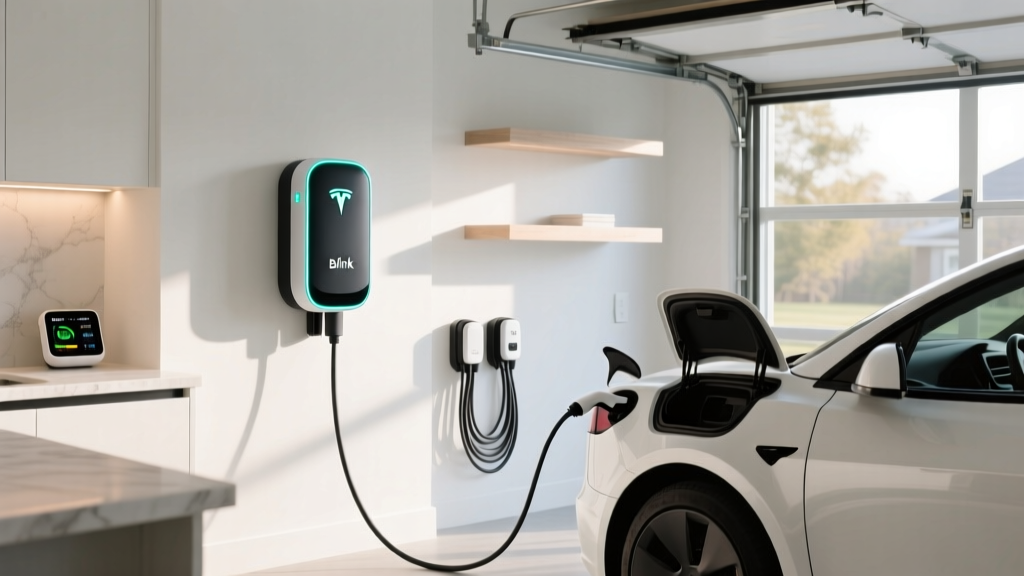
Home Charger Equipment Picks for 2026
Not all Level 2 chargers are equal. Here are three proven units we recommend based on reliability, smart features, and value:
ChargePoint Home Flex
- Power output: Up to 11.5 kW (48A) on a 60A circuit; configurable down to 16A
- Connector: NACS (2025+ models) or CCS1/J1772 (legacy)
- Cable length: 24 feet
- Smart features: Wi-Fi, scheduled charging, Alexa integration, energy tracking
- Price: ~$550–$650
- Best for: Most buyers — flexible amperage, reliable app, UL-listed
Wall Connector (Tesla, Gen 4)
- Power output: Up to 11.5 kW (48A) on a 60A circuit
- Connector: NACS native
- Cable length: 24 feet
- Smart features: Wi-Fi, over-the-air updates, Tesla app integration, load sharing with Powerwall
- Price: ~$475
- Best for: Tesla owners and NACS-equipped Ford/GM/Rivian drivers
Emporia Level 2 EV Charger
- Power output: Up to 11.5 kW (48A)
- Connector: J1772 (CCS1 compatible); NACS version available
- Cable length: 24 feet
- Smart features: Wi-Fi, energy monitoring, solar-integration scheduling, budget-friendly app
- Price: ~$350–$400
- Best for: Budget-conscious buyers who still want smart scheduling and energy tracking
For a 77 kWh battery (Ford Mach-E Extended Range, VW ID.4), charging from 10–80% on an 11.5 kW home charger takes roughly 4.5–5 hours — perfectly suited to overnight charging on a time-of-use electricity plan. The same 10–80% session on a Walmart 150 kW DC fast charger takes about 28 minutes, but costs three to four times more per kWh.
Safety, Code, and Outdoor Installation Considerations
Electrical safety isn't optional, and cutting corners on an EV charger install can void your homeowner's insurance or create a fire hazard. Key requirements:
- Dedicated circuit: Your EV charger must be on its own dedicated breaker — never share a circuit with other appliances.
- GFCI protection: The 2023 NEC update requires GFCI protection for all 240V EV charging outlets (NEMA 14-50). Hardwired installations may have different GFCI rules depending on local code interpretation — your electrician will know.
- Outdoor rating: If your charger is mounted outside or in an exposed carport, ensure it carries a NEMA 4 (weather-resistant) rating. The ChargePoint Home Flex and Wall Connector both meet this standard.
- Permit and inspection: Most jurisdictions require an electrical permit for EV charger installation. The inspection ensures the work meets code and protects your insurance coverage. Budget $50–$200 for the permit fee.
- Cable management: Use a wall-mounted cable organizer to prevent tripping hazards and connector damage. Never let the cable rest on the ground where vehicles can run over it.
Charging Time Examples for Common EV Battery Sizes
Here's how long 10–80% charging takes across the three levels for popular 2026 EV battery capacities. These assume optimal conditions — cold batteries, high states of charge, and grid congestion can add time.
| Vehicle (Battery Size) | Level 1 (1.4 kW) | Level 2 (11.5 kW home) | DC Fast 150 kW (Walmart EA) | DC Fast 350 kW | |
|---|---|---|---|---|---|
| Tesla Model 3 LR (79 kWh) | ~40 hours | ~5 hours | ~30 min | ~22 min | |
| Ford F-150 Lightning ER (131 kWh) | ~65 hours | ~8 hours | ~48 min | ~41 min | |
| Hyundai Ioniq 5 (77.4 kWh, 800V) | ~39 hours | ~4.7 hours | ~28 min | ~18 min | |
| Chevrolet Equinox EV (85 kWh) | ~42 hours | ~5.2 hours | ~32 min | ~28 min (400V limit) |
Notice the diminishing returns above 150 kW for 400V vehicles — the Hyundai Ioniq 5's 800V architecture is the reason it extracts full value from a 350 kW stall, while the Equinox EV's 400V system tapers sharply above 200 kW. This is why peak kW ratings matter less than the sustained charge curve when evaluating real-world charging speed.
Frequently Asked Questions
How much does it cost to install a home EV charger?
A standard Level 2 home installation (40A–60A circuit, <30 ft conduit run, no panel upgrade) typically costs $800–$2,150 including equipment, electrician labor, and permit. If your home needs a 100A-to-200A panel upgrade, add $1,500–$3,500. Always get a load calculation from a licensed electrician before committing.
How fast will each charging level add range?
Level 1 (120V) adds 3–5 miles per hour. Level 2 (240V, 48A/11.5 kW) adds roughly 35–45 miles per hour to a mid-size EV. DC fast charging at 150 kW adds the equivalent of 150–200 miles in 15–20 minutes, though the rate tapers significantly above 80% state of charge.
Which connector is compatible with my EV?
Most 2026 EVs now use NACS (Tesla's connector standard), adopted by Ford, GM, Rivian, Hyundai, Volvo, and others. Older or pre-2025 models from VW, BMW, and some Hyundai trims still use CCS1. CHAdeMO is effectively discontinued on new vehicles. Check your vehicle's charge port or the manufacturer's spec sheet, and note that CCS-to-NACS adapters are available for ~$200.
How much does charging cost per mile vs gas?
Home charging on a national average rate of $0.16/kWh costs roughly $0.05 per mile for a vehicle averaging 3 mi/kWh — less than half the cost of gas at $3.50/gallon and 30 MPG ($0.12/mile). Walmart DC fast charging at $0.48/kWh averages about $0.16/mile — still competitive with gas, but three times your home rate.
What electrical upgrades might I need?
If your home has a 100-amp main panel (common in pre-1990 construction), you'll likely need a panel upgrade to 200A to safely add a 40A–50A EV circuit. Homes with 200A service and available breaker slots usually need only a new dedicated circuit. An electrician's load calculation will determine this — expect the assessment to be free or under $150.
Is Walmart EV charging reliable?
Electrify America's uptime at Walmart locations has improved significantly since 2023, with reported session success rates above 90% at most renovated stations. However, rural or older installations may still experience intermittent outages. Always check the EA or PlugShare app for real-time station status before relying on a single Walmart location for a critical charge.