If you own a Tesla — or are about to buy one — the first question after "what's the range?" is usually how long does it actually take to charge? The answer depends entirely on which charging level you're using, what model you drive, and whether your home electrical panel can support a Level 2 setup. This guide breaks down real-world Tesla charge times across every charging scenario, the exact electrical requirements for home installation, and what you'll actually pay per mile compared to gas.
The Three Charging Levels: Speeds, kW, and Range Added Per Hour
Before looking at specific Tesla charge times, you need to understand the three charging levels and the critical difference between kW (kilowatts — the rate of power delivery, like water pressure from a hose) and kWh (kilowatt-hours — the total energy stored in your battery, like gallons in a tank). A charger's kW rating determines how fast energy flows in; your battery's kWh capacity determines how much it can hold.
| Level | Voltage | Max Power (kW) | Miles of Range Added Per Hour | Typical Use Case |
|---|---|---|---|---|
| Level 1 | 120V AC | 1.0–1.4 kW | 3–5 miles/hr | Emergency / overnight trickle |
| Level 2 | 240V AC | 7.2–19.2 kW | 20–55 miles/hr | Home daily charging, workplace |
| DC Fast (Supercharger) | 400V+ DC | 150–250 kW (V3/V4) | ~1,000+ miles/hr (peak) | Road trips, rapid top-ups |
A few important notes on these figures. Level 1 charging from a standard household outlet is genuinely slow — plugging in a Tesla Model Y Long Range (75 kWh usable battery) at 1.2 kW means a full 0–100% charge takes roughly 62 hours. It's viable only for plug-in hybrids or as an emergency measure. Level 2 at 240V is where the vast majority of Tesla owners do their daily charging. DC fast charging at a Tesla Supercharger is designed for road trips, not daily use, because frequent high-power charging accelerates battery degradation over time.
Real-World Tesla Charge Times by Model and Charging Level
Here's where the rubber meets the road. These charge times are based on each model's current battery capacity and onboard charger limits. Note that 10–80% DC fast charge times are the industry standard measurement because charging slows dramatically above 80% to protect battery health — the charge curve tapers as the battery fills, meaning the last 20% can take as long as the first 60%.
| Model / Trim | Usable Battery (kWh) | Level 1 (0–100%) | Level 2 at 11.5 kW (0–100%) | Level 2 at 7.7 kW (0–100%) | Supercharger 10–80% |
|---|---|---|---|---|---|
| Model 3 RWD | 57.5 (LFP) | ~48 hrs | ~5.5 hrs | ~8 hrs | ~25 min (V3 170 kW peak) |
| Model 3 Long Range AWD | 75 (NMC) | ~62 hrs | ~7 hrs | ~10.5 hrs | ~27 min (V3 250 kW peak) |
| Model Y Long Range AWD | 75 (NMC) | ~62 hrs | ~7 hrs | ~10.5 hrs | ~27 min (V3 250 kW peak) |
| Model S Long Range | 95 (NMC) | ~79 hrs | ~9 hrs | ~13 hrs | ~32 min (V3 250 kW peak) |
| Model X Long Range | 95 (NMC) | ~79 hrs | ~9 hrs | ~13 hrs | ~35 min (V3 250 kW peak) |
| Cybertruck AWD | 123 (NMC) | ~102 hrs | ~11.5 hrs | ~17 hrs | ~38 min (V4 250+ kW peak) |
Home Charger Installation: Electrical Requirements, Costs, and Panel Upgrades
Installing a Level 2 home charger is the single biggest quality-of-life upgrade a Tesla owner can make. Wake up to a full battery every morning, never visit a gas station, and pay a fraction of public charging rates. But the installation isn't as simple as plugging something in — here's what's actually involved.
Electrical Requirements
A Level 2 charger requires a 240V dedicated circuit, the same voltage as your electric dryer or oven. The most common setups for Tesla owners are:
- NEMA 14-50 outlet (240V, 50A circuit, delivers up to 40A continuous / 9.6 kW) — the most popular and flexible option
- Hardwired wall connector (240V, 60A circuit, delivers up to 48A continuous / 11.5 kW) — maximum home charging speed for Tesla
- NEMA 6-50 outlet (240V, 50A circuit, 40A continuous) — a simpler alternative if you don't need neutral wire
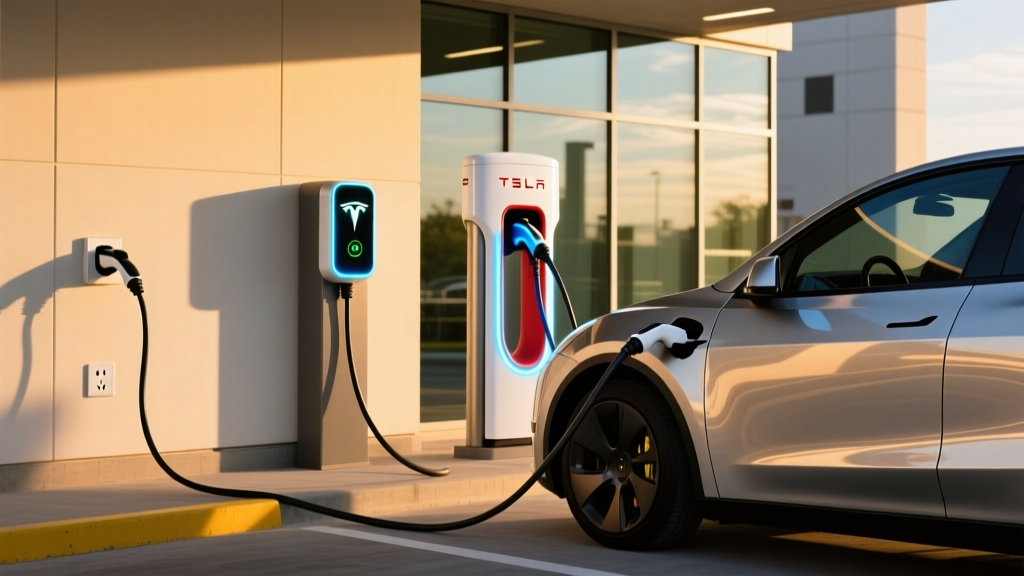
The Tesla Wall Connector supports up to 48A (11.5 kW) when hardwired on a 60A breaker. This is the fastest Level 2 charging Tesla vehicles can accept at home.
Panel Upgrade: The Hidden Cost
Most modern homes with 200A electrical service can accommodate a 50A or 60A EV circuit without a panel upgrade. But if your home has an older 100A panel — common in houses built before the 1990s — or your existing load is already near capacity (electric heat, electric water heater, dryer, oven all running), you may need a panel upgrade to 200A. This is the single largest variable in home charger installation cost.
Some jurisdictions now allow a National Electrical Code-compliant load-management device that lets you add an EV circuit without a full panel upgrade by automatically throttling the charger when other heavy loads are running. Ask your electrician about this option — it can save $2,000–$4,000.
| Item | Low Estimate | High Estimate | Notes |
|---|---|---|---|
| Level 2 Charger Equipment | $250 | $600 | Tesla Wall Connector ~$425; third-party $250–$600 |
| Electrician Labor | $500 | $2,000 | Depends on run length from panel to garage/driveway |
| Electrical Permit | $50 | $300 | Varies by municipality; some areas waive for EV |
| Panel Upgrade (if needed) | $1,500 | $4,500 | 100A → 200A; not needed in most modern homes |
| Total (no panel upgrade) | $800 | $2,900 | Most homeowners fall in the $1,200–$2,000 range |
| Total (with panel upgrade) | $2,300 | $7,400 | Older homes, high existing loads |
Federal incentive: The IRS Residential Clean Energy Credit (IRC §25C) covers 30% of home EV charger equipment and installation costs, up to $1,000 per year, through 2032. This applies to both the charger hardware and the electrician's labor. Check current IRS guidance for eligibility details, as rules around census-tract qualifications apply.
Connector Compatibility: NACS, CCS, and Adapters
As of 2026, the connector landscape has largely consolidated around NACS (North American Charging Standard), the connector Tesla developed and opened to other manufacturers. Here's the current state of play:
| Connector | Who Uses It | Tesla Compatibility | Notes |
|---|---|---|---|
| NACS (Tesla) | Tesla (native); Ford, GM, Rivian, Hyundai, and others (2025+ models) | Native on all Teslas | Standard on Tesla Superchargers; growing public network access |
| CCS1 | Older non-Tesla EVs (pre-2025); Electrify America, EVgo stations | Requires Tesla CCS Adapter (~$175) | Needed for non-Tesla DC fast chargers |
| CHAdeMO | Nissan Leaf (legacy); largely phased out | No adapter available | Effectively obsolete for new vehicles |
Every Tesla sold in North America uses the NACS connector natively. If you need to charge at a non-Tesla DC fast charger (Electrify America, some EVgo stations that still have CCS-only stalls), Tesla sells an official CCS adapter for approximately $175. This adapter enables up to 250 kW charging at CCS stations. Keep one in your frunk for road trips through areas where Supercharger coverage has gaps.
For Level 2 public charging (hotels, shopping centers, workplaces), the J1772 connector is still common on non-Tesla chargers. Tesla includes a J1772 adapter with every new vehicle, so this isn't a problem — just make sure the adapter lives in your car.
Cost to Charge a Tesla: Home vs. Public vs. Gas
One of the strongest arguments for EV ownership is fuel cost savings, but the math depends heavily on where you charge. Let's run the numbers using a Tesla Model Y Long Range (75 kWh battery, ~310 miles EPA range, ~3.6 miles/kWh real-world efficiency).
| Charging / Fueling Scenario | Rate | Cost for 75 kWh (Full Charge) | Cost Per Mile |
|---|---|---|---|
| Home (national avg. electricity) | $0.17/kWh | $12.75 | $0.041 |
| Home (off-peak utility rate) | $0.09/kWh | $6.75 | $0.022 |
| Home (solar / net metering) | ~$0.04/kWh effective | $3.00 | $0.010 |
| Tesla Supercharger (avg.) | $0.32/kWh | $24.00 | $0.077 |
| Non-Tesla DC Fast (avg.) | $0.41/kWh | $30.75 | $0.099 |
| Gas vehicle (25 MPG avg., $3.50/gal) | $3.50/gallon | — | $0.140 |
The takeaway is clear: home charging is where the savings live. At off-peak utility rates, charging a Model Y costs roughly $0.02/mile — about one-seventh the cost of gas. Even at a Supercharger, you're paying roughly half what a gas car costs per mile. But if you rely exclusively on public DC fast charging at $0.40+/kWh, the savings narrow considerably. This is why home Level 2 installation isn't just a convenience — it's the economic foundation of EV ownership.
Many utilities now offer time-of-use (TOU) plans that dramatically reduce overnight rates. If your utility offers EV-specific TOU rates, programming your Tesla to charge between 12 AM and 6 AM can cut your charging costs by 40–60% compared to standard residential rates.
Recommended Home Chargers for Tesla Owners
Here are specific equipment picks based on real-world use, build quality, and feature sets. All recommendations are NACS-native or compatible with Tesla vehicles.
Tesla Wall Connector (Gen 3)
- Power: Up to 11.5 kW (48A) hardwired
- Connector: NACS native, 24-ft cable
- Smart features: Wi-Fi, OTA updates, power sharing (link multiple units on one circuit), access control
- Price: ~$425
- Best for: Tesla-only households wanting maximum speed
ChargePoint Home Flex (NACS)
- Power: Up to 12 kW (50A) on 60A circuit; configurable down to 16A
- Connector: NACS (2025+ models); J1772 with adapter
- Smart features: Wi-Fi, app scheduling, Alexa/Google integration, detailed energy tracking
- Price: ~$550
- Best for: Multi-EV households (Tesla + non-Tesla) with app control
Grizzl-E Smart (NACS)
- Power: Up to 10 kW (40A) on 50A circuit
- Connector: NACS available; 24-ft cable
- Smart features: Wi-Fi, OCPP protocol, adjustable amperage, extreme cold rated (-40°F)
- Price: ~$449
- Best for: Cold-climate owners, budget-conscious buyers wanting smart features
For most Tesla owners, the Tesla Wall Connector is the obvious choice — it's the fastest Level 2 option, integrates seamlessly with your Tesla app, and supports power sharing if you ever add a second EV. The ChargePoint Home Flex is the better pick if your household has both a Tesla and a non-Tesla EV, since its ecosystem handles mixed fleets more gracefully.
Safety, Code, and Installation Best Practices
Level 2 EV charging draws significant continuous current for hours at a time. This isn't like plugging in a lamp — it's more comparable to running your electric oven at full blast for 8 hours straight. Here's what proper installation looks like:
- Dedicated circuit: Your EV charger must be on its own dedicated breaker — never shared with other outlets or appliances.
- Continuous load derating: The National Electrical Code (NEC) requires EV chargers to be treated as continuous loads, meaning a 48A charger needs a 60A breaker (circuit rated at 125% of continuous draw).
- GFCI protection: NEC 2020 and later requires GFCI protection for outdoor EV outlets. Hardwired installations may not require a separate GFCI breaker depending on local code — your electrician will know.
- Outdoor rating: If your charger is installed outside (driveway, exterior wall), ensure the unit carries a NEMA 4 or IP65 weather rating. All three chargers recommended above are outdoor-rated.
- Permit and inspection: Most jurisdictions require an electrical permit for a new 240V circuit. The inspection ensures the work meets code — don't skip this step, as unpermitted work can void homeowners insurance claims.
Hire a licensed electrician with EV charging installation experience. Ask whether they've installed EV chargers before, whether they'll pull the permit, and whether they'll perform a load calculation on your panel before starting work. A reputable electrician will do all of this as standard practice.
Frequently Asked Questions
How much does it cost to install a home Tesla charger?
Expect to pay between $1,200 and $2,000 for a standard installation (Tesla Wall Connector + electrician labor + permit) in a home with a 200A panel and a short wire run. If your panel needs upgrading from 100A to 200A, add $1,500–$4,500. The IRS §25C credit covers 30% of equipment and installation, up to $1,000.
How fast will each charging level add range to my Tesla?
Level 1 (120V) adds roughly 3–5 miles per hour. Level 2 (240V at 11.5 kW) adds roughly 35–44 miles per hour depending on vehicle efficiency. A V3 Supercharger at 250 kW adds approximately 200 miles in 15 minutes at peak rate, though the charge curve tapers significantly above 80% SoC.
Do I need an adapter to charge my Tesla at non-Tesla chargers?
For DC fast charging at CCS stations (Electrify America, some EVgo locations), yes — you'll need Tesla's CCS adapter (~$175). For Level 2 public charging with J1772 connectors, Tesla includes a J1772 adapter with every new vehicle. At Tesla Superchargers and NACS-equipped public chargers, no adapter is needed.
Is it bad to Supercharge my Tesla every day?
Exclusively relying on DC fast charging accelerates long-term battery degradation compared to Level 2 home charging. Tesla's battery management system is excellent at mitigating this, but data from high-mileage Teslas shows slightly higher degradation in vehicles that primarily Supercharge. For daily use, Level 2 home charging is both cheaper and gentler on the battery. Reserve Supercharging for road trips.
What electrical upgrades might I need for a home charger?
If your home has a 200A electrical panel with available capacity, you likely need nothing beyond the new 240V circuit. If you have a 100A panel, an electric vehicle load-management device (which throttles charger power when other loads are high) may let you avoid a full panel upgrade. A licensed electrician should perform a load calculation before any work begins to determine your panel's actual headroom.
How much does charging a Tesla cost per mile versus gas?
At home on off-peak electricity ($0.09/kWh), a Tesla Model Y costs about $0.022 per mile. Even at average residential rates ($0.17/kWh), it's roughly $0.04/mile. A comparable gas SUV at 25 MPG and $3.50/gallon costs $0.14/mile. Home charging saves $0.10–$0.12 per mile, which adds up to $1,200–$1,800 per year at 15,000 miles driven.