The Porsche Taycan Turbo S pairs staggering performance — 750 horsepower in overboost, a 2.4-second 0-60 time — with an EPA-estimated 222 miles of range (2025 model year, Performance Battery Plus). That 93.4 kWh usable battery (105 kWh gross, NMC chemistry) can accept up to 320 kW of DC fast-charging power, making it one of the fastest-charging EVs on the road. But extracting maximum real-world range and keeping charging convenient requires matching your equipment to the Taycan's 800-volt architecture.
This guide covers everything Taycan Turbo S owners (and prospective buyers) need to know about home charging installation, public charging compatibility, costs, and the specific hardware that takes full advantage of Porsche's charging curve.
Porsche Taycan Turbo S: Range and Charging Specifications at a Glance
| Specification | Value |
|---|---|
| EPA Range (Performance Battery Plus) | 222 miles |
| Real-World Range Expectation | ~185-200 mi highway; ~155-170 mi cold weather (below 32°F) |
| Battery (Usable / Gross) | 93.4 kWh / 105 kWh, NMC lithium-ion |
| Architecture | 800-volt nominal |
| Max DC Fast Charge Rate | 320 kW (peak) |
| 10-80% DC Fast Charge Time | ~18 minutes (at 320 kW-capable station) |
| Max Level 2 AC Charge Rate | 19.2 kW (optional onboard charger upgrade); 11 kW standard |
| Level 1 (120V) Charge Rate | ~1.4 kW |
| Connector (US Delivery) | NACS (2025+ models); CCS1 via adapter on earlier builds |
| MPGe (Combined) | 68 MPGe |
| Battery Warranty | 8 years / 100,000 miles (70% capacity retention minimum) |
Charging Levels Explained: Speeds in kW and Miles Added Per Hour
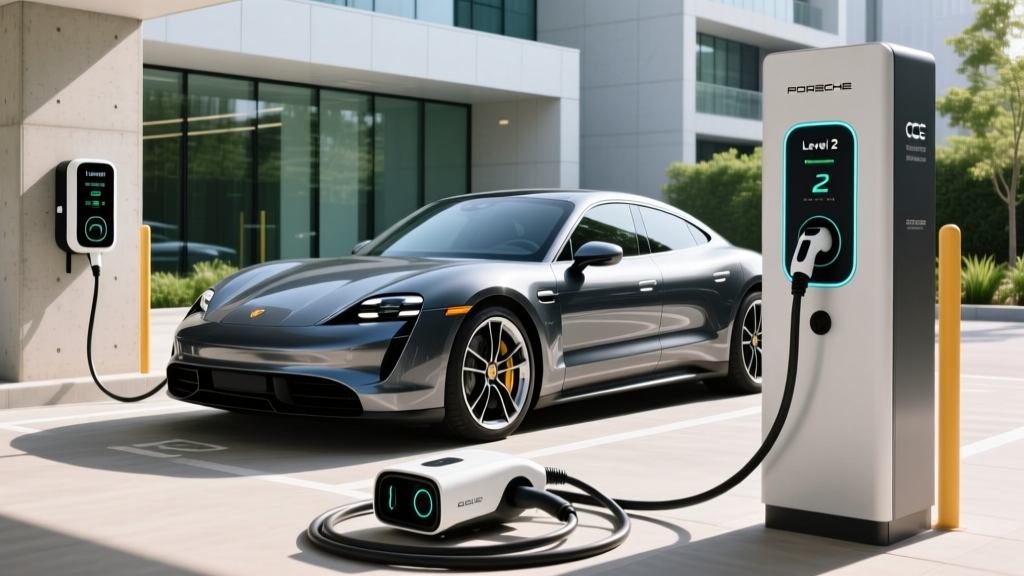
Before selecting equipment, understand the three charging tiers and what each delivers to the Taycan Turbo S's 93.4 kWh battery. Remember: kW (kilowatts) measures power — the rate of energy flow. kWh (kilowatt-hours) measures energy — the battery's total capacity. A charger's kW rating determines how quickly it fills kWh of battery.
| Level | Voltage / Power | Miles of Range Added Per Hour | Full 10-80% Time (Taycan Turbo S) | Best Use Case |
|---|---|---|---|---|
| Level 1 | 120V / 1.4 kW | ~4 miles/hr | ~46 hours | Emergency / overnight trickle only |
| Level 2 (11 kW onboard) | 240V / 11 kW (48A circuit) | ~32 miles/hr | ~6 hours | Daily home charging (standard onboard charger) |
| Level 2 (19.2 kW onboard) | 240V / 19.2 kW (80A circuit) | ~56 miles/hr | ~3.5 hours | Fast home charging (optional 19.2 kW onboard upgrade) |
| DC Fast Charge | 400-920V / up to 320 kW | ~650+ miles/hr (peak) | ~18 minutes (10-80%) | Road trips, rapid top-ups |
The Taycan's 800-volt architecture is its charging superpower. While most EVs run 400V systems, Porsche's higher voltage allows lower current for the same power, reducing heat and enabling sustained fast-charging speeds. At a 320 kW-capable station (like newer Electrify America or Ionity stalls), the Taycan Turbo S maintains above 200 kW well past 50% SoC before tapering — a charge curve advantage over 400V competitors that peak and immediately drop.
Home Charger Installation: Electrical Requirements and Total Cost Breakdown
Most Taycan Turbo S owners will install a Level 2 home charger on a dedicated 240V circuit. The total cost depends on your electrical panel's capacity, the run distance from panel to charger location, and local permit fees.
Electrical Requirements by Charger Amperage
To fully utilize the Taycan's standard 11 kW onboard charger, you need a 240V circuit rated for at least 60 amps (the National Electrical Code requires circuits be rated 125% above continuous load, so a 48A continuous draw requires a 60A breaker). For the optional 19.2 kW onboard charger, you need a 100A circuit — a significant electrical undertaking that many homes cannot support without a panel upgrade.
| Component | Cost Range | Notes |
|---|---|---|
| Level 2 Charger Equipment (48A / 11.5 kW) | $400 – $750 | Hardwired units (e.g., ChargePoint Home Flex, Wallbox Pulsar Plus) |
| Level 2 Charger Equipment (80A / 19.2 kW) | $600 – $1,200 | Ford Charge Station Pro, Wallbox Pulsar Max; requires 100A circuit |
| Electrician Labor (standard install, <30ft run) | $800 – $2,000 | Includes conduit, wiring (6 AWG copper for 60A), breaker, mounting |
| Electrical Permit | $50 – $300 | Varies by municipality; required for code compliance |
| Panel Upgrade (if needed: 100A → 200A service) | $2,000 – $5,000 | Common in pre-1990 homes; essential for 80A+ EV circuits |
| Utility Service Upgrade (if needed) | $3,000 – $8,000+ | Rare; only if utility drop cannot support 200A+ total service |
| Total (typical, no panel upgrade) | $1,250 – $3,050 | Most common scenario for modern homes with 200A panels |
| Total (with 200A panel upgrade) | $3,250 – $8,050 | Older homes with 100A or 150A service |
Safety and Code Considerations
- Dedicated circuit required: EV chargers must be on a dedicated breaker — not shared with other appliances. This prevents overloading and nuisance tripping.
- GFCI protection: NEC 2020 and later requires GFCI protection for outdoor receptacles used for EV charging. Hardwired installations (recommended for 48A+) bypass this requirement and are generally more reliable.
- Outdoor rating: If mounting outdoors, ensure the charger carries a NEMA 4 (or IP65+) rating for weather resistance. Units like the ChargePoint Home Flex and Wallbox Pulsar Plus are rated for outdoor installation.
- Cable management: For garage installations, consider cable retraction systems or hooks to prevent tripping hazards and cable damage.
- Permit and inspection: Always pull an electrical permit. Unpermitted work can void homeowner's insurance coverage and create issues during home resale.
Connector Compatibility: NACS, CCS1, and the Taycan
Porsche began delivering US-market Taycans with the NACS (North American Charging Standard) connector starting with 2025 model-year production. Earlier Taycan models (2020-2024) were delivered with CCS1 ports. This matters for both home charging equipment selection and public network access.
| Connector / Network | 2025+ Taycan (NACS port) | 2020-2024 Taycan (CCS1 port) |
|---|---|---|
| Tesla Supercharger (NACS) | Native — plug and charge | Requires CCS1-to-NACS adapter (Porsche-approved adapter ~$250-350) |
| Electrify America (CCS1 + NACS) | Use NACS cable where available; CCS1 adapter for older stalls | Native CCS1 connection |
| Home Level 2 (J1772 / NACS) | NACS-equipped chargers (Tesla Wall Connector, ChargePoint Home Flex with NACS cable) | J1772 chargers (most universal Level 2 units); NACS chargers require adapter |
| CHAdeMO | Not compatible (no adapter available) | Not compatible (no adapter available) |
For 2025+ Taycan Turbo S owners purchasing a home charger, select a unit with a native NACS cable (Tesla Wall Connector, ChargePoint Home Flex with NACS connector option) to avoid daily adapter use. For 2020-2024 owners, a J1772-equipped charger remains the most flexible choice, as J1772-to-NACS adapters are widely available.
Equipment Recommendations: Best Home Chargers for the Taycan Turbo S
The Taycan's 11 kW standard onboard charger (or 19.2 kW optional upgrade) dictates which home chargers deliver meaningful speed. Here are tested recommendations across both tiers:
ChargePoint Home Flex (NACS or J1772)
- Power Output: Up to 12 kW (50A) on a 60A circuit; adjustable down to 16A for lower-capacity panels
- Connector: Available in NACS or J1772
- Cable Length: 23 feet
- Smart Features: Wi-Fi, app-based scheduling, energy tracking, Alexa integration
- Price: ~$550-$650
- Best For: Most Taycan owners; flexible amperage setting accommodates older panels
Tesla Wall Connector (NACS)
- Power Output: Up to 11.5 kW (48A) on a 60A circuit
- Connector: NACS native
- Cable Length: 24 feet
- Smart Features: Wi-Fi, over-the-air updates, power sharing (link two units on one circuit), Tesla app integration
- Price: ~$420-$475
- Best For: 2025+ Taycan NACS owners seeking a clean, reliable NACS-native solution at the best price
Wallbox Pulsar Max
- Power Output: Up to 19.2 kW (80A) on a 100A circuit
- Connector: J1772 (NACS adapter available)
- Cable Length: 25 feet
- Smart Features: Wi-Fi + Bluetooth, load balancing, solar integration, myWallbox app
- Price: ~$999-$1,199
- Best For: Taycan owners with the optional 19.2 kW onboard charger and sufficient panel capacity
Charging Cost Per Mile: Taycan Turbo S vs. Gasoline Equivalent
The Taycan Turbo S achieves approximately 2.0-2.3 kWh per mile in mixed driving (per EPA fueleconomy.gov data, roughly 68 MPGe combined). That efficiency figure lets us calculate real charging costs across different scenarios.
| Scenario | Rate | Cost Per Mile (Taycan Turbo S) | Comparable Gas Sedan (22 MPG, $3.50/gal) |
|---|---|---|---|
| Home Charging (off-peak utility rate) | $0.10/kWh | $0.21/mile | $0.16/mile |
| Home Charging (national avg residential) | $0.17/kWh | $0.36/mile | $0.16/mile |
| Home Charging (high-cost state, e.g., CA avg) | $0.30/kWh | $0.63/mile | $0.16/mile |
| Public Level 2 (ChargePoint, EVgo L2) | $0.25-$0.39/kWh | $0.53-$0.82/mile | $0.16/mile |
| DC Fast Charge (Electrify America, EA Pass) | $0.48/kWh avg | $1.01/mile | $0.16/mile |
| DC Fast Charge (Tesla Supercharger, NACS Taycan) | $0.35/kWh avg | $0.74/mile | $0.16/mile |
| Gasoline: Porsche Panamera Turbo (18 MPG combined) | $3.50/gal | — | $0.19/mile |
The Taycan Turbo S is a performance vehicle, and its 2.0-2.3 kWh/mile consumption is higher than efficiency-focused EVs (a Hyundai Ioniq 6 achieves roughly 3.5-4.0 mi/kWh). At home off-peak rates, the Taycan charges for less per mile than a comparable Panamera Turbo sips fuel. But frequent DC fast-charging on road trips pushes per-mile costs above gasoline — a trade-off for 18-minute 10-80% fills.
Annual fuel cost estimate (12,000 miles/year, 80% home charging at $0.17/kWh, 20% DC fast at $0.43/kWh): approximately $2,700/year. A Panamera Turbo on premium fuel at 18 MPG: approximately $2,330/year. The Taycan's energy cost advantage narrows significantly for performance-oriented driving and frequent fast-charging.
Public Charging: Maximizing the Taycan's 320 kW Capability
The Taycan Turbo S's 320 kW peak DC charge rate is only achievable at chargers that can deliver it. Most public DC fast chargers in the US peak at 150 kW or 350 kW — but even a "350 kW" stall may not deliver 320 kW to your car if other vehicles share the cabinet's power. Here's how to find chargers that match the Taycan's capability:
- Electrify America 350 kW stalls: Capable of delivering up to 320 kW to the Taycan. Use the EA app to filter for 350 kW-capable stations. Expect 10-80% in approximately 18-22 minutes.
- Tesla Supercharger V4 (NACS): V4 stalls deliver up to 250-350 kW. NACS-equipped 2025+ Taycans can access these natively. Precondition the battery via the Porsche navigation system for optimal charge speed.
- Ionity (Europe): 350 kW CCS stalls; Taycan excels here with sustained high-power charging.
- EVgo 350 kW stalls: Expanding network; compatible with NACS Taycans via native cable or CCS Taycans natively.
Frequently Asked Questions
How much does it cost to install a home EV charger for my Taycan Turbo S?
A typical Level 2 home charger installation (48A/11.5 kW unit on a 60A circuit) costs $1,250-$3,050 total, including equipment ($400-$750), electrician labor ($800-$2,000), and permits ($50-$300). If your home requires a panel upgrade from 100A to 200A service — common in pre-1990 homes — add $2,000-$5,000. Always get a load calculation from a licensed electrician before committing.
How fast will each charging level add range to the Taycan Turbo S?
Level 1 (120V): approximately 4 miles of range per hour — impractical for daily use. Level 2 at 11 kW: approximately 32 miles per hour, fully replenishing 10-80% in about 6 hours overnight. Level 2 at 19.2 kW (optional onboard charger): approximately 56 miles per hour, 10-80% in roughly 3.5 hours. DC fast charging at 320 kW: approximately 650+ miles per hour at peak, achieving 10-80% in about 18 minutes.
Which connector and home charger is compatible with my Taycan?
2025 and newer Taycan Turbo S models ship with a NACS port — choose a NACS-native home charger (Tesla Wall Connector, ChargePoint Home Flex with NACS cable). 2020-2024 Taycans have CCS1 ports — use a J1772 home charger (most universal option) or a NACS charger with a CCS1 adapter. For public Tesla Supercharger access, 2025+ models plug in natively; earlier models require a Porsche-approved CCS1-to-NACS adapter.
How much does charging the Taycan Turbo S cost per mile compared to gas?
At home on the national average residential rate ($0.17/kWh), the Taycan Turbo S costs approximately $0.36 per mile (at ~2.1 kWh/mile). Off-peak rates ($0.10/kWh) drop that to $0.21/mile. DC fast charging at $0.48/kWh pushes cost to roughly $1.01/mile. A comparable gasoline Porsche Panamera Turbo at 18 MPG on premium fuel ($3.50/gal) costs about $0.19/mile. Home charging on off-peak rates is the only scenario where the Taycan's energy cost undercuts the gas equivalent.
What electrical upgrades might I need before installing a Taycan home charger?
A licensed electrician will perform a NEC Article 220 load calculation to determine if your panel can handle a 60A (for 11 kW) or 100A (for 19.2 kW) dedicated circuit. Homes with 100A or 150A total service — typically built before 1990 — often require a panel upgrade to 200A, costing $2,000-$5,000. If your utility service drop itself is insufficient (rare), a service upgrade from the utility can cost $3,000-$8,000+. Modern homes with 200A panels typically accommodate a 60A EV circuit without upgrades, provided existing loads (HVAC, electric range, dryer) leave adequate headroom.
Does the Taycan Turbo S qualify for the federal EV tax credit?
The 2025 Taycan Turbo S (MSRP starting at $190,900) exceeds the IRS §30D new EV tax credit MSRP cap of $55,000 for sedans. It does not qualify for the $7,500 federal credit. However, if you purchase a used Taycan (model year 2022 or older, purchased from a dealer for $25,000 or more below the original MSRP threshold), the Used Clean Vehicle Credit (§25E) may provide up to $4,000 (30% of sale price, capped at $4,000) subject to buyer income limits ($75,000 single / $150,000 joint). Consult a tax professional for eligibility specific to your situation.
How does cold weather affect the Taycan Turbo S's range and charging speed?
In temperatures below 32°F, expect a 20-30% range reduction — from the EPA's 222 miles down to approximately 155-170 miles of real-world range. The Taycan's standard heat pump helps mitigate cabin heating energy draw. Cold batteries also charge more slowly: DC fast-charging speeds may be limited to 150-200 kW until the battery warms via preconditioning. Always use the Porsche PCM navigation to route to a charger — the system automatically preconditions the battery for optimal charge speed upon arrival.