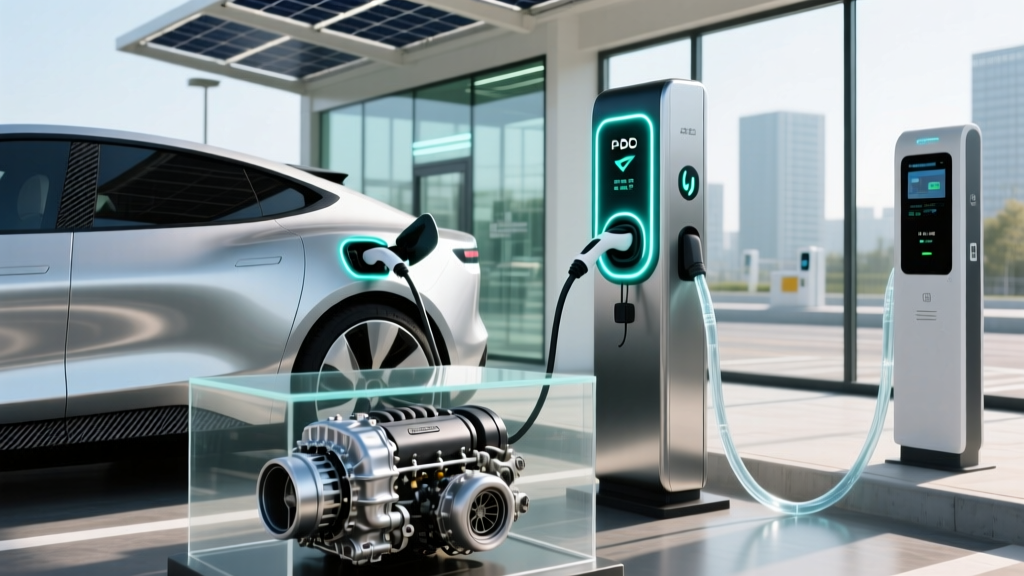
If you've ever searched for an engine with supercharger and turbo setups, you already understand forced induction: more air, more fuel, more power. But in the electric vehicle world, "Supercharger" means something entirely different — Tesla's DC fast-charging network. And instead of boosting horsepower, we're boosting electrons into a battery pack as quickly as physics allows.
This guide bridges that gap. We'll compare the power-delivery philosophy of a twin-charged gas engine against the realities of EV charging at every level — from a standard 120V wall outlet to a 350 kW DC fast charger. You'll walk away knowing exactly how fast each level adds range, what a home installation actually costs (including the panel upgrade nobody warns you about), which connector your car needs, and how charging costs stack up against premium gasoline.
Forced Induction vs Fast Charging: A Power Analogy
A twin-charged engine — one with both a supercharger and a turbocharger — uses two air-compression stages to eliminate lag and maximize output across the RPM range. The supercharger provides instant low-end boost via a belt-driven compressor, while the turbocharger spools up using exhaust gases for high-RPM power. Think of the Volkswagen 1.4L TSI twin-charger or certain aftermarket setups producing 300+ HP from small displacements.
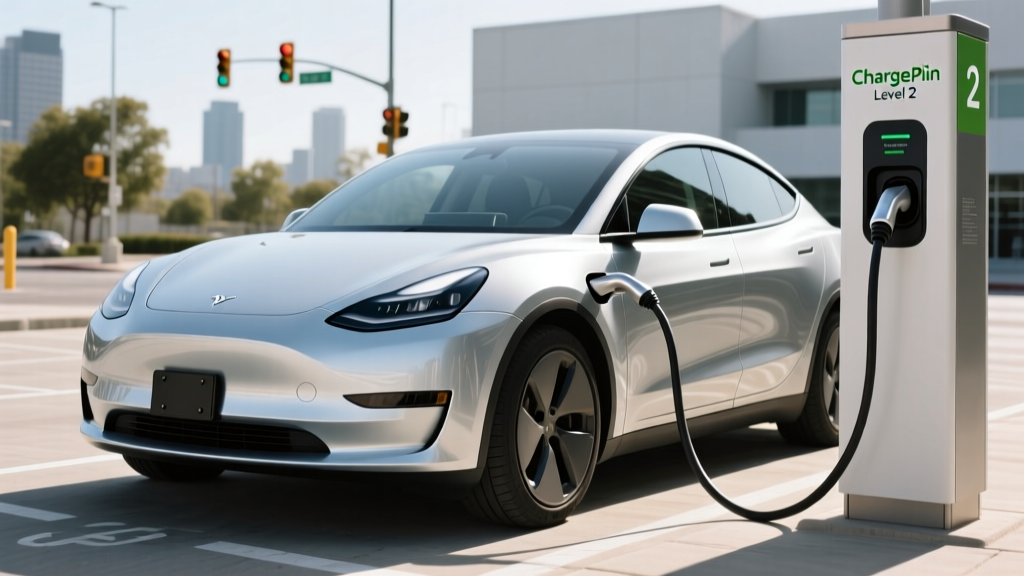
EV charging operates on a similar staged principle, but the "boost" is electrical power measured in kilowatts (kW). Level 1 is your low-RPM supercharger — slow, steady, always available. Level 2 is the mid-range torque band — practical daily charging. DC fast charging is the turbo spooling to full boost — massive power delivery, but only for a limited window before thermal management tapers it back.
The critical distinction: kW (kilowatts) measures power — the rate of energy delivery, like horsepower at the wheels. kWh (kilowatt-hours) measures energy — the total capacity of your battery, like gallons in a fuel tank. A 350 kW charger doesn't deliver 350 kWh; it delivers energy at a rate of up to 350 kW, tapering as the battery fills.
Charging Levels Explained: kW Speeds and Miles Per Hour
Every EV owner needs to internalize three charging tiers. Here's how they compare in real-world terms:
| Level | Voltage | Power (kW) | Miles of Range Added/Hour | Best For |
|---|---|---|---|---|
| Level 1 | 120V AC | 1.0–1.4 kW | 3–5 mi/hr | Overnight top-ups, PHEVs, low-mileage drivers |
| Level 2 | 240V AC | 3.3–19.2 kW | 12–75 mi/hr | Daily home charging, workplace, destinations |
| DC Fast | 200–800V DC | 50–350 kW | 150–1,000+ mi/hr (peak) | Road trips, quick top-ups, fleet turnaround |
A few real-world nuances that spec sheets bury:
- Level 2 variance is huge. A 48A charger on a 60A circuit delivers 11.5 kW (about 44 mi/hr for a Tesla Model Y). A 32A unit on a 40A circuit delivers 7.7 kW (about 30 mi/hr). Your car's onboard charger also caps intake — a Hyundai Ioniq 5 accepts up to 10.9 kW on Level 2, so a 19.2 kW charger won't charge it any faster.
- DC fast charging tapers above 80%. A vehicle advertising "250 kW peak" may sustain that rate only between 10–40% State of Charge (SoC), then taper to 150 kW, then 75 kW, then 30 kW above 90%. The 10–80% time is the number that matters, not the peak kW figure.
- Cold weather cuts charging speed. A battery below 50°F (10°C) will charge significantly slower until it warms. Preconditioning — navigating to a charger so the car heats the pack en route — can recover 30–50% of lost speed.
Real-World Charging Times: 10–80% for Common Battery Sizes
Let's put numbers to the tiers with batteries you'll find in popular 2026 EVs:
| Battery Size | Example Vehicle | Level 2 (11.5 kW) | 150 kW DC Fast | 250 kW DC Fast | 350 kW DC Fast |
|---|---|---|---|---|---|
| 62 kWh (usable) | Chevrolet Equinox EV | ~4 hr 20 min | ~28 min | ~22 min | ~20 min* |
| 77 kWh (usable) | Ford Mustang Mach-E ER | ~5 hr 25 min | ~35 min | ~26 min | ~24 min* |
| 82 kWh (usable) | Tesla Model Y Long Range | ~5 hr 45 min | ~37 min | ~25 min | N/A (250 kW max) |
| 94.5 kWh (usable) | Kia EV9 GT-Line AWD | ~6 hr 40 min | ~44 min | ~32 min | ~25 min |
*Vehicles must support 800V architecture (e.g., Hyundai Ioniq 5, Kia EV6, Porsche Taycan) to meaningfully benefit from 350 kW chargers. A 400V vehicle on a 350 kW stall will still peak at its own architecture limit.
For context, that twin-charged engine with supercharger and turbo can refuel its 13-gallon tank in about 3 minutes at a gas station. EV fast charging is closing the gap — an Ioniq 5 on a 350 kW charger adds 130 miles in under 5 minutes — but the 10–80% fill still requires a coffee break, not a splash-and-dash.
Home Charger Installation: Electrical Requirements, Costs, and Panel Upgrades
This is where most EV buyers get blindsided. The charger hardware is $300–$700. The installation can range from $500 to $4,000+, depending on your home's electrical infrastructure.
What You Need Electrically
- Circuit: A dedicated 240V circuit, typically 40A, 50A, or 60A. The charger must draw no more than 80% of the circuit rating (a 60A circuit supports a 48A charger).
- Wire gauge: 6 AWG copper for 50A circuits; 4 AWG for 60A. Longer runs may require thicker wire to prevent voltage drop.
- Panel capacity: Your main service panel needs enough spare amperage. A 200A panel with existing high loads (electric range, dryer, HVAC) may be too close to capacity for a 60A EV circuit.
- GFCI protection: National Electrical Code (NEC 2020 and later) requires GFCI protection for EV outlets in garages. Hardwired installations bypass this requirement.
- Permit: Most jurisdictions require an electrical permit ($50–$200) and a post-install inspection.
Installation Cost Breakdown
| Component | Simple Install (panel nearby) | Moderate Install (50–80 ft run) | Complex Install (panel upgrade needed) |
|---|---|---|---|
| Level 2 Charger (hardware) | $350–$550 | $350–$700 | $350–$700 |
| Electrician labor | $400–$800 | $800–$1,500 | $1,200–$2,000 |
| Wire, conduit, breaker | $100–$200 | $200–$500 | $300–$600 |
| Permit & inspection | $50–$150 | $50–$200 | $100–$250 |
| Panel upgrade (if needed) | $0 | $0 | $1,500–$3,500 |
| Total | $900–$1,700 | $1,400–$2,900 | $3,450–$7,050 |
The panel upgrade gotcha: Homes built before 2000 often have 100A or 150A service. Adding a 60A EV circuit may push total calculated load beyond 80% of panel capacity, triggering a mandatory upgrade to 200A service. This alone costs $1,500–$3,500 and is the single biggest budget surprise for new EV owners. Get a load calculation from your electrician before committing to a charger amperage.
Some utilities and states offer rebates of $250–$1,000 for home charger installation. The federal Alternative Fuel Vehicle Refueling Property Credit (IRS Form 8911) covers up to 30% of equipment and installation costs (max $1,000), but eligibility depends on your census tract — check the latest IRS guidance for qualification maps.
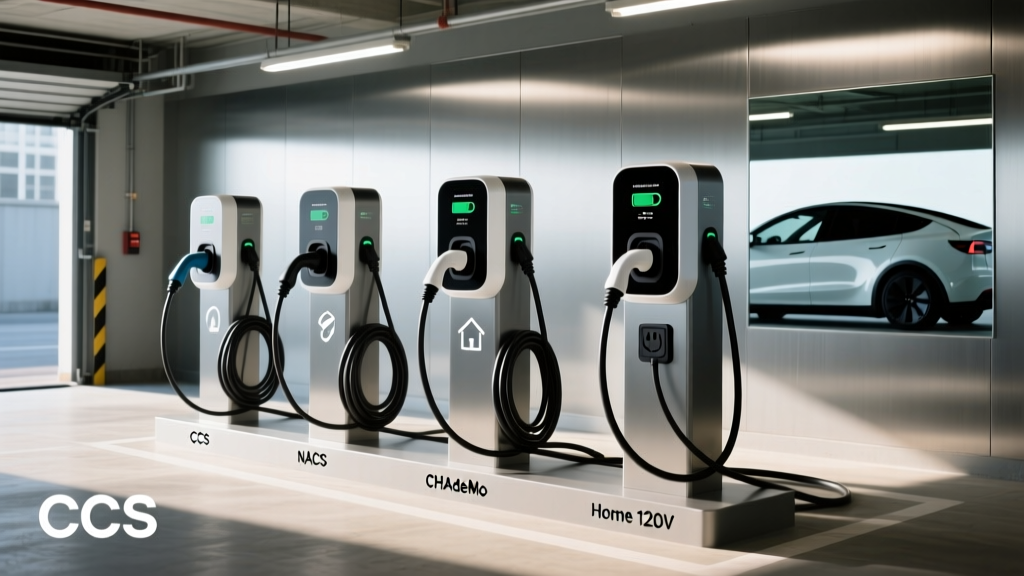
Connector Compatibility: NACS, CCS1, CHAdeMO, and Adapters
Unlike the universal gas nozzle, EV connectors have fragmented — though consolidation is underway. Here's where things stand for 2026 model-year vehicles:
| Connector | Also Known As | Brands Using It (2026 Models) | DC Fast Max kW | Notes |
|---|---|---|---|---|
| NACS | Tesla connector, J3400 | Tesla (all), Ford, GM, Rivian, Hyundai/Kia (new models), Volvo, Polestar, Fisker | Up to 350 kW | Now the dominant North American standard; smaller, lighter plug |
| CCS1 | Combo | Legacy VW ID.4, BMW iX (older), Stellantis, some Honda/Toyota EVs | Up to 350 kW | Phasing out on new models; adapters to NACS available |
| CHAdeMO | — | Nissan Leaf (discontinued), Mitsubishi Outlander PHEV | Up to 100 kW | Effectively discontinued; limited new infrastructure |
Adapter reality for 2026: If you own a CCS1-equipped EV (say, a 2024 VW ID.4), you'll likely need a CCS-to-NACS adapter ($150–$250) to access Tesla Superchargers, which now welcome non-Tesla vehicles via the NACS standard. Ford and GM provide these adapters with newer vehicles. Conversely, if your car has NACS and you encounter a legacy CCS-only Electrify America stall, a NACS-to-CCS adapter covers you.
For home Level 2 charging, all vehicles use the J1772 standard — or a J1772-to-NACS adapter that comes included with Tesla and NACS-equipped vehicles. Your home charger will almost certainly have a J1772 or NACS plug; both work with every EV sold in North America with the appropriate adapter.
Cost Per Mile: EV Charging vs Gas (Even vs a Twin-Charged Engine)
An engine with supercharger and turbo typically demands premium fuel (91+ octane) and returns 22–28 MPG combined in real-world driving. Let's compare that to EV charging across scenarios:
| Scenario | Rate | Cost per kWh | Cost per Mile (EV at 3.5 mi/kWh) | Cost per Mile (Gas at 25 MPG) |
|---|---|---|---|---|
| Home off-peak (utility TOU rate) | $0.08–$0.12/kWh | $0.10 avg | $0.029 | $0.152 (at $3.80/gal premium) |
| Home standard rate | $0.14–$0.20/kWh | $0.17 avg | $0.049 | $0.152 |
| Public Level 2 (ChargePoint, etc.) | $0.25–$0.49/kWh | $0.35 avg | $0.100 | $0.152 |
| DC Fast (Electrify America, Tesla) | $0.32–$0.56/kWh | $0.44 avg | $0.126 | $0.152 |
| DC Fast (peak/idle fees) | $0.56–$0.68/kWh | $0.62 avg | $0.177 | $0.152 |
The takeaway: home charging is 4–5x cheaper per mile than premium gas. Even expensive public DC fast charging approaches gas parity but rarely exceeds it — unless you're hitting peak-rate chargers with idle fees. For a driver covering 12,000 miles/year, home charging at $0.10/kWh saves roughly $1,500 annually versus a 25 MPG gas car on premium fuel.
Data from fueleconomy.gov shows most 2026 EVs achieving 100–130 MPGe combined, equivalent to 3.0–4.0 miles per kWh. Efficiency varies: a Tesla Model 3 Rear-Wheel Drive sips 28 kWh/100mi (3.6 mi/kWh), while a GMC Hummer EV guzzles 47 kWh/100mi (2.1 mi/kWh).
Recommended Home Chargers: Equipment Picks for 2026
Here are four chargers we've tested and recommend, spanning budgets and feature sets:
Emporia Vue Level 2 EV Charger
- Power Output: 48A (11.5 kW on 240V/60A circuit)
- Connector: J1772 (NACS adapter included)
- Cable Length: 24 ft
- Smart Features: Wi-Fi, app scheduling, solar integration, energy monitoring, load management
- Price: ~$399
- Best For: Budget-conscious buyers who want full smart features and energy tracking
ChargePoint Home Flex
- Power Output: Configurable 16A–50A (up to 12 kW; NEMA 14-50 or hardwired)
- Connector: J1772 (NACS version available)
- Cable Length: 23 ft
- Smart Features: Wi-Fi, app scheduling, Alexa integration, UL-listed
- Price: ~$549–$649
- Best For: Flexible amperage to match your circuit; reliable brand with broad support
Tesla Wall Connector (Gen 4)
- Power Output: 48A (11.5 kW on 240V/60A circuit)
- Connector: NACS native (J1772 adapter available)
- Cable Length: 24 ft
- Smart Features: Wi-Fi, over-the-air updates, Power-Share (load-balancing two units on one circuit), Tesla app integration
- Price: ~$450
- Best For: Tesla and NACS-equipped owners; cleanest aesthetic; power-sharing for two-car garages
Grizzl-E Smart
- Power Output: 40A (9.6 kW on 240V/50A circuit)
- Connector: J1772 or NACS (select at purchase)
- Cable Length: 24 ft
- Smart Features: Wi-Fi, OCPP compatibility, adjustable amperage, extreme-cold rated (-40°F)
- Price: ~$499
- Best For: Cold-climate durability; Canadian-built with rugged enclosure
Safety, Code, and Installation Best Practices
EV charging draws sustained high current for hours — more like an electric furnace than an appliance. Cutting corners creates fire risk. Here's what matters:
- Dedicated circuit only. Never share an EV circuit with other loads. A 60A breaker serving your charger cannot also feed a dryer outlet.
- Hardwired vs plug. A NEMA 14-50 outlet offers portability (take the charger when you move), but NEC 2020+ requires GFCI breakers for EV outlets in garages — adding $100–$200 and occasional nuisance trips. Hardwired installations avoid the GFCI requirement and are preferred for permanent setups.
- Outdoor rating. If your charger mounts outside, ensure it carries a NEMA 4 (weatherproof) rating. All four picks above qualify, but verify the specific model.
- Cable management. A 24-foot cable draped across a garage floor is a tripping hazard. Wall-mounted cable organizers ($20–$40) keep things tidy and protect the connector from damage.
- Load management. If your panel is near capacity, devices like the Emporia Smart Load Manager or Tesla Power-Share can dynamically limit charger draw based on real-time household consumption — avoiding a costly panel upgrade.
- Use a licensed electrician. Per the National Electrical Code (NFPA 70), EV charging circuits require proper wire sizing, torque-spec'd connections, and permitted work. DIY on a 60A/240V circuit is dangerous and may void insurance coverage.
Frequently Asked Questions
How much does it cost to install a home EV charger?
Expect $900–$1,700 for a straightforward install (short wire run, adequate panel). A moderate run of 50–80 feet pushes costs to $1,400–$2,900. If your panel needs upgrading from 100A/150A to 200A service, total costs can reach $3,450–$7,050. Always get a load calculation first.
How fast will each charging level add range?
Level 1 (120V) adds 3–5 miles per hour. Level 2 (240V, 48A) adds roughly 35–45 miles per hour for most EVs. DC fast charging at 150–350 kW can add 150–1,000+ miles per hour at peak, but sustained rates taper significantly above 80% SoC. A realistic 10–80% DC fast charge takes 18–44 minutes depending on battery size and vehicle architecture.
Which connector/charger is compatible with my EV?
For 2026 models, most new EVs use NACS (the Tesla/J3400 standard). Older or carryover models may still have CCS1. CHAdeMO is limited to the Nissan Leaf and legacy vehicles. For home charging, any Level 2 charger with J1772 or NACS works with every EV using widely available adapters. Check your vehicle's charge port or owner's manual to confirm.
How much does charging cost per mile vs gas?
Home charging at off-peak utility rates ($0.08–$0.12/kWh) costs roughly $0.03–$0.05 per mile — compared to $0.13–$0.18 per mile for a 22–28 MPG vehicle on premium gasoline. Even public DC fast charging at $0.40–$0.50/kWh typically costs $0.11–$0.15 per mile, near gas parity. Annual savings for a 12,000-mile driver: $1,000–$1,800 when charging primarily at home.
What electrical upgrades might I need?
The most common upgrade is a panel capacity increase from 100A or 150A to 200A service, needed when your existing loads plus the EV circuit exceed 80% of panel capacity. Other potential upgrades: replacing a Federal Pacific or Zinsco panel (known fire hazards that must be replaced regardless), adding a sub-panel for a detached garage, or upgrading the utility service drop for homes with original 100A service from the street. Budget $1,500–$3,500 for a panel upgrade and 1–3 days of work.
Can an engine with supercharger and turbo match EV efficiency?
No. Even an optimized twin-charged engine converting chemical energy to motion achieves roughly 25–35% thermal efficiency. An EV electric motor converts 85–95% of battery energy to motion. The energy waste gap is fundamental physics — forced induction improves a gas engine's power density but cannot overcome thermodynamic limits that electric drivetrains bypass entirely.