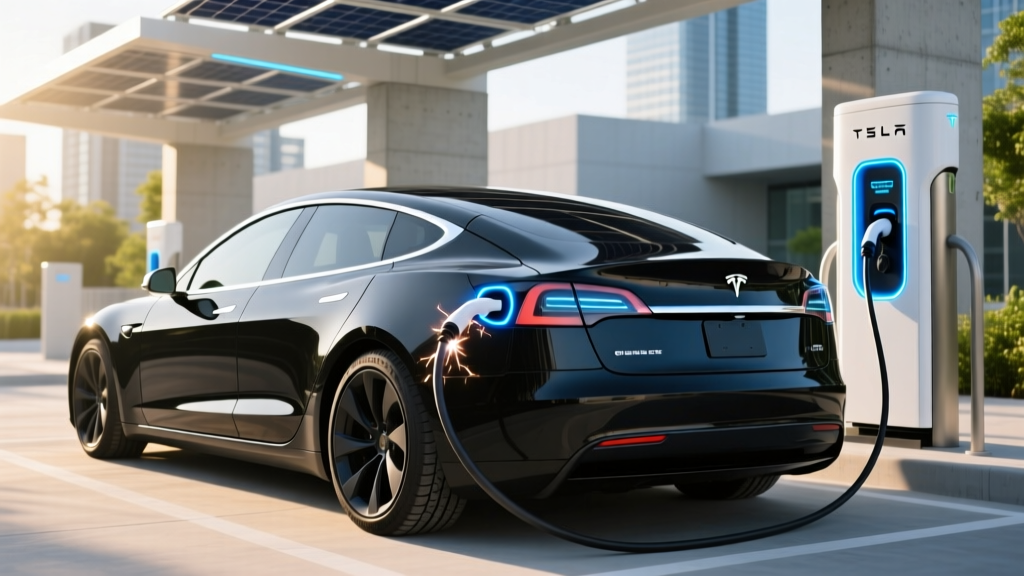
If you've searched for supercharger tesla time, you're likely trying to plan road trips, compare EVs, or decide whether a Tesla's charging speed justifies the purchase. The short answer: a Tesla Model Y on a V3 Supercharger adds roughly 10% to 80% in 25–28 minutes, while the Cybertruck and refreshed Model 3 can shave that closer to 18–22 minutes on V4 stalls. But peak kW numbers on a spec sheet don't tell the full story. Charging speed depends on battery chemistry, state of charge (SoC), ambient temperature, and whether the vehicle has preconditioned its pack.
This guide breaks down exactly how long Tesla Supercharging takes across the current lineup, then zooms out to cover every charging level, home installation costs, connector compatibility, and what you'll actually pay per mile compared to gasoline. Whether you own a Tesla, a Ford with a NACS adapter, or are shopping for your first EV, the numbers below will set realistic expectations.
Tesla Supercharger Times by Model and Stall Generation
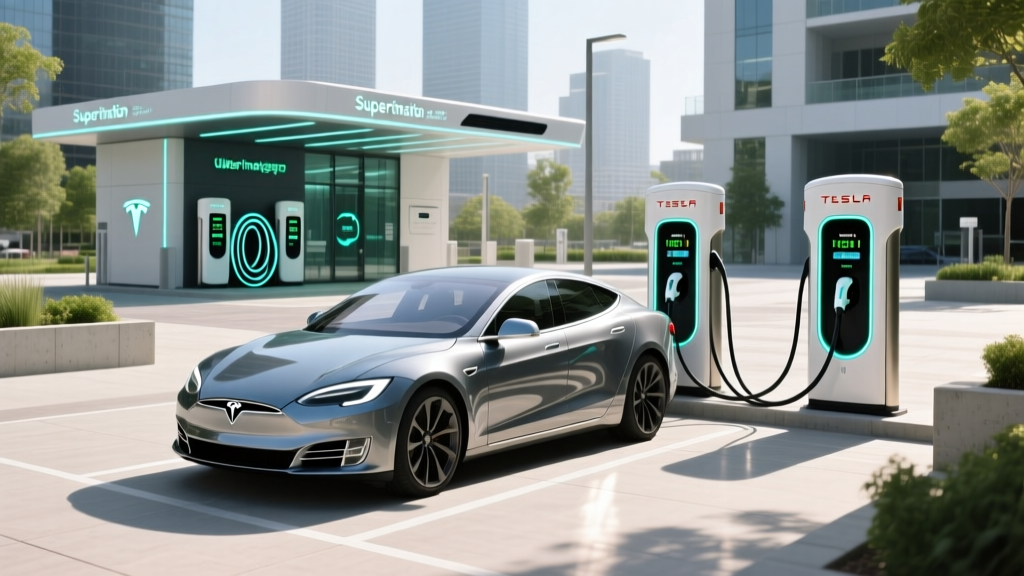
Tesla's Supercharger network has evolved through three main generations still in active service. V2 stalls peak at 150 kW, V3 stalls at 250 kW, and the newer V4 architecture (rolled out broadly through 2025–2026) supports up to 325 kW for compatible vehicles. Not every Tesla can absorb V4's full rate — the limitation is on the vehicle side, not just the stall.
| Model (Trim / Battery) | Battery (kWh usable) | Peak DC Rate | V3 (250 kW) 10–80% | V4 (325 kW) 10–80% |
|---|---|---|---|---|
| Model 3 Long Range (NMC) | 75 kWh | 250 kW | ~25 min | N/A (250 kW cap) |
| Model 3 RWD (LFP) | 57.5 kWh | 170 kW | ~30 min | N/A (170 kW cap) |
| Model Y Long Range (NMC) | 75 kWh | 250 kW | ~27 min | N/A (250 kW cap) |
| Model S / X (NMC) | 95 kWh | 250 kW | ~30 min | N/A (250 kW cap) |
| Cybertruck AWD (NMC) | 123 kWh | 325 kW (V4) | ~35 min | ~22 min |
Understanding the Charge Curve: Why Peak kW Misleads
A Tesla Model Y Long Range "peaks" at 250 kW, but it only sustains that rate for roughly the first 15–20% of the session (approximately 10% to 30% SoC). As the battery fills, the battery management system tapers current to protect the cells. By 60% SoC, you may see 100–120 kW; by 80%, perhaps 40–60 kW. This is why manufacturers and testers quote 10–80% times rather than 0–100% — charging from 80% to 100% on DC fast charging can take as long as the entire 10–80% session.
The practical takeaway: on a road trip, plan stops around the 10–80% window. Charging past 80% at a Supercharger is rarely time-efficient unless you're at your final destination or the next charger is more than 150 miles away.
All Three Charging Levels: Speeds in kW and Miles Per Hour
Superchargers are only one piece of the picture. Most Tesla charging — and most EV charging generally — happens at home. Here is how the three levels compare. Note: kW (kilowatts) measures power — the rate of energy delivery. kWh (kilowatt-hours) measures energy — what your battery stores. Think of kW as the width of a hose and kWh as the size of the bucket.
| Level | Voltage / Amperage | Power (kW) | Miles of Range Per Hour | Typical Use |
|---|---|---|---|---|
| Level 1 | 120V / 12A | ~1.4 kW | 3–5 mi/hr | Overnight top-up, emergency, low-mileage drivers |
| Level 2 (Home) | 240V / 32–48A | 7.7–11.5 kW | 25–44 mi/hr | Daily home charging, primary method for most owners |
| Level 2 (Public/Workplace) | 208–240V / 30–80A | 6.6–19.2 kW | 22–70 mi/hr | Shopping centers, workplaces, hotels |
| DC Fast (V3 Supercharger) | 400–500V DC | Up to 250 kW | Up to ~1,000 mi/hr (peak) | Road trips, highway corridors |
| DC Fast (V4 Supercharger) | 400–900V DC | Up to 325 kW | Up to ~1,200 mi/hr (peak) | Newer highway and urban Supercharger stations |
| DC Fast (Non-Tesla CCS) | 400–900V DC | 50–350 kW | 180–1,300 mi/hr (peak) | Electrify America, EVgo, Ionity, etc. |
For a Tesla Model Y Long Range (EPA 320 miles, real-world highway ~270–290 miles), a full overnight charge on a 48A Level 2 wall connector delivers roughly 44 miles of range per hour — meaning a depleted-to-full charge takes about 7–8 hours. That's ideal for arriving home, plugging in, and waking up to a full battery every morning.
How Much Does It Cost to Install a Home EV Charger?
Home Level 2 charging is the backbone of practical EV ownership, but installation costs vary enormously based on your home's electrical panel, the distance from panel to charger location, and local permitting. Here's a realistic breakdown based on 2026 national averages for a 48A Level 2 charger on a dedicated 60A circuit.
| Component | Low End | High End | Notes |
|---|---|---|---|
| Level 2 Charger (Equipment) | $400 | $750 | 48A smart charger, NACS or J1772/NACS combo |
| Electrician Labor | $500 | $2,000 | Depends on run length, wall type, conduit |
| Electrical Permit | $50 | $300 | Varies by municipality |
| Panel Upgrade (if needed) | $1,500 | $4,000 | Required if panel is 100A or near capacity |
| Total (no panel upgrade) | $950 | $3,050 | Most homes with 200A service |
| Total (with panel upgrade) | $2,450 | $7,050 | Older homes with 100A or maxed-out panels |
What Electrical Upgrades Might I Need?
A 48A Level 2 charger requires a dedicated 60A breaker (NEC code requires circuits to be rated at 125% of continuous load: 48A × 1.25 = 60A). Your home's electrical panel must have enough spare capacity to accommodate this. Homes with 200A service and room on the panel typically need no upgrade. Homes with 100A service — common in houses built before the 1990s — or panels already near their rated load will likely need a panel upgrade to 200A, which adds $1,500–$4,000 to the project.
A licensed electrician will perform a load calculation before installation. Some utilities offer rebates of $200–$500 for Level 2 installations, and certain states provide additional incentives. Always check with your local utility before scheduling work. (For final electrical specifications, defer to a licensed electrician — this guide provides planning estimates, not professional electrical advice.)
Connector Compatibility: NACS, CCS, CHAdeMO, and Adapters
As of 2026, the North American Charging Standard (NACS) — originally Tesla's proprietary connector — has become the dominant EV charging connector in the United States. Most automakers have transitioned to NACS for new models, and Tesla has opened its Supercharger network to non-Tesla EVs equipped with NACS or an approved adapter.
| Connector | Used By | Tesla Supercharger Compatible? | Notes |
|---|---|---|---|
| NACS (native) | Tesla (all), Ford (2025+), GM (2025+), Rivian (2025+), Hyundai/Kia (2026+), others | Yes — direct plug | Standard on most new EVs sold in 2026 |
| CCS1 | Older Ford, GM, VW, Hyundai/Kia models (pre-NACS transition) | Yes — with Tesla CCS-to-NACS adapter (~$175–$250) | Adapter required; check Tesla app for station compatibility |
| CHAdeMO | Nissan Leaf (legacy), Mitsubishi Outlander PHEV | No | Being phased out; limited new DC infrastructure |
| J1772 (Level 2 AC) | All non-Tesla EVs (AC charging) | Yes — Tesla Mobile Connector includes J1772 adapter; Tesla Wall Connector has Magic Dock at some locations | Standard for public Level 2 AC charging |
If you drive a non-Tesla EV with a native CCS1 port and want to use the Supercharger network, you'll need a Tesla-approved CCS-to-NACS adapter. Not all Supercharger stalls support non-Tesla vehicles — check the Tesla app or your vehicle's navigation for compatible stations before planning a trip.
Cost to Charge: Home vs. Supercharger vs. Gas per Mile
Charging cost is where EV ownership economics either shine or disappoint, depending on your setup. The key metric is cost per mile, which lets you compare directly with gasoline. Below, we use a Tesla Model Y Long Range at approximately 3.5 miles per kWh (roughly 28 kWh/100 mi, per fueleconomy.gov) as the baseline.
| Scenario | Rate ($/kWh) | Cost Per Mile | Full "Tank" (75 kWh, ~260 mi real-world) |
|---|---|---|---|
| Home — Off-Peak Utility Rate | $0.08–$0.12 | $0.023–$0.034 | $6.00–$9.00 |
| Home — Standard Residential Rate | $0.13–$0.18 | $0.037–$0.051 | $9.75–$13.50 |
| Tesla Supercharger (avg 2026) | $0.28–$0.36 | $0.080–$0.103 | $21.00–$27.00 |
| Non-Tesla DC Fast (EA, EVgo) | $0.35–$0.55 | $0.100–$0.157 | $26.25–$41.25 |
| Gasoline Car (28 MPG avg, $3.40/gal) | — | $0.121 | $31.50 (for 260 mi) |
The takeaway is clear: home charging is 3–5× cheaper per mile than gasoline, while exclusive Supercharger or public DC fast charging narrows the gap considerably — sometimes approaching gas-car costs depending on your local electricity and fuel prices. For the best economics, charge at home whenever possible and use Superchargers primarily for road trips.
Recommended Level 2 Home Chargers (2026)
Not all Level 2 chargers are equal. The right unit depends on your vehicle's connector, your desired charge speed, cable length needs, and whether you want smart scheduling features (useful for off-peak utility rates). Below are three proven options for Tesla and NACS-equipped vehicles.
Tesla Wall Connector (Gen 4)
- Power Output: Up to 11.5 kW (48A at 240V)
- Connector: NACS native; J1772 adapter included
- Cable Length: 24 ft
- Smart Features: Wi-Fi, OTA updates, Tesla app integration, load sharing with second unit, Powerwall integration
- Price: ~$475
- Best For: Tesla owners wanting seamless integration; also charges NACS-equipped Ford, GM, Rivian
ChargePoint Home Flex (NACS)
- Power Output: Up to 12 kW (50A at 240V, configurable down to 16A)
- Connector: NACS (2025+ model); J1772 version also available
- Cable Length: 23 ft
- Smart Features: Wi-Fi, ChargePoint app, Alexa integration, flexible amperage for older panels
- Price: ~$599
- Best For: Multi-EV households, adjustable amperage to avoid panel upgrades
Emporia Vue Level 2 Charger
- Power Output: Up to 11.5 kW (48A at 240V)
- Connector: NACS or J1772 versions available
- Cable Length: 24 ft
- Smart Features: Wi-Fi, energy monitoring via Emporia Vue panel integration, solar-aware scheduling, scheduled charging
- Price: ~$399
- Best For: Budget-conscious buyers, solar panel owners wanting energy tracking
Safety and Electrical Code Considerations
EV charging involves sustained high-current draw — more like running an electric oven for 8 hours than plugging in a phone charger. Proper installation is non-negotiable for safety and code compliance.
- Dedicated Circuit: Your Level 2 charger must be on its own dedicated circuit — never shared with other appliances. A 48A charger requires a 60A breaker per NEC 2023/2026 continuous-load rules.
- GFCI Protection: NEC 2023 Article 625.54 requires GFCI protection for EV charging outlets (receptacle-based installations). Hardwired installations may have different requirements — your electrician will determine the correct approach for your jurisdiction.
- Outdoor Rating: If your charger is mounted outdoors or in an unenclosed carport, it must carry a NEMA 4 (or IP65+) weather rating. All three chargers recommended above meet this standard.
- Wire Gauge: A 60A circuit typically requires 6 AWG copper wire for runs up to ~50 feet, or 4 AWG for longer runs to prevent voltage drop. Your electrician will size wire appropriately.
- Permit and Inspection: Virtually all jurisdictions require an electrical permit and post-installation inspection for EV charger installations. Skipping this step can void homeowner's insurance coverage and create resale issues.
Frequently Asked Questions
How much does it cost to install a home EV charger?
Most homeowners pay between $950 and $3,050 for a complete Level 2 installation (charger + electrician + permit) when no panel upgrade is needed. If your home has a 100A electrical panel or one that's near capacity, a panel upgrade to 200A adds $1,500–$4,000, bringing the total to $2,450–$7,050. Get at least two quotes from licensed electricians and check with your utility for rebates before committing.
How fast will each charging level add range?
Level 1 (120V standard outlet) adds about 3–5 miles of range per hour — enough for drivers who travel under 40 miles daily. Level 2 (240V, 48A) adds 25–44 miles per hour, fully recharging most EVs overnight in 7–10 hours. DC fast charging (Supercharger V3 at 250 kW) can add up to 200 miles in 15 minutes at peak rate, though sustained averages are lower due to charge-curve tapering.
Which connector/charger is compatible with my EV?
If you own a Tesla, your vehicle uses NACS natively and charges at any Supercharger or NACS-equipped Level 2 station. If you own a 2025+ Ford, GM, Rivian, or 2026+ Hyundai/Kia, your vehicle likely has NACS as well. Older non-Tesla EVs with CCS1 ports need a Tesla CCS-to-NACS adapter (~$175–$250) to use Superchargers. CHAdeMO vehicles (Nissan Leaf) cannot use Superchargers. For Level 2 AC charging, all non-Tesla EVs use the J1772 connector; Tesla provides a J1772 adapter with its Mobile Connector.
How much does charging cost per mile vs. gas?
Home charging at off-peak utility rates ($0.08–$0.12/kWh) costs approximately $0.02–$0.03 per mile — roughly 75–85% cheaper than gasoline at $3.40/gallon in a 28 MPG car ($0.12/mile). Supercharger charging ($0.28–$0.36/kWh) costs $0.08–$0.10 per mile, still 15–35% cheaper than gas. Exclusive reliance on expensive public DC fast chargers ($0.40–$0.55/kWh) can approach or exceed gasoline costs, which is why home charging access remains the single biggest factor in EV ownership economics.
What electrical upgrades might I need?
The most common upgrade is a panel capacity increase from 100A to 200A, needed in older homes where the existing panel cannot support an additional 60A continuous load. Some homes may also need a new conduit run if the panel is far from the desired charger location (e.g., panel in the basement, charger in a detached garage). In rare cases, the utility may need to upgrade the service drop to your home. A licensed electrician's load calculation is the definitive way to determine what's required. According to NEC guidelines, the 125% continuous-load rule means a 48A charger needs a 60A circuit — and your panel must have that headroom available.
Does Supercharger speed degrade over time as the battery ages?
Marginally. As lithium-ion batteries age and their internal resistance increases slightly, peak charge rates may decrease by 5–10% over 100,000+ miles. However, Tesla's battery management system is conservative, and Tesla's battery warranty guarantees at least 70% capacity retention over 8 years or 100,000–150,000 miles (depending on model). Most owners report negligible change in Supercharger times within the warranty period.
Is it worth charging past 80% at a Supercharger?
Generally, no. The charge curve tapers dramatically above 80% — you might spend 15–20 additional minutes to go from 80% to 100%, gaining only ~50–60 miles of range in that time. On a road trip, it's almost always faster to charge to 80% and drive to the next Supercharger. The exception: if you're at your destination for the day or the next charger is more than 150 miles away. Tesla's navigation system typically routes you to arrive at the next stop with 10–15% remaining, optimizing total trip time.
Understanding your real Supercharger Tesla time — and how home charging fits into the bigger picture — is the difference between an EV ownership experience that feels effortless and one that feels like a compromise. For most owners, the math is simple: install a Level 2 charger at home for daily driving, and let the Supercharger network handle road trips. With 10–80% times under 30 minutes on V3 stalls and under 22 minutes on V4 for compatible vehicles, the wait is shorter than a meal stop — and the cost per mile, when charging at home, is a fraction of what you'd pay at the pump.