What "Supercharger for Cars" Actually Means in 2026
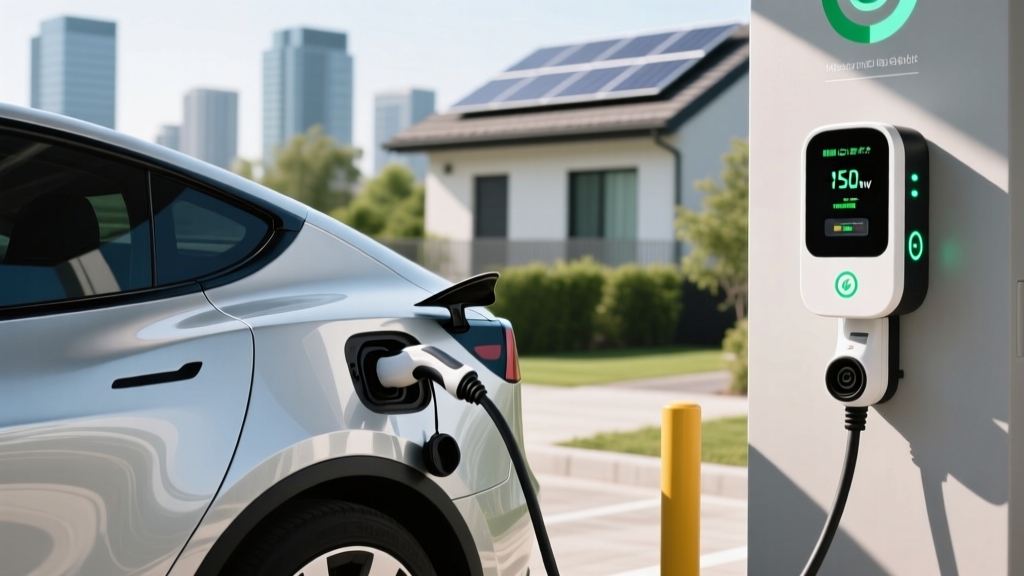
When EV owners search for a "supercharger for cars," they're usually asking one of two questions: Can I use Tesla's Supercharger network with a non-Tesla EV? And can I install fast-charging hardware at home that approaches those speeds? The short answer to both is yes — but the details on connectors, electrical service, and real-world charge rates matter enormously for your budget and your car's battery.
As of 2026, Tesla has opened thousands of Supercharger stalls to non-Tesla EVs via the North American Charging Standard (NACS), and nearly every major automaker — Ford, GM, Rivian, Hyundai, Kia, Volvo, and others — now ships vehicles with a native NACS port. For the home side of the equation, a true Supercharger-class DC fast charger is impractical for residential use (480V three-phase power, $40,000+ hardware), but a properly installed Level 2 wall connector delivers 30–45 miles of range per hour, which covers the daily needs of 95% of EV drivers.
This guide breaks down every charging tier, what your home's electrical panel can actually support, which connector your car needs, and what you'll spend per mile compared to gasoline.
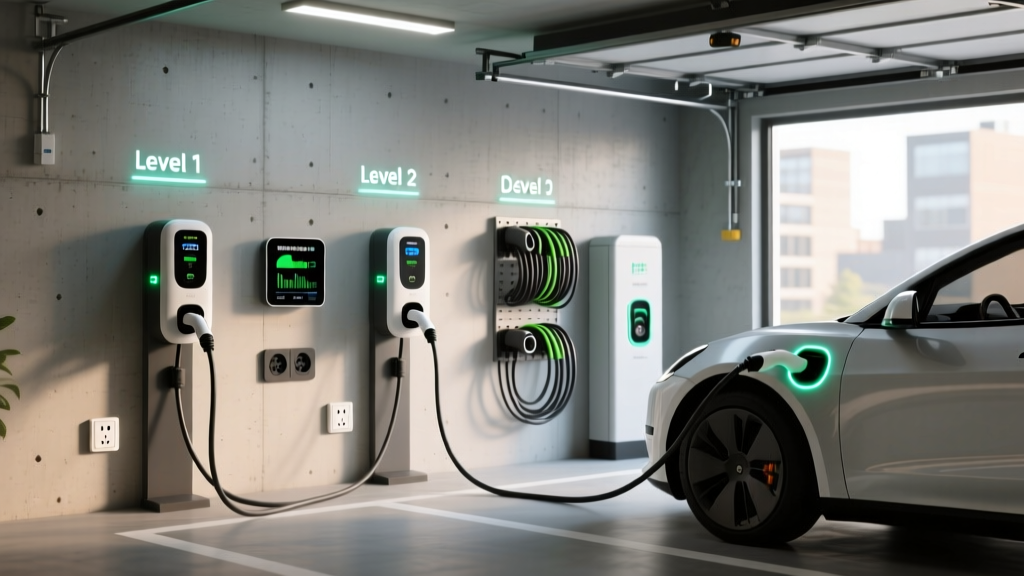
The Three Charging Levels: Speed, Power, and Real-World Range Added
Before you buy equipment or call an electrician, you need to understand the three charging tiers. The critical distinction: kW (kilowatts) measures power — how fast energy flows into your battery. kWh (kilowatt-hours) measures energy — the total capacity of your battery, like gallons in a fuel tank. A 75 kWh battery charged at 11.5 kW takes roughly 6.5 hours from empty to full; that same battery on a 250 kW DC fast charger can hit 80% in about 20 minutes.
| Level | Voltage / Phase | Typical Power (kW) | Miles of Range Added per Hour | Best Use Case |
|---|---|---|---|---|
| Level 1 | 120V / single | 1.2–1.9 kW | 3–5 mi/hr | Overnight trickle, PHEVs, low-mileage drivers |
| Level 2 | 240V / single | 7.2–19.2 kW | 20–60 mi/hr | Daily home charging, workplace, hotels |
| DC Fast (incl. Supercharger) | 400–800V / DC | 50–350 kW | 150–1,000+ mi/hr (at peak) | Road trips, highway corridors, 10–80% top-ups |
A few real-world caveats. Those "miles per hour" figures assume a vehicle efficiency around 3–3.5 mi/kWh (typical for a mid-size crossover like the Hyundai Ioniq 5 or Tesla Model Y). Heavy trucks like the Ford F-150 Lightning or Rivian R1T will see fewer miles per kWh. And DC fast charging follows a charge curve: a vehicle rated for a peak 250 kW may only sustain that rate between 10–40% State of Charge (SoC), then taper to 150 kW, then 80 kW, and finally trickle below 30 kW past 80%. This is why manufacturers advertise "10–80%" times rather than "0–100%" — charging above 80% is painfully slow and, done regularly, accelerates battery degradation.
Can You Install a Supercharger for Cars at Home?
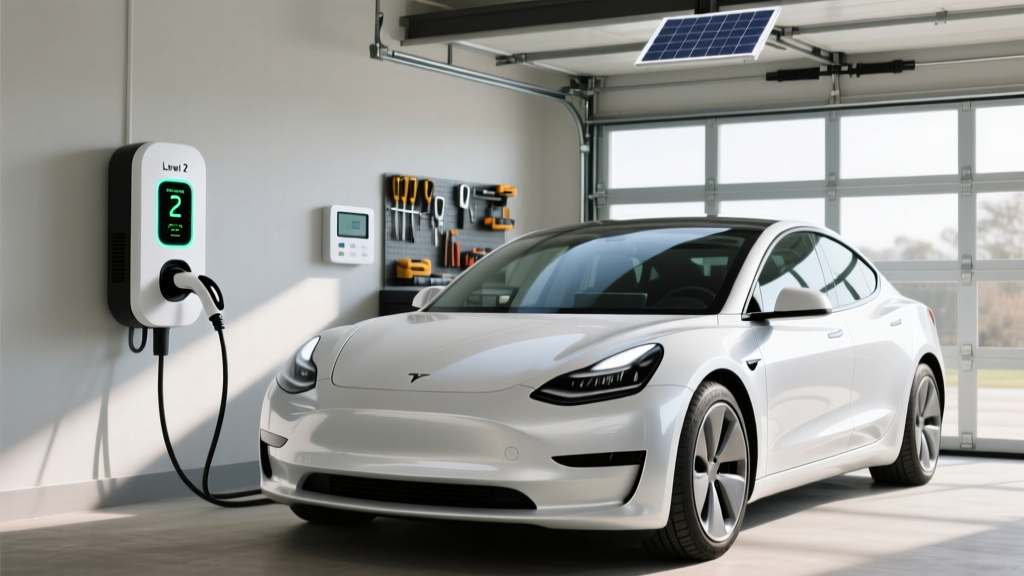
A Tesla V4 Supercharger stall delivers up to 350 kW and requires 480V three-phase commercial power — infrastructure that doesn't exist in residential settings and would cost $50,000+ to bring to a house even if your utility allowed it. What you can install at home is a Level 2 wall connector on a dedicated 240V circuit, which is what most EV owners mean when they talk about a "home supercharger."
A hardwired Level 2 unit on a 60-amp breaker delivers up to 11.5 kW (48 amps continuous, per the NEC's 80% rule for continuous loads). That's roughly 35–40 miles of range per hour for an efficient sedan, or about 28–32 miles per hour for a heavier SUV or truck. Plug in at 10 PM with 40 miles of range, and you'll wake up at 7 AM with 280+ miles — more than enough for almost any daily driving pattern.
Electrical Requirements: What Your Panel Needs to Support
Most modern homes have a 200-amp main service panel. A 60-amp EV circuit draws on that capacity, and the National Electrical Code (NEC) Article 220 requires that your total calculated load not exceed 80% of panel capacity. If your panel is already heavily loaded — electric range, dryer, HVAC, water heater — an electrician may recommend a load-management device (like the Emporia Smart Load Center or Tesla Wall Connector's built-in load-sharing) that dynamically reduces EV charging when other appliances kick on.
Homes built before the 1980s often have 100-amp panels. Upgrading to 200 amps typically costs $1,500–$3,500 depending on your utility's requirements, local labor rates, and whether a new meter base or service drop is needed. In some cases, a secondary panel or a line-side tap can avoid a full upgrade, but only a licensed electrician can evaluate this on-site.
Home EV Charger Installation Cost Breakdown (2026)
Installation costs vary wildly based on panel proximity to the garage, wall construction, and local permit fees. Below is a realistic range based on national averages and electrician surveys from 2025–2026.
| Component | Basic Install (panel adjacent) | Complex Install (long run, panel upgrade) |
|---|---|---|
| Level 2 charger hardware (40–48A) | $400–$650 | $500–$750 |
| Electrician labor (2–4 hrs basic, 6–10 hrs complex) | $300–$600 | $900–$2,000 |
| Materials (conduit, wire, junction box) | $50–$150 | $200–$500 |
| Permit and inspection | $50–$200 | $100–$350 |
| Panel upgrade (if needed) | $0 | $1,500–$3,500 |
| Total | $800–$1,600 | $3,200–$7,100 |
A few cost-reduction tips: The federal Alternative Fuel Vehicle Refueling Property Credit (IRS Form 8911) covers 30% of home charging equipment and installation costs, up to $1,000, for equipment placed in service through 2032 — though it's subject to census-tract eligibility requirements. Some utilities also offer rebates of $200–$500 for smart Level 2 chargers that participate in demand-response programs. Check with your local co-op or investor-owned utility before purchasing.
Connector Compatibility: NACS, CCS1, and CHAdeMO Explained
The connector landscape has consolidated dramatically. As of 2026, NACS (North American Charging Standard, originally the Tesla proprietary connector) has effectively won the North American market. CCS1 (Combined Charging System) remains on many 2022–2025 vehicles, and CHAdeMO is essentially legacy — still supported at older public stations but no longer specified on new vehicles sold in the US except the Nissan Ariya's early trims.
| Connector | Native on These Brands | Adapter Needed? | Public Network Access |
|---|---|---|---|
| NACS (Tesla standard) | Tesla, Ford, GM, Rivian, Hyundai, Kia, Volvo, Polestar, Mercedes (2025+), Toyota (bZ series 2026+) | None for NACS stations; CCS adapter (~$150–$200) for legacy CCS stalls | Tesla Supercharger network (17,000+ stalls open to NACS), Electrify America (new stalls), ChargePoint |
| CCS1 | VW ID.4 (2024 and earlier), BMW i4/iX (pre-2026), some Stellantis models | CCS-to-NACS adapter ($200–$300) for Tesla Superchargers | Electrify America, EVgo, ChargePoint, non-Tesla DC networks |
| CHAdeMO | Nissan Leaf (discontinued), Mitsubishi Outlander PHEV (legacy) | No practical adapter to NACS/CCS | Declining availability; some Electrify America and EVgo legacy stalls |
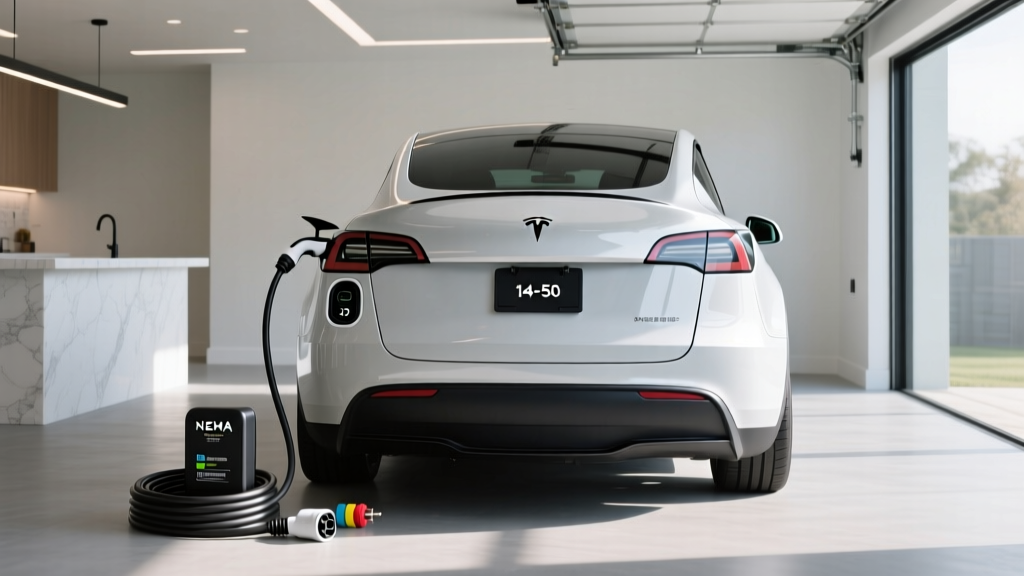
If you're buying a new EV in 2026, it almost certainly ships with NACS. If you own a 2022–2025 EV with CCS1, plan for a $200–$300 adapter to access Tesla Superchargers — Tesla sells an official CCS-to-NACS adapter, and third-party options from brands like Lectron and A2Z are widely available. For home Level 2 charging, NACS and J1772 (the legacy Level 2 standard) are easily cross-compatible: most new wall connectors ship with NACS, and a $50–$80 J1772-to-NACS adapter lets you charge older EVs.
Level 2 Home Charger Recommendations: What to Buy in 2026
Here are four well-regarded Level 2 units that cover different budgets and feature sets. All are UL-listed (a non-negotiable safety requirement), support NACS natively or via included adapter, and work with common smart-home platforms.
Tesla Wall Connector (Gen 4)
Power output: Up to 11.5 kW (48A) on a 60A circuit
Cable length: 24 ft
Connector: NACS native
Smart features: Wi-Fi, OTA firmware updates, load sharing with up to 6 units, access control, integrated cable management
Price: ~$475
Best for: Tesla owners and NACS-native EV owners who want seamless integration with the Tesla app. Load-sharing is ideal for two-EV households on a single circuit.
Emporia Vue Level 2 EV Charger
Power output: Up to 11.5 kW (48A) on a 60A circuit
Cable length: 24 ft
Connector: NACS native (J1772 adapter included)
Smart features: Energy monitoring via Emporia Vue panel integration, solar-aware charging, time-of-use scheduling, Alexa support
Price: ~$399
Best for: Solar-panel owners who want to charge exclusively from excess solar production. The energy-monitoring integration is the best in class.
ChargePoint Home Flex (2nd Gen)
Power output: Up to 12 kW (50A) on a 60A circuit; configurable down to 16A for lower-capacity panels
Cable length: 23 ft
Connector: NACS (J1772 version also available)
Smart features: Wi-Fi, ChargePoint app scheduling, utility demand-response compatible, Alexa/Google Home, detailed session history
Price: ~$599
Best for: Drivers who want a proven brand with wide utility-rebate compatibility. The configurable amperage is helpful for older panels where a full 60A circuit isn't feasible.
Grizzl-E Smart (United Chargers)
Power output: Up to 10 kW (40A) on a 50A circuit
Cable length: 24 ft
Connector: NACS or J1772 (specify at purchase)
Smart features: Wi-Fi, OCPP protocol (future utility integration), adjustable amperage via dip switches, extreme cold rating (-40°F)
Price: ~$449
Best for: Cold-climate owners and those who value ruggedness over sleek design. Built in Canada, IP67-rated, and one of the few chargers explicitly rated for unheated garages in sub-zero conditions.
Cost to Charge per Mile: EV Electricity vs. Gasoline
The economics of EV charging depend entirely on where and when you charge. Here's a realistic comparison using 2026 national averages: residential electricity at $0.17/kWh, public Level 2 at $0.30/kWh, DC fast charging at $0.42/kWh, and regular unleaded gasoline at $3.35/gallon. We'll compare a mid-size EV (3.2 mi/kWh, like a Tesla Model Y or Hyundai Ioniq 5) against a 28 MPG combined gas crossover (like a Toyota RAV4).
| Scenario | Rate | Cost per Mile | Annual cost (12,000 mi) |
|---|---|---|---|
| Home, off-peak (time-of-use rate) | $0.12/kWh | $0.038 | $450 |
| Home, standard residential rate | $0.17/kWh | $0.053 | $638 |
| Public Level 2 (workplace, shopping) | $0.30/kWh | $0.094 | $1,125 |
| DC fast charging (road trips, Supercharger) | $0.42/kWh | $0.131 | $1,575 |
| Gas vehicle, 28 MPG combined | $3.35/gal | $0.120 | $1,436 |
The takeaway: home charging on an off-peak or standard rate is dramatically cheaper than gasoline — roughly 60–70% less per mile. But if you rely exclusively on DC fast charging (apartment dwellers without home access, for example), your per-mile cost can actually exceed gasoline. This is why home Level 2 installation isn't just a convenience — it's the single biggest factor in EV ownership economics.
Charging Time Examples: 10–80% for Common Battery Sizes
Battery sizes and onboard charger capacities vary significantly. Below are realistic 10–80% charging times for popular 2026 EVs at home (Level 2, 11.5 kW) and at a public DC fast charger. Note that DC fast times depend on peak charge rate and the charge curve taper — the number below reflects sustained average, not the advertised peak.
| Vehicle | Battery (usable kWh) | Max DC kW | Level 2 at 11.5 kW (hrs) | DC Fast 10–80% (min) |
|---|---|---|---|---|
| Tesla Model Y (Long Range) | 75 kWh | 250 kW | ~4.6 | ~22 |
| Hyundai Ioniq 5 (Long Range) | 77.4 kWh | 240 kW (800V) | ~4.7 | ~18 |
| Ford F-150 Lightning (Extended) | 131 kWh | 155 kW | ~8.0 | ~41 |
| Chevrolet Equinox EV (RS) | 85 kWh | 150 kW | ~5.2 | ~28 |
| BMW iX xDrive50 | 105.2 kWh | 200 kW | ~6.4 | ~30 |
Notice the Hyundai Ioniq 5's 800V architecture allows it to sustain higher charge rates longer, resulting in a faster 10–80% time than vehicles with higher peak kW ratings but 400V systems. When evaluating a vehicle's charging speed, always look at the 10–80% time, not the peak kW figure alone.
Safety, Code, and Permit Considerations
Level 2 EV charging is a continuous load under NEC Article 220, which means the circuit must be rated for 125% of the charger's maximum draw. A 48-amp charger requires a 60-amp breaker and 6 AWG copper wire (or 4 AWG aluminum). Skipping this sizing is a fire hazard and will fail inspection.
- Dedicated circuit: Your EV charger should be on its own breaker — not shared with a dryer, welder, or other appliance. "Dryer splitter" adapters exist but are not recommended for daily use.
- GFCI protection: The 2023 NEC (adopted by most jurisdictions by 2025–2026) requires GFCI protection for outdoor receptacles used for EV charging. Hardwired installations (no plug) avoid this requirement and are generally preferred for reliability.
- Outdoor rating: If your charger is mounted outside or in an open carport, ensure it's rated at least IP65 (dust-tight and protected against water jets). The Grizzl-E and Tesla Wall Connector both meet this standard.
- Permit: Virtually every jurisdiction requires an electrical permit for a new 240V circuit. Permit fees range from $50 to $350. Skipping the permit risks insurance claim denials if an electrical fire occurs, and may cause issues at home sale.
- Wi-Fi connectivity: Smart chargers with Wi-Fi aren't just for convenience — many utility rebates require a networked charger that can participate in demand-response events (reducing charge rate during grid peaks).
Frequently Asked Questions
How much does it cost to install a home EV charger?
A straightforward Level 2 installation with the panel near the garage typically costs $800–$1,600 all-in (hardware, electrician, permit). If your panel needs upgrading or the wire run is long (through finished walls, underground conduit), expect $3,200–$7,100. The federal Alternative Fuel Vehicle Refueling Property Credit can offset 30% of the cost, up to $1,000, subject to census-tract eligibility.
How fast will each charging level add range?
Level 1 (120V standard outlet) adds 3–5 miles per hour — enough for a PHEV with a small battery but frustratingly slow for a full BEV. Level 2 (240V, 48A) adds 30–45 miles per hour, fully replenishing most EVs overnight. DC fast charging adds 150–1,000+ miles per hour at peak, but only for short bursts between 10–80% SoC.
Which connector is compatible with my EV?
If your EV is a 2025–2026 model from Tesla, Ford, GM, Rivian, Hyundai, Kia, or Volvo, it has a native NACS port. Older CCS1 vehicles need a CCS-to-NACS adapter (~$200) for Tesla Supercharger access. For home Level 2 charging, nearly all new wall connectors ship with NACS, and inexpensive adapters cover J1772 legacy vehicles.
How much does charging cost per mile vs. gas?
Home charging at standard residential rates ($0.17/kWh) costs roughly $0.053 per mile in an efficient EV — less than half the $0.120 per mile of a 28 MPG gas vehicle at $3.35/gallon. Off-peak home rates drop that to under $0.04 per mile. However, exclusive reliance on DC fast charging ($0.42/kWh) pushes EV costs to $0.131/mile, slightly above gasoline.
What electrical upgrades might I need?
If your home has a 200-amp panel with available capacity, you likely need only a new 60-amp breaker and wire run. Homes with 100-amp service or heavily loaded 200-amp panels may need a panel upgrade ($1,500–$3,500) or a load-management device that dynamically shares capacity between the EV charger and other appliances. A licensed electrician can perform a load calculation per NEC Article 220 to determine your options.