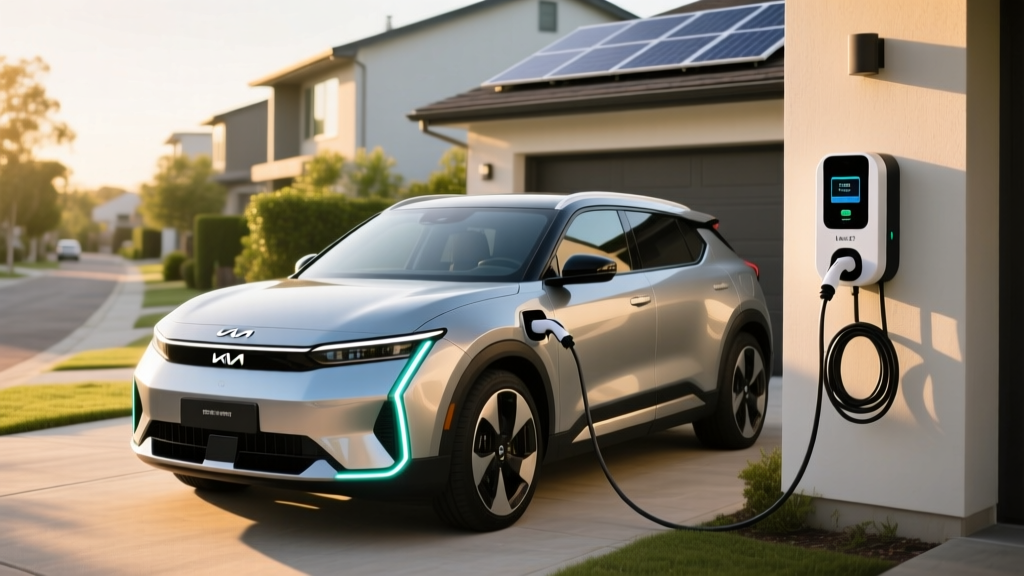
If you're shopping for an electric vehicle or have just taken delivery, the single most important ownership decision you'll make is how you'll charge it. Public charging infrastructure continues to expand, but the vast majority of EV charging — roughly 80% by most estimates — happens at home. Understanding the differences between EV charging Level 1, 2, and 3 (DC fast charging) determines your daily convenience, your road-trip planning, and your monthly energy budget.
This guide breaks down each charging level with exact power figures, real-world range recovery rates, home installation requirements and costs, connector compatibility across every major brand, and a per-mile cost comparison against gasoline. All figures reflect the 2026 charging landscape, including the ongoing industry-wide transition to the NACS connector standard.
The Three EV Charging Levels: Power, Speed, and Use Cases
Before diving into specifics, a critical distinction that trips up many new EV owners: kW (kilowatts) measures power — how fast energy flows into your battery. kWh (kilowatt-hours) measures energy — the total capacity of your battery, analogous to gallons in a gas tank. A charger rated at 11.5 kW delivers energy at that rate; a 75 kWh battery holds 75 kWh of total usable energy. Confusing the two is the most common EV literacy mistake.
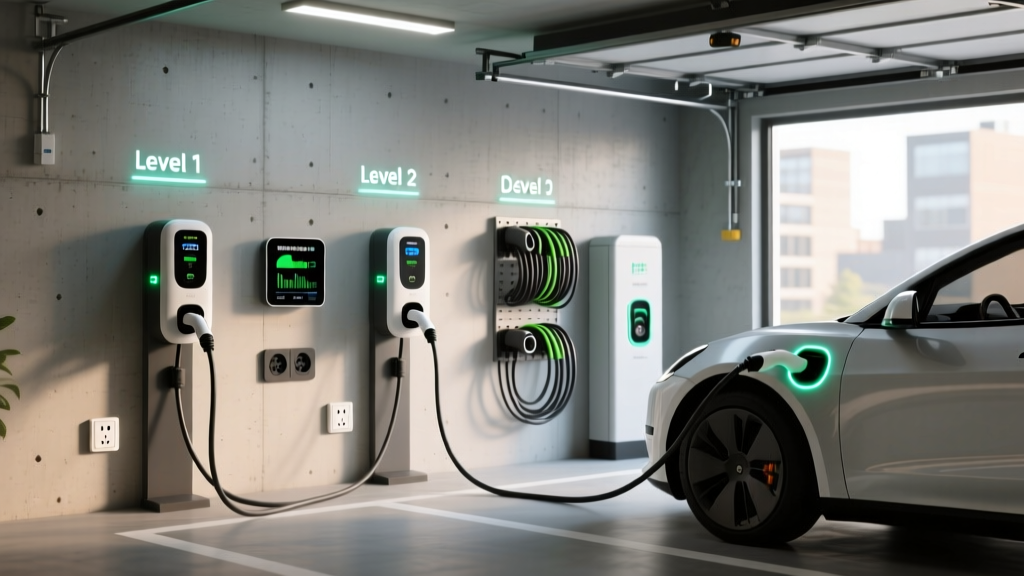
The three charging levels are defined by their voltage, power output, and typical installation context:
| Level | Voltage | Power (kW) | Miles of Range Added Per Hour | Typical Location | 10-80% Charge Time (75 kWh Battery) |
|---|---|---|---|---|---|
| Level 1 | 120V AC | 1.0 – 1.4 kW | 3 – 5 mi/hr | Standard household outlet | ~50+ hours (impractical for full charge) |
| Level 2 | 240V AC | 3.3 – 19.2 kW | 12 – 75 mi/hr | Home, workplace, public | 4 – 10 hours (depending on kW and onboard charger) |
| Level 3 (DC Fast) | 400 – 900V DC | 50 – 350+ kW | 150 – 1,200+ mi/hr (peak) | Public fast-charging stations | 15 – 45 minutes (varies by vehicle and charger) |
Level 1: The Emergency Trickle
Level 1 charging uses a standard 120V household outlet and the portable cord that ships with most EVs. At roughly 1.2 kW continuous, you'll recover about 4 miles of range per hour of charging. For a plug-in hybrid (PHEV) with a 15 kWh battery, an overnight session of 10 hours adds roughly 40 miles — often enough to cover a full electric-only commute. For a battery-electric vehicle (BEV) with a 75 kWh pack, Level 1 is best treated as emergency or supplementary charging. You won't recover a full charge overnight, but if your daily driving is under 30 miles, it can technically keep up.
Level 2: The Daily Workhorse
Level 2 requires a 240V circuit — the same voltage your electric dryer or oven uses. This is the standard for home EV charging and the level most owners rely on daily. Power output ranges from 3.3 kW (16A on a 240V circuit) up to 19.2 kW (80A), though most home installations fall in the 7.7 kW to 11.5 kW range (32A to 48A). At 11.5 kW, a typical mid-size EV recovers roughly 44 miles of range per hour, easily replenishing a day's driving in 2-3 hours.
Your actual Level 2 speed depends on two factors: the charger's output and your vehicle's onboard charger capacity. For example, if your home charger delivers 11.5 kW but your EV's onboard charger maxes at 7.7 kW, you'll charge at 7.7 kW. Check your vehicle's spec sheet before overspending on a high-amperage unit.
Level 3 (DC Fast Charging): Road-Trip Speed
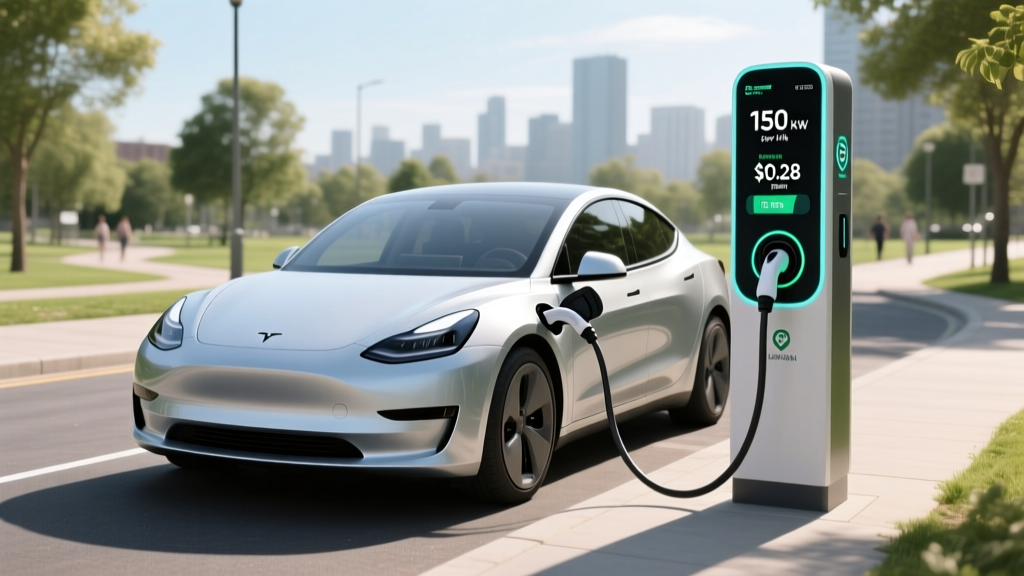
DC fast charging — often called Level 3, though the SAE and industry technically refer to it simply as "DCFC" — bypasses the vehicle's onboard charger and feeds DC current directly into the battery. Power levels range from 50 kW legacy stations up to 350 kW (and emerging 500+ kW) ultra-fast chargers. A modern 800V-architecture EV like the Hyundai Ioniq 5 or Porsche Taycan can accept peak rates above 230 kW, adding 10-80% charge in roughly 18 minutes at a compatible station.
Home Level 2 Installation: Electrical Requirements and Costs
Installing a Level 2 home charger is straightforward in newer homes with modern electrical panels, but costs can escalate in older properties. Here's what's involved:
Electrical Specifications
Most residential Level 2 installations use a 240V dedicated circuit with a NEMA 14-50 outlet or a hardwired connection. The circuit must be rated for 125% of the charger's continuous draw — a 48A charger requires a 60A breaker, and a 40A charger requires a 50A breaker. This is National Electrical Code (NEC) requirement, not optional.
- 40A circuit / 32A charger (7.7 kW): Adequate for most daily driving; requires 6 AWG copper wire
- 50A circuit / 40A charger (9.6 kW): Common NEMA 14-50 setup; requires 6 AWG copper
- 60A circuit / 48A charger (11.5 kW): Fast residential option; requires 4 AWG copper
- 100A circuit / 80A charger (19.2 kW): Maximum residential; requires 2 AWG copper and significant panel capacity
Panel Capacity and Upgrade Considerations
Your home's electrical panel has a finite amperage capacity — typically 100A in older homes and 200A in newer construction. Adding a 50A EV circuit to a 100A panel that's already heavily loaded may exceed capacity. A licensed electrician will perform a load calculation per NEC Article 220 to determine if your panel can handle the additional draw.
If your panel is at capacity, you have options:
- Panel upgrade (200A or 400A service): $2,000 – $5,000+ depending on utility requirements and local labor rates
- Smart load management device: Products like the Emporia Smart Load Management or Span Drive panel allow EV charging to dynamically reduce draw when other circuits are active — avoiding a full panel upgrade for $300-$800
- Lower-amperage charger: Dropping from 48A to 32A reduces circuit demand and may fit within existing capacity
| Component | Low Estimate | High Estimate | Notes |
|---|---|---|---|
| Level 2 charging equipment (32A–48A) | $350 | $750 | Wi-Fi-enabled smart chargers; basic units from $250 |
| Electrical permit | $50 | $250 | Varies by municipality; some jurisdictions waive for EV installs |
| Electrician labor (standard install, panel within 30 ft of garage) | $500 | $1,500 | Includes wiring, breaker, outlet or hardwire, and inspection coordination |
| Panel upgrade (if required) | $2,000 | $5,000+ | 200A–400A service upgrade; may require utility coordination |
| Additional wiring/conduit (long runs, underground trenching) | $200 | $3,000 | Detached garages or chargers far from panel add significant cost |
| Total (no panel upgrade) | $900 | $2,500 | Most common scenario for newer homes |
| Total (with panel upgrade) | $2,900 | $8,000+ | Older homes with 100A service |
The IRS §30D tax credit applies to vehicles, but the separate Alternative Fuel Vehicle Refueling Property Credit (IRC §30C) may cover up to 30% of home charger equipment and installation costs (capped at $1,000 for residential property), subject to income limits and census-tract eligibility. Consult a tax professional or IRS guidance for your specific situation.
Connector Compatibility: NACS, CCS1, and CHAdeMO
The connector landscape has shifted dramatically since 2023, when Ford, GM, Rivian, and nearly every major automaker announced adoption of Tesla's North American Charging Standard (NACS) for their vehicles. By 2026, NACS is the dominant connector for new EVs sold in North America, while CCS1 remains on vehicles produced through 2024-2025 model years, and CHAdeMO is effectively legacy (Nissan Leaf being the primary remaining vehicle).
| Connector | Brands Using It (New Vehicles) | DC Fast Charging Network Access | Adapter Availability |
|---|---|---|---|
| NACS (Tesla standard) | Tesla, Ford, GM, Rivian, Hyundai/Kia (2025+), Volvo/Polestar, BMW, Mercedes-Benz, Lucid, Subaru | Tesla Supercharger network (native), Electrify America, EVgo, and others adding NACS cables | CCS1-to-NACS adapters available ($150–$250); some OEMs include them |
| CCS1 (Combined Charging System) | VW (ID.4 through 2024), older Ford/GM/Hyundai models, Stellantis, some legacy models | Electrify America, EVgo, ChargePoint, Ionity (EU); declining native NACS stations | NACS-to-CCS1 adapters available for Tesla Supercharger access ($200–$300) |
| CHAdeMO | Nissan Leaf (discontinued after 2025 model year), Mitsubishi Outlander PHEV (older) | Limited and declining; many networks have removed CHAdeMO connectors | No practical adapter to NACS/CCS1 for DC fast charging |
Key takeaway for buyers: If you're purchasing a new EV in 2026, NACS is the connector to have. It grants native access to the Tesla Supercharger network — the most reliable and extensive DC fast-charging network in North America with over 30,000 stalls. If you own a CCS1-equipped vehicle, adapters from companies like Lectron or A2Z provide Supercharger access, though you should verify compatibility with your specific model before purchasing.
Charging Cost: Per-Mile Economics vs. Gasoline
One of the strongest arguments for EV ownership is lower per-mile fuel cost, but the savings depend heavily on where and when you charge. Electricity rates vary significantly by region, time of day, and charging level.
| Scenario | Rate | Cost Per Mile (at 3.5 mi/kWh efficiency) | Annual Cost (12,000 mi/yr) |
|---|---|---|---|
| Home charging (off-peak / time-of-use rate) | $0.08 – $0.12/kWh | $0.023 – $0.034 | $275 – $410 |
| Home charging (standard residential rate) | $0.14 – $0.18/kWh | $0.040 – $0.051 | $480 – $615 |
| Public Level 2 (workplace, retail) | $0.20 – $0.35/kWh | $0.057 – $0.100 | $685 – $1,200 |
| DC fast charging (public) | $0.30 – $0.55/kWh | $0.086 – $0.157 | $1,030 – $1,885 |
| Gasoline (28 MPG combined, $3.40/gal) | $3.40/gallon | $0.121 | $1,455 |
| Gasoline (22 MPG combined, $3.40/gal — truck/SUV) | $3.40/gallon | $0.155 | $1,855 |
The data makes clear: home charging is where the savings live. An EV owner charging primarily at home on an off-peak rate spends roughly $300-$400 annually on "fuel" — about one-quarter the cost of gasoline for an equivalent compact car. Even at standard residential rates, EVs undercut gasoline on a per-mile basis in most US markets.
However, exclusive reliance on DC fast charging — as apartment dwellers without home charging access may experience — can push per-mile costs close to or above gasoline. This is the strongest economic argument for prioritizing home or workplace Level 2 charging access before purchasing an EV.
Equipment Recommendations: Best Home Level 2 Chargers (2026)
The home charger market has matured significantly. Here are proven units that balance reliability, smart features, and value, based on long-term owner feedback and professional installer recommendations:
ChargePoint Home Flex (2nd Gen)
- Power: Up to 12 kW (50A) — configurable from 16A to 50A via DIP switches
- Connector: NACS (native); J1772 version available for older EVs
- Cable length: 18 ft or 23 ft options
- Smart features: Wi-Fi, scheduling, energy tracking, Alexa integration, UL-listed
- Price: $549 – $599
- Best for: Most homeowners; flexible amperage fits varied panel capacities
Tesla Wall Connector (Gen 4)
- Power: Up to 11.5 kW (48A)
- Connector: NACS native; includes J1772 adapter in box
- Cable length: 24 ft
- Smart features: Wi-Fi, power sharing (link up to 6 units on one circuit), OTA updates, access control
- Price: $425
- Best for: Tesla owners and multi-EV households (power sharing is unique); best value-to-performance ratio
Emporia Vue Level 2 Charger
- Power: Up to 11.5 kW (48A)
- Connector: NACS (2025+ models); J1772 version available
- Cable length: 24 ft
- Smart features: Wi-Fi, real-time energy monitoring, solar integration, load management with Emporia panel sensors, scheduling
- Price: $399
- Best for: Solar-equipped homes and budget-conscious buyers who want energy monitoring
Grizzl-E Smart (United Chargers)
- Power: Up to 10 kW (40A)
- Connector: NACS or J1772 options
- Cable length: 24 ft
- Smart features: Wi-Fi, OCPP-compatible, adjustable amperage, extreme cold-rated (-40°F)
- Price: $449
- Best for: Cold-climate installations; rugged outdoor builds; commercial/fleet applications
When selecting a charger, prioritize: (1) matching the amperage to your circuit and vehicle's onboard charger, (2) cable length sufficient to reach your charge port without tension, (3) UL listing or equivalent safety certification, and (4) NACS connector if you're buying a new vehicle in 2026. Hardwired installations are preferred over plug-in (NEMA 14-50) for reliability — outlets can loosen over time with high-amperage continuous loads, and some jurisdictions now require hardwiring for circuits above 40A.
Safety, Code, and Installation Best Practices
EV charging involves sustained high-amperage electrical draw — often 8+ hours continuously. This is fundamentally different from intermittent loads like a dryer or stove. Proper installation protects your home and your vehicle:
- Dedicated circuit: Your EV charger must be on its own dedicated breaker — never shared with other appliances. Continuous loads (defined as 3+ hours) require the circuit to be rated at 125% of the charger's draw per NEC 210.20.
- GFCI protection: NEC 2023 and later require GFCI (Ground Fault Circuit Interrupter) protection for all EV charging outlets. Hardwired installations are generally exempt from this requirement. Many quality chargers include built-in ground fault protection.
- Outdoor rating: If installing outdoors, ensure the charger carries a NEMA 4 or IP65 rating for weather resistance. The electrical junction box and conduit must also be rated for wet locations.
- Wire gauge: Undersized wire is a fire hazard. Always follow NEC ampacity tables — 6 AWG copper for 50A circuits, 4 AWG for 60A circuits. Aluminum wire is cheaper but requires one gauge larger for equivalent ampacity.
- Permitting and inspection: Most jurisdictions require an electrical permit for new 240V circuits. The inspection ensures code compliance and protects your homeowner's insurance coverage. Do not skip this step — unpermitted electrical work can void insurance claims in the event of a fire.
- Surge protection: Consider a whole-panel surge protector ($150-$300 installed) or a charger with integrated surge suppression. Lightning and grid switching events can damage EV charger electronics.
Charging Time Examples by Battery Size
To make charging speeds concrete, here are approximate 10-80% charge times for common EV battery sizes across charging levels. These assume optimal conditions — cold batteries, high SoC, or charger sharing will increase times.
| Vehicle Example | Usable Battery (kWh) | Level 1 (1.2 kW) | Level 2 Home (11.5 kW) | DC Fast (150 kW peak) | DC Fast (250 kW peak) |
|---|---|---|---|---|---|
| Chevrolet Equinox EV | 85 kWh | ~49 hrs | ~5.1 hrs | ~38 min | ~28 min |
| Tesla Model Y (Long Range) | 75 kWh | ~44 hrs | ~4.6 hrs | ~34 min | ~25 min |
| Hyundai Ioniq 5 (800V) | 77.4 kWh | ~45 hrs | ~4.7 hrs | ~30 min | ~18 min |
| Ford F-150 Lightning (Extended) | 131 kWh | ~76 hrs | ~8.0 hrs | ~55 min | ~41 min |
| Toyota RAV4 Prime (PHEV) | 18.1 kWh | ~10.5 hrs | ~1.1 hrs | N/A (no DCFC) | N/A |
Notice how PHEVs with smaller batteries are well-served by Level 1 or basic Level 2, while large-battery trucks like the F-150 Lightning Extended Range truly need high-power DC fast charging for road trips and robust Level 2 (48A+) at home to charge overnight.
Frequently Asked Questions
How much does it cost to install a home EV charger?
A typical Level 2 home installation with an existing 200A panel and short wire runs costs between $900 and $2,500, including the charger unit ($350-$750), electrician labor ($500-$1,500), and permit ($50-$250). Homes needing a panel upgrade to 200A or 400A service should budget $2,900-$8,000+ total. Always get at least two quotes from licensed electricians and confirm they include a load calculation.
How fast will each charging level add range?
Level 1 adds approximately 3-5 miles of range per hour. Level 2 at 11.5 kW adds roughly 40-44 miles per hour for a typical efficiency EV (3.5 mi/kWh). DC fast charging adds range non-linearly — at peak, a 250 kW charger can add 10+ miles per minute, but this rate tapers as the battery fills. Use the 10-80% time as your practical benchmark, not peak kW.
Which connector is compatible with my EV?
For 2026 model-year vehicles: Tesla, Ford, GM, Rivian, Hyundai/Kia, Volvo, BMW, and most others now use the NACS connector. Older (2024 and earlier) non-Tesla EVs typically use CCS1. The Nissan Leaf uses CHAdeMO. Check your vehicle's charge port or owner's manual. Adapters are available to cross between NACS and CCS1 for approximately $150-$300, enabling access to the Tesla Supercharger network for CCS1 vehicles.
How much does charging cost per mile compared to gas?
Home charging on a standard residential rate ($0.14-$0.18/kWh) costs roughly $0.04-$0.05 per mile — about one-third the cost of gasoline at $3.40/gallon in a 28 MPG vehicle ($0.12/mile). Off-peak home rates drop this to $0.02-$0.03/mile. However, exclusive DC fast charging at $0.35-$0.55/kWh can push costs to $0.10-$0.16/mile, approaching or exceeding gasoline. Home charging access is the key variable.
What electrical upgrades might I need for a home charger?
The most common upgrade is a panel capacity increase from 100A to 200A service, costing $2,000-$5,000. Other potential needs include: adding a new 240V circuit with appropriate wire gauge and breaker, upgrading the meter base if your utility requires it, or installing a smart load management device ($300-$800) that allows EV charging without a full panel upgrade by dynamically reducing charge rate when household demand is high. A licensed electrician's load calculation will identify your specific requirements.
Is a NEMA 14-50 outlet or hardwired installation better?
Hardwired is generally preferred for EV chargers drawing 40A or more. A NEMA 14-50 outlet provides portability (you can take the charger when you move), but high-amperage continuous loads can cause outlet terminals to heat and degrade over time. Some jurisdictions now require hardwiring for circuits above 40A. If using a 14-50 outlet, ensure it's a high-quality industrial-grade receptacle (Hubbell or Bryant, not a $10 big-box store unit) installed by a qualified electrician who torques terminals to spec.
Understanding EV charging Level 1, 2, and 3 speeds, costs, and infrastructure requirements puts you in a position to make an informed decision — whether you're evaluating your first EV purchase or optimizing your existing charging setup. For most owners, the formula is simple: invest in a quality Level 2 home installation, use DC fast charging for road trips, and enjoy per-mile fuel costs that are a fraction of gasoline.