The Real Cost of Tesla Supercharging in 2026
If you've ever pulled up to a Tesla Supercharger and watched the kWh price flash on the screen, you've probably wondered: how much does this actually cost me per mile — and would I save money charging at home instead? The answer depends on where you live, what time of day you charge, and whether your home electrical panel can handle a Level 2 charger.
This guide breaks down Supercharger pricing across the U.S. in 2026, compares it to gas and home charging on a per-mile basis, and walks you through the real costs of installing a home EV charger — including the panel upgrade scenario that catches many older-home buyers off guard.
Supercharger Pricing: What You'll Actually Pay
Tesla Supercharger pricing varies significantly by location, time of day, and whether your vehicle is a Tesla or a non-Tesla EV using the network via the Tesla app. In 2026, typical Supercharger rates across the U.S. fall into these ranges:
- Off-peak hours (late night/early morning): $0.25–$0.35 per kWh
- Standard/peak hours: $0.35–$0.50 per kWh
- High-demand urban locations (downtown LA, NYC, SF): $0.48–$0.66 per kWh
- Non-Tesla vehicles using Superchargers: typically 15–25% surcharge above Tesla rates
Some states — notably California, New York, and parts of the Northeast — have seen Supercharger prices creep toward $0.58–$0.66/kWh at peak times. Meanwhile, states like Oklahoma, Louisiana, and parts of the Midwest still offer rates as low as $0.24–$0.28/kWh.
Tesla also charges idle fees of $0.50–$1.00 per minute if your vehicle remains plugged in after reaching its charge limit and the station is at or above 50% capacity. This alone can add $5–$15 to your session if you're not paying attention.
Cost Per Mile: Supercharger vs. Gas vs. Home Charging
The most useful comparison for EV buyers isn't cost per kWh — it's cost per mile. Here's how Supercharging stacks up against a comparable gas car and home Level 2 charging, using a Tesla Model Y (EPA-rated 310 miles range, ~3.5 miles/kWh efficiency) and a Toyota RAV4 gas model (~30 MPG combined) as benchmarks:
| Charging Method | Rate | Cost/Mile | Annual Cost (12,000 mi) |
|---|---|---|---|
| Home Level 2 (national avg $0.16/kWh) | $0.16/kWh | $0.046 | $549 |
| Home off-peak (TOU rate $0.09/kWh) | $0.09/kWh | $0.026 | $309 |
| Supercharger (avg $0.38/kWh) | $0.38/kWh | $0.109 | $1,303 |
| Supercharger (expensive metro $0.58/kWh) | $0.58/kWh | $0.166 | $1,989 |
| Gas car (30 MPG, $3.45/gal) | $3.45/gal | $0.115 | $1,380 |
| Gas car (25 MPG, $3.45/gal) | $3.45/gal | $0.138 | $1,656 |
Charging Levels Explained: Speed, Power, and Real-World Range Added
Understanding charging levels is essential for predicting how long you'll wait and what it will cost. Here's the breakdown by level, with real-world range-added rates for a typical EV averaging 3.0–3.5 miles per kWh:
| Level | Power (kW) | Voltage / Amps | Miles of Range/Hour | 10–80% Time (75 kWh battery) |
|---|---|---|---|---|
| Level 1 (standard outlet) | 1.4–1.9 kW | 120V / 12–16A | 3–5 mi/hr | ~36+ hours |
| Level 2 (home/public AC) | 7.2–19.2 kW | 240V / 30–80A | 25–60 mi/hr | 5–8 hours |
| DC Fast Charging (Supercharger, Electrify America, etc.) | 50–350 kW | 400–800V DC | 150–1,000+ mi/hr | 15–45 minutes |
Home EV Charger Installation: Real Costs and Electrical Requirements
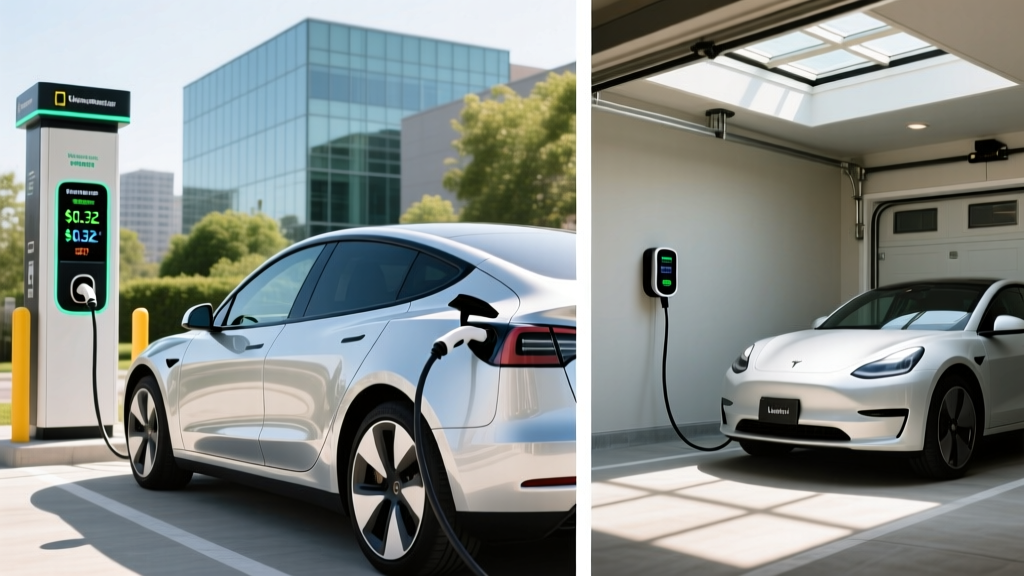
The single biggest factor in EV ownership economics is whether you can charge at home. A Level 2 home charger transforms your daily fuel cost from Supercharger prices (~$0.11/mile) to off-peak home rates (~$0.03/mile). But installation costs vary wildly depending on your home's electrical infrastructure.
Electrical Requirements for Level 2 Charging
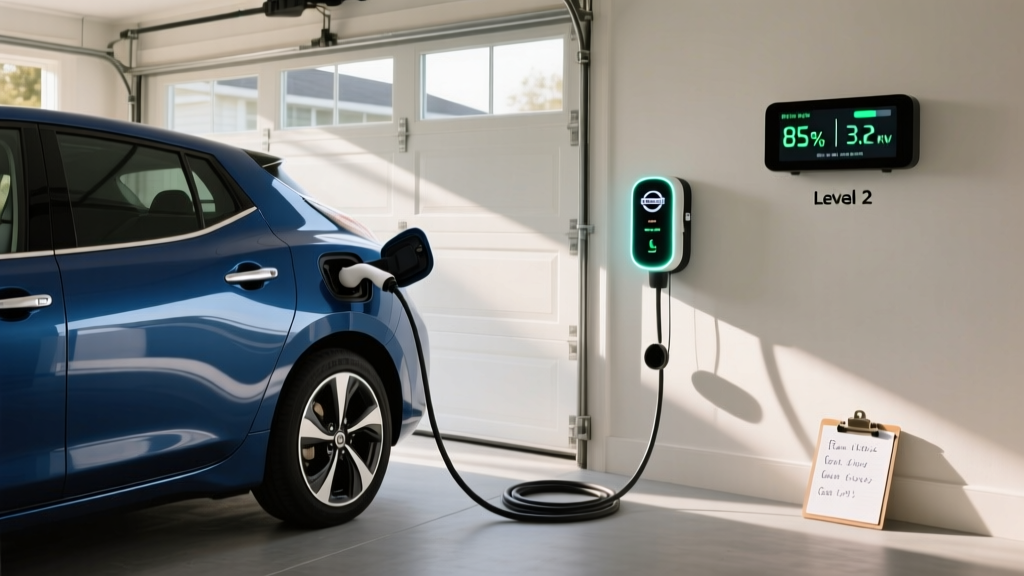
A Level 2 charger requires a 240-volt dedicated circuit — the same voltage as your electric dryer or oven. The most common home setup is a 240V/48A circuit supporting a 40A continuous charger (electrical code requires circuits rated at 125% of continuous load). Here's what you need to know:
- Minimum viable setup: 240V / 20A circuit → 3.8 kW charger (adds ~13 miles/hour)
- Standard recommended setup: 240V / 60A circuit → 48A charger (adds ~35–40 miles/hour)
- High-power setup: 240V / 100A circuit → 80A charger (adds ~55–60 miles/hour, requires hardwired install)
Panel Upgrade: The Hidden Cost
Many homes built before 2000 have 100-amp or 150-amp main electrical panels. Adding a 60A dedicated circuit for EV charging may require a panel upgrade to 200A, which is the most expensive part of the installation. Homes with existing 200A panels and available breaker slots can often add a Level 2 circuit without a panel upgrade.
A qualified electrician will perform a load calculation to determine if your panel can handle the additional draw. Some utilities offer "smart panel" devices or load-management systems that allow EV charging without a full upgrade by dynamically limiting draw when other appliances are running.
| Component | Simple Install (panel-ready) | Complex Install (panel upgrade) |
|---|---|---|
| Level 2 charger unit (40–48A) | $400–$750 | $400–$750 |
| Electrician labor (2–4 hrs simple; 6–12 hrs complex) | $300–$800 | $1,200–$3,000 |
| Electrical panel upgrade (if needed) | $0 | $1,500–$3,500 |
| Permit and inspection fees | $50–$200 | $100–$350 |
| Conduit, wiring (50-ft run), mounting hardware | $100–$300 | $200–$600 |
| TOTAL ESTIMATE | $850–$2,050 | $3,400–$8,200 |
Always get at least three quotes from licensed electricians. Many utilities offer rebates of $250–$1,000 for Level 2 charger installation, and some states offer additional incentives. The IRS Residential Clean Energy Credit may also cover 30% of installation costs (up to $1,000) for equipment placed in service — consult a tax professional for eligibility.
Connector Compatibility: NACS, CCS1, CHAdeMO, and Adapters
The charging connector landscape has consolidated significantly since Tesla opened the Supercharger network and the North American Charging Standard (NACS) was adopted by nearly every major automaker starting in 2024–2025. Here's where things stand in 2026:
| Connector | Native Brands | Network Access | Adapter Needed? |
|---|---|---|---|
| NACS (J3400) | Tesla, Ford, GM, Rivian, Volvo, Polestar, Mercedes, Nissan (2025+), Honda (2025+), BMW (2025+), Hyundai/Kia (2025+) | Tesla Superchargers, Electrify America (select), ChargePoint, EVgo | No (native on new models) |
| CCS1 | Older Ford/GM/Hyundai/Kia/VW models (pre-NACS transition), Lucid, some BMW | Electrify America, EVgo, ChargePoint, Tesla Superchargers (with adapter) | CCS-to-NACS adapter (~$200–$250) for Tesla Superchargers |
| CHAdeMO | Nissan Leaf (legacy), Mitsubishi Outlander PHEV (older) | Declining network support; some Electrify America and EVgo stations | Limited adapter options; network is sunsetting |
For home Level 2 charging, all EVs use the J1772 connector for AC charging — except Tesla, which uses a proprietary AC connector. However, every Tesla ships with a J1772 adapter, and most aftermarket Level 2 chargers now offer NACS connector options or include adapters. If you buy a non-Tesla home charger for a Tesla, you'll use the J1772-to-Tesla adapter that came with the car.
Best Home EV Chargers for 2026: Equipment Recommendations
Here are four well-regarded Level 2 home chargers that cover different budgets and power needs. All are UL-listed for safety and compatible with most EVs via NACS or J1772 connectors:
Tesla Wall Connector
- Power output: 11.5 kW (48A) on 60A circuit
- Connector: NACS (J1772 adapter included)
- Cable length: 24 ft
- Smart features: Wi-Fi, OTA updates, load sharing between multiple units, access control
- Price: ~$475
- Best for: Tesla owners or NACS-native EVs; cleanest integration with Tesla vehicles
ChargePoint Home Flex
- Power output: Up to 12 kW (50A), configurable 16–50A
- Connector: J1772 (NACS adapter available)
- Cable length: 23 ft
- Smart features: Wi-Fi, app scheduling, energy tracking, Alexa integration, flexible amperage to match your circuit
- Price: ~$550–$700
- Best for: Multi-EV households; adjustable amperage avoids panel upgrades
Emporia Vue Level 2 Charger
- Power output: 11.5 kW (48A) on 60A circuit
- Connector: J1772
- Cable length: 24 ft
- Smart features: Wi-Fi, app with detailed energy monitoring, solar integration with Emporia Vue panel monitor, scheduled charging
- Price: ~$400
- Best for: Budget-conscious buyers who want smart features and energy tracking
Grizzl-E Smart
- Power output: 10 kW (40A) on 50A circuit
- Connector: J1772 or NACS (select at purchase)
- Cable length: 24 ft
- Smart features: Wi-Fi, OCPP protocol, adjustable amperage (16–40A), extreme cold rated to -40°F
- Price: ~$450–$550
- Best for: Cold-climate owners; outdoor installations; Canadian-built durability
Safety, Electrical Code, and Permit Requirements
EV charger installation isn't a DIY project — improper wiring can cause fires, void insurance, and fail home inspection. Here's what code requires and what you should insist on from your electrician:
- Dedicated circuit: Your Level 2 charger must be on its own dedicated breaker — not shared with other appliances. A 48A charger requires a 60A breaker (per NEC Article 625, continuous loads must not exceed 80% of breaker rating).
- GFCI protection: The 2020 NEC update requires GFCI (Ground Fault Circuit Interrupter) protection for all EV charging outlets. Hardwired chargers typically have GFCI built in; receptacle-plugged units require a GFCI breaker.
- Outdoor rating: If your charger is installed outside or in an unconditioned garage, ensure the unit carries a NEMA 4 (weather-resistant) rating. All chargers listed above meet this standard.
- Permit and inspection: Most jurisdictions require an electrical permit for new 240V circuits. Your electrician should pull this permit, and the work will be inspected by your local building department. Unpermitted work can cause issues during home resale.
- Wire gauge: A 60A circuit requires 6 AWG copper wire (THHN in conduit) or 4 AWG aluminum. Your electrician will size this correctly based on run length and local code.
- NEMA 14-50 receptacle vs. hardwired: Plug-in installations using a NEMA 14-50 outlet offer flexibility (you can take the charger when you move) but require GFCI breakers. Hardwired installations eliminate the receptacle failure point and often don't require GFCI at the breaker. Many electricians now recommend hardwired for reliability.
Frequently Asked Questions
How much does it cost to use a Supercharger on a road trip?
For a typical road trip session charging from 10% to 80% on a 75 kWh battery (like the Tesla Model Y), you'd use roughly 52 kWh of energy. At the national average Supercharger rate of $0.38/kWh, that session costs about $19.75 and adds roughly 230 miles of range. In expensive metro areas at $0.58/kWh, the same session would cost $30.16.
Is it cheaper to charge at home or use a Supercharger?
Home charging is almost always cheaper. At the national average residential rate of $0.16/kWh, the same 52 kWh session costs $8.32 — less than half the Supercharger price. With a time-of-use plan and off-peak charging, you could pay as little as $4.68 for the same energy.
Can non-Tesla EVs use Superchargers?
Yes. Tesla has opened many Supercharger stations to non-Tesla EVs via the Tesla app. However, you'll need a NACS-compatible vehicle or a CCS-to-NACS adapter, and non-Tesla vehicles typically pay a 15–25% surcharge. Not all Supercharger locations are open to non-Tesla vehicles — check the Tesla app for station availability.
How fast will a Level 2 home charger add range overnight?
A 48A (11.5 kW) Level 2 charger adds approximately 35–40 miles of range per hour for a typical EV. Over an 8-hour overnight charge, that's 280–320 miles — enough to fully replenish most EV batteries from near-empty. This is why home charging eliminates range anxiety for daily driving.
Do I qualify for any tax credits for installing a home charger?
The IRS Residential Clean Energy Credit (IRC §25D) covers 30% of the cost of EV charging equipment and installation, up to $1,000, for property placed in service through 2032. Eligibility depends on your tax liability and whether you live in a qualifying census tract for certain provisions. Consult a tax professional and review current IRS guidelines before claiming.
What if my home only has a 100-amp electrical panel?
A 100A panel can typically support a Level 2 charger at reduced amperage (16–24A, delivering 3.8–5.8 kW) if other loads are modest. However, if you run central AC, an electric oven, and an electric dryer simultaneously, you may need a panel upgrade to 200A. Your electrician's load calculation will determine this. Budget $1,500–$3,500 for a panel upgrade if required.
Are Superchargers bad for my EV battery?
Occasional DC fast charging has minimal impact on battery health. However, exclusive reliance on high-power DC fast charging (150+ kW) can accelerate degradation by 1–3% over several years compared to primarily Level 2 charging, based on data from fueleconomy.gov and long-term fleet studies. Tesla's battery management system actively manages heat during Supercharging to mitigate this. For optimal longevity, favor Level 2 home charging for daily use and reserve Superchargers for road trips.