The Supercharger Network Is Open — But Can Your EV Plug In?
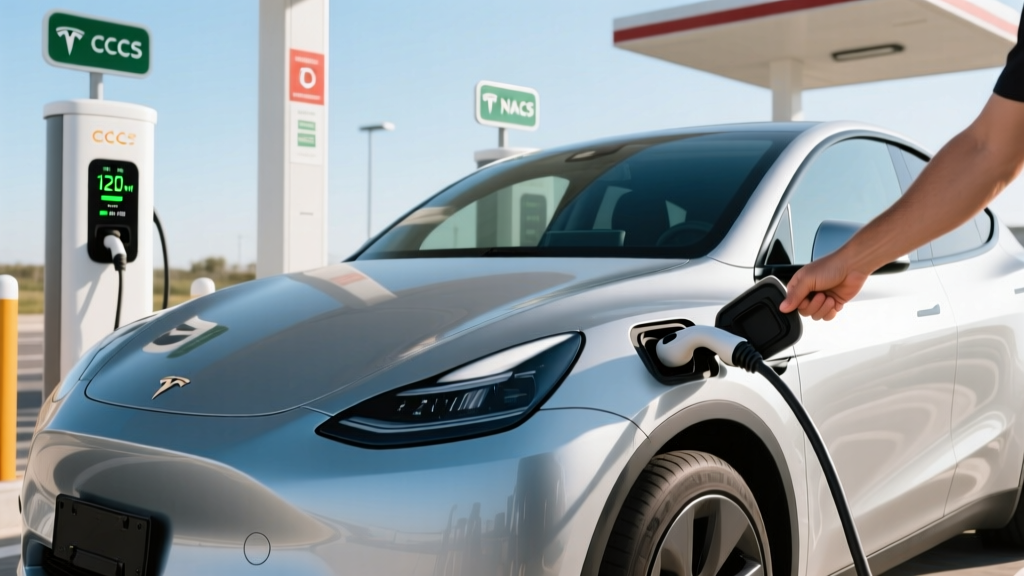
If you've searched for a "supercharger car" lately, you're not alone. The Tesla Supercharger network — over 6,000 stations and 60,000+ stalls across North America as of early 2026 — has long been the gold standard for DC fast charging reliability. The big shift: Tesla opened its network to non-Tesla vehicles through the North American Charging Standard (NACS), and nearly every major automaker has adopted NACS for new models starting in 2025–2026.
But compatibility isn't universal. Your ability to pull up to a Supercharger and charge depends on your vehicle's model year, its native connector type, and whether you need an adapter. This guide covers exactly which EVs can use Superchargers, what you'll need at home, and what charging actually costs per mile.
Charging Levels Explained: kW, Speed, and Real-World Times
Before we get to Supercharger compatibility, let's lock down the three charging levels every EV owner needs to understand. The critical distinction: kW (kilowatts) measures power — the rate of energy flow, like water pressure from a hose. kWh (kilowatt-hours) measures energy — the total amount stored in your battery, like gallons in a tank. A 75 kWh battery charged at 11 kW takes roughly 7 hours; at 150 kW, the math changes dramatically.
| Level | Voltage | Power (kW) | Miles of Range Added per Hour | Typical Use Case |
|---|---|---|---|---|
| Level 1 | 120V AC | 1.0–1.4 kW | 3–5 mi/hr | Overnight top-off, PHEVs, emergency |
| Level 2 | 240V AC | 7.2–19.2 kW | 25–75 mi/hr | Home daily charging, workplace |
| DC Fast (incl. Supercharger) | 400–800V DC | 50–350 kW | 150–1,000+ mi/hr (peak) | Road trips, rapid replenishment |
Real-world charging time examples (10–80% SoC):
- Tesla Model Y (75 kWh usable, NMC): ~25 min at a V3 Supercharger (peak 250 kW), tapering significantly above 80%
- Ford F-150 Lightning Extended Range (131 kWh usable): ~41 min at 150 kW DC fast charger; ~30 min at 350 kW stations that support its charge curve
- Hyundai Ioniq 5 (77.4 kWh, 800V architecture): ~18 min at a 350 kW Electrify America station (peak 240 kW sustained)
- Chevrolet Bolt EV (65 kWh): ~55 min at 50 kW DC; this older CCS platform was limited to ~55 kW peak
The key insight: peak kW is not sustained kW. Every EV's charge curve tapers as the battery fills. You'll see the fastest rates between 10–50% SoC; above 80%, speeds drop sharply to protect battery health. Plan road-trip stops around 10–80% sessions, not 0–100%.
Supercharger Compatibility: NACS, CCS, and Adapters
Not every electric car can use a Supercharger natively. Here's the compatibility landscape as of 2026:
| Connector | Native Supercharger Access? | Key Vehicles (2025–2026) | Adapter Needed? |
|---|---|---|---|
| NACS (Tesla / North American Charging Standard) | Yes — direct plug | All Tesla models, Ford F-150 Lightning (2025+), Ford Mustang Mach-E (2025+), Rivian R1T/R1S (2025+), GM Ultium vehicles (2025+), Hyundai/Kia (2026 models) | None for Superchargers; CCS adapter needed for non-Tesla DC networks |
| CCS1 (Combined Charging System) | Yes — via Magic Dock adapter at select Superchargers, or use OEM adapter | VW ID.4, BMW iX, older Ford/Hyundai/Kia models (pre-NACS switch) | Tesla Magic Dock (built into some stalls) or OEM-provided NACS-to-CCS adapter |
| CHAdeMO | No — not compatible | Nissan Leaf (all years), Mitsubishi Outlander PHEV (older) | No reliable adapter exists; use Electrify America or other CCS networks |
Important nuance: Tesla's "Magic Dock" — a built-in CCS adapter at select Supercharger stalls — allows CCS-equipped vehicles to charge without carrying their own adapter. However, Magic Dock availability is limited to certain stations, primarily in urban areas. Most CCS-vehicle owners will want to carry a manufacturer-supplied NACS-to-CCS adapter (Ford, GM, Rivian, and others include or sell these) for reliable Supercharger access.
According to Tesla's Supercharger page, non-Tesla EVs with approved adapters can access the network through the Tesla app, which handles authentication and payment.
Home Charger Installation: Electrical Requirements and Real Costs
Charging at home is where 80%+ of EV charging happens for most owners. A Level 2 home charger is the practical baseline — it adds enough range overnight to cover any daily commute. But installation costs vary enormously based on your home's electrical panel.
Electrical Requirements
A typical Level 2 home charger requires:
- 240V dedicated circuit (same voltage as your electric dryer or oven)
- 40A to 60A breaker, depending on charger amperage (a 48A charger needs a 60A breaker per the National Electrical Code's 80% continuous-load rule)
- Panel capacity: Most modern homes with 200A service can accommodate a 60A EV circuit. Older homes with 100A panels may need a panel upgrade — a significant added cost.
| Component | Low-End Estimate | High-End Estimate | Notes |
|---|---|---|---|
| Level 2 Charger (hardware) | $350 | $750 | 40A–48A Wi-Fi-enabled units; premium models with load management cost more |
| Electrician labor | $500 | $1,500 | Depends on run length from panel to garage/driveway; longer runs = more conduit and wire |
| Permit and inspection | $50 | $300 | Required in most jurisdictions; varies by municipality |
| Electrical panel upgrade (if needed) | $1,500 | $4,000 | Upgrading from 100A to 200A service; not required for most modern homes |
| Total (no panel upgrade) | $900 | $2,550 | Typical range for homes with adequate panel capacity |
| Total (with panel upgrade) | $2,400 | $6,550 | Older homes or homes with high existing electrical load |
Panel upgrade gotcha: Before budgeting for a charger, have an electrician perform a load calculation on your panel. If you already run electric heat, an electric water heater, and an electric dryer on a 100A panel, there may not be headroom for a 60A EV circuit. Some utilities offer "make-ready" programs that subsidize panel upgrades — check with your local provider.
Safety and Code Considerations
- Dedicated circuit required: Your EV charger must have its own breaker — never share a circuit with other appliances.
- GFCI protection: NEC 2020 and later requires GFCI protection for outdoor receptacles; many hardwired chargers include built-in ground-fault protection.
- Outdoor rating: If mounting outside, ensure the charger carries a NEMA 4 or IP65 weather rating. Most major chargers (ChargePoint, Emporia, Wallbox) are outdoor-rated.
- Hardwired vs. plug: Hardwired installations (no plug) are common for 48A+ chargers and eliminate the need for a 240V receptacle. A NEMA 14-50 outlet offers portability but is limited to 40A continuous (50A breaker).
Level 2 Charger Recommendations: What to Buy in 2026
The home charger market has matured considerably. Here are three proven options across different budgets, all with NACS connectors available (or configurable) for 2025–2026 EVs:
Emporia Vue Level 2 Charger
- Power output: 48A / 11.5 kW (hardwired) or 40A / 9.6 kW (NEMA 14-50)
- Connector: NACS or J1772 (configurable at purchase)
- Cable length: 24 ft
- Smart features: Wi-Fi, energy monitoring, solar integration, scheduling via app
- Price: ~$399
- Best for: Budget-conscious buyers who want smart features and energy tracking
ChargePoint Home Flex
- Power output: Up to 50A / 12 kW (adjustable via DIP switches for panel-limited homes)
- Connector: NACS or J1772 (swap the pigtail)
- Cable length: 23 ft
- Smart features: Wi-Fi, Alexa/Google integration, flexible amperage, detailed app
- Price: ~$599
- Best for: Homes with varying panel capacity; the adjustable amperage is a standout feature
Tesla Wall Connector
- Power output: 48A / 11.5 kW
- Connector: NACS native; also includes J1772 adapter in box
- Cable length: 24 ft
- Smart features: Wi-Fi, OTA updates, power-sharing between two units on one circuit, Tesla app integration
- Price: ~$475
- Best for: Tesla owners or households with mixed NACS/J1772 vehicles; excellent value
For homes with limited panel capacity, look for chargers with load management features (Emporia and some Enel X JuiceBox models offer this). These units dynamically reduce charge rate when other household loads spike, potentially avoiding a costly panel upgrade.
Charging Cost Per Mile: Home vs. Public vs. Gas
The economic case for EV charging depends heavily on where you charge. Let's run the numbers using a representative midsize EV consuming 30 kWh per 100 miles (roughly equivalent to a Tesla Model Y or Hyundai Ioniq 5 in mixed driving).
| Scenario | Rate | Cost per 100 Miles | Cost per Mile |
|---|---|---|---|
| Home (off-peak utility rate) | $0.09/kWh | $2.70 | $0.027 |
| Home (average US residential) | $0.17/kWh | $5.10 | $0.051 |
| Public Level 2 (workplace/commercial) | $0.25–$0.35/kWh | $7.50–$10.50 | $0.075–$0.105 |
| DC Fast (Electrify America, non-sub) | $0.43–$0.56/kWh | $12.90–$16.80 | $0.129–$0.168 |
| Tesla Supercharger (non-Tesla, pay-as-you-go) | $0.35–$0.50/kWh | $10.50–$15.00 | $0.105–$0.150 |
| Gas baseline (28 MPG combined, $3.40/gal) | $3.40/gallon | $12.14 | $0.121 |
The takeaway: Home charging at off-peak rates delivers fuel costs at roughly one-quarter to one-fifth the cost of gasoline. Even at average residential rates, EV charging per mile beats gas. However, frequent exclusive reliance on DC fast charging (Superchargers or Electrify America) can push EV fuel costs to parity with — or even above — an efficient gas car. The economics strongly favor home charging as your primary routine.
For a deeper breakdown of efficiency ratings across current models, the EPA's EV fuel economy resource provides MPGe and kWh/100mi data for every certified vehicle.
Federal Tax Credit for Home Charging Equipment
The IRS §30C Alternative Fuel Vehicle Refueling Property Credit can offset up to 30% of home charger hardware and installation costs, capped at $1,000. However, eligibility is location-dependent: the credit applies only to equipment installed in a census tract classified as "low-income" or "non-urban" under current IRS guidelines.
Key §30C requirements:
- Charger must be new and installed at your primary residence
- Maximum credit: 30% of total cost (equipment + labor), up to $1,000
- Location eligibility depends on census tract designation — check the IRS §30C page for qualifying areas
- Claimed on your federal tax return (Form 8911); not available as a point-of-sale rebate
This credit is separate from the §30D new EV purchase credit. If you qualify for both, they stack — but always consult a tax professional for your specific situation.
Frequently Asked Questions
How much does it cost to install a home EV charger?
Expect $900–$2,550 for a typical Level 2 installation in a home with adequate 200A panel capacity, including the charger hardware ($350–$750), electrician labor ($500–$1,500), and permits ($50–$300). If your home needs a panel upgrade from 100A to 200A service, add $1,500–$4,000. Get at least two quotes from licensed electricians — pricing varies significantly by region and run complexity.
How fast will each charging level add range?
Level 1 (120V standard outlet) adds 3–5 miles per hour — fine for PHEVs with small batteries or overnight top-offs. Level 2 (240V, 48A) adds 30–40 miles per hour, replenishing most EV batteries fully in 8–10 hours. DC fast charging at 150+ kW can add 150–300 miles in 20–30 minutes, depending on your battery size and the vehicle's charge curve.
Which connector is compatible with my EV?
For 2025–2026 model-year vehicles, check your manufacturer's specs. Most new EVs from Ford, GM, Rivian, Hyundai, and Kia now ship with NACS ports and can plug directly into Tesla Superchargers. Older CCS-equipped EVs (pre-2025) can access Superchargers using an OEM-supplied NACS-to-CCS adapter or Tesla's Magic Dock at select stations. CHAdeMO vehicles (Nissan Leaf) cannot use Superchargers — use Electrify America or other CCS networks instead.
How much does charging cost per mile compared to gas?
Home charging at off-peak rates ($0.09/kWh) costs about $0.027/mile — roughly one-quarter the cost of gas at $3.40/gallon in a 28 MPG vehicle ($0.121/mile). Even at average residential rates ($0.17/kWh), home EV charging is about $0.05/mile. Public DC fast charging at $0.40–$0.55/kWh pushes costs to $0.12–$0.17/mile, comparable to gas. The savings are maximized by charging at home.
What electrical upgrades might I need?
The most common upgrade is a panel capacity increase from 100A to 200A service, needed when your existing electrical load (heat, water heater, dryer, AC) leaves insufficient headroom for a 40–60A EV circuit. An electrician will perform a NEC Article 220 load calculation to determine if an upgrade is necessary. Some homes may also need a conduit run from the panel to the garage or driveway if the panel is far from the charging location, adding to labor costs.
Is preconditioning my battery important for Supercharger stops?
Yes. Most EVs with active thermal management (Tesla, Hyundai/Kia E-GMP, GM Ultium) will precondition the battery when you navigate to a DC fast charger. This warms or cools the cells to the optimal temperature for accepting high charge rates. Without preconditioning — especially in cold weather — your peak charge rate may be cut in half, adding 10–15 minutes to a typical 10–80% session. Always use the vehicle's built-in navigation to route to a charger when possible.