If you've been searching for a supercharged Toyota Sienna, you've likely encountered a mix of forum rumors, aftermarket speculation, and genuine confusion about what Toyota's hybrid minivan can actually do. Here's the reality: Toyota has never produced a factory supercharged Sienna, and the current-generation Sienna (2021–present) is exclusively a 2.5-liter hybrid powertrain. There is no supercharger, no turbo, and no plug-in variant sold in the United States as of 2026.
But that search query reveals something useful: minivan buyers want more power, better efficiency, and the ability to charge at home like an EV owner. This guide uses that curiosity as a springboard into what actually matters — understanding how home and public EV charging works, what it costs, and what equipment you need. Whether you're cross-shopping a Sienna Hybrid against a true plug-in minivan like the Chrysler Pacifica PHEV, or you already own an EV and need a definitive charging setup guide, the data below is built for real-world decisions.
What "Supercharged Toyota Sienna" Actually Means in 2026
The current Toyota Sienna uses a 2.5-liter four-cylinder engine paired with two electric motors (three on AWD trims) for a combined 245 horsepower. It's a self-charging hybrid (HEV), not a plug-in. That means no charging port, no electric-only range, and no eligibility for the federal §30D EV tax credit. The EPA rates it at 36 MPG combined, which is genuinely impressive for a 4,600-pound minivan, but it doesn't plug in.
The "supercharged" rumor likely stems from three things: (1) aftermarket supercharger kits that existed for the older 3.5L V6 Sienna (2011–2020), (2) confusion with Toyota's plug-in RAV4 Prime, and (3) wishful thinking from minivan enthusiasts who want EV-like performance. None of these translate to a production supercharged or plug-in Sienna.
If you want a plug-in minivan with a charge port and electric-only driving, your only mainstream option in the US remains the Chrysler Pacifica PHEV (32 miles EPA electric range, 84 MPGe). If you want a three-row EV, you're looking at the Kia EV9, Tesla Model X, or Rivian R1S. The Sienna Hybrid sits in between — excellent fuel economy, no plug, no forced induction.
Charging Levels Explained: Level 1, Level 2, and DC Fast
For any plug-in vehicle — whether it's a Pacifica PHEV, a RAV4 Prime, or a full battery-electric SUV — understanding charging levels is the foundation. The single most important distinction: kW (kilowatts) measures power — how fast energy flows. kWh (kilowatt-hours) measures energy — the total capacity of the battery. Think of kW as the width of a hose and kWh as the size of the bucket.
| Level | Voltage | Power (kW) | Miles of Range Added per Hour | Typical Use Case |
|---|---|---|---|---|
| Level 1 | 120V AC | 1.0–1.9 kW | 3–5 miles | Overnight trickle; PHEVs with small batteries |
| Level 2 | 240V AC | 3.3–19.2 kW | 12–75 miles | Home daily charging; workplace; public AC stations |
| DC Fast | 200–800V DC | 50–350 kW | 150–1,000+ miles (theoretical) | Road trips; 10–80% in 18–45 minutes depending on vehicle |
A few real-world nuances: DC fast charging speeds are peak rates, not sustained. A vehicle that peaks at 250 kW may only hold that rate for 5–8 minutes before the charge curve tapers to protect the battery. Above 80% State of Charge (SoC), speeds drop dramatically — which is why 10–80% time is the standard metric, not 0–100%. And Level 2 home charging at 11.5 kW (48A on a 60A circuit) will fully replenish most EV batteries overnight, making it the practical sweet spot for daily ownership.
Home Charger Installation: Electrical Requirements and Costs
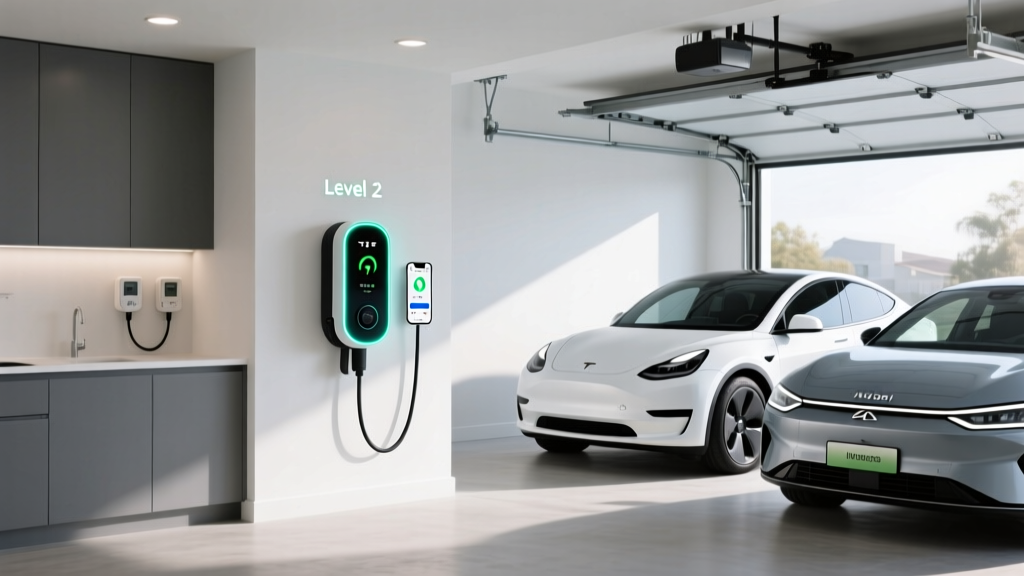
Installing a Level 2 home charger is the single highest-impact upgrade an EV owner can make. Here's what it requires electrically and financially.
Electrical requirements: A typical Level 2 charger delivering 11.5 kW requires a 240V circuit rated for 60 amps (the charger draws a continuous 48A, and the National Electrical Code requires circuits to be rated at 125% of continuous load). Smaller 40A chargers (9.6 kW, 32A continuous draw) can run on a 50A circuit. If you're charging a PHEV with a small battery (like the Pacifica's 16 kWh pack), even a 30A/24A circuit at 7.2 kW is more than adequate.
Panel capacity: Most modern homes with 200A electrical service can accommodate a 60A EV circuit without a panel upgrade. Older homes with 100A or 150A service may need a panel upgrade — typically $1,500–$3,500 — or a smart load-management device like the Emporia V2X or Span panel that dynamically limits EV charging when other loads are high.
Permits: Nearly all jurisdictions require an electrical permit for a new 240V circuit. Costs range from $50–$300 depending on your municipality, and an inspection is typically required after installation.
| Item | Typical Range | Notes |
|---|---|---|
| Level 2 Charger (Equipment) | $300–$750 | Hardwired or NEMA 14-50 plug; 40A–48A units |
| Electrician Labor (240V circuit run) | $600–$2,500 | Depends on distance from panel, wall type, conduit needs |
| Electrical Permit | $50–$300 | Varies by city/county |
| Panel Upgrade (if needed) | $1,500–$3,500 | Only for homes with insufficient service (100A/150A) |
| Total (No Panel Upgrade) | $950–$3,550 | Most homes fall in $1,200–$2,000 range |
| Total (With Panel Upgrade) | $2,450–$7,050 | Older homes; consider utility rebates |
Many utilities offer rebates of $250–$1,000 for Level 2 charger installation, and some states stack additional incentives on top. Always check your local utility's EV program before scheduling work. A licensed electrician should perform a load calculation per NEC Article 220 before recommending a circuit size.
Connector Compatibility: NACS, CCS1, and CHAdeMO in 2026
The connector landscape has shifted dramatically. As of 2026, the North American Charging Standard (NACS), developed by Tesla, is the dominant connector for new EVs. Nearly every major automaker — Ford, GM, Rivian, Hyundai, Kia, BMW, Mercedes — has adopted NACS for their 2025+ models. CCS1 (Combined Charging System) remains on many 2023–2024 vehicles still on the road. CHAdeMO is effectively legacy, found only on older Nissan Leafs and Mitsubishi Outlander PHEVs.
| Connector | Brands Using It (2026) | Adapter Needed? |
|---|---|---|
| NACS (Tesla) | Tesla, Ford, GM, Rivian, Hyundai, Kia, BMW, Mercedes, Volvo, Polestar | CCS-to-NACS adapters available ($150–$250) for older CCS vehicles to use Superchargers |
| CCS1 | VW (some 2024 carryover), Stellantis/Chrysler (Pacifica PHEV uses J1772 AC only), legacy models | NACS-to-CCS adapters available for non-Tesla DC networks |
| CHAdeMO | None for new 2026 models; legacy Nissan Leaf, Mitsubishi | No reliable CHAdeMO-to-NACS adapter; CHAdeMO stations declining |
| J1772 (AC only) | All EVs/PHEVs use this for Level 1/2 AC charging (or NACS for AC on newer vehicles) | J1772-to-NACS adapter included with most NACS vehicles |
For home Level 2 charging, most chargers ship with a J1772 connector or a NACS connector. If your vehicle uses the other standard, a simple adapter ($30–$80) resolves the mismatch. For DC fast charging on road trips, the network you'll use depends on your vehicle's native connector — Tesla Superchargers (NACS) are the most reliable network in North America, while Electrify America and EVgo primarily offer CCS1 (with NACS cables increasingly added).
Cost to Charge: Home vs. Public vs. Gas Comparison
The economic case for plug-in vehicles hinges on per-mile energy cost. Here's how it breaks down across scenarios, using a mid-size EV averaging 3.0 miles per kWh (roughly 33 kWh/100mi, typical for a crossover like the Hyundai Ioniq 5 or Tesla Model Y) and a gas minivan like the Toyota Sienna Hybrid at 36 MPG combined.
| Scenario | Price | Cost per Mile (EV at 3 mi/kWh) | Cost per Mile (Sienna HEV at 36 MPG, $3.40/gal) |
|---|---|---|---|
| Home Level 2 (off-peak utility rate) | $0.09–$0.14/kWh | $0.03–$0.05 | $0.09 |
| Home Level 2 (standard rate) | $0.15–$0.22/kWh | $0.05–$0.07 | $0.09 |
| Public Level 2 (ChargePoint, etc.) | $0.25–$0.49/kWh | $0.08–$0.16 | $0.09 |
| DC Fast Charging (Electrify America, EVgo) | $0.35–$0.55/kWh | $0.12–$0.18 | $0.09 |
| Tesla Supercharger (varies by location/time) | $0.25–$0.45/kWh | $0.08–$0.15 | $0.09 |
The takeaway: home charging at off-peak rates is dramatically cheaper than gas — typically 2–3 cents per mile versus 9 cents for the Sienna Hybrid. But frequent DC fast charging at public rates can equal or exceed gas costs. This is why home charging access is the single most important factor in EV ownership satisfaction. If you can install a Level 2 charger at home, a plug-in vehicle will save you $800–$1,500 annually in fuel costs over a comparable hybrid (assuming 15,000 miles/year).
For PHEV owners (like Pacifica PHEV drivers), the math is even more favorable for daily commuting: if your round-trip commute is under 32 miles, you may burn almost zero gasoline on weekdays, only engaging the hybrid system for longer weekend trips.
Charging Time Examples: What to Expect by Battery Size
Charging time depends on the battery's usable capacity (in kWh) and the charger's sustained power output (in kW). Here are real-world benchmarks for common vehicle categories:
- PHEV (16–20 kWh battery, e.g., Chrysler Pacifica PHEV): Level 1 (1.4 kW): ~12–14 hours for a full charge. Level 2 (7.2 kW): ~2.5–3 hours. DC fast: not supported on most PHEVs.
- Compact EV (60–65 kWh battery, e.g., Hyundai Kona Electric): Level 2 (11.5 kW): ~5.5–6 hours 0–100%. DC fast (peak 100 kW): 10–80% in ~43 minutes.
- Mid-size EV (75–85 kWh battery, e.g., Tesla Model Y, Ioniq 5): Level 2 (11.5 kW): ~7–7.5 hours 0–100%. DC fast (peak 250 kW on Ioniq 5): 10–80% in ~18 minutes.
- Large EV / Three-row (100–110 kWh battery, e.g., Kia EV9, Rivian R1S): Level 2 (11.5 kW): ~9–10 hours 0–100%. DC fast (peak 200–250 kW): 10–80% in ~25–35 minutes depending on charge curve.
Remember: charge curves matter. A vehicle rated for "250 kW peak" may only sustain that rate between 10–30% SoC before tapering. The 10–80% time is the metric that actually reflects your road-trip experience, since you'll rarely charge above 80% on DC fast charging (it's too slow to justify).
Recommended Home Chargers: 2026 Equipment Picks
Not all Level 2 chargers are equal. Here are four well-regarded options spanning different budgets and feature sets, all UL-listed (or equivalent) for safety:
Tesla Wall Connector (Gen 4)
- Power output: 11.5 kW (48A continuous) on a 60A circuit
- Connector: NACS native; J1772 adapter included
- Cable length: 24 feet
- Smart features: Wi-Fi, OTA updates, load sharing between multiple units, Powerwall integration
- Price: ~$475
- Best for: NACS-vehicle owners who want a clean, reliable, no-subscription unit
Emporia Level 2 EV Charger
- Power output: 11.5 kW (48A) or configurable down to 32A
- Connector: J1772 (NACS version available)
- Cable length: 24 feet
- Smart features: Real-time energy monitoring, solar integration, time-of-use scheduling, load management
- Price: ~$399
- Best for: Budget-conscious buyers who want granular energy data and solar pairing
ChargePoint Home Flex
- Power output: Up to 12 kW (50A) on a 60A circuit; configurable via dip switches
- Connector: J1772 (NACS adapter available)
- Cable length: 23 feet
- Smart features: App scheduling, Alexa integration, amperage flexibility for older panels
- Price: ~$699
- Best for: Homes needing flexible amperage settings to avoid panel upgrades
Grizzl-E Smart
- Power output: 10 kW (40A) on a 50A circuit
- Connector: J1772 or NACS (select at purchase)
- Cable length: 24 feet
- Smart features: OCPP-compatible, adjustable amperage, extreme cold-rated (-40°F)
- Price: ~$549
- Best for: Cold-climate owners and outdoor installations; built in Canada
Safety, Code, and Installation Best Practices
EV charging involves sustained high-current draw — more like running an electric furnace than plugging in a phone. Safety and code compliance are non-negotiable.
- Dedicated circuit: Your Level 2 charger must be on its own dedicated circuit. Sharing a circuit with other appliances risks tripping breakers or overheating wiring.
- GFCI protection: The 2023 NEC (adopted in most jurisdictions by 2026) requires GFCI protection for EV charging outlets. Hardwired chargers may be exempt depending on local interpretation — ask your electrician.
- Outdoor rating: If your charger is installed outdoors (garage-exterior wall, carport, driveway post), it must carry a NEMA 4 or IP65 weather rating. All four chargers recommended above are outdoor-rated.
- NEMA 14-50 vs. hardwired: A NEMA 14-50 outlet offers portability (take the charger when you move) but requires GFCI breaker protection and proper strain relief. Hardwired installations eliminate the outlet as a failure point and may not require GFCI in some jurisdictions. For permanent installations, hardwired is generally preferred by electricians.
- Cable management: Never use an extension cord with an EV charger. If the cable doesn't reach your charge port, relocate the charger or install a longer-cable unit.
Frequently Asked Questions
How much does it cost to install a home EV charger?
Most homeowners spend between $1,200 and $2,000 for a professional Level 2 installation (charger + electrician + permit) when no panel upgrade is needed. If your home has a 100A or 150A panel that needs upgrading to 200A, add $1,500–$3,500. Utility rebates can offset $250–$1,000 of this cost in many areas.
How fast will each charging level add range?
Level 1 (120V) adds roughly 3–5 miles of range per hour. Level 2 (240V) adds 12–75 miles per hour depending on the charger's kW output and the vehicle's onboard charger limit. DC fast charging can add 150+ miles in 15–20 minutes at peak power, though sustained rates taper significantly above 80% SoC.
Which connector/charger is compatible with my EV?
For 2026 model-year vehicles, most new EVs use NACS. Vehicles from 2023–2024 likely use CCS1. Older Nissan Leafs use CHAdeMO. For home Level 2 AC charging, J1772 is the legacy standard and NACS is the new standard — adapters between the two cost $30–$80 and work seamlessly. Check your vehicle's charge port or owner's manual to confirm.
How much does charging cost per mile vs gas?
Home charging at off-peak rates typically costs 3–5 cents per mile for an efficient EV. Gasoline at $3.40/gallon in a 36 MPG Sienna Hybrid costs about 9 cents per mile. Public DC fast charging at $0.40–$0.55/kWh can cost 12–18 cents per mile — sometimes exceeding gas. The economic advantage of an EV depends heavily on home charging access.
What electrical upgrades might I need?
If your home has 200A electrical service and available breaker slots, you likely need nothing beyond the new 240V circuit. If your service is 100A or 150A, or your panel is full, you may need a panel upgrade ($1,500–$3,500) or a smart load-management device that dynamically limits charging current. A licensed electrician's load calculation per NEC Article 220 will determine this definitively.
For more on federal incentives that can reduce EV and charger costs, see the IRS clean vehicle credit guidelines and check whether your utility offers a Level 2 installation rebate. The Sienna Hybrid remains an excellent vehicle — just don't expect to plug it in or find a supercharger under the hood.