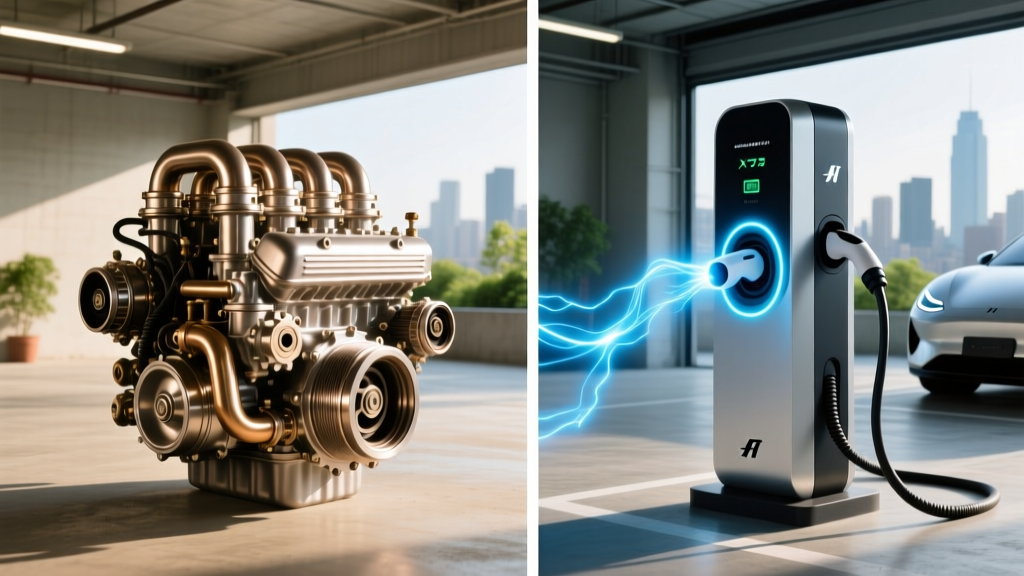
Search for "supercharged straight 6" and you'll find enthusiasts debating the merits of forced-induction inline-six engines — the Jaguar AJ126, the Toyota 2JZ-GTE with aftermarket blowers, or classic Roots-type setups on BMW M30 blocks. These engines produce thrilling bursts of mechanical power measured in horsepower. But if you're transitioning from a performance gas car to an electric vehicle, you'll quickly discover that EV power delivery speaks a different language: kilowatts (kW) for charge rate and kilowatt-hours (kWh) for battery energy.
This guide bridges that gap. We'll compare the raw power concepts behind a supercharged straight 6 to how EV charging actually works, then give you the exact numbers you need to set up home charging, find public stations, and calculate your real cost per mile in 2026.
Power Delivery: Supercharged Straight 6 vs. EV Charging Explained
A supercharged straight 6 engine might produce 350–450 horsepower at the crank. Converting that to kilowatts (1 hp ≈ 0.746 kW), you're looking at roughly 260–335 kW of mechanical output — but only at wide-open throttle, at a specific RPM, for as long as your fuel supply lasts.
EV charging works differently. A DC fast charger might deliver 150–350 kW of electrical power directly into a battery, but that rate isn't constant. The charge curve tapers as the battery fills — peak kW is only sustained between roughly 10% and 40% state of charge (SoC), then drops progressively. Think of it like a supercharger's boost curve: maximum pressure at low RPM, tapering as the engine approaches its rev limit.
kW (kilowatt) = power, or how fast energy flows. A 150 kW charger delivers energy at that rate.
kWh (kilowatt-hour) = energy, or how much the battery stores. An 82 kWh battery holds that much total energy.
Analogy: kW is how fast you're filling a bucket (gallons per minute). kWh is the bucket's total capacity (gallons).
Charging Levels: Speeds in kW and Miles Per Hour
Every EV owner encounters three charging tiers. Here's exactly what each delivers:
| Level | Voltage | Power (kW) | Miles of Range Added Per Hour | Typical Use Case |
|---|---|---|---|---|
| Level 1 | 120V AC | 1.0–1.9 kW | 3–5 mi/hr | Overnight top-up, PHEVs, emergencies |
| Level 2 | 240V AC | 7.2–19.2 kW | 25–65 mi/hr | Home daily charging, workplace, hotels |
| DC Fast (Level 3) | 400–800V DC | 50–350 kW | 150–1,200+ mi/hr (at peak) | Road trips, highway corridors, quick top-ups |
Real-world context: A Level 2 home charger at 11.5 kW (48 amps) adds roughly 40 miles of range per hour of charging for a mid-size EV like the Hyundai Ioniq 6 (EPA efficiency ~27 kWh/100 mi). That means a full overnight session (8 hours) restores about 320 miles — more than enough for virtually any daily commute.
DC fast charging speeds vary dramatically by vehicle. The Tesla Model 3 Highland (Long Range, 82 kWh NMC battery) can accept up to 250 kW peak, achieving a 10–80% charge in roughly 25 minutes at a V3 Supercharger. The Hyundai Ioniq 5, with its 800V architecture, peaks at 240 kW and hits 10–80% in approximately 18 minutes under ideal conditions. But "ideal" means a preconditioned battery, moderate ambient temperature, and a station capable of delivering the full rated power.
Home Charger Installation: Electrical Requirements and Costs
Installing a Level 2 home charger is the single biggest ownership setup task. Here's what's involved electrically:
- Circuit: A dedicated 240V circuit, typically 40A, 50A, or 60A depending on charger amperage
- Breaker sizing: EV chargers are "continuous loads" under NEC Article 625, meaning the circuit breaker must be rated 125% above the charger's max draw. A 40A charger requires a 50A breaker; a 48A charger requires a 60A breaker
- Wire gauge: 6 AWG copper for 50A circuits, 4 AWG for 60A — your electrician will confirm based on run length
- Panel capacity: Most modern 200A service panels can accommodate a 50A EV circuit. Older homes with 100A panels often need a service upgrade ($1,500–$3,500)
- Permit: Required in virtually all US jurisdictions for new 240V circuits; costs $50–$200 depending on locality
Installation Cost Breakdown
| Component | Simple Install (panel nearby, no upgrade) | Complex Install (long run, panel upgrade) |
|---|---|---|
| Level 2 Charger (hardware) | $350–$700 | $350–$700 |
| Electrician labor | $400–$800 | $800–$2,000 |
| Electrical permit | $50–$150 | $50–$200 |
| Panel upgrade (if needed) | — | $1,500–$3,500 |
| Conduit, wire, miscellaneous | $100–$300 | $300–$800 |
| Total | $900–$1,950 | $3,000–$7,200 |
The federal Residential Clean Energy Credit (IRS Form 5695) does not cover EV charger hardware for 2026 — that provision expired for standalone charger installations. However, some states and utilities offer rebates of $200–$1,000 for home charger installation. Check the Alternative Fuels Data Center state incentive database for current programs in your area.
Connector Compatibility: NACS, CCS1, and CHAdeMO
The connector landscape has consolidated significantly since 2024, when Ford, GM, Rivian, Volvo, and others announced adoption of Tesla's North American Charging Standard (NACS). Here's where things stand in 2026:
| Connector | Brands Using It (native) | DC Fast Charge Networks | Adapter Needed? |
|---|---|---|---|
| NACS (Tesla) | Tesla, Ford, GM, Rivian, Volvo, Polestar, Mercedes-Benz (2025+), Honda (2025+), Fisker | Tesla Supercharger, Electrify America (partial), EVgo (partial) | CCS→NACS adapter for older non-Tesla vehicles with CCS ports accessing Superchargers |
| CCS1 | Hyundai, Kia, BMW, Volkswagen, Audi, Porsche, Stellantis, legacy Ford/GM (pre-2025) | Electrify America, EVgo, ChargePoint DC, most non-Tesla networks | NACS→CCS adapter for CCS vehicles accessing some Superchargers |
| CHAdeMO | Nissan Leaf (legacy), Mitsubishi Outlander PHEV (legacy) | Limited — being phased out at most networks | No widely available adapter to NACS/CCS |
Practical advice for 2026 buyers: If you're purchasing a new EV, NACS-equipped vehicles now have the largest fast-charging network advantage — Tesla's Supercharger network exceeds 6,500 stations and 65,000+ connectors in North America. CCS vehicles retain strong coverage through Electrify America and EVgo, but reliability at non-Tesla networks remains inconsistent according to J.D. Power's EV charging satisfaction studies.
For home Level 2 charging, all vehicles use the J1772 connector (or NACS, which supports Level 2 AC through the same port on Tesla vehicles). Universal home chargers with J1772 plugs work with every EV sold in the US; Tesla owners use the included J1772-to-NACS adapter.
Cost to Charge: Home, Public, and DC Fast Charging vs. Gas
Electricity pricing varies enormously by location, time of day, and charging method. Here are representative 2026 scenarios:
| Scenario | Price ($/kWh) | Cost to Add 200 Miles* | Cost Per Mile | Equivalent Gas Price (at 28 MPG) |
|---|---|---|---|---|
| Home, off-peak utility rate | $0.08–$0.14 | $4.48–$7.84 | $0.022–$0.039 | $0.62–$1.09/gal |
| Home, average US rate | $0.16–$0.20 | $8.96–$11.20 | $0.045–$0.056 | $1.26–$1.57/gal |
| Public Level 2 (workplace/mall) | $0.25–$0.49 | $14.00–$27.44 | $0.070–$0.137 | $1.96–$3.84/gal |
| DC Fast (Electrify America, EVgo) | $0.35–$0.58 | $19.60–$32.48 | $0.098–$0.162 | $2.74–$4.54/gal |
| Tesla Supercharger (average) | $0.28–$0.40 | $15.68–$22.40 | $0.078–$0.112 | $2.18–$3.14/gal |
*Based on a mid-size EV averaging 28 kWh/100 mi (approximately 3.6 mi/kWh), similar to a Tesla Model Y or Ford Mustang Mach-E.
The takeaway: home charging at off-peak rates delivers fuel costs equivalent to gasoline under $1/gallon. Even the most expensive DC fast charging is generally cheaper than gasoline at 2026 national average prices (~$3.30/gal). But frequent reliance on public DC fast charging erodes the cost advantage significantly — which is why home Level 2 installation is the single highest-ROI investment an EV owner can make.
For comparison with our opening topic: a supercharged straight 6 engine in a 3,800-lb sports sedan averaging 18 MPG combined at $3.30/gal costs roughly $0.183 per mile in fuel alone — nearly 5× the cost of home EV charging.
Equipment Recommendations: Best Home Level 2 Chargers for 2026
Not all Level 2 chargers are equal. Here are our top picks based on power output, reliability, smart features, and value:
Emporia Level 2 EV Charger
- Power: 48A / 11.5 kW (240V, hardwired)
- Connector: J1772 (NACS adapter available)
- Cable length: 24 ft
- Smart features: Wi-Fi, app scheduling, solar integration, energy monitoring, load management
- Price: ~$399
- Best for: Budget-conscious buyers who want full smart features and solar pairing
ChargePoint Home Flex
- Power: Up to 50A / 12 kW (240V, NEMA 14-50 plug or hardwired)
- Connector: J1772
- Cable length: 23 ft
- Smart features: Wi-Fi, app scheduling, Alexa integration, flexible amperage (16A–50A DIP switch)
- Price: ~$649
- Best for: Flexibility — adjustable amperage lets you match your circuit capacity without buying a new unit
Tesla Wall Connector
- Power: 48A / 11.5 kW (240V, hardwired)
- Connector: NACS (native Tesla); J1772 version also available
- Cable length: 24 ft
- Smart features: Wi-Fi, over-the-air updates, power sharing (link up to 6 units on one circuit), load management
- Price: ~$475
- Best for: Tesla/NACS owners who want seamless integration and multi-charger power sharing
Grizzl-E Smart
- Power: 40A / 9.6 kW (240V, NEMA 14-50 or hardwired)
- Connector: J1772
- Cable length: 24 ft
- Smart features: Wi-Fi, app control, OCPP compatibility (works with utility demand-response programs)
- Price: ~$449
- Best for: Cold-climate durability (rated to -40°F) and utility program participation
Key buying note: Always match the charger's amperage to your circuit. A 48A charger requires a 60A breaker (per NEC 125% continuous-load rule). If your panel can only support a 50A breaker, choose a charger configurable to 40A or less.
Charging Time Examples: 10–80% for Common Battery Sizes
How long does a real charge session take? These estimates assume starting at 10% SoC and charging to 80% (the practical fast-charging ceiling — charging above 80% slows dramatically to protect battery health):
| Vehicle | Battery (usable kWh) | Peak DC Fast kW | DC Fast 10–80% | Level 2 Home (11.5 kW) |
|---|---|---|---|---|
| Tesla Model 3 Long Range (2026) | 79 kWh (NMC) | 250 kW | ~25 min | ~4.8 hrs (0–100%) |
| Hyundai Ioniq 5 (2026) | 77.4 kWh (NMC) | 240 kW (800V) | ~18 min | ~4.7 hrs |
| Ford Mustang Mach-E Extended Range | 91 kWh (NMC) | 150 kW | ~38 min | ~5.6 hrs |
| Chevrolet Equinox EV (2026) | 85 kWh (NMC) | 190 kW | ~30 min | ~5.2 hrs |
| BMW i4 eDrive40 | 81.5 kWh (NMC) | 200 kW | ~28 min | ~5.0 hrs |
| Toyota bZ4X (2026) | 71.4 kWh (NMC) | 150 kW | ~32 min | ~4.4 hrs |
- Cold weather: Below 40°F, DC fast charging can be 30–50% slower unless the battery is preconditioned (most EVs do this automatically when you navigate to a charger)
- Station power sharing: Some DC fast stations split power between two stalls — you may get 75 kW instead of 150 kW if both stalls are occupied
- Charge curve taper: The 10–80% time tells only part of the story. Charging from 80–100% can take as long as 10–80% due to tapering — plan to charge to 80% and drive on
Safety and Electrical Code Considerations
EV charging involves sustained high-current draw — more demanding on your home's electrical system than almost any other appliance. Key safety requirements:
- Dedicated circuit: Your EV charger must have its own dedicated circuit — never shared with other appliances
- GFCI protection: NEC 2023 (Article 625.54) requires GFCI protection for all EV charging outlets rated 150V to ground or less and 60A or less. Hardwired installations may have different requirements — your electrician will determine compliance
- Outdoor rating: If installing outdoors, the charger must carry a NEMA 4 or NEMA 4X rating (weatherproof). All chargers recommended above carry outdoor ratings
- Cable management: Use a wall-mounted holster or cable reel to prevent tripping hazards and protect the cable from vehicle damage
- Load calculation: A licensed electrician must perform a NEC Article 220 load calculation to confirm your panel can handle the added circuit without overloading
Never use an extension cord with an EV charger. Never plug a portable charger into a standard 15A household outlet expecting sustained daily use — these outlets aren't rated for continuous 12A+ draw over 8–12 hour sessions and can overheat.
Frequently Asked Questions
How much does it cost to install a home EV charger?
For a straightforward installation with a 200A panel and the charger mounted within 20 feet of the panel, expect $900–$1,950 total (charger hardware + electrician labor + permit). If your home needs a panel upgrade from 100A to 200A service, total costs can reach $3,000–$7,200. Always get 2–3 quotes from licensed electricians who have specific EV charger installation experience.
How fast will each charging level add range?
Level 1 (120V) adds 3–5 miles per hour. Level 2 (240V home charging) adds 25–65 miles per hour depending on amperage and vehicle efficiency. DC fast charging adds 150–1,200+ miles per hour at peak power, but sessions are typically measured in minutes (18–40 minutes for 10–80%), not hours.
Which connector/charger is compatible with my EV?
For 2026 model-year vehicles: Tesla, Ford, GM, Rivian, Volvo, Polestar, Honda, and Mercedes-Benz use NACS. Hyundai, Kia, BMW, VW, Audi, Porsche, and Stellantis use CCS1. For home Level 2 charging, all vehicles accept J1772 (Tesla owners use an included adapter). Check your vehicle's charge port or owner's manual to confirm.
How much does charging cost per mile vs gas?
Home charging at average US electricity rates ($0.16–$0.20/kWh) costs roughly $0.045–$0.056 per mile for a typical EV. A comparable gas car at 28 MPG combined with $3.30/gal fuel costs about $0.118 per mile. That's a 50–60% fuel cost savings for the EV with home charging. DC fast charging narrows the gap to roughly 15–30% savings depending on network pricing.
What electrical upgrades might I need?
The most common upgrade is a panel capacity increase from 100A to 200A service ($1,500–$3,500). Other potential needs: replacing a Federal Pacific or Zinsco panel (known safety hazards, $1,200–$2,500 replacement), running new conduit for long wire runs from panel to garage ($5–$15/foot), or installing a smart load-management system if your panel is near capacity but you want to avoid a full upgrade ($300–$600 for the device plus installation).