What "Super Charger Car" Actually Means in 2026
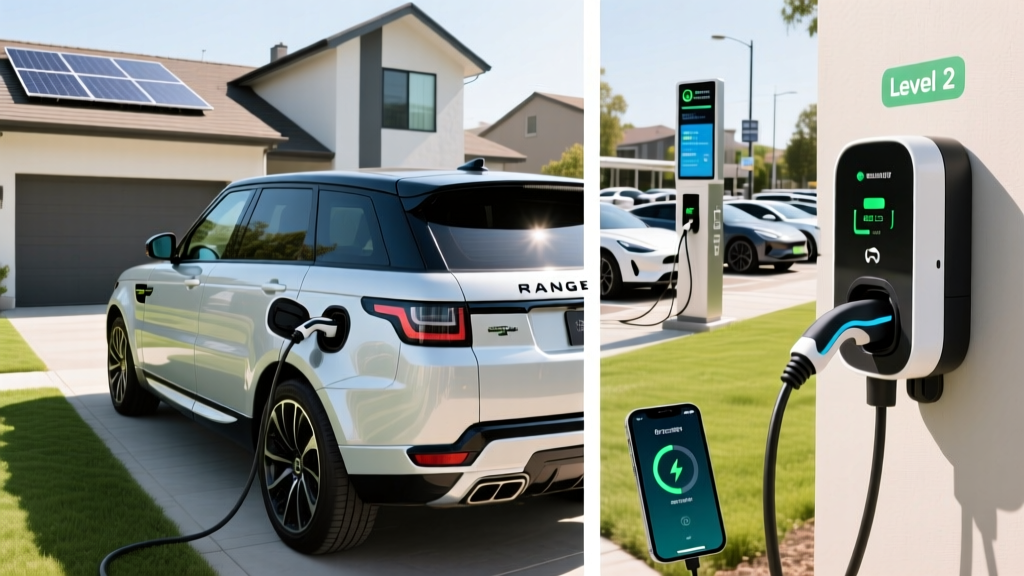
If you've searched for a super charger car, you're likely asking one of three things: Can my EV use Tesla Superchargers? How fast can I charge at home or on the road? And what will it cost? The term "super charger" has become shorthand for any fast-charging setup — but in EV terminology, it blends three very different technologies: Level 1 (120V trickle), Level 2 (240V home/public), and DC Fast Charging (including Tesla's Supercharger network, now open to most brands via the NACS connector standard).
This guide breaks down every charging tier with exact kW figures, miles-per-hour rates, real-world install costs, connector compatibility, and per-mile economics — so you can plan your charging setup with precision, not guesswork.
Charging Levels Decoded: kW Speeds and Miles Per Hour
Before comparing chargers, the most critical distinction in EV literacy: kW (kilowatts) measures power — how fast energy flows into your battery. kWh (kilowatt-hours) measures energy — the total capacity of your battery. Think of kW as the width of a hose and kWh as the size of the bucket. A 350 kW DC fast charger fills a 75 kWh battery far faster than a 7.2 kW Level 2 unit, even though the battery size stays the same.
| Level | Voltage / Phase | Power (kW) | Miles of Range Added Per Hour | Typical Use Case |
|---|---|---|---|---|
| Level 1 | 120V / 1-phase | 1.2–1.9 kW | 3–5 mi/hr | Overnight trickle, PHEVs, emergency |
| Level 2 (Home) | 240V / 1-phase | 3.3–19.2 kW | 12–75 mi/hr | Daily home & workplace charging |
| DC Fast (CCS/NACS) | 200–900V DC | 50–350 kW | 150–1,000+ mi/hr (peak) | Road trips, highway corridors |
| Tesla Supercharger V4 | Up to 900V DC | Up to 350 kW | Up to ~1,000 mi/hr (peak) | Tesla & NACS-equipped EVs |
Real-world context: A Level 2 home charger at 11.5 kW (48A on a 60A circuit) adds roughly 40–44 miles of range per hour for a mid-size SUV like the Hyundai Ioniq 5 or Tesla Model Y. That means a depleted 75 kWh battery reaches full in roughly 7–8 hours — easily covered by an overnight session. DC fast charging, by contrast, is measured in minutes, not hours: a 10–80% session on a 250 kW-capable vehicle typically takes 18–25 minutes, though the charge curve tapers significantly above 80% State of Charge (SoC) to protect the battery.
Home EV Charger Installation: Costs, Electrical Requirements, and Panel Upgrades
Installing a Level 2 home charger is the single highest-impact upgrade an EV owner can make. But costs vary enormously depending on your home's electrical panel, the distance from panel to charger location, and local permit requirements.
Electrical Requirements
Most Level 2 home chargers run on a 240V dedicated circuit, typically requiring 40A to 60A service. The National Electrical Code (NEC) mandates that continuous loads (like EV charging) use only 80% of a circuit's rated capacity — so a 48A charger needs a 60A breaker. Common setups:
- 32A / 7.7 kW — requires a 40A breaker; works with 100A home panels
- 40A / 9.6 kW — requires a 50A breaker; most popular home setup
- 48A / 11.5 kW — requires a 60A breaker; ideal for larger batteries
- 80A / 19.2 kW — requires a 100A breaker; needs 200A+ panel, rare in homes
Panel Upgrade Reality
If your home has a 100A main panel (common in pre-1990 construction), adding a 60A EV circuit may exceed available capacity. A panel upgrade to 200A typically costs $1,500–$3,500 and is the single biggest variable in install pricing. Some utilities offer rebates for panel upgrades tied to EV adoption — check with your local provider.
| Component | Low Estimate | High Estimate | Notes |
|---|---|---|---|
| Level 2 Charger Equipment | $300 | $750 | 32A–48A smart charger, hardwired or NEMA 14-50 plug |
| Electrician Labor | $400 | $2,000 | Depends on run length, conduit, drywall work |
| Electrical Permit | $50 | $300 | Varies by municipality |
| Panel Upgrade (if needed) | $1,500 | $3,500 | 100A → 200A service upgrade |
| Total (no panel upgrade) | $750 | $3,050 | Most homes with 200A panel |
| Total (with panel upgrade) | $2,250 | $6,550 | Older homes needing service upgrade |
Safety and Code Considerations
- Dedicated circuit: EV chargers must be on their own breaker — never shared with other appliances.
- GFCI protection: NEC 2020+ requires GFCI breakers for outdoor receptacles; hardwired units may exempt from this in some jurisdictions.
- Outdoor rating: If mounted outside, the charger must carry a NEMA 4 (or IP65+) weather-resistance rating.
- NEMA 14-50 vs. hardwired: A 14-50 outlet offers portability but requires a GFCI breaker (adding ~$100–$150). Hardwired installs skip the receptacle and are often simpler for inspectors.
Always hire a licensed electrician familiar with NEC Article 625 (EV charging equipment). Per the National Fire Protection Association, improper EV charger wiring is a fire risk and may void home insurance coverage.
Connector Compatibility: NACS, CCS1, CHAdeMO, and Adapters
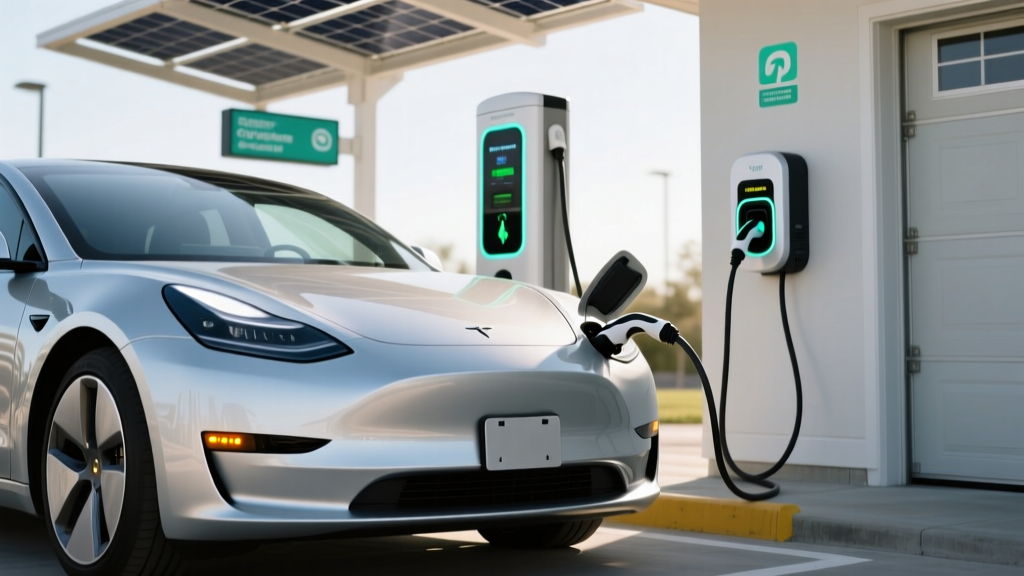
The connector landscape shifted dramatically between 2023 and 2026. Tesla's North American Charging Standard (NACS) has been adopted by Ford, GM, Rivian, Hyundai, Kia, BMW, Volvo, and most major automakers. CCS1 remains on many 2022–2025 models, and CHAdeMO is effectively legacy (Nissan Leaf being the last major holdout).
| Connector | Brands Using It (2026) | DC Fast Charging Access | Adapter Needed? |
|---|---|---|---|
| NACS (Tesla standard) | Tesla, Ford, GM, Rivian, Hyundai, Kia, BMW, Volvo, Polestar, Mercedes | Tesla Supercharger network + NACS-equipped public stations | CCS→NACS adapters available (~$200–$300) for older CCS vehicles |
| CCS1 | VW ID.4 (pre-2026), some Stellantis models, legacy 2022–2025 EVs | Electrify America, EVgo, ChargePoint, Ionity | NACS→CCS adapter for Supercharger access (where enabled) |
| CHAdeMO | Nissan Leaf (discontinued after 2025), Mitsubishi Outlander PHEV (legacy) | Limited — networks phasing out CHAdeMO stalls | No viable adapter to NACS/CCS for DC fast charging |
Adapter note: Tesla sells a CCS-to-NACS adapter (~$250) allowing older CCS vehicles to access Superchargers. Ford and Rivian also offer approved adapters. Third-party adapters exist but verify they're UL-listed — non-certified adapters can damage the vehicle's charge port or void warranty.
Charging Time Examples: 10–80% Sessions by Battery Size
DC fast charging times depend on three factors: peak charge rate (kW), battery capacity (kWh), and the charge curve — the rate at which the vehicle throttles charging speed as SoC increases to prevent battery damage. Peak kW is rarely sustained for the full session.
| Vehicle | Battery (kWh) | Peak DC Rate (kW) | Charger Used | 10–80% Time |
|---|---|---|---|---|
| Tesla Model Y (2026) | ~75 kWh (NMC) | 250 kW | Tesla V3 Supercharger | ~25 min |
| Hyundai Ioniq 5 (2026) | 84 kWh (NMC) | 240 kW (800V) | 350 kW Electrify America | ~18 min |
| Ford F-150 Lightning Ext. Range | 131 kWh (NMC) | 155 kW | 150 kW DCFC | ~42 min |
| Chevrolet Equinox EV (2026) | ~85 kWh (NMC) | 190 kW | 250 kW station | ~28 min |
| Nissan Ariya (2025) | 91 kWh (NMC) | 130 kW | 150 kW DCFC | ~40 min |
Charge curve reality check: The Hyundai Ioniq 5 peaks near 240 kW at low SoC but tapers to ~100 kW by 60% and ~50 kW above 80%. That's why manufacturers quote 10–80% times — charging from 80–100% can take as long as the 10–80% session. On road trips, plan stops around the 10–80% window for maximum efficiency.
Level 2 Home Charger Equipment Picks (2026)
Here are four well-regarded Level 2 chargers with exact specs. All support J1772 or NACS connectors and are UL-listed for safety.
ChargePoint Home Flex
- Power: Up to 12 kW (50A) on a 60A circuit
- Connector: J1772 (NACS adapter included in 2026 bundle)
- Cable length: 23 feet
- Smart features: Wi-Fi, app scheduling, utility demand-response integration, Alexa
- Price: ~$599
- Best for: Flexible amperage (dip-switch adjustable from 16A–50A to match your circuit)
Tesla Wall Connector
- Power: Up to 11.5 kW (48A) on a 60A circuit
- Connector: NACS native (J1772 adapter included)
- Cable length: 24 feet
- Smart features: Wi-Fi, OTA updates, Power Sharing (link up to 6 units on one circuit), load management
- Price: ~$475
- Best for: Tesla and NACS-equipped owners; cleanest integration with Tesla vehicles
Emporia Vue EV Charger
- Power: Up to 11.5 kW (48A)
- Connector: J1772 or NACS (configurable)
- Cable length: 24 feet
- Smart features: Energy monitoring, solar integration, time-of-use scheduling
- Price: ~$399
- Best for: Budget-conscious buyers wanting energy monitoring without a premium price
Grizzl-E Smart
- Power: Up to 10 kW (40A)
- Connector: J1772 or NACS
- Cable length: 24 feet
- Smart features: OCPP-compatible, app control, extreme cold-rated (-40°C)
- Price: ~$449
- Best for: Cold-climate durability; Canadian-built with robust housing
Cost to Charge: Per-Mile Economics vs. Gas
The financial case for EV charging hinges on where and when you charge. Here's a comparison using a mid-size EV averaging 3.0 miles per kWh (roughly 112 MPGe) and a comparable gas vehicle at 28 MPG combined.
| Scenario | Rate ($/kWh) | Cost Per Mile (EV) | Gas Equivalent (28 MPG @ $3.40/gal) | Annual Savings (12,000 mi) |
|---|---|---|---|---|
| Home Level 2 (off-peak TOU) | $0.08–$0.12 | $0.027–$0.040 | $0.121 | $970–$1,130 |
| Home Level 2 (standard rate) | $0.14–$0.18 | $0.047–$0.060 | $0.121 | $730–$890 |
| Public Level 2 (network) | $0.20–$0.35 | $0.067–$0.117 | $0.121 | $50–$650 |
| DC Fast Charging (road trip) | $0.35–$0.55 | $0.117–$0.183 | $0.121 | -$70 to -$750 (costs more) |
Key takeaway: Home charging on off-peak rates delivers massive savings — often 3–4x cheaper per mile than gasoline. Public DC fast charging, however, can exceed the cost of gas per mile. The economics strongly favor installing a Level 2 home charger. According to fueleconomy.gov, the average EV owner who charges primarily at home saves $800–$1,200 annually on fuel compared to a 25 MPG gas vehicle.
Federal Tax Credit for Home Charger Installation
The IRS §30C Alternative Fuel Vehicle Refueling Property Credit covers 30% of the cost of home EV charger equipment and installation, up to a maximum of $1,000. Key eligibility requirements for 2026:
- The charger must be installed at your primary residence in the United States.
- The property must be located in an eligible census tract (generally non-urban or low-income communities — check the IRS eligibility tool).
- The credit applies to both equipment and labor costs.
- This is a non-refundable credit — it reduces your tax liability but doesn't generate a refund beyond zero.
Always consult a tax professional for your specific situation. State and utility rebates may stack on top of the federal credit — many utilities offer $250–$500 rebates for smart Level 2 charger installations.
Frequently Asked Questions
How much does it cost to install a home EV charger?
Without a panel upgrade, expect $750–$3,050 total (equipment, electrician, and permit). With a panel upgrade from 100A to 200A, costs range from $2,250–$6,550. The federal §30C credit can offset up to $1,000, and utility rebates may cover an additional $250–$500.
How fast will each charging level add range?
Level 1 (120V): 3–5 miles per hour. Level 2 (240V, 40A): ~28–32 miles per hour. Level 2 (240V, 48A): ~38–44 miles per hour. DC fast charging: 150–1,000+ miles per hour at peak, though sessions are measured in minutes (18–40 min for 10–80%) due to charge curve tapering.
Which connector/charger is compatible with my EV?
For 2026 models, most new EVs from Tesla, Ford, GM, Hyundai, Kia, Rivian, BMW, and Volvo use the NACS connector. Older CCS1 vehicles (2022–2025 model years) can access Tesla Superchargers with a certified adapter (~$200–$300). CHAdeMO is effectively discontinued — only legacy Nissan Leaf models use it. Check your vehicle's charge port or owner's manual for the exact connector type.
How much does charging cost per mile vs gas?
Home charging on off-peak electricity ($0.08–$0.12/kWh) costs roughly $0.03–$0.04 per mile — about 3–4x cheaper than gas at $3.40/gallon and 28 MPG. Public DC fast charging ($0.35–$0.55/kWh) can cost $0.12–$0.18 per mile, sometimes exceeding gasoline. The savings case for EVs depends heavily on home charging access.
What electrical upgrades might I need?
If your home has a 100A main service panel, adding a 48A+ EV charger circuit may require a panel upgrade to 200A ($1,500–$3,500). Homes with 200A panels usually have sufficient headroom. Your electrician will perform a load calculation per NEC Article 220 to determine if your panel can handle the additional circuit. In some cases, a lower-amperage charger (32A / 7.7 kW) avoids the need for a panel upgrade entirely.
Can any EV use a Tesla Supercharger?
As of 2026, Tesla has opened its Supercharger network to non-Tesla vehicles equipped with the NACS connector or an approved CCS-to-NACS adapter. Ford, Rivian, GM, and Hyundai/Kia EVs can access Superchargers with the appropriate adapter. Vehicles with CCS1 ports without an approved adapter cannot use Superchargers but can access Electrify America, EVgo, and ChargePoint DC fast stations. CHAdeMO vehicles have no adapter path to Superchargers.
Is it safe to charge an EV in the rain?
Yes. All UL-listed EV chargers and vehicle charge ports are rated for outdoor use and wet conditions. The connector and port are designed so that no electrical contacts are exposed until a sealed connection is established. Never use a damaged cable or a non-UL-listed charger, and ensure outdoor installations use NEMA 4-rated (or higher) equipment.