Why the Hybrid Range Rover Sport Demands a Real Charging Strategy
The 2026 Range Rover Sport P460e and P550e plug-in hybrids pair a turbocharged inline-six with a 23.9 kWh usable battery (31.8 kWh gross), delivering an EPA-estimated 48 miles of electric-only range and up to 450–542 combined horsepower. That electric buffer is the entire point of the PHEV powertrain: silent, torque-rich school runs and city commutes without touching the gas tank. But those 48 miles only matter if you actually plug in.
A PHEV that never charges becomes a heavy, thirsty SUV. Owners who plug in daily report real-world electric commutes of 35–42 miles (cold weather and highway speeds cut into the EPA figure), with fuel consumption dropping below 1.5 gallons per 100 miles on mixed driving. The difference between capturing that efficiency and wasting it comes down to one thing: your charging setup.
This guide covers every charging scenario for the hybrid Range Rover Sport — from the 120V outlet in your garage to a dedicated Level 2 wallbox and public DC fast charging — with exact numbers on cost, speed, and electrical requirements.
Charging Levels Explained: kW, Miles Per Hour, and What Each Means for Your PHEV
Before comparing chargers, the distinction between kW (kilowatts, the rate of power flow) and kWh (kilowatt-hours, the total energy stored in the battery) must be clear. Your Range Rover Sport PHEV holds roughly 23.9 kWh of usable energy. A charger rated at 7.2 kW delivers 7.2 kilowatts of power per hour — filling that battery in about 3.3 hours from empty.
| Level | Voltage / Current | Max Power (kW) | Miles of Range Added Per Hour | 0–100% Time (23.9 kWh) |
|---|---|---|---|---|
| Level 1 (120V household) | 120V / 12A | 1.4 kW | ~4–5 mi/hr | ~17 hours |
| Level 2 (240V home/public) | 240V / 32A | 7.7 kW | ~22–25 mi/hr | ~3.1 hours |
| Level 2 (240V / 48A circuit) | 240V / 40A vehicle-limited | 7.2 kW (onboard limit) | ~22 mi/hr | ~3.3 hours |
| DC Fast Charge (CCS) | 400V architecture | 50 kW peak | ~120+ mi/hr equivalent | 10–80% in ~20 min |
The Range Rover Sport PHEV's onboard charger caps Level 2 acceptance at 7.2 kW. Plugging into a 48A / 11.5 kW wallbox will not charge it faster — the vehicle's inverter is the bottleneck. That said, a 48A-rated charger is still a smart buy if you plan to add a full EV (like a future electric Range Rover) or already own one alongside the PHEV.
Level 1 charging from a standard 120V outlet technically works for the PHEV's modest battery, but 17 hours for a full charge means you will never fully recover range between evening plug-in and morning departure if you drive more than 20 miles. Level 2 is the practical minimum for daily PHEV ownership.
Home Level 2 Installation: Electrical Requirements, Costs, and Panel Gotchas
Installing a 240V Level 2 charger for your hybrid Range Rover Sport is straightforward in newer homes with modern electrical panels — and potentially expensive in older ones. The variables that drive cost are circuit amperage, wire run distance, and whether your panel has spare capacity.
A 7.2 kW charger draws 32 amps continuously. The National Electrical Code requires continuous loads to be on a circuit rated 125% above the draw, meaning you need a 40-amp breaker on a 240V dedicated circuit. If you install a higher-capacity 48A charger for future-proofing, you need a 60-amp breaker.
| Item | Low End | High End | Notes |
|---|---|---|---|
| Level 2 charger (hardware) | $350 | $750 | 32A–48A, NEMA 14-50 or hardwired |
| Electrician labor (wire + breaker + mount) | $500 | $1,500 | Depends on wire run length and wall type |
| Permit and inspection | $50 | $250 | Varies by municipality |
| Panel upgrade (if needed) | $1,500 | $4,000 | Required if panel is at or near capacity (common in pre-2000 homes with 100A service) |
| Total (no panel upgrade) | $900 | $2,500 | Most homes with 200A service and short wire runs |
| Total (with panel upgrade) | $2,400 | $6,500 | Older homes or those adding multiple EV circuits |
Before scheduling an electrician, check your panel's amperage rating (usually printed on the main breaker — 100A, 150A, or 200A). A licensed electrician will perform a load calculation per NEC Article 220 to confirm spare capacity. Homes with 200A service and electric cooking, HVAC, and water heating may still have room for a 40A circuit, but it is not guaranteed.
For the hybrid Range Rover Sport specifically, a 40A breaker / 32A continuous charger is sufficient to max out the vehicle's 7.2 kW onboard charger. Spending extra on a 48A / 60A circuit only makes sense as future-proofing for a full-BEV addition to your garage.
Connector Compatibility: CCS1, NACS, and What the Range Rover Sport PHEV Uses
The 2026 Range Rover Sport PHEV sold in North America uses a CCS1 (Combo 1) connector for both Level 2 AC charging and DC fast charging. Land Rover has not yet transitioned its PHEV lineup to the Tesla NACS (North American Charging Standard) connector, though the all-electric Range Rover (expected for the 2027 model year) is anticipated to adopt NACS.
| Connector Type | Native Fit? | Adapter Needed? | Where You'll Use It |
|---|---|---|---|
| J1772 (Level 2 AC) | Yes (CCS1 upper portion) | No | Home wallboxes, public Level 2 stations, workplaces |
| CCS1 (DC Fast) | Yes | No | Electrify America, EVgo, most non-Tesla DC networks |
| NACS (Tesla) | No | CCS-to-NACS adapter (~$200–$300) | Tesla Supercharger network (V3/V4 stalls with Magic Dock or via adapter) |
| CHAdeMO | No | Not recommended (rare, no adapter) | Legacy Nissan Leaf infrastructure — largely retired |
If you plan to use Tesla Superchargers on road trips — increasingly relevant as Tesla opens its network to non-Tesla vehicles — budget for a CCS-to-NACS adapter from a reputable manufacturer like Lectron or A2Z. Tesla's built-in Magic Dock adapter at some Supercharger stalls also works with CCS1 vehicles, but availability varies by station.
For daily home charging, the CCS1 connector's J1772 upper portion is all you need. Every Level 2 home wallbox ships with a J1772 plug, so no adapter is required for your garage setup.
Cost to Charge: Home Electricity vs. Public DC Fast vs. Gasoline
The economic case for plugging in your hybrid Range Rover Sport hinges on your electricity rate and how much you drive on battery power. A PHEV charged at home on off-peak rates costs dramatically less per mile than gasoline; a PHEV that relies on public DC fast charging or its gasoline engine closes the gap.
| Scenario | Energy Cost | Cost Per Mile (Electric Mode) | Cost Per Mile (Gas, 19 MPG combined) |
|---|---|---|---|
| Home Level 2 (off-peak, $0.13/kWh) | $0.13/kWh | $0.043 | $0.184 (at $3.50/gal) |
| Home Level 2 (peak, $0.28/kWh) | $0.28/kWh | $0.093 | $0.184 |
| Public Level 2 ($0.35/kWh avg) | $0.35/kWh | $0.117 | $0.184 |
| DC Fast Charge ($0.48/kWh avg) | $0.48/kWh | $0.160 | $0.184 |
At national average rates, home charging saves $0.14 per mile compared to gasoline — roughly $2,100 annually for a driver who covers 15,000 miles and charges nightly. Even on peak residential rates, electric mode undercuts gas. Public DC fast charging narrows the savings to $0.02 per mile, which is why PHEV ownership economics work best with reliable home charging.
The Range Rover Sport PHEV achieves approximately 3.0 miles per kWh in real-world mixed driving (EPA-rated combined efficiency is around 42 MPGe in charge-depleting mode, per fueleconomy.gov). Use that figure to estimate your personal costs: multiply your local $/kWh rate by 0.33 to get cost per electric mile.
Equipment Recommendations: Wallbox Chargers That Fit the Range Rover Sport PHEV
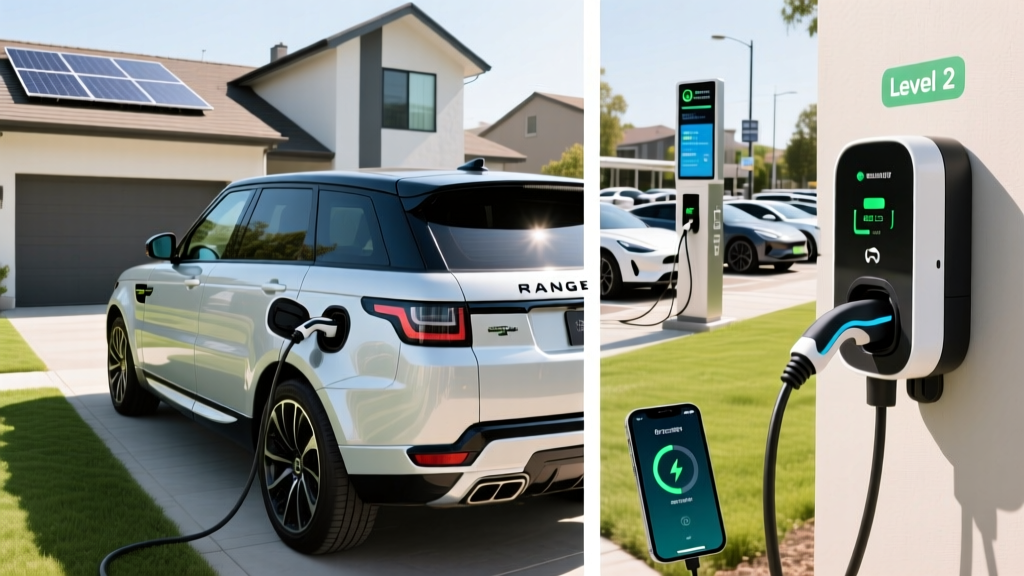
Since the Range Rover Sport PHEV caps AC charging at 7.2 kW, you do not need the most powerful charger on the market. You do need reliability, a cable long enough to reach the charge port (located on the driver's side rear quarter panel), and smart scheduling to exploit off-peak electricity rates.
Emporia Level 2 EV Charger (48A)
Power output: 11.5 kW max (vehicle-limited to 7.2 kW on Range Rover Sport PHEV)
Connector: J1772 (CCS1 compatible)
Cable length: 24 feet
Smart features: Wi-Fi, app scheduling, solar integration, energy monitoring
Price: ~$399
Best for: Budget-conscious PHEV owners who want smart scheduling and future-proofing for a full EV. The 48A circuit is overkill for the PHEV today but ready for tomorrow.
ChargePoint Home Flex (50A)
Power output: 12 kW max (vehicle-limited to 7.2 kW)
Connector: J1772
Cable length: 23 feet
Smart features: Wi-Fi, Alexa integration, app scheduling, flexible amperage dip-switch settings
Price: ~$699
Best for: Owners who want a proven brand with broad utility-company rebate compatibility. ChargePoint is frequently listed on utility incentive programs that can reduce the hardware cost by $200–$400.
Wallbox Pulsar Plus (40A)
Power output: 9.6 kW max (vehicle-limited to 7.2 kW)
Connector: J1772
Cable length: 25 feet
Smart features: Wi-Fi + Bluetooth, app scheduling, load balancing (useful if panel capacity is tight)
Price: ~$599
Best for: Homes with limited panel headroom. The Pulsar Plus's Power Sharing feature can dynamically reduce draw if other large appliances kick on, avoiding nuisance breaker trips without a full panel upgrade.
All three chargers are NEMA 4 rated for outdoor installation and include integrated cable management. For the Range Rover Sport PHEV, the 40A Emporia or Wallbox units are electrically matched to the vehicle's 7.2 kW ceiling, while the ChargePoint's adjustable amperage lets you dial it down to 32A on a 40A breaker if your electrician recommends it.
Safety, Electrical Code, and Installation Best Practices
Level 2 EV charging is a continuous high-amperage load — essentially running a clothes dryer for three hours straight. Proper installation protects your home and your vehicle. Key requirements per the National Electrical Code and best-practice standards:
- Dedicated circuit: The charger must be on its own breaker — no shared circuits with other appliances. A 7.2 kW charger needs a 40A double-pole breaker; a 9.6 kW unit needs a 50A or 60A breaker.
- GFCI protection: NEC 2020 and later require ground-fault circuit interrupter protection for all EV charging outlets (NEMA 14-50 or 6-50). Hardwired chargers typically have GFCI built into the unit. If you use a plug-in charger on a receptacle, your electrician should install a GFCI breaker.
- Outdoor rating: If your charger mounts outside or in an unsealed garage, confirm it carries a NEMA 4 (splash-resistant) or NEMA 4X (corrosion-resistant) rating. All three chargers recommended above meet this standard.
- Wire gauge: A 40A circuit requires 8 AWG copper wire (THHN in conduit or NM-B/Romex rated for the installation). A 60A circuit requires 6 AWG. Longer wire runs (over 50 feet) may need upsized wire to prevent voltage drop.
- Permit and inspection: Most jurisdictions require an electrical permit for new 240V circuits. The inspection confirms proper grounding, breaker sizing, wire gauge, and GFCI compliance. Skipping the permit risks insurance claim denials if a fire originates from the circuit.
A critical real-world note: if your home was built before 1990 and has a 100A panel with original breakers, a load calculation will almost certainly require a panel upgrade to 200A before adding a 40A EV circuit. Budget $1,500–$4,000 for this work, and plan for a 1–2 week timeline including utility coordination.
DC Fast Charging the Range Rover Sport PHEV: When and Where It Makes Sense
The 2026 Range Rover Sport PHEV supports DC fast charging at up to 50 kW via its CCS1 port. That rate is modest compared to full EVs (which commonly accept 150–350 kW), but it is meaningful for a 23.9 kWh battery: a 10–80% charge takes approximately 20 minutes at a station delivering its rated power.
Real-world DC fast charging for this PHEV makes sense in specific scenarios:
- Road trips exceeding 48 miles between stops: A 20-minute DC top-up at a rest-area Electrify America station adds ~30 miles of electric range, letting you complete short highway segments on battery power before the engine engages.
- Apartment dwellers without home charging: If you lack Level 2 access at home, a weekly DC fast charge (combined with opportunistic public Level 2 charging at work or shopping centers) keeps the battery buffer usable.
- Preconditioning for efficiency: Some route-planning features in the Range Rover's Pivi Pro infotainment system will precondition the battery when a DC charger is set as a navigation waypoint, optimizing charge speed.
However, DC fast charging at $0.48/kWh national average costs nearly as much per mile as gasoline in this vehicle. For daily use, it is economically inferior to home Level 2. Reserve DC charging for road trips and emergencies.
Charging curve note: the PHEV's 50 kW peak rate applies only between roughly 10% and 50% state of charge. Above 80%, the charge rate tapers significantly to protect battery health — a universal behavior in lithium-ion batteries. Plan your DC stops around 10–80% windows rather than attempting a full charge.
Frequently Asked Questions
How much does it cost to install a home EV charger for the hybrid Range Rover Sport?
Expect $900–$2,500 for a standard installation (hardware, electrician, and permit) in a home with a 200A panel and a short wire run. If your panel needs upgrading from 100A to 200A, add $1,500–$4,000. The Range Rover Sport PHEV only needs a 40A / 7.2 kW circuit, which is among the least demanding EV installations.
How fast will each charging level add range to the Range Rover Sport PHEV?
Level 1 (120V) adds roughly 4–5 miles of range per hour — about 45 miles overnight, which barely covers the EPA-rated 48-mile range. Level 2 (240V / 32A) adds 22–25 miles per hour, fully recharging the 23.9 kWh battery in about 3.1 hours. DC fast charging at 50 kW reaches 10–80% in approximately 20 minutes.
Which connector and charger are compatible with my hybrid Range Rover Sport?
The 2026 Range Rover Sport PHEV uses a CCS1 connector. Any J1772 Level 2 charger (all standard home wallboxes) fits the upper portion of the CCS port. For Tesla Supercharger access, you need a CCS-to-NACS adapter ($200–$300). CHAdeMO is not compatible and is largely obsolete in North America.
How much does charging cost per mile compared to gas?
At the national average residential rate of $0.16/kWh, home charging costs approximately $0.053 per mile in electric mode. Gasoline at $3.50/gallon and 19 MPG combined costs $0.184 per mile. Home-charged electric driving saves roughly $0.13 per mile, or about $1,950 per year at 15,000 miles. Public DC fast charging at $0.48/kWh costs $0.16/mile — nearly matching gas.
What electrical upgrades might I need for a home charger?
The most common upgrade is a panel replacement from 100A to 200A service, required in older homes that lack spare breaker capacity. You may also need a new conduit run if the wire distance from panel to garage exceeds 50 feet (requiring upsized wire to prevent voltage drop). Homes with 200A service installed after 2000 rarely need more than a new 40A breaker and a wire run. A licensed electrician's load calculation per NEC Article 220 will determine your specific requirements.
Does the federal tax credit cover home charger installation?
The IRS §30D credit applies to the vehicle, not the charger. However, the Alternative Fuel Vehicle Refueling Property Credit (IRS §30C) may cover up to 30% of home charger hardware and installation costs (capped at $1,000) if you live in an eligible census tract. Eligibility depends on your address and the current year's IRS guidance — consult a tax professional and review IRS.gov guidance on §30C before claiming.
Will charging the PHEV every night degrade the battery?
No. The Range Rover Sport PHEV uses an NMC (nickel manganese cobalt) battery with a gross capacity of 31.8 kWh and a usable window of 23.9 kWh — the vehicle's battery management system reserves buffers at the top and bottom to prevent full cycling. Daily charging to 100% on a Level 2 timer is fine and recommended by Land Rover for PHEVs. The high-voltage battery carries an 8-year / 100,000-mile warranty against capacity loss below 70%, per Land Rover's published warranty terms.