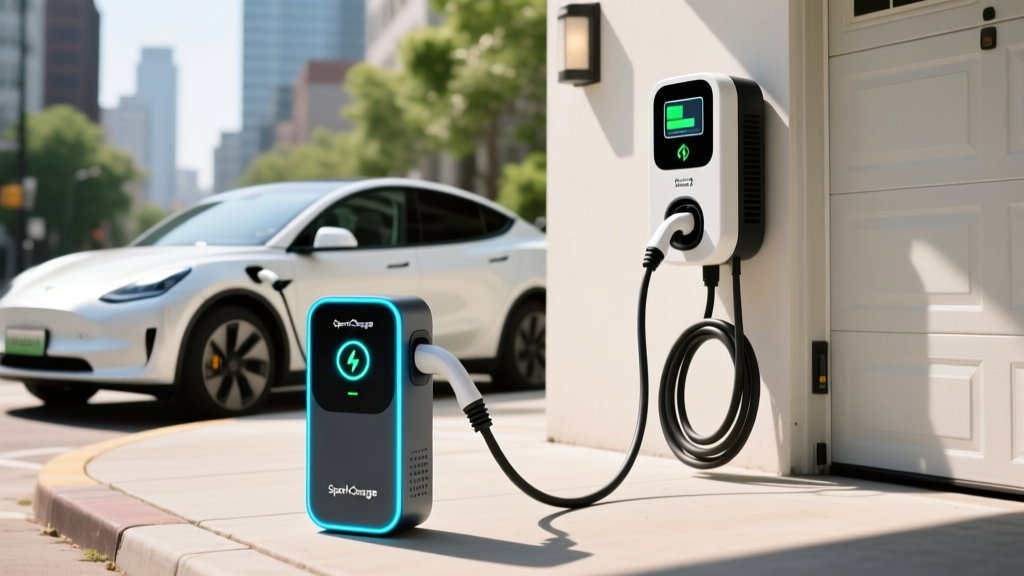
If you live in an apartment, park on the street, or simply lack access to a garage outlet, keeping an electric vehicle charged can feel like a part-time logistics job. Enter SparkCharge mobile EV charging — an on-demand service that delivers DC fast charging directly to your parked car, typically via a fleet of portable battery units or generator-equipped vans. It's a real solution for a real problem, but it's not a replacement for a home Level 2 charger if you can install one. This guide breaks down exactly what SparkCharge delivers, how it compares to fixed home charging, and what the math looks like per mile.
Understanding Charging Levels: The Speed Ladder
Before comparing mobile delivery to a wall-mounted unit, you need the baseline vocabulary locked in. Power is measured in kW (kilowatts) — that's the rate of flow, like water pressure from a hose. Energy is measured in kWh (kilowatt-hours) — that's the total volume delivered, like gallons in a bucket. Your EV's battery is rated in kWh; your charger is rated in kW.
| Level | Voltage / Power | Typical kW | Miles of Range per Hour | Best Use Case |
|---|---|---|---|---|
| Level 1 | 120V / 12A | ~1.4 kW | 3–5 mi/hr | Overnight top-offs, PHEVs |
| Level 2 (Home) | 240V / 32–48A | 7.7–11.5 kW | 25–44 mi/hr | Daily home charging |
| DC Fast Charging | 400–800V DC | 50–350 kW | 150–1,000+ mi/hr (peak) | Road trips, rapid top-ups |
| SparkCharge Mobile (typical) | Portable DC unit | ~20–50 kW | ~75–180 mi/hr | No-home-charging scenarios |
SparkCharge's portable DC units typically deliver between 20 and 50 kW depending on the market and unit generation. That's meaningfully faster than Level 2 but well below a 150–350 kW public DC fast charger. Think of it as a bridge: fast enough to add 100+ miles in an hour, slow enough that a full 10–80% session on a 75 kWh battery might take 60–90 minutes rather than the 18–25 minutes you'd see at a high-power Electrify America or Tesla Supercharger stall.
SparkCharge Mobile EV Charging: How It Actually Works
SparkCharge operates primarily through partnerships — fleet operators, roadside assistance programs (AAA in several regions), and some direct-to-consumer on-demand requests via their app. A technician arrives with a portable DC charging unit (often a battery pack on wheels or a small generator-based system), plugs into your vehicle's DC fast-charge port, and delivers a preset amount of energy — usually 20–40 kWh per visit, enough to add 60–130 miles of range to a typical mid-size EV.
The value proposition is access, not price. If you cannot install a home charger, SparkCharge eliminates the need to detour to a public station and wait. For fleet operators, it eliminates downtime. For apartment dwellers, it's a lifeline. But per-kWh, it will always cost more than electrons pulled from your own 240V circuit.
Home Level 2 Installation: The Cost Reality
If you can install a home Level 2 charger, the economics shift decisively in your favor. Here's what that actually costs in 2026, broken down honestly — including the panel-upgrade scenario that catches many older-home buyers off guard.
| Component | Typical Range | Notes |
|---|---|---|
| Level 2 charger hardware | $350–$750 | 32A–48A smart chargers (ChargePoint, Emporia, Wallbox) |
| Electrician labor (standard install) | $500–$1,500 | Short run from panel to garage; longer runs add cost |
| Permit & inspection | $100–$300 | Varies by municipality; required for code compliance |
| Electrical panel upgrade (if needed) | $1,500–$3,500 | 100A → 200A service; common in pre-1990 homes |
| Total (no panel upgrade) | $950–$2,550 | Most homes with 200A service and short wire runs |
| Total (with panel upgrade) | $2,450–$6,050 | Older homes or panels at capacity |
The federal IRS Residential Clean Energy Credit (§25C) can offset up to 30% of charger hardware and installation costs (capped at $1,000 annually for EVSE). This applies through 2032. Check with a tax professional for eligibility — income and principal-residence requirements apply.
Electrical Requirements You Need to Know
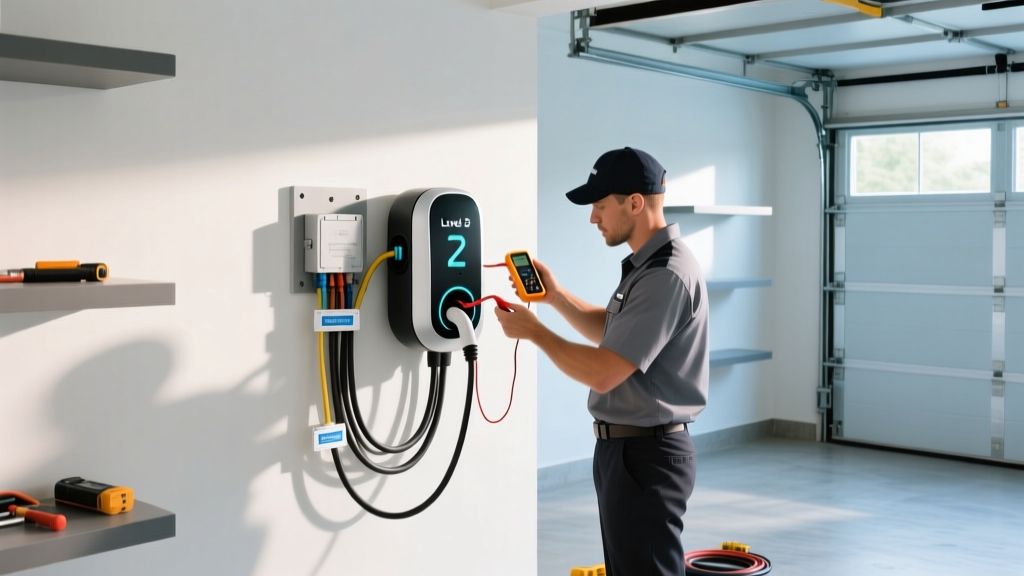
A 48A Level 2 charger requires a dedicated 60A circuit (the National Electrical Code requires circuits to be rated at 125% of continuous load). That means 6-gauge copper wire, a double-pole breaker, and a NEMA 14-60 outlet (or hardwired connection). If your panel is already near capacity — common in homes with electric dryers, ranges, and HVAC — a load calculation by a licensed electrician is mandatory before any work begins. Do not skip this; overloaded panels are a fire risk.
For outdoor installations, your charger must carry a NEMA 4 or IP65 weather rating, and the circuit must include GFCI protection per 2023 NEC updates (now standard in most jurisdictions for 2026 installs).
Connector Compatibility: Will It Plug In?
The connector landscape has consolidated significantly since 2024, but you still need to know what your vehicle uses — especially when dealing with mobile charging services that may carry specific cable types.
| Connector | Brands Using It | Adapter Needed? |
|---|---|---|
| NACS (Tesla / SAE J3400) | Tesla, Ford, GM, Rivian, Volvo, Polestar, Hyundai/Kia (2025+), Honda, BMW, Mercedes | CCS → NACS adapter for older CCS vehicles at Tesla Superchargers |
| CCS1 | Legacy VW ID.4, older Bolt, some 2023–2024 models | NACS → CCS adapter increasingly available |
| CHAdeMO | Nissan Leaf (legacy); effectively discontinued for new vehicles | No mainstream adapter path; network shrinking |
SparkCharge mobile units in most markets carry both CCS1 and NACS cables, but confirm connector availability when scheduling — particularly if you drive a Nissan Leaf (CHAdeMO) or an early-adopter CCS vehicle using a NACS adapter. Adapter compatibility with portable DC units is not guaranteed the way it is at fixed stations.
Cost Per Mile: SparkCharge vs. Home vs. Gas
This is where the ownership math either works or doesn't. Let's run the numbers on a vehicle averaging 3.5 miles per kWh (roughly 285 Wh/mi — typical for a Model Y, Ioniq 5, or EV6 in mixed driving).
| Scenario | Rate | Cost per Mile | Annual Cost (12,000 mi) |
|---|---|---|---|
| Home Level 2 (off-peak utility) | $0.12–$0.16/kWh | $0.034–$0.046 | $410–$550 |
| Home Level 2 (standard rate) | $0.18–$0.25/kWh | $0.051–$0.071 | $620–$860 |
| Public DC fast charging | $0.35–$0.55/kWh | $0.10–$0.16 | $1,200–$1,900 |
| SparkCharge mobile delivery | $0.45–$0.75/kWh | $0.13–$0.21 | $1,550–$2,570 |
| Gasoline (25 MPG avg, $3.40/gal) | $3.40/gallon | $0.136 | $1,632 |
Equipment Picks: Best Home Level 2 Chargers for 2026
If you have the option to install, here are three chargers we recommend based on power output, cable length, smart features, and reliability track records.
Emporia Vue Level 2 (48A)
- Power: 11.5 kW max (48A / 240V)
- Cable length: 24 ft
- Connector: NACS (J3400), CCS adapter available
- Smart features: Wi-Fi, solar integration, energy monitoring, scheduling via app
- Price: ~$399–$449
- Best for: Solar homeowners, budget-conscious buyers wanting full smart features
ChargePoint Home Flex (up to 50A)
- Power: Up to 12 kW (50A, adjustable down to 16A)
- Cable length: 23 ft
- Connector: NACS or J1772 (configurable)
- Smart features: Wi-Fi, Alexa, amperage adjustment, detailed session logs
- Price: ~$549–$649
- Best for: Flexibility across panel capacities; strong app ecosystem
Wallbox Pulsar Plus (48A)
- Power: 11.5 kW max (48A / 240V)
- Cable length: 25 ft
- Connector: NACS or J1772
- Smart features: Wi-Fi + Bluetooth, Power Sharing (dual-charger load balancing), Eco-Smart solar mode
- Price: ~$549–$699
- Best for: Two-EV households, compact form factor
All three support scheduled charging (critical for off-peak utility rates), carry UL certification, and offer NEMA 4 outdoor ratings. Hardwired installation is recommended over plug-in for 48A units — it eliminates the NEMA 14-60 receptacle as a potential failure point and is often required by local code for circuits above 40A.
Charging Time Benchmarks: What to Expect
Here's how long common EV battery sizes take to charge across methods. These assume a 10–80% session — the practical range most owners use, since charging slows dramatically above 80% to protect battery health (the charge curve tapers as the battery management system reduces current to prevent lithium plating and excess heat).
| Battery Size (usable kWh) | Level 1 (1.4 kW) | Level 2 (11.5 kW) | SparkCharge Mobile (~35 kW) | DC Fast (150 kW) | DC Fast (350 kW) |
|---|---|---|---|---|---|
| 60 kWh (e.g., Chevy Equinox EV) | ~30 hrs | ~3.6 hrs | ~1.2 hrs | ~28 min | ~18 min |
| 75 kWh (e.g., Tesla Model Y) | ~37 hrs | ~4.6 hrs | ~1.5 hrs | ~32 min | ~22 min |
| 84 kWh (e.g., Hyundai Ioniq 5) | ~42 hrs | ~5.1 hrs | ~1.7 hrs | ~18 min* | ~18 min* |
| 100 kWh (e.g., Ford F-150 Lightning Ext.) | ~50 hrs | ~6.1 hrs | ~2.0 hrs | ~40 min | ~30 min |
*Ioniq 5's 800V architecture sustains high charge rates longer, making 150 kW and 350 kW times nearly identical for the 10–80% window. Source: fueleconomy.gov and manufacturer testing data.
Safety, Code, and the Panel-Upgrade Gotcha
Any Level 2 installation must comply with NEC Article 625 (Electric Vehicle Charging System Equipment). Key requirements for 2026:
- Dedicated circuit: Your EV charger cannot share a circuit with other appliances. A 48A charger needs a dedicated 60A breaker.
- GFCI protection: Required for all receptacles used for EV charging (2023 NEC update, now enforced in most jurisdictions).
- Outdoor rating: Any outdoor charger or receptacle must carry NEMA 3R minimum (NEMA 4 preferred for full weather resistance).
- Load calculation: A licensed electrician must perform a NEC Article 220 load calculation to confirm your panel can handle the added draw. If your 200A panel is already running an electric range, dryer, and central AC, you may be close to capacity — and a panel upgrade or a smart load-management device (like the Emporia VUE with automatic curtailment) becomes necessary.
- Permit and inspection: Required in virtually all US jurisdictions. Unpermitted work can void homeowner's insurance coverage in the event of an electrical fire.
The panel-upgrade scenario is the single biggest surprise cost for EV buyers in older homes. A 100A-to-200A service upgrade runs $1,500–$3,500 depending on your utility's requirements and whether a new meter base is needed. In some cases, utilities offer rebates or time-of-use rate plans that partially offset this. Always get the load calculation done before committing to a charger purchase.
When SparkCharge Makes Sense — and When It Doesn't
SparkCharge mobile EV charging fills a genuine gap. Here's a practical decision framework:
- You live in an apartment or condo with no charging access and no realistic path to installing a Level 2 unit
- You rely on street parking and public DC fast chargers are sparse or unreliable in your area
- You're a fleet operator who needs vehicles charged on-site without depot infrastructure
- You need emergency roadside charge assistance (AAA partnerships in select regions)
- You own or long-term lease a home with a garage or driveway
- Your electrical panel has capacity (or you're willing to invest in an upgrade)
- You want the lowest possible cost per mile — home off-peak charging is 3–5x cheaper per kWh than mobile delivery
- You drive daily and need predictable, effortless overnight charging
Frequently Asked Questions
How much does it cost to install a home EV charger?
A standard home Level 2 installation (48A charger, short wire run, no panel upgrade) typically costs $950–$2,550 including equipment, electrician labor, and permit. If your home needs a panel upgrade from 100A to 200A service, add $1,500–$3,500. The federal §25C Residential Clean Energy Credit can offset up to 30% of costs (capped at $1,000) through 2032 — consult a tax professional for eligibility.
How fast will each charging level add range?
Level 1 (120V) adds 3–5 miles per hour. Level 2 (240V, 48A) adds 30–44 miles per hour depending on vehicle efficiency. DC fast charging at 150 kW can add 200+ miles in 20 minutes on compatible vehicles. SparkCharge mobile units typically deliver 20–50 kW, adding roughly 75–180 miles per hour.
Which connector is compatible with my EV?
Most 2025–2026 EVs now use the NACS (J3400) connector, including Tesla, Ford, GM, Rivian, Hyundai, Kia, and others. Older CCS1 vehicles can use adapters at NACS stations. CHAdeMO is limited to the Nissan Leaf and is effectively discontinued. Confirm connector type with your vehicle manufacturer and with any mobile charging service before scheduling.
How much does EV charging cost per mile compared to gas?
Home Level 2 charging at off-peak rates ($0.12–$0.16/kWh) costs roughly $0.03–$0.05 per mile for a typical EV — about 75% less than gasoline at $3.40/gallon and 25 MPG. Public DC fast charging ($0.35–$0.55/kWh) lands at $0.10–$0.16/mile, comparable to gas. SparkCharge mobile delivery ($0.45–$0.75/kWh) runs $0.13–$0.21/mile — at or slightly above gasoline cost.
What electrical upgrades might I need for a home charger?
The most common upgrade is a panel capacity increase from 100A to 200A service ($1,500–$3,500), required when your existing panel is near its load limit. You'll also need a dedicated 60A circuit with 6-gauge copper wire for a 48A charger. In some homes, a smart load-management device can avoid a panel upgrade by dynamically reducing charger power when other appliances cycle on. Always get a professional load calculation before proceeding.
Is SparkCharge available in my area?
SparkCharge operates in select metro areas and through partnerships with fleet operators and roadside assistance providers. Coverage is expanding but remains limited compared to fixed public charging networks. Check the SparkCharge app or website for current service areas, and always have a backup charging plan (public DC fast charger map via AFDC) for when mobile service isn't available.