Buying an electric vehicle is only half the equation. The other half — the part that determines whether ownership feels effortless or frustrating — happens in your garage or driveway. A proper home charging setup lets you wake up to a full battery every morning, skip gas stations entirely, and pay a fraction of what you'd spend on fuel. But getting there requires navigating electrical panels, permits, connector types, and equipment choices that most first-time EV buyers haven't encountered before.
This guide walks through every practical decision in a home electric car charger installation, from the electrical basics to real equipment recommendations, with exact numbers on cost, speed, and compatibility.
Understanding EV Charging Levels: Speed in kW and Miles Per Hour
Before you buy equipment or call an electrician, you need to understand the three charging levels and what each delivers. The critical distinction: kW (kilowatts) measures the rate of power delivery — how fast energy flows into your car. kWh (kilowatt-hours) measures total energy stored in the battery — like gallons in a tank. A 75 kWh battery charged at 11.5 kW will take roughly 6.5 hours from empty to full (75 ÷ 11.5). Confusing these two is the single most common mistake new EV owners make.
| Level | Voltage | Power (kW) | Miles of Range Per Hour | Typical Use Case |
|---|---|---|---|---|
| Level 1 | 120V AC | 1.2 – 1.9 kW | 3 – 5 miles/hr | Overnight top-ups, PHEVs, low-mileage drivers |
| Level 2 | 240V AC | 7.2 – 19.2 kW | 20 – 60+ miles/hr | Primary home charging for all BEVs and PHEVs |
| DC Fast Charge | 200–800V DC | 50 – 350+ kW | 150 – 1,000+ miles/hr (peak) | Road trips, public stations — not for home install |
Level 1 uses a standard household outlet. It's included with most EVs and works fine for plug-in hybrids with small batteries (say, 15–20 kWh) or for BEV owners who drive under 30 miles a day. But for a battery-electric vehicle with a 75–100 kWh pack, Level 1 is painfully slow — adding just 30–40 miles overnight.
Level 2 is what this guide focuses on. It requires a dedicated 240V circuit (the same voltage as your electric dryer or oven) and is the practical standard for daily home charging. Most EV owners install a Level 2 station and never think about public charging except on road trips.
DC fast charging uses direct current and massive power levels to charge batteries in minutes, not hours. These are public-only stations — you cannot install one at home (nor would you want to, given the $50,000+ infrastructure cost and commercial-grade electrical requirements).
How Much Does Home Electric Car Charger Installation Actually Cost?
The honest answer spans a wide range because every home's electrical situation is different. A straightforward install in a newer home with panel capacity to spare might run $800–$1,500 total. An older home needing a panel upgrade, a long conduit run from the panel to the garage, or trenching for a detached garage can push costs to $3,000–$5,000 or more.
| Cost Component | Simple Install | Moderate Install | Complex Install |
|---|---|---|---|
| Level 2 Charger (Equipment) | $350 – $600 | $400 – $700 | $500 – $800 |
| Electrician Labor (licensed) | $300 – $600 | $500 – $1,200 | $1,000 – $2,500 |
| Permit & Inspection | $50 – $150 | $100 – $250 | $150 – $400 |
| Electrical Panel Upgrade (if needed) | $0 (not needed) | $0 – $500 (minor) | $1,500 – $3,500 (200A upgrade) |
| Conduit, Wiring, Additional Materials | $50 – $100 | $100 – $300 | $300 – $800 |
| Total Estimated Cost | $750 – $1,450 | $1,100 – $2,950 | $3,450 – $8,000 |
Federal and State Incentives for Home Charging
The federal Alternative Fuel Vehicle Refueling Property Credit (IRS Form 8911) covers 30% of the cost of home charging equipment and installation, up to $1,000 per year. However, this credit has income eligibility limits and is only available in certain census tracts designated as low-income or non-urban. Check the IRS guidance and your specific census tract before counting on it. Many states and utilities also offer rebates — some covering $200–$1,000 of equipment or installation costs. Your local utility's website is the best starting point.
Electrical Requirements: What Your Home Needs for a Level 2 Charger
A Level 2 charger requires a dedicated 240-volt circuit. The specific amperage determines how fast you can charge and what wiring is required.
Circuit Amperage and Charger Power
EV charging follows the NEC 80% rule: a circuit rated for 50 amps can only deliver a continuous 40 amps to the vehicle. Here's how common circuit sizes translate to charging power:
- 20-amp circuit → 16A continuous → 3.8 kW → ~12–14 miles of range per hour
- 30-amp circuit → 24A continuous → 5.8 kW → ~18–22 miles of range per hour
- 40-amp circuit → 32A continuous → 7.7 kW → ~25–30 miles of range per hour
- 50-amp circuit → 40A continuous → 9.6 kW → ~30–36 miles of range per hour
- 60-amp circuit → 48A continuous → 11.5 kW → ~36–44 miles of range per hour
Most EVs have onboard chargers that accept between 7.7 kW and 11.5 kW on Level 2. Installing a 50-amp circuit (delivering 40A / 9.6 kW) covers the majority of current EVs and is the most common residential recommendation. If your vehicle supports 48A charging (e.g., the Tesla Model S/X or Ford F-150 Lightning with the 80A onboard charger option), a 60-amp circuit lets you use the vehicle's full Level 2 capability.
Wiring, Conduit, and Safety Code
Your electrician will pull copper wire — typically 6 AWG for a 50-amp circuit or 4 AWG for a 60-amp circuit — from your panel to the charger location. If the run goes through unfinished walls, conduit is required. Outdoor installations need NEMA 4-rated (weatherproof) enclosures and GFCI (Ground Fault Circuit Interrupter) protection per NEC 625. Most quality Level 2 chargers have built-in GFCI, but your local inspector will verify.
Key safety requirements per NEC Article 625 and typical local codes:
- Dedicated circuit — the charger cannot share a breaker with other outlets or appliances
- GFCI protection on all outdoor receptacles and hardwired outdoor chargers
- Proper wire gauge for the circuit length (longer runs may need thicker wire to prevent voltage drop)
- Hardwired connections preferred for circuits above 40 amps (NEMA 14-50 receptacles are acceptable up to 50 amps but must be installed to code — some jurisdictions now require GFCI breakers on receptacles, which can cause nuisance tripping with some chargers)
- Permit and inspection required in nearly all jurisdictions — skipping this risks insurance issues and code violations
Connector Compatibility: NACS, CCS, and CHAdeMO Explained
The physical plug that connects the charger to your car matters, and the landscape has shifted dramatically. As of 2025–2026, the North American Charging Standard (NACS) — originally Tesla's proprietary connector — has become the dominant standard. Most major automakers (Ford, GM, Rivian, Volvo, Polestar, BMW, Hyundai, Kia, and others) have adopted NACS on new vehicles or provide adapters.
| Connector | Automakers Using It (New Vehicles) | Home Charger Availability |
|---|---|---|
| NACS (J3400) | Tesla, Ford, GM, Rivian, Volvo, Polestar, BMW, Hyundai, Kia, Mercedes, others | Widely available — Tesla Wall Connector, ChargePoint, Emporia, Grizzl-E, and others now offer NACS models |
| CCS1 (J1772 combo) | VW ID.4 (prior model years), some Stellantis models, legacy EVs | Widely available — most universal chargers still include J1772/CCS or offer adapters |
| CHAdeMO | Nissan Leaf (discontinued after 2025), Mitsubishi Outlander PHEV (legacy) | Limited — primarily a DC fast-charge standard; home Level 2 uses J1772 for these vehicles |
For home Level 2 charging, the connector on the charger unit is either NACS or J1772 (the AC portion of CCS1). If you buy a NACS-equipped charger and own a J1772 vehicle (or vice versa), adapters are available for $100–$250. Many charger manufacturers now sell units with interchangeable connector options or include adapters in the box.
Real-World Charging Times: What to Expect at Home
Charging time depends on three variables: the circuit's power output (kW), the vehicle's onboard charger capacity, and the battery size. Here are realistic 10%–80% charge times for common EV battery sizes on a typical 9.6 kW (40A) home Level 2 circuit:
| Battery Size (kWh usable) | Example Vehicles | 10%–80% Time | Overnight (8 hrs) Range Added |
|---|---|---|---|
| 58 kWh | VW ID.4 Standard, base Hyundai Kona Electric | ~4.2 hours | ~77 kWh → full charge easily |
| 75 kWh | Tesla Model Y Long Range, Ford Mustang Mach-E Extended Range | ~5.5 hours | ~77 kWh → full charge easily |
| 85–90 kWh | BMW iX xDrive50, Rivian R1S (Standard) | ~6.3 hours | ~77 kWh → ~85–90% |
| 100–110 kWh | Tesla Model S, GMC Hummer EV, Ford F-150 Lightning Extended | ~7.5–8 hours | ~77 kWh → ~70–77% |
| 131–135 kWh | GMC Hummer EV (max pack), Lucid Air (some trims) | ~9.5–10 hours | ~77 kWh → ~57–60% |
Most EV owners rarely charge from 10% to 80% at home. Typical daily use involves plugging in at night with 40–70% remaining and topping back up to 80–90%. On a 9.6 kW circuit, replenishing 200 miles of driving (roughly 50–60 kWh depending on efficiency) takes about 5–6 hours — well within a standard overnight window.
One real-world consideration: charging efficiency losses. Expect roughly 5–10% energy loss during AC-to-DC conversion inside the vehicle's onboard charger. So drawing 77 kWh from your wall delivers approximately 70–73 kWh to the battery. This matters for calculating your electricity cost.
Cost to Charge: Home vs. Public vs. Gas, Per Mile
This is where EV ownership economics really shine — or occasionally disappoint, depending on your local electricity rates and how much you rely on public DC fast charging.
| Scenario | Rate | Cost Per Mile (3 mi/kWh EV) | Cost Per Mile (3 mi/kWh, cold/hwy) |
|---|---|---|---|
| Home, off-peak utility rate | $0.09/kWh | $0.030/mile | $0.036/mile (2.5 mi/kWh) |
| Home, average US rate | $0.16/kWh | $0.053/mile | $0.064/mile |
| Home, high-cost state (CA, HI, Northeast) | $0.28/kWh | $0.093/mile | $0.112/mile |
| Public Level 2 (ChargePoint, etc.) | $0.25–$0.49/kWh | $0.083–$0.163/mile | $0.100–$0.196/mile |
| DC Fast Charging (Electrify America, EVgo) | $0.35–$0.55/kWh | $0.117–$0.183/mile | $0.140–$0.220/mile |
| Tesla Supercharger (varies by location/time) | $0.25–$0.40/kWh | $0.083–$0.133/mile | $0.100–$0.160/mile |
| Gasoline car (28 MPG combined, $3.40/gal) | $3.40/gallon | $0.121/mile | $0.136/mile (25 MPG highway) |
Source: Average US residential electricity rate from EIA data; fuel economy baselines from fueleconomy.gov.
The takeaway: home charging on an off-peak or average rate costs roughly one-quarter to one-half what gasoline costs per mile. Even on expensive DC fast chargers, you're usually paying less than gas — though not dramatically less. The economic case for EVs depends heavily on having reliable home charging access. If you must rely exclusively on public DC fast charging at $0.45–$0.55/kWh, the cost advantage over a fuel-efficient hybrid narrows significantly.
Many utilities offer time-of-use (TOU) plans with deeply discounted overnight rates — sometimes $0.05–$0.09/kWh between midnight and 6 AM. Setting your charger (or your car's built-in scheduler) to charge during these windows maximizes savings. Some utilities, like PG&E's EV2-A plan or ConEdison's EV rate, offer dedicated EV tariffs worth investigating.
Equipment Picks: Recommended Home Level 2 Chargers for 2026
Based on reliability records, feature sets, connector options, and value, these are the Level 2 chargers we recommend for home electric car charger installation across different budgets and needs.
Tesla Wall Connector (NACS)
Power: Up to 11.5 kW (48A)
Connector: NACS native
Cable Length: 24 ft
Smart Features: Wi-Fi, OTA updates, load sharing between two units, Power-Share with Tesla Powerwall
Price: ~$475
Best For: Tesla owners or NACS-equipped households. Excellent build quality, sleek design, and the most reliable Wi-Fi connectivity in the category. Load-sharing lets you install two units on a single 60A circuit — ideal for two-EV garages.
ChargePoint Home Flex
Power: Configurable up to 12 kW (50A) — adjustable in app to match your circuit
Connector: J1772 (NACS adapter included in recent bundles)
Cable Length: 24 ft
Smart Features: Wi-Fi, app scheduling, Alexa/Google integration, detailed energy reporting
Price: ~$599–$699
Best For: Multi-EV households with mixed connectors. The adjustable amperage is uniquely useful — you can set it to 32A on a 40A circuit or 40A on a 50A circuit via software, no electrician revisit needed.
Emporia Vue Level 2 Charger
Power: Up to 11.5 kW (48A)
Connector: J1772 (NACS version available)
Cable Length: 24 ft
Smart Features: Wi-Fi, integrates with Emporia Vue energy monitor for whole-home load tracking, solar-aware charging
Price: ~$399–$449
Best For: Budget-conscious buyers who want smart features. The Emporia ecosystem is excellent for homes with solar panels — you can set the charger to use only excess solar production.
Grizzl-E Smart
Power: Up to 9.6 kW (40A)
Connector: J1772 (NACS adapter available)
Cable Length: 24 ft
Smart Features: Wi-Fi, OCPP-compatible, adjustable amperage via DIP switches
Price: ~$449–$549
Best For: Harsh climates and outdoor installations. Built in Canada, rated to -40°F/-40°C, with a rugged aluminum enclosure. One of the most durable units on the market.
All four units above are hardwired-capable, UL-listed (or equivalent certification), and support firmware updates. Hardwired installation is recommended over plug-in (NEMA 14-50) for circuits at or above 40 amps — it eliminates the receptacle as a potential failure point and avoids the GFCI-breaker nuisance-tripping issues some jurisdictions now require on receptacles.
Your Installation Checklist: From Permit to First Charge
Here's the step-by-step process for a home electric car charger installation, based on what actually happens in practice:
- Assess your electrical panel. Open your panel and check the amperage rating (printed on the main breaker — usually 100A, 150A, or 200A). Add up existing dedicated circuits (dryer, oven, HVAC). If you're unsure, skip to step 2 and let the electrician assess.
- Get 2–3 quotes from licensed electricians. Look for electricians who specifically advertise EV charger installs — they'll know NEC Article 625 requirements and can advise on load calculations. Ask whether your panel can support the new circuit or if an upgrade is needed.
- Choose your charger and circuit amperage. Based on your EV's onboard charger capacity and the electrician's panel assessment, decide on circuit size (40A or 50A are most common). Order the charger before the install date so it's on-site.
- Pull a permit. Your electrician typically handles this. Permit costs range from $50–$400 depending on jurisdiction. The permit ensures the work will be inspected, which protects you legally and for insurance purposes.
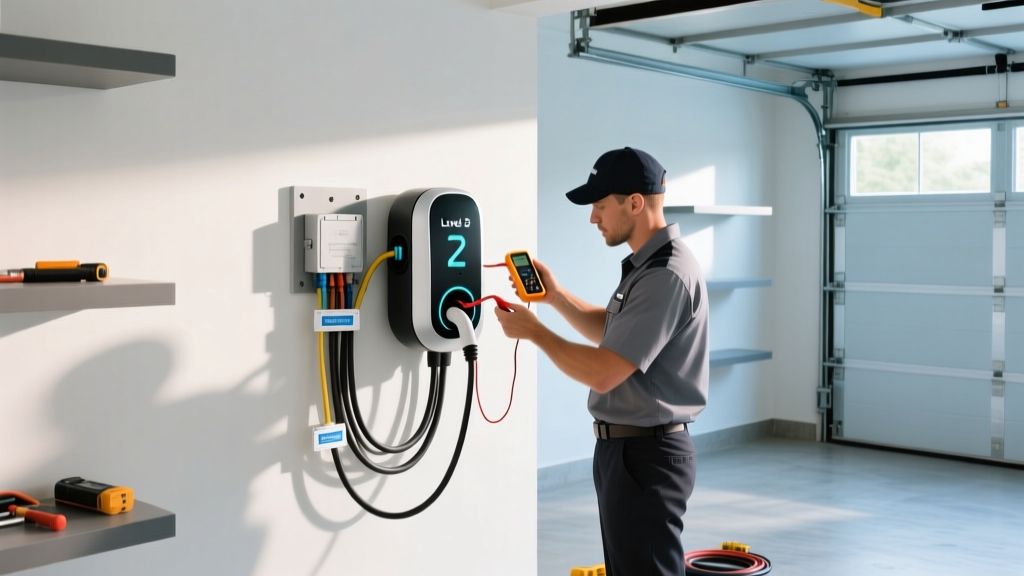
- Installation day. Expect 2–6 hours depending on complexity. The electrician runs conduit and wire from the panel to the charger location, mounts the unit, makes connections, and tests the circuit.
- Inspection. A city or county inspector visits (usually within 1–2 weeks) to verify the installation meets code. Your electrician may coordinate this. Don't skip inspection — an unpermitted, uninspected install can void homeowner's insurance claims related to electrical fires.
- Configure and test. Connect the charger to Wi-Fi, set your preferred amperage and schedule in the app, and run your first full charge session. Monitor the first few sessions for any unusual heat at the breaker or receptacle.
Frequently Asked Questions
How much does it cost to install a home EV charger?
A typical home electric car charger installation costs between $750 and $2,950 for most homes with adequate panel capacity. This includes the Level 2 charger ($350–$700), licensed electrician labor ($300–$1,200), permits ($50–$250), and materials. If your home needs a 200-amp panel upgrade, add $1,500–$3,500. The federal Alternative Fuel Vehicle Refueling Property Credit may cover 30% of costs up to $1,000, subject to income and census-tract eligibility per IRS guidelines.
How fast will each charging level add range?
Level 1 (120V) adds 3–5 miles of range per hour — adequate for PHEVs but too slow for most BEVs. Level 2 (240V) on a 40A circuit delivers ~9.6 kW and adds 25–36 miles per hour depending on vehicle efficiency. Level 2 on a 48A circuit pushes ~11.5 kW for 35–44 miles per hour. DC fast charging at public stations peaks at 50–350 kW, adding 150–1,000+ miles per hour at peak — though the charge curve tapers significantly above 80% state of charge.
Which connector or charger is compatible with my EV?
Check your vehicle's charge port. If it's a 2025+ Tesla, Ford, GM, Rivian, Volvo, Hyundai, or Kia, it likely uses NACS (J3400). Older model-year EVs from most non-Tesla brands use J1772 (AC) and CCS1 (DC). The Nissan Leaf uses CHAdeMO for DC but J1772 for AC Level 2 home charging. Most home Level 2 chargers are available in both NACS and J1772 versions, and adapters are widely available for $100–$250 if you need to bridge between connector types.
How much does charging cost per mile compared to gas?
At the US average residential electricity rate of ~$0.16/kWh, a typical EV achieving 3 miles per kWh costs about $0.053 per mile. A comparable gas car at 28 MPG combined with fuel at $3.40/gallon costs $0.121 per mile — roughly 2.3× more. On off-peak utility rates ($0.09/kWh), the EV cost drops to $0.03/mile. However, relying exclusively on public DC fast charging at $0.45+/kWh narrows the gap to $0.15/mile, which is close to or slightly above the gas cost. Home charging access is the primary economic driver.
What electrical upgrades might I need?
The most common and costly upgrade is a panel service upgrade from 100A to 200A, needed when your existing panel lacks capacity for a new 40–50A dedicated circuit. This costs $1,500–$3,500. Less dramatic upgrades include replacing a fuse box with a breaker panel (in very old homes), adding a sub-panel for a detached garage ($500–$1,500), or installing a load-management device that dynamically throttles the charger to avoid overloading the panel ($200–$500 for the device plus programming). Your electrician's load calculation per NEC Article 220 will determine what's required.
Can I install a Level 2 charger myself?
Technically, a skilled homeowner with electrical experience can wire a NEMA 14-50 receptacle or hardwire a charger. However, we strongly recommend using a licensed electrician. EV charging draws high continuous current for hours — any loose connection, undersized wire, or improper torque on a breaker terminal creates a fire risk. Most jurisdictions require a permit and inspection for new 240V circuits, and DIY work that fails inspection or causes damage may not be covered by homeowner's insurance. The $300–$1,200 labor cost is worthwhile protection.