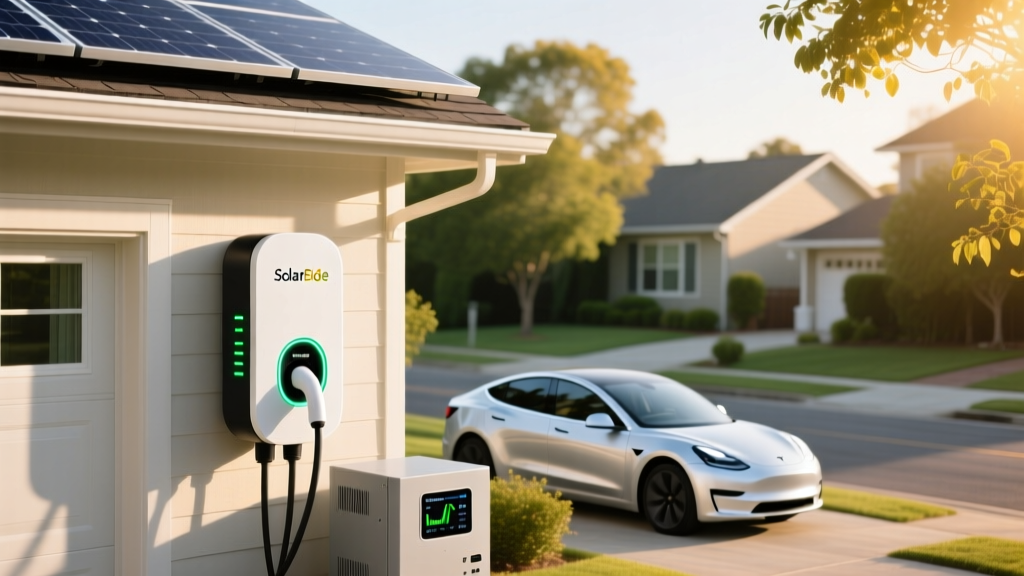
If you already have SolarEdge inverters or power optimizers on your roof, the SolarEdge home EV charger looks like an obvious add-on — a Level 2 wallbox that talks directly to your solar array and prioritizes self-generated electricity over grid power. But does the solar-ecosystem advantage justify the hardware, and what does a real installation actually cost? We break down the specs, the electrical requirements, the true install bill, and how the SolarEdge EV charger stacks up against mainstream alternatives like the ChargePoint Home Flex and Enel X Way.
Quick Verdict: Who Should Consider the SolarEdge Home EV Charger?
The SolarEdge EV charger is a 32-amp, 7.7 kW Level 2 wallbox best suited for homeowners who already run a SolarEdge inverter system and want to maximize on-site solar self-consumption. Its "Solar Boost" mode dynamically allocates excess solar production to EV charging, reducing grid draw during peak sun hours. For homes without SolarEdge solar hardware, the charger functions as a standard smart Level 2 unit — but you lose the headline feature, and competitors offer more flexibility at similar or lower price points.
Charging Levels Explained: Where the SolarEdge Fits
Before evaluating any home charger, it helps to understand the three charging tiers available to EV owners. The SolarEdge home EV charger is a Level 2 unit — the practical standard for daily home charging.
| Level | Voltage / Amperage | Power (kW) | Miles of Range / Hour | Typical Use |
|---|---|---|---|---|
| Level 1 | 120V / 12A | 1.4 kW | 3–5 mi/hr | Overnight trickle; PHEV-friendly |
| Level 2 (SolarEdge) | 240V / 32A | 7.7 kW | 25–32 mi/hr | Daily home charging; full overnight refill |
| Level 2 (48A typical) | 240V / 48A | 11.5 kW | 37–46 mi/hr | Faster home charging; large-battery EVs |
| DC Fast | 400–800V / variable | 50–350 kW | 150–1,000+ mi/hr | Road trips; 10–80% in 18–40 min |
kW vs. kWh — the critical distinction: kW (kilowatts) measures power — how fast energy flows into your car. kWh (kilowatt-hours) measures energy — the total capacity of your battery. A 7.7 kW charger delivering power for one hour adds 7.7 kWh to your battery. A 75 kWh battery charged from 10% to 80% (52.5 kWh needed) at a sustained 7.7 kW takes roughly 6.8 hours.
SolarEdge EV Charger: Specs, Solar Boost & Real-World Charging Times
The SolarEdge home EV charger delivers a maximum of 7.7 kW on a 240V/32A circuit. Here's what that means for common 2025–2026 EV battery sizes when charging from 10% to 80% State of Charge (SoC):
| Vehicle (Example) | Usable Battery (kWh) | Energy for 10–80% (kWh) | Time at 7.7 kW |
|---|---|---|---|
| Chevrolet Equinox EV | 85 kWh | 59.5 | ~7.7 hours |
| Tesla Model Y (Long Range) | 75 kWh | 52.5 | ~6.8 hours |
| Hyundai Ioniq 5 (Long Range) | 77.4 kWh | 54.2 | ~7.0 hours |
| Ford F-150 Lightning (Ext.) | 131 kWh | 91.7 | ~11.9 hours |
| Toyota RAV4 Prime (PHEV) | 18.1 kWh | 12.7 | ~1.6 hours |
Solar Boost mode: When paired with a SolarEdge inverter, the charger monitors real-time solar production. If your panels generate 5 kW and the house consumes 2 kW, the charger allocates the 3 kW surplus to your EV — then ramps up to the full 7.7 kW by supplementing with grid power if needed. In practice, this means summer charging sessions can run 30–60% on free solar energy, depending on your array size and local irradiance. The trade-off: Solar Boost only works within the SolarEdge ecosystem. If you have Enphase microinverters or a different inverter brand, this feature is unavailable.
Electrical Requirements & Installation Cost Breakdown
The SolarEdge EV charger requires a dedicated 240V circuit. Because it draws 32A continuous, the National Electrical Code (NEC) requires the circuit breaker to be rated at 125% of the continuous load — meaning a 40-amp breaker on a 40A circuit. Here's what homeowners should budget:
| Component | Low Estimate | High Estimate | Notes |
|---|---|---|---|
| SolarEdge EV charger (hardware) | $600 | $700 | 32A hardwired or plug-in |
| Electrician labor (basic install) | $400 | $1,200 | Run from panel to garage; varies by distance |
| Electrical permit | $50 | $200 | Required in most jurisdictions |
| NEMA 14-50 outlet (if plug-in) | $75 | $150 | Allows charger portability |
| Panel upgrade (if needed) | $1,500 | $4,000+ | 100A→200A service; common in pre-1990 homes |
| TOTAL (no panel upgrade) | $1,125 | $2,250 | Typical scenario |
| TOTAL (with panel upgrade) | $2,625 | $6,250+ | Older homes with 100A service |
Panel upgrade reality check: If your home has a 100-amp main panel and you're already running central A/C, an electric dryer, and an electric range, adding a 40A EV circuit may exceed your panel's capacity. A licensed electrician will perform a load calculation per NEC Article 220. Upgrading to a 200A panel typically costs $1,500–$4,000 depending on your utility's service drop requirements and local labor rates. Always get this assessment before purchasing hardware.
Connector Compatibility: NACS, CCS & Adapter Needs
The SolarEdge EV charger ships with a J1772 connector — the legacy North American standard. As of 2025–2026, the industry is rapidly transitioning to the North American Charging Standard (NACS), pioneered by Tesla and now adopted by Ford, GM, Hyundai, Rivian, Volvo, and most major automakers. Here's how compatibility breaks down:
| Connector on Vehicle | Brands (2025–2026) | Adapter Needed? |
|---|---|---|
| J1772 (legacy) | Older Nissan Leaf, Chevy Bolt (pre-2026), some PHEVs | No — direct plug |
| NACS (Tesla-style) | Tesla (all), Ford, GM, Hyundai, Rivian, Volvo, BMW (2025+) | Yes — J1772-to-NACS adapter (~$100–$200) |
| CCS1 | VW ID.4 (pre-2026), some older models | No — J1772 is the AC portion of CCS1 |
| CHAdeMO | Nissan Leaf (legacy DC only) | No — J1772 for AC charging |
If you drive a newer NACS-equipped vehicle (most 2025+ models from Ford, GM, Hyundai, and of course Tesla), you will need a J1772-to-NACS adapter to use the SolarEdge charger. Tesla sells an official adapter for ~$95; third-party options from Lectron and others run $100–$175. This is a minor friction point — competitors like the Wallbox Pulsar Plus and newer ChargePoint models now ship with a native NACS connector option, eliminating the adapter requirement entirely.
Cost to Charge: Home Solar vs. Grid vs. Public DC Fast
One of the strongest arguments for pairing an EV charger with rooftop solar is the dramatic reduction in per-mile fueling cost. Here's how different scenarios compare for a typical mid-size EV consuming 30 kWh per 100 miles (roughly the efficiency of a Tesla Model Y or Hyundai Ioniq 5):
| Scenario | Effective Rate ($/kWh) | Cost / 100 mi | Cost Per Mile |
|---|---|---|---|
| Home solar (excess production) | $0.00 (sunk cost) | $0.00 | $0.00 |
| Home grid (off-peak TOU) | $0.08–$0.12 | $2.40–$3.60 | $0.02–$0.04 |
| Home grid (peak / standard) | $0.15–$0.25 | $4.50–$7.50 | $0.05–$0.08 |
| Public Level 2 (ChargePoint, etc.) | $0.20–$0.40 | $6.00–$12.00 | $0.06–$0.12 |
| DC Fast (Electrify America, Tesla) | $0.30–$0.55 | $9.00–$16.50 | $0.09–$0.17 |
| Gas car (28 MPG @ $3.40/gal) | — | $12.14 | $0.12 |
The solar self-consumption advantage is substantial. According to fueleconomy.gov, the average EV achieves 3–4 miles per kWh. If your SolarEdge system produces 30 kWh of surplus daily and your EV consumes 30 kWh per 100 miles, you could drive up to 100 miles per day on effectively free fuel — after the solar system's payback period. For comparison, a gas vehicle at 28 MPG and $3.40/gallon costs $0.12/mile, making solar-charged EV driving 85–100% cheaper per mile.
Equipment Comparison: SolarEdge vs. ChargePoint vs. Enel X vs. Wallbox
How does the SolarEdge home EV charger compare to the major Level 2 alternatives? Here's a head-to-head look at hardware specs, smart features, and pricing:
SolarEdge EV Charger
- Max output: 7.7 kW (32A)
- Connector: J1772 (25 ft cable)
- Smart features: Solar Boost, energy monitoring, scheduling
- Ecosystem: Requires SolarEdge inverter for solar features
- Wi-Fi: Yes + Ethernet
- Price: ~$600–$700
ChargePoint Home Flex
- Max output: 11.5 kW (48A) — adjustable
- Connector: J1772 or NACS (23 ft cable)
- Smart features: App scheduling, Alexa, energy reports
- Ecosystem: Works standalone; no solar dependency
- Wi-Fi: Yes
- Price: ~$550–$650
Wallbox Pulsar Plus
- Max output: 11.5 kW (48A)
- Connector: J1772 or NACS (25 ft cable)
- Smart features: Eco-Smart solar mode, Power Sharing
- Ecosystem: Solar integration with any inverter brand
- Wi-Fi: Yes + Bluetooth
- Price: ~$550–$650
Enel X Way JuiceBox Pro
- Max output: 11.5 kW (48A)
- Connector: J1772 (25 ft cable)
- Smart features: App control, scheduling, usage tracking
- Ecosystem: Standalone; utility demand-response compatible
- Wi-Fi: Yes
- Price: ~$500–$600
Key differentiator: The SolarEdge charger's 7.7 kW output is notably lower than the 11.5 kW offered by ChargePoint, Wallbox, and Enel X at similar price points. For EVs with large batteries (Ford F-150 Lightning Extended Range at 131 kWh, Rivian R1S at 128 kWh), that difference adds 2–3 hours to a full charge. However, if your electrical panel has limited headroom, the 32A/7.7 kW draw may actually be an advantage — it requires only a 40A breaker versus the 60A breaker needed for 48A chargers.
Safety, Code & Installation Best Practices
Any Level 2 charger installation must comply with NEC Article 625 (Electric Vehicle Charging System Equipment) and local building codes. Key requirements for the SolarEdge EV charger include:
- Dedicated circuit: The charger must be on its own dedicated 40A breaker — no shared circuits with other appliances.
- GFCI protection: NEC 2020 and later require GFCI protection for all EV charging outlets. Hardwired installations may have different requirements depending on your local AHJ (Authority Having Jurisdiction).
- Outdoor rating: The SolarEdge charger carries an IP55 rating (protected against dust and water jets), suitable for outdoor mounting. Verify your installation location meets the manufacturer's clearance requirements.
- Cable management: The 25-foot cable should be routed to avoid trip hazards and vehicle tire contact. Wall-mounted cable organizers are recommended.
- Load management: If your panel is near capacity, consider a smart load-management system (like the SolarEdge energy hub or a third-party device such as the Emporia Load Shedder) that throttles charger amperage when household demand spikes.
Always hire a licensed electrician and pull a permit. Unpermitted EV charger installations can void homeowner's insurance coverage and create liability issues during a home sale.
Federal & State Incentives for Home Charger Installation
The IRS §30C Alternative Fuel Vehicle Refueling Property Credit offers a tax credit of up to 30% of the cost of home EV charging equipment and installation, capped at $1,000 per tax year. This credit covers both the charger hardware and electrician labor. However, eligibility depends on your census tract meeting specific low-income or rural criteria — a requirement added in 2023. Consult a tax professional to verify your eligibility. Some states and utilities offer additional rebates; check the AFDC state incentive database for current programs in your area.
Frequently Asked Questions
How much does it cost to install a SolarEdge home EV charger?
Expect $1,125–$2,250 total (hardware + electrician + permit) for a straightforward installation where your electrical panel has sufficient capacity. If your home needs a panel upgrade from 100A to 200A service, add $1,500–$4,000+, bringing the total to $2,625–$6,250+. Get a load calculation from a licensed electrician before purchasing.
How fast will the SolarEdge charger add range to my EV?
At 7.7 kW (32A @ 240V), expect 25–32 miles of range per hour of charging, depending on your vehicle's efficiency. A Tesla Model Y (EPA 320 mi, ~75 kWh battery) gains roughly 30 miles per hour. A larger Ford F-150 Lightning gains about 22 miles per hour. An overnight 10-hour session adds 250–320 miles — more than enough for most daily driving needs.
Is the SolarEdge charger compatible with my Tesla or NACS-equipped EV?
The SolarEdge charger uses a J1772 connector. For any NACS-equipped vehicle (all Teslas, 2025+ Ford, GM, Hyundai, Rivian, Volvo), you'll need a J1772-to-NACS adapter (~$95–$175). It works perfectly with the adapter, but competitors like ChargePoint and Wallbox now offer native NACS cable options that eliminate the adapter entirely.
How much does charging at home cost per mile compared to gas?
Home charging on off-peak grid rates costs $0.02–$0.04 per mile. Charging on excess solar production costs effectively $0.00 per mile after the solar system payback. A comparable gas vehicle at 28 MPG and $3.40/gallon costs $0.12 per mile. Over 15,000 annual miles, solar-powered EV charging saves roughly $1,500–$1,800 per year versus gasoline.
What electrical upgrades might I need for a home EV charger?
The most common upgrade is a panel replacement from 100A to 200A service ($1,500–$4,000). You may also need a new 40A breaker slot, upgraded wiring (6 AWG copper for 40A), and a GFCI breaker if installing a NEMA 14-50 outlet rather than hardwiring. Homes built after 2000 typically have 200A panels with sufficient headroom and need no panel upgrade.
Does the SolarEdge charger work without SolarEdge solar panels?
Yes — it functions as a standard 7.7 kW Level 2 smart charger on any home electrical system. However, the Solar Boost feature (dynamic solar self-consumption) only works when paired with a SolarEdge inverter. If you have Enphase, SMA, or another inverter brand, you won't access solar-optimized charging; consider the Wallbox Pulsar Plus, which offers solar integration with any inverter via its Eco-Smart mode.