What Is a Sixpack Charger and Who Needs One?
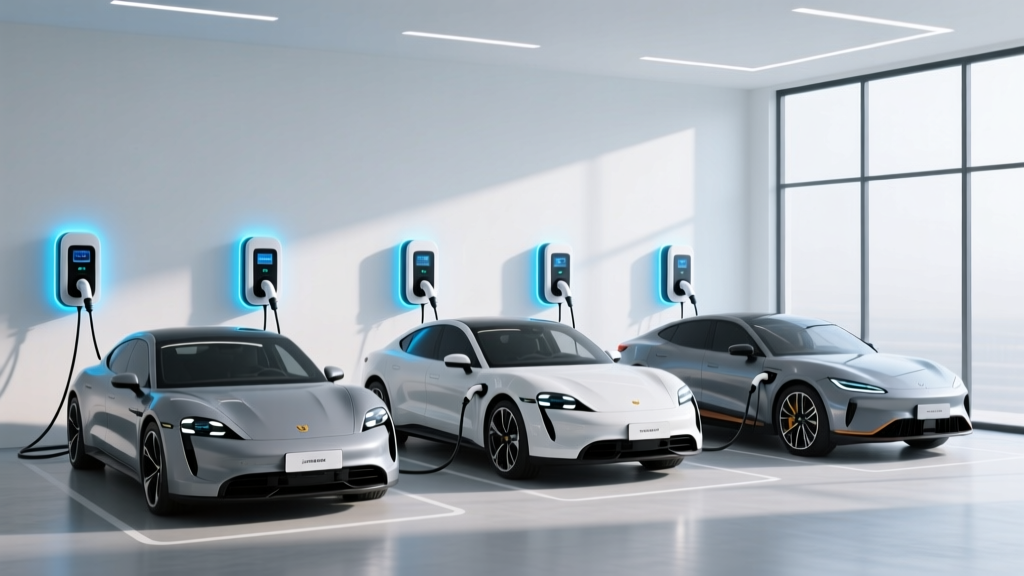
The term "sixpack charger" in EV circles refers to a high-amperage Level 2 home charging station — typically a 48-amp (or dual-port) unit capable of delivering up to 11.5 kW of continuous power on a 240V/60A dedicated circuit. The name is borrowed from the idea of having enough juice to "pack in" a full charge for multiple EVs overnight, or to serve a household with two or more electric vehicles. Some enthusiasts also use the term to describe load-sharing dual-port stations that can split power between two plugged-in vehicles.
If you own (or plan to own) more than one EV, drive a large-battery truck like the Ford F-150 Lightning (131 kWh usable) or Chevy Silverado EV (200+ kWh), or simply want the fastest possible Level 2 charge without stepping into commercial-grade equipment, a sixpack-class charger is the sweet spot. Here's exactly what you need to know about specs, installation, compatibility, and real-world cost.
Charging Levels Explained: Speeds in kW and Miles Per Hour
Before choosing equipment, understand what each level actually delivers. The critical distinction: kW (kilowatts) measures power — how fast energy flows into your car. kWh (kilowatt-hours) measures energy — the total capacity of your battery. Think of kW as the diameter of the hose and kWh as the size of the bucket.
| Level | Voltage / Amps | Max Power (kW) | Miles of Range Added Per Hour | Best Use Case |
|---|---|---|---|---|
| Level 1 | 120V / 12A | 1.4 kW | 3–5 mi/hr | Emergency / PHEV top-ups |
| Level 2 (standard) | 240V / 32A | 7.7 kW | 20–28 mi/hr | Daily home charging |
| Level 2 (sixpack-class) | 240V / 48A | 11.5 kW | 32–44 mi/hr | Large batteries, multi-EV homes |
| DC Fast Charging | 400V–800V DC | 50–350 kW | 150–1,000+ mi/hr (peak) | Road trips, quick top-ups |
A 48-amp sixpack charger at 11.5 kW will replenish a Tesla Model Y Long Range (78 kWh usable battery, ~320 mi EPA) from 10% to 80% in roughly 5.5 hours. That same session on a 32A/7.7 kW unit takes closer to 8 hours. For an F-150 Lightning Extended Range (131 kWh), the difference is even starker: ~10 hours at 11.5 kW versus ~15 hours at 7.7 kW.
Electrical Requirements and Installation Costs
A sixpack-class 48A charger requires a dedicated 60-amp, 240-volt circuit using 6 AWG copper wire (or 4 AWG aluminum). The National Electrical Code (NEC) mandates that continuous loads — and EV charging qualifies — cannot exceed 80% of a circuit's rated capacity. So a 48A charger needs a 60A breaker, not a 50A.
Does Your Panel Need an Upgrade?
Most homes built after 2000 have a 200-amp main panel, which usually accommodates a 60A EV circuit without issue. However, if you already have electric range, dryer, HVAC, and a hot tub drawing against a 150A or 100A panel, a 60A EV circuit may push you past safe capacity. A licensed electrician will perform a load calculation (NEC Article 220) to determine if you need a panel upgrade — typically to 200A or 400A service.
Panel upgrades add significant cost: a 200A upgrade runs $1,500–$3,000, while a 400A upgrade (increasingly common for multi-EV homes) costs $2,500–$5,000+ depending on your utility's service drop requirements. Always factor this into your total budget.
| Component | Typical Cost Range |
|---|---|
| Level 2 charger (48A, hardwired, NACS or J1772) | $400–$750 |
| Electrical permit | $50–$200 |
| 60A circuit install (short run, same panel, no upgrade) | $500–$1,200 |
| 60A circuit install (long run, sub-panel, or conduit) | $1,200–$2,500 |
| Panel upgrade (150A → 200A, if needed) | $1,500–$3,000 |
| Panel upgrade (200A → 400A, if needed) | $2,500–$5,000 |
| Total (no panel upgrade) | $950–$4,150 |
| Total (with 200A panel upgrade) | $2,450–$7,150 |
Always hire a licensed electrician and pull a permit. Unpermitted EV charger installs can void home insurance claims and create fire risk. Some utilities offer rebates of $250–$1,000 for Level 2 installations — check with your local provider.
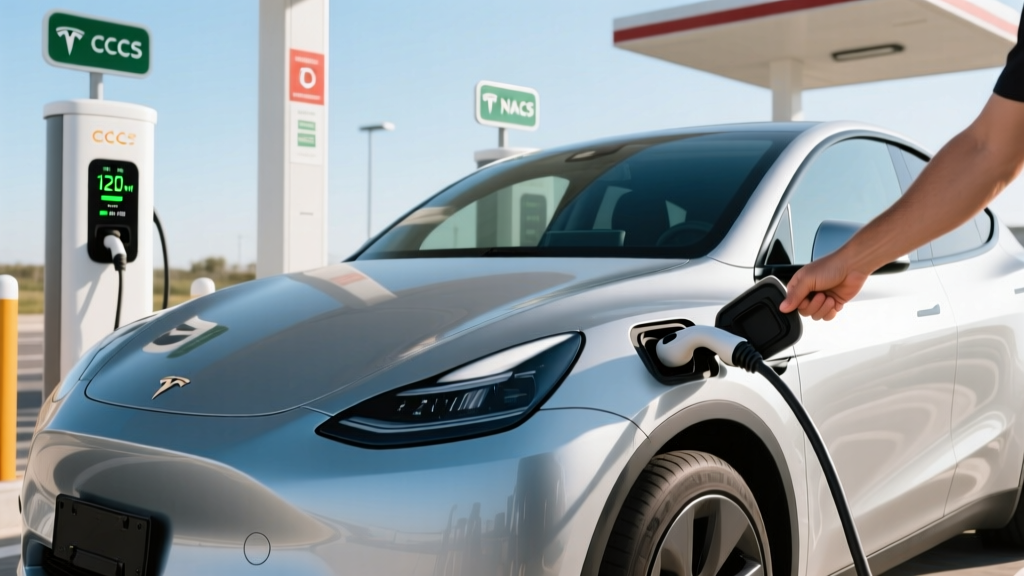
Connector Compatibility: NACS, CCS, and CHAdeMO
As of 2026, the North American Charging Standard (NACS) — originally Tesla's proprietary connector — has become the dominant light-duty EV connector. Ford, GM, Rivian, Volvo, Polestar, and Hyundai/Kia now ship vehicles with native NACS ports. Stellantis, Volkswagen, and BMW have also adopted NACS for their 2025–2026 model-year vehicles.
| Connector | Vehicles Using It (2026) | Home Charger Availability | Adapter Needed? |
|---|---|---|---|
| NACS (Tesla-style) | Tesla, Ford, GM, Rivian, Hyundai/Kia, Volvo, Polestar, most new models | Widely available (Tesla Wall Connector, Emporia, Enel X, Grizzl-E) | CCS1→NACS adapters available ($150–$250) for legacy chargers |
| CCS1 | Older VW ID.4 (pre-2025), older BMW i4/iX, some Stellantis models | Available but declining in new hardware | NACS→CCS1 adapters available ($200–$300) |
| CHAdeMO | Nissan Leaf (legacy only — discontinued in US after 2025) | Limited new options | No practical adapter to NACS for DC fast charging |
Our recommendation: If you're installing a new sixpack-class charger in 2026, buy a NACS-connector unit. Even if your current EV uses CCS1, a NACS-to-CCS1 adapter ($200–$300) lets you charge today while future-proofing for your next vehicle.
Equipment Recommendations: Top Sixpack-Class Chargers
These are our picks for 48A, hardwired Level 2 chargers that meet the "sixpack" performance threshold. All are UL-listed (or equivalent) and rated for indoor or outdoor use.
Tesla Wall Connector (Gen 4)
- Power Output: 11.5 kW (48A @ 240V)
- Connector: NACS native
- Cable Length: 24 ft
- Smart Features: Wi-Fi, OTA updates, load sharing (pair up to 6 units on one circuit), scheduling, energy tracking via Tesla app
- Price: ~$450
- Best For: Tesla owners and multi-EV households using NACS vehicles. Load-sharing lets two Wall Connectors split a single 60A circuit dynamically.
Emporia Vue Smart EV Charger (48A)
- Power Output: 11.5 kW (48A @ 240V)
- Connector: J1772 (NACS version shipping mid-2026)
- Cable Length: 24 ft
- Smart Features: Integration with Emporia Vue energy monitor, solar-aware scheduling, time-of-use optimization, load management
- Price: ~$400
- Best For: Homes with solar panels or Emporia energy monitoring. Excellent value for a full-featured 48A unit.
Grizzl-E Smart (48A)
- Power Output: 11.5 kW (48A @ 240V, dip-switch adjustable to 40/32/24/16A)
- Connector: J1772 (NACS adapter included with 2026 models)
- Cable Length: 24 ft
- Smart Features: OCPP-compatible, works with Home Assistant, EVduty app scheduling, extreme cold-rated (-40°F)
- Price: ~$550
- Best For: Cold-climate garages and tech-savvy users who want open protocol (OCPP) compatibility. Canadian-built, 3-year warranty.
Enel X JuiceBox Pro (48A)
- Power Output: 11.5 kW (48A @ 240V)
- Connector: J1772 (NACS version available)
- Cable Length: 25 ft
- Smart Features: Wi-Fi, JuiceNet app, smart grid / utility demand-response programs, energy usage reports
- Price: ~$500
- Best For: Utility demand-response participants. Enel X partners with dozens of US utilities for off-peak charging incentives.
Cost to Charge: Home vs. Public vs. Gas Per Mile
The economic case for home charging is overwhelming — but the numbers depend heavily on your local electricity rate and whether you charge on a time-of-use (TOU) plan.
| Scenario | Rate ($/kWh) | Cost to Add 200 Miles* | Cost Per Mile |
|---|---|---|---|
| Home, off-peak TOU (national avg) | $0.10 | $6.00 | $0.030 |
| Home, standard residential (national avg) | $0.16 | $9.60 | $0.048 |
| Public Level 2 (ChargePoint, EVgo) | $0.30–$0.45 | $18–$27 | $0.09–$0.135 |
| DC Fast Charging (Electrify America, Tesla Supercharger) | $0.35–$0.55 | $21–$33 | $0.105–$0.165 |
| Gas equivalent (25 MPG avg, $3.30/gal) | — | $26.40 | $0.132 |
*Based on a vehicle averaging 3.3 mi/kWh (typical for a mid-size crossover EV like the Hyundai Ioniq 5 or Tesla Model Y). Per fueleconomy.gov, efficiency varies from 2.5 mi/kWh (large trucks) to 4.5 mi/kWh (sedans like the Lucid Air).
Home off-peak charging at $0.10/kWh delivers fuel costs roughly 75% lower than gasoline on a per-mile basis. Even at standard residential rates, you're saving 60%+ versus gas. Public DC fast charging, however, has reached near-parity with gasoline in many markets — which is exactly why a sixpack-class home charger pays for itself quickly if you drive more than 10,000 miles per year.
Charging Time Examples: 10–80% by Battery Size
Here's how long a 10%–80% session takes on a 48A/11.5 kW sixpack charger versus a 32A/7.7 kW standard Level 2 unit. Note: Level 2 charging is linear (no taper curve like DC fast charging), so these times scale predictably.
| Vehicle (Battery Size) | 11.5 kW (48A) 10–80% | 7.7 kW (32A) 10–80% |
|---|---|---|
| Tesla Model 3 RWD (57 kWh usable) | ~3.5 hours | ~5.2 hours |
| Hyundai Ioniq 5 Long Range (77.4 kWh) | ~4.7 hours | ~7.0 hours |
| Ford F-150 Lightning Ext. Range (131 kWh) | ~8.0 hours | ~11.9 hours |
| Chevy Silverado EV 4WT (200+ kWh) | ~12.2 hours | ~18.2 hours |
For large-battery trucks, the sixpack-class charger is essentially mandatory if you want a full overnight recovery. A 32A charger simply cannot refill a 131 kWh battery in a single night if you've depleted it significantly.
Safety, Code, and Best Practices
Per the National Electrical Code (NEC) Article 625, EV charging equipment must meet specific requirements:
- Dedicated circuit: Your EV charger must be on its own breaker — no sharing with outlets, lights, or other appliances.
- GFCI protection: 2023 and 2026 NEC editions require GFCI protection for all EV receptacles. Hardwired units are generally exempt from GFCI breaker requirements (the charger's internal protection suffices), but your local inspector's interpretation governs. Hardwiring avoids nuisance GFCI trips that plague some 240V receptacle installs.
- Outdoor rating: If mounting outside, the unit must carry a NEMA 3R or NEMA 4 (watertight) rating. All four chargers recommended above meet this standard.
- Cable management: NEC requires the charging cable not create a tripping hazard. Wall-mount with a holster or use a retractable cable management system.
- Permitting: Virtually all US jurisdictions require an electrical permit for a new 60A circuit. The permit fee is typically $50–$200, and the inspection ensures your install meets code — protecting your home and insurance coverage.
Pro tip: Hardwire your charger rather than using a NEMA 14-50 receptacle. Hardwiring eliminates one failure point (the receptacle), avoids the GFCI breaker requirement, and allows the full 48A continuous draw. A NEMA 14-50 outlet on a 50A breaker only supports 40A continuous (9.6 kW), leaving performance on the table.
Frequently Asked Questions
How much does it cost to install a sixpack-class home EV charger?
Expect $950–$4,150 total if your electrical panel has capacity (equipment + electrician + permit). If you need a panel upgrade to 200A or 400A, add $1,500–$5,000. Get at least three quotes from licensed electricians, and confirm they perform an NEC Article 220 load calculation before quoting.
How fast will a 48A Level 2 charger add range?
A 48A/11.5 kW charger adds approximately 32–44 miles of range per hour, depending on your vehicle's efficiency. A highly efficient sedan like the Tesla Model 3 (~4.0 mi/kWh) gains closer to 44 mi/hr, while a heavy truck like the F-150 Lightning (~2.5 mi/kWh) gains about 29 mi/hr.
Which connector should I choose for my home charger in 2026?
NACS is the clear choice for new installations in 2026. The vast majority of new EVs sold in the US now use NACS natively. If your current EV still has a CCS1 port, a NACS-to-CCS1 adapter ($200–$300) bridges the gap. See the IRS clean vehicle credit page for current incentive details that may offset charger costs through utility rebates.
How does charging cost compare to gas per mile?
Home off-peak charging costs roughly $0.03/mile — about 75% less than gas at $3.30/gallon and 25 MPG. Standard residential rates (~$0.16/kWh) still deliver $0.05/mile, roughly 60% savings. Public DC fast charging ($0.35–$0.55/kWh) approaches gas parity at $0.11–$0.17/mile.
What electrical upgrades might my home need for a 48A charger?
The most common upgrade is a panel capacity increase. If your main panel is 100A or 150A, adding a 60A EV circuit may require upgrading to 200A ($1,500–$3,000). Homes with multiple EVs, electric heating, and an electric range may benefit from a 400A service ($2,500–$5,000+). Older homes with knob-and-tube or aluminum branch wiring may also need localized rewiring near the panel. A licensed electrician's load calculation will identify exactly what's needed.
Can I charge two EVs simultaneously on a single 60A circuit?
Yes, with load-sharing chargers. The Tesla Wall Connector (Gen 4) supports pairing up to 6 units on a single circuit, dynamically splitting the available 48A between connected vehicles. If one car is unplugged, the other gets the full 11.5 kW. This is ideal for two-EV households that don't want to pay for a second dedicated circuit and panel space.
For the latest EV efficiency data and MPGe ratings, consult fueleconomy.gov. For safety ratings on EVs you're considering, check IIHS and NHTSA.