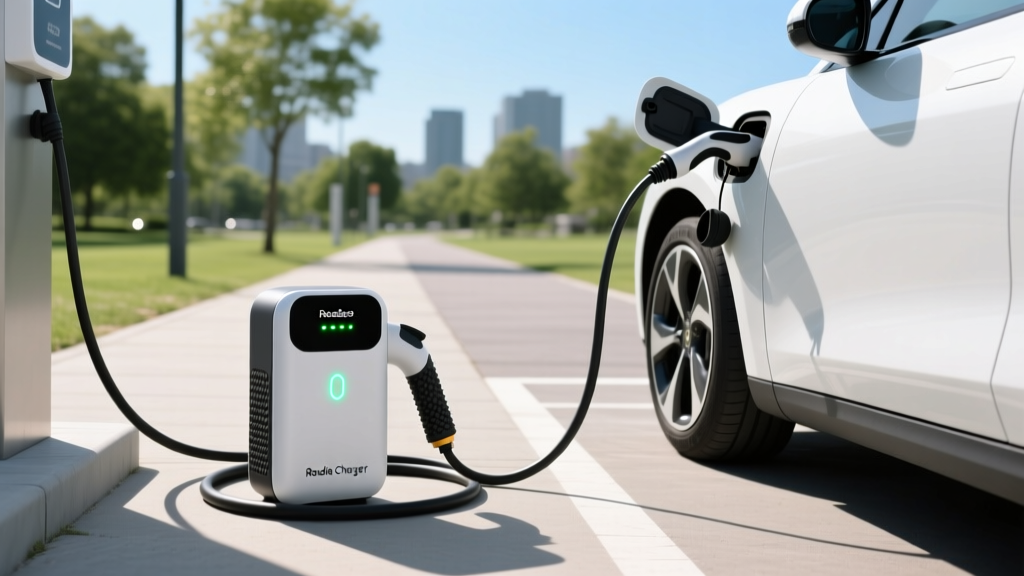
When you hear "Roadie charger," most EV owners think of a rugged, portable Level 2 charging unit designed for drivers who need flexibility beyond a hardwired wall box. Portable chargers like the Roadie fill a genuine gap: apartment dwellers without dedicated garage circuits, road-trippers who want a backup unit, and rural drivers who rely on 240V outlets at cabins or workplaces. But before you buy one — or any portable EVSE (Electric Vehicle Supply Equipment) — you need to understand exactly what power you're getting, what electrical infrastructure you need, and how it stacks up against public DC fast charging on cost and speed.
This guide breaks down portable Level 2 charging end-to-end: real kW speeds, installation realities (including panel upgrades), connector compatibility across the 2026 EV market, and what you'll actually pay per mile compared to gasoline.
Charging Levels Explained: kW Speeds and Miles Per Hour
The single most important distinction in EV charging is between kW (kilowatts — the rate of power delivery, like water pressure) and kWh (kilowatt-hours — the total energy stored in your battery, like gallons in a tank). A 10 kW charger delivering power for 5 hours adds 50 kWh of energy. Confusing these two is the most common EV literacy mistake new owners make.
Here's how the three charging levels translate to real-world range recovery:
| Level | Voltage / Amps | Max Power (kW) | Miles of Range Per Hour | Best For |
|---|---|---|---|---|
| Level 1 | 120V / 12A | 1.4 kW | 3–5 mi/hr | Overnight top-ups, PHEVs, emergencies |
| Level 2 (Portable) | 240V / 16–32A | 3.8–7.7 kW | 14–30 mi/hr | Daily home charging, Roadie-style units |
| Level 2 (Hardwired) | 240V / 40–48A | 9.6–11.5 kW | 32–44 mi/hr | Primary home charging, large batteries |
| DC Fast Charge | 400–800V DC | 50–350 kW | 150–1,000+ mi/hr | Road trips, rapid top-ups |
A portable Level 2 charger like the Roadie typically operates between 3.8 kW (16A on a NEMA 14-50 outlet) and 7.7 kW (32A on a NEMA 14-50 or hardwired-adapter setup). That means a full overnight session — say, 10 hours — adds roughly 140 to 300 miles of range, which covers most daily driving needs and fully replenishes even a large 100 kWh battery overnight.
How Much Does a Home Level 2 Charger Installation Cost?
If you're plugging a Roadie charger or similar portable Level 2 unit into an existing 240V outlet (like a NEMA 14-50 used for dryers or welders), your installation cost is essentially zero — just the price of the charger itself. But if you need a new 240V circuit run, here's what to budget:
| Component | Simple Install (Panel Nearby) | Complex Install (Panel Far / Upgrade Needed) |
|---|---|---|
| Portable Level 2 Charger (Roadie-class, 32A) | $350–$600 | $350–$600 |
| Hardwired Wall Connector (48A, optional) | $400–$750 | $400–$750 |
| Electrician: new 240V/50A circuit (NEMA 14-50) | $500–$1,200 | $1,500–$3,000 |
| Electrical panel upgrade (100A → 200A service) | $0 (not needed) | $1,800–$4,000 |
| Permit and inspection | $50–$200 | $100–$350 |
| Total Estimated Cost | $900–$2,550 | $3,750–$8,700 |
The biggest cost variable is your home's electrical panel. Homes built before 1990 often have 100-amp service, and adding a 40A or 50A continuous-load EV circuit may exceed available capacity. A licensed electrician will perform a load calculation (per NEC Article 220) to determine whether your panel can support the additional draw. If it can't, a panel upgrade to 200A service is required — and that's where costs can jump past $5,000.
For portable chargers specifically, many owners choose a NEMA 14-50 receptacle rather than hardwiring. This gives you flexibility to unplug and take the charger when you move, and it's generally $200–$400 cheaper to install than a hardwired connection. However, some jurisdictions now require GFCI breakers on 14-50 receptacles per NEC 2020/2023 code, which adds $50–$150 to the breaker cost and can occasionally cause nuisance tripping with certain EVSE units.
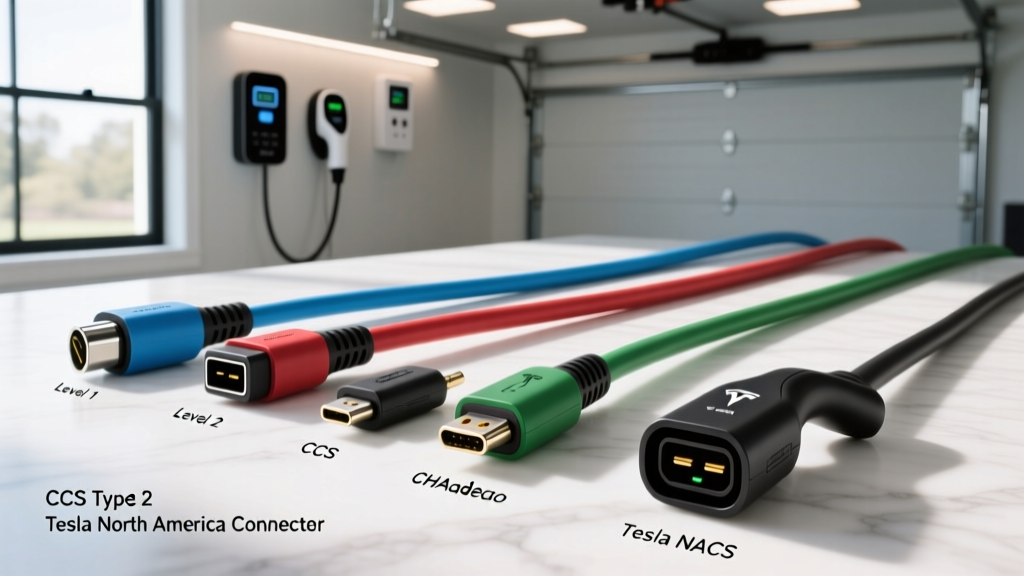
Connector Compatibility: NACS, CCS1, and CHAdeMO in 2026
The connector landscape has consolidated significantly. As of the 2026 model year, the North American Charging Standard (NACS) — originally developed by Tesla — is the dominant connector for new EVs. Most legacy CCS1 vehicles can access Tesla Superchargers via a NACS adapter, and new vehicles from Ford, GM, Rivian, Hyundai, Kia, and others ship with native NACS ports.
| Connector | Native Vehicle Brands | Adapter Needed? | Notes |
|---|---|---|---|
| NACS (Tesla) | Tesla, Ford, GM, Rivian, Hyundai, Kia, Volvo, Polestar, BMW | No (native on 2025+ models) | Dominant standard; works at Superchargers and NACS-equipped public stations |
| CCS1 | VW ID.4 (pre-2025), older Bolt EV/EUV, legacy BMW i4/iX | NACS adapter for Supercharger access | Still supported at Electrify America, EVgo, ChargePoint DC stations |
| CHAdeMO | Nissan Leaf (legacy only — discontinued) | No adapters widely available | Effectively deprecated; new DC stations rarely include CHAdeMO |
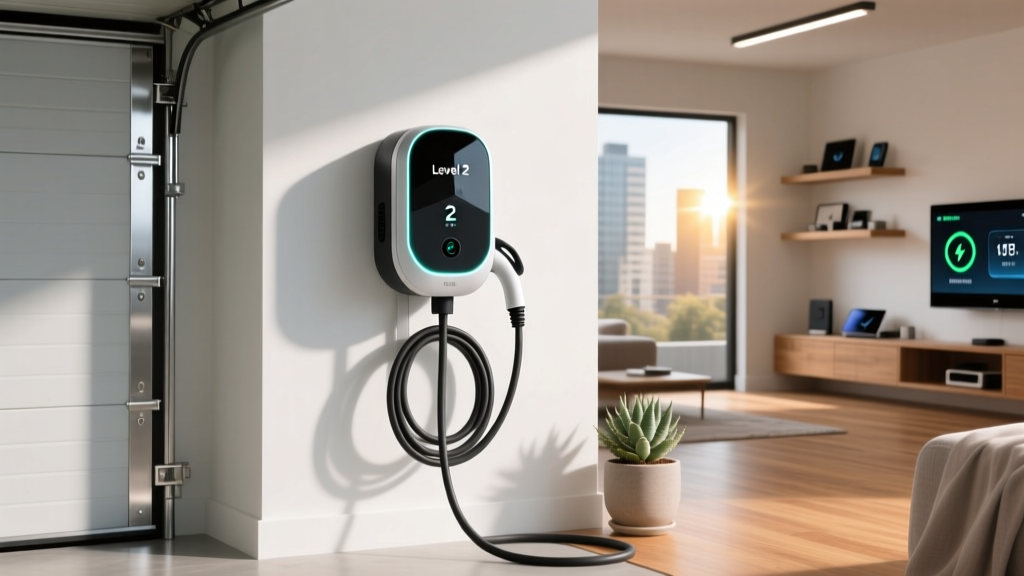
For a portable Level 2 charger like the Roadie, the connector situation is simpler: Level 2 AC charging in North America uses the J1772 connector for all non-Tesla vehicles, and Tesla vehicles include a J1772-to-Tesla adapter in the glovebox (or you can purchase an aftermarket NACS-equipped portable charger). When buying a portable charger, confirm whether it ships with a J1772 plug or a NACS plug — and whether adapters are included or sold separately.
What Does Charging Cost Per Mile vs. Gasoline?
One of the strongest arguments for home Level 2 charging — whether with a Roadie portable unit or a hardwired wall connector — is the per-mile fuel cost. Electricity prices vary by region and time-of-use, so let's run three realistic scenarios:
| Scenario | Rate | Vehicle Efficiency | Cost Per Mile |
|---|---|---|---|
| Home Level 2 (off-peak TOU rate) | $0.09/kWh | 3.5 mi/kWh (286 Wh/mi) | $0.026/mi |
| Home Level 2 (standard residential) | $0.16/kWh | 3.5 mi/kWh | $0.046/mi |
| Public DC Fast Charge (average) | $0.40/kWh | 3.5 mi/kWh | $0.114/mi |
| Public DC Fast (Tesla Supercharger) | $0.28/kWh | 3.5 mi/kWh | $0.080/mi |
| Gasoline (25 MPG combined, $3.40/gal) | $3.40/gallon | 25 mi/gal | $0.136/mi |
| Gasoline (30 MPG combined, $3.40/gal) | $3.40/gallon | 30 mi/gal | $0.113/mi |
The takeaway is clear: home Level 2 charging at off-peak rates costs roughly 80% less per mile than gasoline. Even at standard residential rates, you're paying about a third of what a 25 MPG gas car costs. The economics only break down if you rely exclusively on expensive public DC fast charging — which is why home charging access remains the single biggest factor in EV ownership satisfaction.
For a driver covering 12,000 miles per year, home charging at $0.12/kWh saves approximately $1,100–$1,300 annually compared to a 25 MPG gasoline vehicle at $3.40/gallon, per EPA fuel cost estimates.
Charging Time Examples: How Long to Reach 80%?
Charging time depends on three variables: battery capacity (kWh), charger power (kW), and the vehicle's onboard charger limit. Most EVs accept the full output of a 7.7 kW portable Level 2 charger, but some older models cap at 6.6 kW or even 3.3 kW internally.
Here are real-world charging times for common battery sizes using a 7.7 kW (32A, 240V) portable charger:
| Vehicle Example | Usable Battery (kWh) | 10–80% Time (7.7 kW) | Full Charge (0–100%) |
|---|---|---|---|
| Chevrolet Equinox EV | 85 kWh | ~7.7 hours | ~11.0 hours |
| Tesla Model Y (Long Range) | 75 kWh | ~6.8 hours | ~9.7 hours |
| Hyundai Ioniq 5 (Long Range) | 77.4 kWh | ~7.0 hours | ~10.1 hours |
| Ford F-150 Lightning (Extended) | 131 kWh | ~11.9 hours | ~17.0 hours |
| Toyota RAV4 Prime (PHEV) | 14.9 kWh | ~1.4 hours | ~1.9 hours |
For DC fast charging on road trips, the same vehicles charge dramatically faster. A Hyundai Ioniq 5 with its 800V architecture can peak at 240 kW on a compatible DC charger, reaching 10–80% in approximately 18 minutes. A Tesla Model Y peaks around 250 kW at V3 Superchargers for a 10–80% time of roughly 20–25 minutes. These speeds are irrelevant to a portable Level 2 charger but matter for trip planning.
Portable Charger Equipment Recommendations
The Roadie charger occupies the portable Level 2 category alongside several well-established competitors. Here's how the major options compare for 2026:
Roadie Charger (32A Portable)
- Power Output: 7.7 kW (32A @ 240V)
- Connector: J1772 (NACS adapter available separately)
- Cable Length: 25 ft
- Smart Features: App scheduling, energy monitoring
- Weight: ~12 lbs
- Price: ~$450–$550
Best for: Drivers who travel frequently and need a rugged, portable backup or primary Level 2 unit.
Tesla Universal Wall Connector
- Power Output: 11.5 kW (48A @ 240V, hardwired)
- Connector: NACS with integrated J1772 adapter (Magic Dock)
- Cable Length: 24 ft
- Smart Features: Wi-Fi, OTA updates, load sharing, access control
- Weight: Wall-mounted (not portable)
- Price: $475
Best for: Tesla and NACS-equipped EV owners with a dedicated garage circuit. Not portable.
ChargePoint Home Flex
- Power Output: Up to 12 kW (50A @ 240V, adjustable)
- Connector: J1772 (NACS version available)
- Cable Length: 23 ft
- Smart Features: Wi-Fi, Alexa, app scheduling, utility demand-response
- Weight: Wall-mounted or plug-in (NEMA 14-50)
- Price: $550–$700
Best for: Owners wanting maximum flexibility with amperage adjustment and utility integration.
Emporia Vue Level 2 Charger
- Power Output: 11.5 kW (48A @ 240V)
- Connector: J1772
- Cable Length: 24 ft
- Smart Features: Whole-home energy monitoring integration, solar-aware charging
- Weight: Wall-mounted
- Price: $400–$500
Best for: Solar-panel owners and budget-conscious buyers who want smart energy management.
For pure portability — the Roadie's primary use case — the key advantage is the ability to plug into any NEMA 14-50 outlet you encounter (at RV parks, campgrounds, or a friend's house) and get 7.7 kW charging without permanent installation. The trade-off versus a hardwired 48A wall connector is roughly 3–4 kW less power, meaning about 30–40% slower charging.
Safety, Electrical Code, and Installation Requirements
EV charging involves sustained high-current draw — often for 8+ hours straight — which is fundamentally different from intermittent loads like a dryer or oven. The National Electrical Code (NEC) treats EVSE as a continuous load, meaning the circuit must be rated for 125% of the charger's maximum draw. A 32A portable charger requires a 40A breaker; a 48A hardwired unit requires a 60A breaker.
Key safety and code requirements for any Level 2 installation:
- Dedicated circuit: Your EV charger must have its own dedicated breaker — no sharing with other appliances.
- GFCI protection: NEC 2020 and later requires GFCI protection for outdoor receptacles and, in many jurisdictions, for indoor 14-50 outlets used for EV charging. Hardwired EVSE units typically have built-in ground-fault protection and may not require a GFCI breaker.
- Outdoor rating: If your charger or outlet is outdoors, both the EVSE unit and the receptacle must carry a NEMA 4 (weatherproof) rating. The Roadie and most quality portable chargers meet this standard, but verify before outdoor installation.
- Wire gauge: A 50A circuit (for a 40A continuous load) requires 6 AWG copper wire. Undersized wire is a fire hazard and will fail inspection.
- Permit and inspection: Most jurisdictions require a permit for new 240V circuits. The inspection ensures correct wire gauge, breaker sizing, grounding, and GFCI compliance. Skipping the permit risks insurance claim denial in the event of an electrical fire.
Never use an extension cord with a portable Level 2 charger unless it is specifically rated for EVSE use (heavy-gauge, 240V, properly grounded). Standard household extension cords — even "heavy-duty" 120V types — are not rated for the sustained current of Level 2 charging and present a serious fire risk.
Frequently Asked Questions
How much does it cost to install a home EV charger?
If you already have a 240V NEMA 14-50 outlet (common for electric dryers), your only cost is the charger itself — $350 to $700 for a quality portable or wall-mount unit. A new 240V circuit installation typically costs $500 to $1,200 for labor and materials if your electrical panel has sufficient capacity. If a panel upgrade from 100A to 200A service is needed, add $1,800 to $4,000. Total installed cost ranges from roughly $900 on the low end to $8,700+ for complex installs with panel upgrades.
How fast will each charging level add range?
Level 1 (120V standard outlet) adds about 3–5 miles of range per hour — adequate only for PHEVs with small batteries or emergency trickle charging. Level 2 at 7.7 kW (typical portable charger like the Roadie) adds 14–30 miles per hour depending on vehicle efficiency. Hardwired Level 2 at 11.5 kW adds 32–44 miles per hour. DC fast charging at 150–350 kW can add 150 to over 1,000 miles per hour, but is intended for road-trip top-ups, not daily use.
Which connector and charger is compatible with my EV?
For 2026 model-year vehicles, most new EVs use the NACS connector natively (Tesla, Ford, GM, Rivian, Hyundai, Kia, and others). Older CCS1-equipped EVs (like pre-2025 VW ID.4 or Chevrolet Bolt) still use CCS1 but can access Tesla Superchargers with a NACS adapter. For Level 2 AC home charging, all non-Tesla EVs use the J1772 connector, and Tesla includes a J1772 adapter. Check your vehicle's charge port before purchasing a charger.
How much does EV charging cost per mile vs. gas?
Home Level 2 charging at the national average residential rate of ~$0.16/kWh costs approximately $0.046 per mile for an EV averaging 3.5 mi/kWh. Gasoline at $3.40/gallon in a 25 MPG vehicle costs $0.136 per mile — roughly three times more. Off-peak TOU rates can push home charging costs as low as $0.026/mile. Public DC fast charging at $0.35–$0.48/kWh costs $0.10–$0.14/mile, approaching or matching gasoline costs.
What electrical upgrades might I need for a Level 2 charger?
The most common upgrade is running a new dedicated 240V circuit from your panel to your garage or parking spot. If your home has a 100A electrical panel (common in pre-1990 construction), you may need a panel upgrade to 200A service to safely support a 40A or 50A EV circuit alongside existing household loads. A licensed electrician will perform a NEC Article 220 load calculation to determine whether your panel can handle the additional draw. Some utilities offer rebates of $250–$1,000 for panel upgrades associated with EV adoption — check with your local provider.