The Rivian R1T is one of the most capable electric trucks on the market, but extracting its full utility depends heavily on how you charge it. Whether you own the Dual-Motor with the Standard battery or the Tri-Motor with the Max Pack, understanding the relationship between charging infrastructure and real-world range is the difference between seamless ownership and frustrating compromises.
This guide breaks down exactly what it takes to keep an R1T charged — from the electrical requirements of a home Level 2 installation to the realities of DC fast charging on road trips — with precise numbers for every 2025–2026 Rivian battery configuration.
Rivian R1T Range: EPA Estimates vs. Real-World Reality
Before discussing charging hardware, we need to establish the baseline: how far does an R1T actually go? The EPA range figures published by Rivian represent idealized mixed-driving conditions. Real-world results vary based on speed, temperature, terrain, and payload.
| Powertrain | Battery Pack | Usable Capacity (kWh) | EPA Range (mi) | Real-World Highway (~75 mph) | Cold Weather Est. (32°F) |
|---|---|---|---|---|---|
| Dual-Motor | Standard | 95 | 270 | 220–240 | 200–220 |
| Dual-Motor | Large | 128 | 352 | 290–310 | 260–280 |
| Tri-Motor | Max | 149 | 420 | 340–370 | 310–340 |
For context, the EPA's fueleconomy.gov lists the R1T Dual-Motor Large at 73 MPGe combined. Efficiency in truck form is measured in kWh per 100 miles — the R1T Large consumes roughly 43 kWh/100mi, which matters when calculating charging costs.
Charging Levels Explained: Speeds, Power, and Miles Added Per Hour
Electric vehicle charging operates at three primary levels. Understanding the distinction between kW (power — how fast energy flows) and kWh (energy — the battery's total capacity) is essential. Think of kW as the flow rate of a hose, and kWh as the size of the bucket.
| Level | Voltage / Amps | Max Power (kW) | Miles of Range Per Hour | Best Use Case |
|---|---|---|---|---|
| Level 1 | 120V / 12–16A | 1.4–1.9 kW | 3–5 mi/hr | Overnight trickle, emergency top-ups |
| Level 2 (Home) | 240V / 32–48A | 7.7–11.5 kW | 20–30 mi/hr | Daily home charging, overnight full recharge |
| DC Fast Charge | 400V+ / up to 500A | Up to 200+ kW (R1T peak) | 300–500 mi/hr (peak) | Road trips, rapid 10–80% fills |
DC Fast Charging Times by R1T Battery Pack
Rivian's Gen 2 vehicles (2025 model year onward) feature improved charge acceptance, with the Large Pack capable of peaking at approximately 200 kW on a capable CCS or NACS DC charger. The Max Pack can accept even higher sustained rates. Note that peak kW is not sustained kW — the charge curve tapers significantly above 80% state of charge to protect battery health.
| Battery Pack | Peak Charge Rate | 10–80% Time | Notes |
|---|---|---|---|
| Standard (95 kWh) | ~170 kW | ~25 min | Shorter taper due to smaller pack |
| Large (128 kWh) | ~200 kW | ~28 min | Sustains peak longer; tapers hard above 85% |
| Max (149 kWh) | ~220 kW | ~32 min | Longest sustained peak; best road-trip pack |
Preconditioning matters: The R1T's battery thermal management system must warm the pack to optimal temperature (roughly 85–95°F) before it will accept peak charge rates. When navigating to a DC fast charger via the Rivian navigation system, the truck automatically begins preconditioning. If you arrive at a charger without preconditioning — especially in cold weather — expect 10–80% times to increase by 30–50%.
Home Charger Installation: Electrical Requirements, Costs, and Panel Upgrades
Level 2 home charging is the backbone of practical R1T ownership. A full overnight charge on Level 2 replenishes even the Max Pack in 12–15 hours, meaning you wake up to a full battery every morning. But installing a 240V circuit requires understanding your home's electrical capacity.
Electrical Requirements for R1T Home Charging
The Rivian Wall Connector and most third-party Level 2 chargers operate on a 240V circuit. The R1T's onboard charger accepts up to 11.5 kW (48A), which requires a 60A dedicated circuit (National Electrical Code requires circuits to be rated at 125% of continuous load — 48A × 1.25 = 60A).
- Minimum viable circuit: 240V / 40A breaker (delivers ~9.6 kW / 32A continuous) — adequate for overnight charging of all pack sizes
- Optimal circuit: 240V / 60A breaker (delivers ~11.5 kW / 48A continuous) — fastest home charge; fully replenishes Max Pack overnight
- Wire gauge: 6 AWG copper for 40A; 4 AWG copper for 60A (may vary by run length and local code)
- Dedicated circuit required: NEC mandates EV chargers have their own breaker — no sharing with dryers or ovens
Will You Need a Panel Upgrade?
This is the cost variable most homeowners overlook. If your home has a 100A main electrical panel — common in homes built before 1990 — adding a 60A EV circuit may exceed your panel's capacity, especially if you already run electric heating, an electric oven, and a dryer. A licensed electrician will perform a load calculation to determine available capacity.
Homes with 200A panels (standard in most post-2000 construction) typically accommodate a 60A EV circuit without an upgrade. If a panel upgrade is needed, expect to add $1,500–$3,500 to your project cost for a 200A service upgrade.
| Component | Simple Install (panel nearby) | Complex Install (long run / panel upgrade) |
|---|---|---|
| Level 2 Charger (hardware) | $500–$700 | $500–$700 |
| Electrician labor (2–6 hrs) | $300–$800 | $800–$2,000 |
| Electrical permit | $50–$150 | $50–$200 |
| Wire, conduit, breaker | $100–$300 | $300–$800 |
| Panel upgrade (if needed) | — | $1,500–$3,500 |
| Total Estimated Cost | $950–$1,950 | $3,150–$7,200 |
Always hire a licensed electrician and pull a permit. Unpermitted EV charger installations can void home insurance claims and create fire hazards. The National Electrical Code (NEC) Article 625 governs EV charging equipment specifically.
Connector Compatibility: NACS, CCS, and the Rivian Adapter Situation
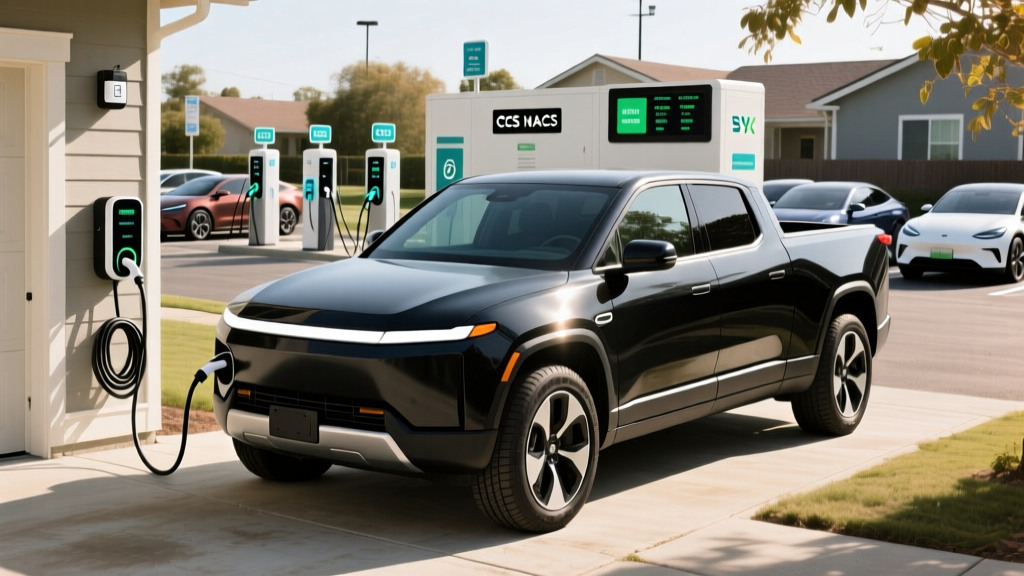
The charging connector landscape has shifted dramatically. As of the 2025 model year, Rivian transitioned to the NACS (North American Charging Standard) port — the same connector used by Tesla. This unlocks access to Tesla's Supercharger network, the most reliable DC fast charging infrastructure in North America.
| Connector Type | 2022–2024 R1T (CCS Port) | 2025+ R1T (NACS Port) |
|---|---|---|
| NACS (Tesla Supercharger) | Requires Rivian NACS adapter (included by Rivian) | Native — plug and charge |
| CCS1 (Electrify America, EVgo, etc.) | Native — plug and charge | Requires CCS-to-NACS adapter |
| CHAdeMO | Not compatible (no adapter available) | Not compatible |
| J1772 (Level 2 public) | Native for AC charging | Requires J1772-to-NACS adapter (included) |
For pre-2025 R1T owners: Rivian began shipping NACS adapters to existing owners in 2024. This adapter enables Supercharger access with the CCS-port truck. Verify your adapter is Rivian-approved — third-party adapters may not communicate correctly with the vehicle's charge management system.
For 2025+ R1T owners: Your truck charges natively at any Tesla Supercharger V3 (up to 250 kW) or V4 station. For Electrify America or other CCS networks, you'll need a CCS-to-NACS adapter. Rivian includes a J1772 adapter in the vehicle for public Level 2 stations.
Cost to Charge: Home Electricity vs. Public DC Fast Charging vs. Gas
One of the strongest arguments for the R1T is fuel cost savings — but the magnitude depends entirely on where and when you charge. Let's compare real scenarios using the R1T Large Pack's efficiency of ~43 kWh/100mi.
| Scenario | Rate ($/kWh) | Cost for 100 mi | Cost Per Mile | Equiv. Gas MPG (at $3.50/gal) |
|---|---|---|---|---|
| Home (off-peak utility rate) | $0.08–$0.12 | $3.44–$5.16 | $0.03–$0.05 | 70–102 MPG |
| Home (standard rate, no TOU) | $0.14–$0.18 | $6.02–$7.74 | $0.06–$0.08 | 44–58 MPG |
| Public Level 2 (ChargePoint, etc.) | $0.20–$0.35 | $8.60–$15.05 | $0.09–$0.15 | 23–39 MPG |
| DC Fast Charge (Electrify America) | $0.35–$0.55 | $15.05–$23.65 | $0.15–$0.24 | 15–23 MPG |
| Tesla Supercharger (avg.) | $0.28–$0.40 | $12.04–$17.20 | $0.12–$0.17 | 21–29 MPG |
| Gas truck baseline (Ford F-150, 18 MPG) | $3.50/gal | $19.44 | $0.19 | 18 MPG |
The takeaway is clear: home charging is where the economics work best. At off-peak residential rates, the R1T costs roughly one-quarter what a comparable gas truck spends per mile. Even at public DC fast charging rates, you're often at parity or slightly ahead of gas — but exclusively relying on DC fast charging erodes the cost advantage substantially.
Many utilities offer Time-of-Use (TOU) plans that discount electricity during overnight hours (typically 10 PM – 6 AM). Pairing a TOU plan with scheduled charging on your Level 2 charger maximizes savings. Check with your local utility for EV-specific rate plans.
Recommended Level 2 Chargers for the Rivian R1T
The R1T's 11.5 kW onboard charger means you benefit from a 48A-capable Level 2 unit. Here are top picks based on power output, cable length, smart features, and build quality — all verified for 2025–2026 availability.
Rivian Wall Connector
- Power: 11.5 kW (48A)
- Connector: NACS (2025+) / CCS (pre-2025)
- Cable: 25 ft
- Smart features: Wi-Fi, OTA updates, Rivian app integration, scheduled charging
- Price: ~$600 (often bundled with vehicle purchase)
- Verdict: Best integration with R1T; automatic software coordination
ChargePoint Home Flex
- Power: Up to 11.5 kW (48A, adjustable)
- Connector: NACS or J1772 (configurable)
- Cable: 24 ft
- Smart features: Wi-Fi, app scheduling, Alexa, load sharing
- Price: ~$550–$650
- Verdict: Excellent third-party option; flexible amperage for older panels
Tesla Wall Connector
- Power: 11.5 kW (48A)
- Connector: NACS
- Cable: 24 ft
- Smart features: Wi-Fi, OTA updates, power sharing between units
- Price: ~$475
- Verdict: Best value for 2025+ NACS-port R1T; reliable hardware
Emporia Vue Level 2
- Power: Up to 11.5 kW (48A)
- Connector: J1772 (NACS adapter needed for 2025+ R1T)
- Cable: 24 ft
- Smart features: Energy monitoring, solar integration, load management
- Price: ~$400–$500
- Verdict: Best for solar-panel homes; detailed energy tracking
All chargers listed above are hardwired units requiring professional installation. Plug-in (NEMA 14-50) variants exist but limit you to 40A (9.6 kW) due to NEC continuous-load rules on receptacles. For the R1T's large battery packs, hardwired 48A is the recommended configuration.
Safety, Code Compliance, and Installation Best Practices
EV charging draws sustained high current for hours — this is fundamentally different from intermittent loads like a microwave. Proper installation is non-negotiable for safety and insurance purposes.
- GFCI protection: NEC 2020 and later requires GFCI (Ground Fault Circuit Interrupter) protection for all EV charging outlets. Hardwired units may have built-in GFCI; verify with your electrician.
- Outdoor rating: If your charger is mounted outside or in an open garage, it must carry a NEMA 4 (or IP65+) weatherproof rating. All units recommended above meet this standard.
- Dedicated circuit: The EV charger must have its own breaker — never share with other appliances. A shared circuit risks tripping breakers or overheating wires.
- Cable management: Use a holster or cable retractor to keep the charge cable off the ground. Dragging cables across concrete accelerates jacket wear and exposes conductors.
- Surge protection: Consider a whole-home surge protector or a charger with built-in surge suppression, especially in areas with frequent lightning or unstable grid power.
- Permit and inspection: Most jurisdictions require an electrical permit for new 240V circuits. The inspection ensures code compliance and protects your home insurance coverage. Typical permit cost: $50–$200.
The National Fire Protection Association (NFPA) maintains the NEC, which is adopted by most US jurisdictions. Local amendments may apply — your electrician will know the requirements specific to your area.
Frequently Asked Questions
How much does it cost to install a home EV charger for my Rivian R1T?
For a straightforward installation (200A panel, short wire run to garage), expect $950–$1,950 total including the charger hardware, electrician labor, permit, and materials. If your home needs a panel upgrade from 100A to 200A service, total costs can reach $3,150–$7,200. Always get 2–3 quotes from licensed electricians.
How fast will each charging level add range to the R1T?
Level 1 (120V standard outlet) adds roughly 3–5 miles per hour — enough only for overnight top-ups of 30–50 miles. Level 2 (240V home charger at 48A) adds 20–30 miles per hour, fully recharging any R1T pack overnight. DC fast charging at peak rate can add 300–500 miles per hour, though this tapers significantly above 80% state of charge.
Which connector and charger is compatible with my R1T?
2025 and newer R1Ts have a native NACS port — compatible with Tesla Superchargers and any NACS-equipped station. 2022–2024 R1Ts have a CCS1 port and require Rivian's NACS adapter for Supercharger access. For home Level 2 charging, any NACS or J1772 charger (with adapter) will work. CHAdeMO is not compatible with any R1T.
How much does charging cost per mile compared to gas?
At home off-peak rates ($0.08–$0.12/kWh), the R1T costs $0.03–$0.05 per mile — equivalent to a gas truck getting 70–102 MPG. At public DC fast chargers ($0.35–$0.55/kWh), costs rise to $0.15–$0.24/mile, roughly matching or slightly beating a gas truck at 18 MPG. Home charging is where the R1T delivers maximum fuel savings.
What electrical upgrades might I need for a Level 2 charger?
The most common upgrade is a panel capacity increase from 100A to 200A main service ($1,500–$3,500). You may also need a new 60A double-pole breaker, 4 AWG copper wire run, and a permit. Homes with 200A+ panels usually accommodate a 48A EV circuit without upgrades. A licensed electrician's load calculation is the definitive answer.
Can I use a NEMA 14-50 outlet instead of hardwiring?
Yes, but with a trade-off. A NEMA 14-50 receptacle is rated for 50A, and NEC continuous-load rules limit you to 40A (80% of breaker rating), yielding ~9.6 kW instead of 11.5 kW. For the R1T Large or Max Pack, that means overnight charging takes 2–3 hours longer. Hardwired 48A is preferred for daily charging of large battery packs. If you choose 14-50, have your electrician install a high-quality industrial-grade receptacle (Hubbell or Bryant) — cheap receptacles have caused fires under sustained EV charging loads.
Does the Rivian R1T qualify for the federal EV tax credit?
Federal tax credit eligibility under IRS §30D depends on multiple factors: the vehicle must be assembled in North America (the R1T is built in Normal, Illinois), MSRP must be under $80,000 for trucks, and the buyer must meet income caps ($300K joint / $150K single for new vehicles). Battery component and critical mineral sourcing requirements also apply and change annually. As of 2025–2026, some R1T configurations qualify for up to $7,500, which can be applied as a point-of-sale reduction. Consult a tax professional and verify current eligibility on IRS.gov before purchasing.