The F-150 Crossroads: Supercharged Gas or Lightning Electric?
Searches for the 2025 Ford F-150 Supercharged have surged as enthusiasts weigh the Raptor R's supercharged 5.2L Predator V8 (700+ hp) against the battery-electric F-150 Lightning. But there's a critical charging-related dimension to this decision that most buyers overlook: the infrastructure and ongoing energy costs each powertrain demands. The supercharged F-150 relies on an Eaton supercharger that compresses intake air for more power — it has nothing to do with Tesla-style EV Superchargers. The Lightning, meanwhile, depends entirely on home and public charging infrastructure.
This guide breaks down exactly what you need to know to charge a Lightning at home, what it costs per mile versus pumping premium fuel into a supercharged F-150, and what electrical work your garage might require. If you're cross-shopping these trucks, the charging math could decide your purchase.
EV Charging Levels Explained: kW, Miles per Hour, and Real-World Speeds
Before we compare trucks, let's nail down the three charging tiers every Lightning owner (or prospective owner) must understand. Note: kW (kilowatts) measures power — how fast energy flows. kWh (kilowatt-hours) measures energy — the battery's total capacity. A 131 kWh Lightning Extended Range battery is like a 36-gallon fuel tank; a 150 kW charger is like a high-flow fuel pump.
| Level | Voltage | Power (kW) | Miles of Range Added per Hour | Best For |
|---|---|---|---|---|
| Level 1 | 120V | 1.4 kW | ~3 mi/hr | Emergency top-ups only |
| Level 2 | 240V | 7.7–19.2 kW | 20–52 mi/hr | Daily home charging |
| DC Fast | 400V+ DC | 50–150+ kW | ~150–250 mi in 30 min | Road trips |
The F-150 Lightning with the standard 98 kWh battery pack accepts up to 150 kW on DC fast charging, reaching 15–80% in roughly 41 minutes on a capable station (Ford F-150 Lightning specs). The Extended Range 131 kWh pack charges at a similar peak rate but takes longer in absolute time due to larger capacity. Level 2 charging via the optional 80A Charge Station Pro adds up to 30 miles of range per hour — meaning a full overnight charge easily replenishes a day of towing or commuting.
Home Charger Installation: Costs, Electrical Requirements, and Panel Gotchas
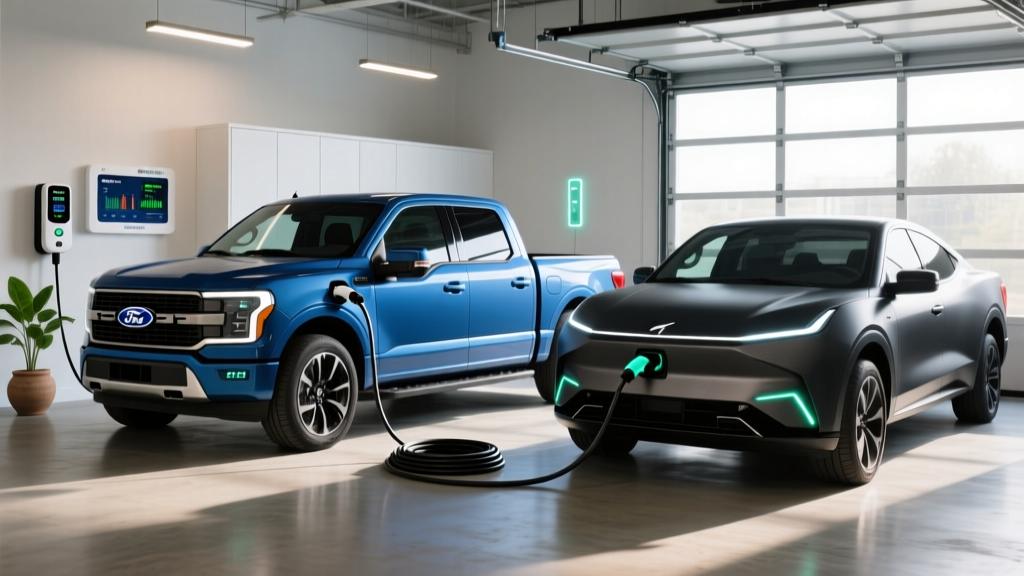
Here's where Lightning ownership gets real. A proper Level 2 home install is not a plug-and-play Amazon purchase — it requires a dedicated circuit, the right amperage, and likely a licensed electrician pulling a permit.
Electrical Requirements for the Lightning
- Ford Mobile Power Cord (included): 240V/30A NEMA 14-50 outlet → 7.7 kW → ~20 mi/hr
- Ford Charge Station Pro (optional): 240V/80A hardwired → 19.2 kW → ~52 mi/hr
- Circuit sizing rule: NEC requires a circuit rated 125% of continuous load, so a 40A charger needs a 50A breaker, an 80A charger needs a 100A breaker
Install Cost Breakdown
| Component | Low End | High End | Notes |
|---|---|---|---|
| Level 2 Charger (equipment) | $400 | $1,300 | Charge Station Pro is ~$1,300 MSRP |
| Electrician labor | $500 | $2,000 | Varies by run length from panel |
| Permit & inspection | $100 | $400 | Required in most jurisdictions |
| Electrical panel upgrade (if needed) | $1,500 | $4,500 | Older 100A panels may need 200A service |
| Total (no panel upgrade) | $1,000 | $3,700 | Most newer homes |
| Total (with panel upgrade) | $2,500 | $8,200 | Homes built before 1990 |
The panel upgrade is the budget killer. If your home has a 100-amp service and you want the full 80A Charge Station Pro, you'll almost certainly need a service upgrade to 200A. Get an electrician's load calculation before committing to equipment. The National Electrical Contractors Association recommends getting three quotes for any install over $1,500.
Connector Compatibility: NACS, CCS1, and the Adapter Situation
Ford made a pivotal move in 2024: the F-150 Lightning transitioned from CCS1 to the Tesla-designed NACS (North American Charging Standard) port starting with the 2025 model year. This unlocks Tesla Supercharger access natively — a huge advantage for road-tripping Lightning owners.
| Model Year | Native Port | Tesla Supercharger Access | CCS Station Access |
|---|---|---|---|
| 2022–2024 | CCS1 | Via Ford-provided NACS adapter | Native |
| 2025–2026 | NACS | Native | Via NACS-to-CCS adapter |
CHAdeMO is effectively dead for new light-duty vehicles — you won't encounter it on a Lightning. If you own a 2022–2024 Lightning, Ford distributed complimentary NACS adapters for Supercharger network access. For 2025+ trucks, keep a CCS adapter in the frunk for Electrify America or other legacy CCS stations.
Cost Per Mile: Lightning Electricity vs Supercharged F-150 Premium Fuel
This is where the Lightning wins decisively — if you charge smartly. The supercharged F-150 (Raptor R, 700 hp) is EPA-rated around 12 mpg combined. The Lightning Extended Range is rated at 66 MPGe combined (fueleconomy.gov). Let's translate that into dollars per mile.
| Scenario | Cost per Mile | Annual Cost (12,000 mi) |
|---|---|---|
| Lightning — home off-peak ($0.12/kWh) | $0.04 | $480 |
| Lightning — home peak ($0.22/kWh) | $0.07 | $840 |
| Lightning — public Level 2 ($0.30/kWh) | $0.10 | $1,200 |
| Lightning — DC fast charging ($0.48/kWh) | $0.16 | $1,920 |
| Supercharged F-150 — premium ($4.20/gal, 12 mpg) | $0.35 | $4,200 |
At home on off-peak rates, the Lightning costs roughly one-ninth what the supercharged F-150 costs in fuel per mile. Even on expensive DC fast charging, the Lightning is less than half the cost. Over five years and 60,000 miles, a home-charging Lightning owner saves approximately $18,000–$20,000 in energy costs versus premium fuel. That nearly closes the gap between a Lightning Lariat (~$62,000 MSRP) and an F-150 Raptor R (~$110,000 MSRP).
Charging Time Examples: What to Expect With the Lightning's Battery Packs
The Lightning offers two battery sizes. Here are realistic charge times accounting for the charge-curve taper that slows charging above 80% state of charge:
- Standard Range (98 kWh usable, LFP chemistry):
- Level 1 (1.4 kW): 0–100% in ~70 hours — impractical
- Level 2, 32A (7.7 kW): 0–100% in ~13 hours
- Level 2, 80A (19.2 kW): 0–100% in ~5.5 hours
- DC Fast (150 kW peak): 15–80% in ~41 min; 10–90% in ~58 min
- Extended Range (131 kWh usable, NMC chemistry):
- Level 2, 80A (19.2 kW): 0–100% in ~7.5 hours
- DC Fast (150 kW peak): 15–80% in ~45 min
LFP (lithium iron phosphate) batteries in the Standard Range pack tolerate regular 100% charging better than NMC, so daily top-offs to full are fine. The Extended Range NMC pack benefits from charging to 80% daily and 100% only before road trips — this preserves long-term state of health.
Recommended Home Chargers for the F-150 Lightning
Ford Charge Station Pro
Power: 19.2 kW / 80A
Connector: NACS (2025+ compatible natively)
Cable length: 25 ft
Smart features: FordPass integration, scheduled charging, Pro Power Onboard vehicle-to-home readiness
Price: ~$1,300
Verdict: Best for Lightning owners who want max speed and OEM integration. Requires 100A dedicated circuit.
Emporia Vue + Level 2 Charger
Power: 11.5 kW / 48A
Connector: J1772 (NACS adapter needed for 2025+ Lightning)
Cable length: 24 ft
Smart features: Energy monitoring, solar integration, load management
Price: ~$550
Verdict: Great value for solar-home owners; lower amperage means a 60A circuit suffices.
Wallbox Pulsar Plus
Power: 11.5 kW / 48A
Connector: J1772 (NACS adapter needed)
Cable length: 25 ft
Smart features: Wi-Fi, app scheduling, Power Sharing for dual installs
Price: ~$650
Verdict: Compact, reliable, good for 2-car garages with shared circuit.
Safety, Code, and Installation Best Practices
EV charging is a continuous high-load electrical event — treat it like an appliance that runs for 8 hours straight. Key code and safety points:
- Dedicated circuit: Your Level 2 charger must have its own breaker — never share with other outlets.
- GFCI protection: NEC 2020+ requires GFCI breakers for outdoor EV outlets; hardwired units may be exempt depending on jurisdiction.
- Outdoor rating: If your charger is outside, ensure NEMA 4 weatherproof rating and a weatherproof cover for the receptacle.
- Cable management: Use a wall holster — never leave cables on the ground where vehicles can run over them.
- Permit and inspection: Skipping permits risks insurance claim denials if a fire occurs. Most municipalities require inspection for any new 240V circuit.
Frequently Asked Questions
How much does it cost to install a home EV charger for the F-150 Lightning?
Between $1,000 and $3,700 for most homes with adequate panel capacity (200A service). If your home needs an electrical panel upgrade from 100A to 200A, add $1,500–$4,500. The Ford Charge Station Pro itself costs ~$1,300 before installation.
How fast will each charging level add range to the Lightning?
Level 1 (120V) adds about 3 miles per hour — useless for daily use. Level 2 (240V) adds 20–52 miles per hour depending on amperage. DC fast charging adds roughly 150–250 miles in 30 minutes at a 150 kW station.
Which connector does the 2025 F-150 Lightning use?
2025 and 2026 Lightnings use the NACS (Tesla-style) connector natively, granting direct Supercharger access. Older 2022–2024 models have CCS1 ports and require a Ford-provided adapter for Superchargers.
How much does charging the Lightning cost per mile vs gas in the supercharged F-150?
Home off-peak charging costs about $0.04/mile in the Lightning. The supercharged F-150 Raptor R costs roughly $0.35/mile on premium fuel — nearly 9x more. Even public DC fast charging at $0.16/mile is half the cost of gas.
What electrical upgrades might my home need?
Homes built before 1990 often have 100A panels that can't support an 80A charger circuit. A panel upgrade to 200A costs $1,500–$4,500. Even newer homes may need a sub-panel if the main panel is full. Get a licensed electrician's load calculation before purchasing equipment.
Does the supercharged F-150 have anything to do with EV Superchargers?
No. The "supercharged" in the F-150 Raptor R refers to its Eaton mechanical supercharger — a belt-driven compressor that forces more air into the V8 engine for 700+ horsepower. Tesla's "Supercharger" is a branded DC fast-charging network for electric vehicles. Completely different technologies with the same root word.
Source references: fueleconomy.gov, Ford Motor Company, IRS §30D Clean Vehicle Credit rules.