Rivian's Switch to NACS: What It Means for Your Charging Setup
Starting with the 2025 model year, Rivian transitioned both the R1T and R1S from CCS1 to the North American Charging Standard (NACS) — the Tesla-designed connector now adopted across the industry. For 2026, every new R1T and R1S leaves the factory with a native NACS port, unlocking direct access to Tesla's Supercharger network without an adapter. If you own an earlier CCS-equipped Rivian (2022–mid-2024), Rivian offers a CCS-to-NACS adapter that grants the same Supercharger access.
This guide covers everything you need to charge a Rivian at home and on the road under the NACS ecosystem: charging speeds at every level, home installation costs with electrical requirements, connector compatibility, real charging times for the R1's large battery packs, and equipment picks.
Charging Levels Explained: Speeds, kW, and Miles Per Hour
Before choosing equipment, understand the three charging tiers. The critical distinction: kW (kilowatts) measures power — how fast energy flows into the battery. kWh (kilowatt-hours) measures energy — the battery's total capacity. A 100 kWh battery charged at 10 kW takes roughly 10 hours from empty to full (minus losses).
| Level | Voltage | Max Power (kW) | Miles of Range Added Per Hour | Typical Use Case |
|---|---|---|---|---|
| Level 1 | 120V AC | 1.4 kW | ~3–5 mi/hr | Emergency / trickle top-up |
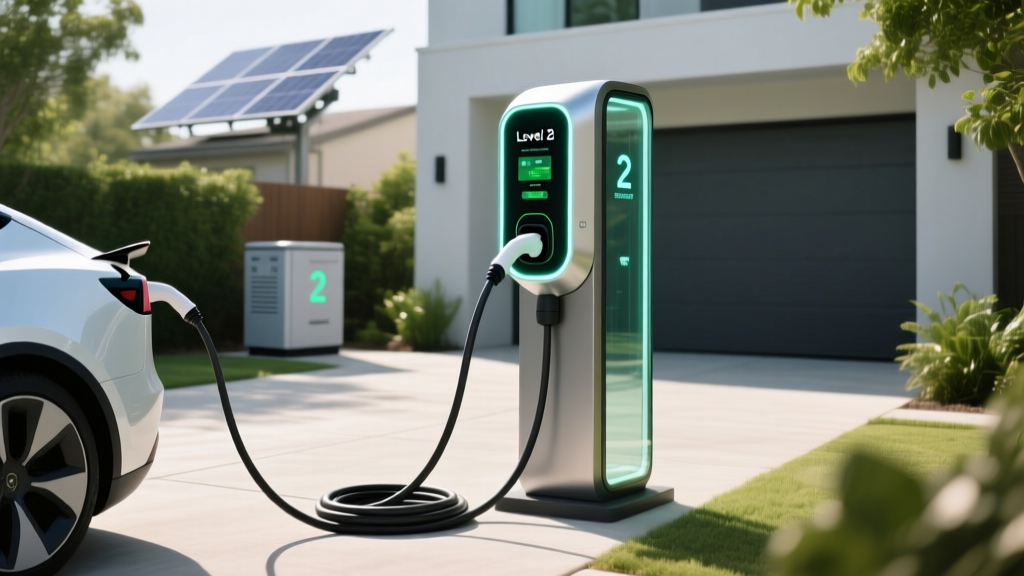
| Level 2 (Home) | 240V AC | 11.5 kW (48A) / 19.2 kW (80A) | ~30–50 mi/hr | Daily home charging |
| DC Fast Charging | 400V+ DC | ~220 kW peak (NACS Supercharger V4) | ~150–200 mi in 20 min | Road trips, rapid top-ups |
The Rivian R1T and R1S support up to 19.2 kW AC Level 2 charging via their onboard charger — one of the highest AC rates in the segment. That means on a properly provisioned 100-amp circuit (80A continuous), you can add roughly 50 miles of range per hour. On a standard 48A / 60A circuit at 11.5 kW, expect about 30 miles per hour.
Home Level 2 Charger Installation: Electrical Requirements and Costs
A Level 2 home charger is the backbone of practical Rivian ownership. Here is what the installation actually requires and costs.
Electrical Requirements
- Circuit: Dedicated 240V circuit. For 48A charging, you need a 60-amp breaker (NEC requires 125% headroom for continuous loads). For the full 80A / 19.2 kW capability, a 100-amp breaker is required.
- Wire gauge: 6 AWG copper for 60A circuits; 3 AWG or 2 AWG for 100A circuits, depending on run length and local code.
- Panel capacity: Your main electrical panel must have sufficient spare capacity. A 200-amp panel with existing heavy loads (electric range, dryer, HVAC) may require a panel upgrade to 300–400 amps or a load-management device.
- Permit: Most jurisdictions require an electrical permit for EV charger installation. Your electrician pulls this; inspection follows.
- GFCI: NEC 2020+ requires GFCI protection for outdoor receptacles. Hardwired chargers may or may not require GFCI depending on local interpretation — your licensed electrician will confirm.
- Outdoor rating: If mounting outdoors, the charger must carry a NEMA 4 or NEMA 4X weatherproof rating.
Installation Cost Breakdown
| Component | Cost Range | Notes |
|---|---|---|
| Level 2 Charger (Equipment) | $400 – $750 | 48A smart chargers; 80A units $700–$1,000+ |
| Electrician Labor (standard install) | $600 – $1,500 | Short run from panel; conduit, wiring, breaker |
| Electrician Labor (long run / complex) | $1,500 – $3,500 | Long conduit runs, trenching, attic crawls |
| Electrical Permit | $50 – $250 | Varies by municipality |
| Panel Upgrade (if needed) | $2,000 – $5,000+ | 200A → 300A/400A; older homes most affected |
| Total (standard, no panel upgrade) | $1,050 – $2,500 | Most common scenario for newer homes |
| Total (with panel upgrade) | $3,000 – $7,000+ | Older homes with 100A or 150A service |
Connector Compatibility: NACS, CCS1, and Adapter Options
The connector landscape has consolidated around NACS, but legacy infrastructure still matters.
| Model Year | Native Port | Supercharger Access | CCS Station Access | CHAdeMO |
|---|---|---|---|---|
| 2022 – mid-2024 R1T/R1S | CCS1 | Via Rivian-provided CCS-to-NACS adapter | Direct (native) | Not supported |
| 2025–2026 R1T/R1S | NACS | Direct (native) | Via NACS-to-CCS adapter (sold separately) | Not supported |
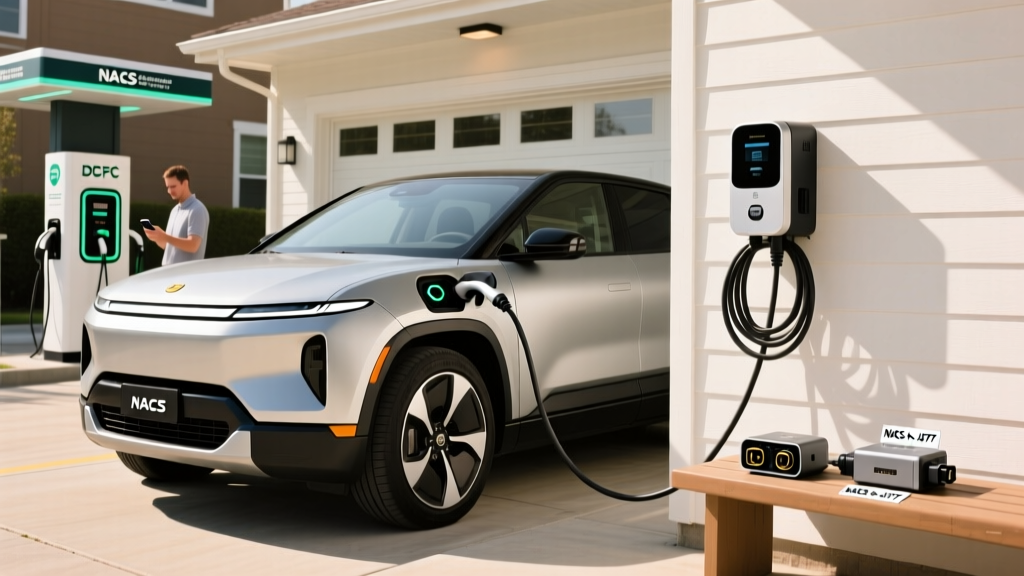
Key adapter note: If you have a 2025+ NACS-equipped Rivian and encounter a CCS-only public charger (common at Electrify America, EVgo, and older ChargePoint stations), you need a NACS-to-CCS adapter. Rivian sells an official adapter, and third-party options from brands like Lectron and A2Z are available for $150–$250. CCS-to-NACS adapters (for older Rivians to access Superchargers) are provided or sold by Rivian directly.
CHAdeMO is effectively obsolete for new Rivian owners. The few remaining CHAdeMO stations cannot be adapted without expensive, uncommon hardware — skip this connector entirely.
Charging Times for Rivian Battery Packs: 10–80% Estimates
Rivian offers two main battery sizes for the 2026 R1T and R1S. Charging times depend heavily on the power source and the battery's charge curve — peak kW is only sustained at low states of charge and tapers significantly above 80%.
| Battery Pack | Usable Capacity | Chemistry | DC Fast (220 kW peak) | Level 2 at 19.2 kW (80A) | Level 2 at 11.5 kW (48A) |
|---|---|---|---|---|---|
| Standard | ~106 kWh | LFP | ~25–30 min | ~4.5 hrs | ~7 hrs |
| Large | ~128 kWh | NMC | ~30–40 min | ~5.5 hrs | ~8.5 hrs |
Cost to Charge: Home vs. Public vs. Gas
One of the strongest ownership arguments for the R1T and R1S is fuel cost savings, but the gap narrows significantly when relying on public DC fast charging.
| Scenario | Rate ($/kWh) | Cost per 100 Miles | Equivalent Gas Vehicle (18 MPG, $3.50/gal) |
|---|---|---|---|
| Home Off-Peak (utility TOU rate) | $0.08 – $0.12 | $2.67 – $4.00 | $19.44 |
| Home Standard Rate | $0.14 – $0.18 | $4.67 – $6.00 | $19.44 |
| Public Level 2 (ChargePoint, EVgo) | $0.25 – $0.39 | $8.33 – $13.00 | $19.44 |
| DC Fast Charging (Supercharger / EA) | $0.35 – $0.55 | $11.67 – $18.33 | $19.44 |
Home charging at off-peak rates delivers the most dramatic savings — roughly 80–85% less per mile than a comparable gas truck. Even at standard residential rates, you save 65–75%. But DC fast charging on road trips approaches gas-car costs, especially at $0.50+/kWh urban Supercharger locations. This is typical across all EVs, not unique to Rivian.
The federal IRS §30D tax credit may apply to new Rivian purchases, but eligibility depends on MSRP caps, buyer income limits, battery critical-mineral sourcing, and point-of-sale transfer rules that shift annually. Always verify current-year requirements on IRS.gov or with a tax professional.
Recommended Home Chargers for Rivian (NACS, 2026)
These chargers pair well with Rivian's high AC acceptance rate and NACS port. All recommendations are NACS-native (no adapter needed for 2025+ vehicles).
Tesla Wall Connector (NACS)
- Power: Up to 11.5 kW (48A) on 60A circuit
- Connector: Native NACS
- Cable: 24 ft
- Smart features: Wi-Fi, OTA updates, load sharing between units, access control
- Price: ~$475
- Best for: Budget-friendly, reliable daily charger; ideal if you also own a Tesla
ChargePoint Home Flex (NACS version)
- Power: Up to 19.2 kW (80A) on 100A circuit; configurable down to 16A
- Connector: Native NACS (2025+ model)
- Cable: 23 ft
- Smart features: Wi-Fi, app scheduling, Alexa integration, energy reporting
- Price: ~$650
- Best for: Maximizing Rivian's 19.2 kW onboard charger; flexible amperage for any panel
Emporia Vue + Level 2 Charger
- Power: Up to 11.5 kW (48A) on 60A circuit
- Connector: Native NACS
- Cable: 24 ft
- Smart features: Integrated home energy monitoring, solar integration, scheduled charging, load management
- Price: ~$550 (charger) / ~$850 (with Vue panel monitor)
- Best for: Solar-equipped homes and panel-constrained installations needing smart load management
Safety, Code, and Installation Best Practices
EV charging draws sustained high current for hours — treat it like a major appliance installation, not a phone charger.
- Dedicated circuit only: Never share the EV charger circuit with other loads. The NEC requires a dedicated breaker.
- Hardwired vs. plug: Hardwired installations (no NEMA 14-50 receptacle) are generally safer for continuous 48A+ loads, eliminate the GFCI-nuisance-tripping issue common with 14-50 outlets, and are required by some local codes for circuits above 60A.
- NEMA 14-50 caution: If using a plug-in setup, ensure the receptacle is rated for continuous 50A draw. Residential-grade 14-50 outlets from big-box stores have failed under sustained EV loads — specify an industrial-grade Hubbell or Bryant receptacle.
- Outdoor installations: Use a NEMA 4-rated charger enclosure. Ensure the conduit and junction boxes are rated for wet locations. A drip loop on the cable prevents water ingress.
- Load management: If your panel is near capacity but you want to avoid a full upgrade, devices like the Emporia Vue or Sense monitor can dynamically throttle charger amperage based on real-time household load.
- Always use a licensed electrician: Final circuit sizing, wire gauge, and code compliance should be determined by a licensed professional who has performed a load calculation on your specific panel. This guide provides typical ranges, not a substitute for a site assessment.
Frequently Asked Questions
How much does it cost to install a home EV charger for my Rivian?
Most homeowners spend between $1,050 and $2,500 for a standard Level 2 installation (charger + electrician + permit) when no panel upgrade is needed. If your home requires a panel upgrade from 100A/150A to 200A+, total costs can reach $3,000–$7,000+. Always get a load calculation first.
How fast will each charging level add range to my Rivian?
Level 1 (120V) adds roughly 3–5 miles per hour — suitable only for overnight trickle charging. Level 2 at 48A / 11.5 kW adds ~30 miles per hour. Level 2 at 80A / 19.2 kW (Rivian's max AC rate) adds ~50 miles per hour. DC fast charging at a Supercharger V4 can add 140+ miles in 20 minutes under optimal conditions.
Which connector and charger is compatible with my Rivian?
2025–2026 Rivian R1T and R1S models have a native NACS port and plug directly into Tesla Superchargers and any NACS-equipped Level 2 charger. Earlier CCS1-equipped Rivians (2022–mid-2024) require Rivian's CCS-to-NACS adapter for Supercharger access. For CCS-only public chargers with a NACS Rivian, you need a NACS-to-CCS adapter.
How much does charging a Rivian cost per mile vs. gas?
At home off-peak rates ($0.10/kWh), a Rivian R1T costs roughly $0.03/mile to drive — compared to ~$0.19/mile for a gas truck averaging 18 MPG at $3.50/gallon. Public DC fast charging at $0.45/kWh costs roughly $0.15/mile, narrowing the gap substantially. Home charging is where the economics work best.
What electrical upgrades might I need for a Rivian home charger?
The most common upgrade is a panel capacity increase (200A to 300A/400A), needed when your existing panel lacks spare capacity for a 60A or 100A dedicated EV circuit. Older homes with 100A service almost always need an upgrade. Alternatives include smart load-management devices that throttle charger draw based on real-time household usage, potentially avoiding a full panel swap.
Should I charge my Rivian to 100% every night?
For the Large battery (NMC chemistry), set a daily charge limit of 80–90% to minimize long-term degradation; charge to 100% only before road trips. The Standard battery (LFP chemistry) tolerates regular 100% charging better — in fact, LFP benefits from periodic full charges for accurate state-of-charge calibration. Rivian's app lets you set custom charge limits per schedule.