Rivian's R1T and R1S are among the most capable electric trucks and SUVs on the road, but their charging setup has evolved significantly since the brand's 2022 launch. If you're shopping for a new Rivian or optimizing your current ownership, understanding exactly how the Rivian charging port works — from connector type and adapter requirements to home Level 2 installation and public DC fast charging — is essential to getting the most from your vehicle.
This guide breaks down every charging scenario a Rivian owner will encounter in 2026, with exact kW figures, real-world charge times, and honest cost data.
Rivian Charging Port: NACS vs. CCS1 by Model Year
The biggest thing to know about Rivian's charging port is that the physical connector changed mid-generation. Here's what you need to know based on which R1T or R1S you own or plan to buy:
- 2022–2024 Rivian R1T/R1S (Gen 1): Equipped with a CCS1 (Combined Charging System) port. These vehicles use the CCS1 standard for DC fast charging and a J1772 inlet for Level 1/Level 2 AC charging.
- 2025–2026 Rivian R1T/R1S (Gen 2): Built with the native NACS (North American Charging Standard) port — the same connector used by Tesla. This gives Gen 2 Rivians direct access to the Tesla Supercharger network without an adapter.
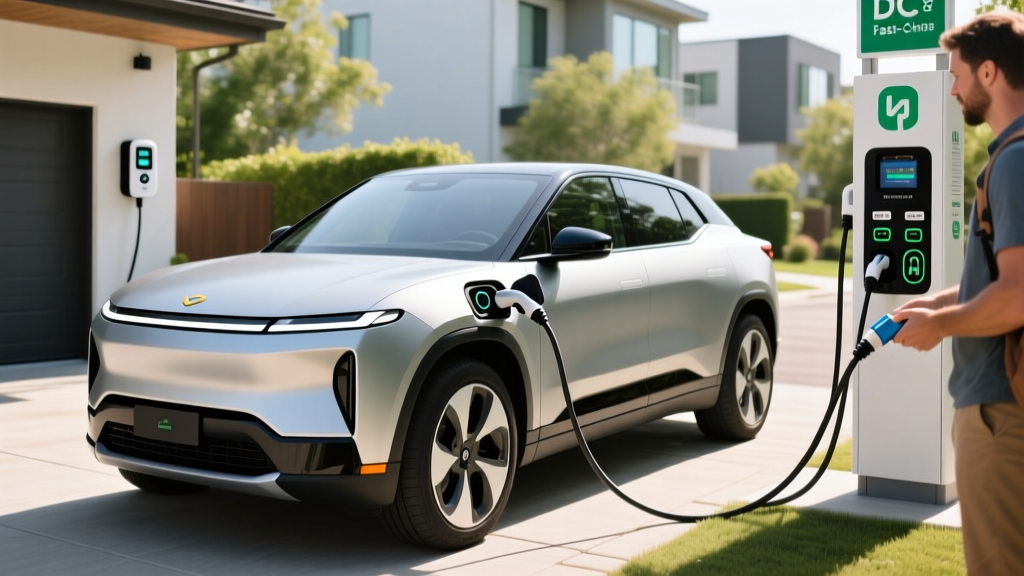
If you own a Gen 1 Rivian with CCS1 and want to use Tesla Superchargers, Rivian began shipping a NACS adapter to registered owners starting in mid-2024. This adapter plugs into your CCS1 port and allows connection to NACS chargers. As of 2026, Rivian Gen 1 vehicles have access to over 15,000 V3 and V4 Supercharger stalls across the U.S. using this adapter, though not all Supercharger sites have stalls configured with the cable reach to accommodate non-Tesla port placements — always check the Rivian app or in-car navigation for confirmed compatible stalls.
| Connector | Gen 1 (2022–2024) | Gen 2 (2025–2026) | Adapter Required? |
|---|---|---|---|
| NACS (Tesla Supercharger) | Yes (with adapter) | Native | Gen 1: Yes (Rivian-supplied NACS adapter) |
| CCS1 (Electrify America, EVgo, etc.) | Native | Yes (with adapter) | Gen 2: Yes (CCS1-to-NACS adapter, sold separately) |
| CHAdeMO | Not supported | Not supported | N/A — CHAdeMO is effectively discontinued in the U.S. |
| J1772 (Level 2 public AC) | Native | Yes (NACS-to-J1772 adapter) | Gen 2: Yes (typically included with vehicle) |
Key takeaway: If you're buying a 2025 or 2026 Gen 2 Rivian, you'll want to keep a CCS1-to-NACS adapter in the frunk for Electrify America and other non-Tesla DC fast networks. If you're on Gen 1, the Rivian-supplied NACS adapter unlocks Supercharger access. Either way, plan to carry one adapter for the connector your vehicle doesn't natively support.
Charging Levels Explained: How Fast Each Adds Range to a Rivian
Before we get into specific times, a critical distinction: kW (kilowatts) measures charging power — the rate at which energy flows into your battery. kWh (kilowatt-hours) measures energy capacity — the total amount of energy your battery holds. Think of kW as the width of the hose and kWh as the size of the tank. A Rivian R1T with the Max battery holds roughly 149 kWh of usable energy; one with the Standard battery holds about 106 kWh. The larger the battery, the longer any given kW rate will take to fill it.
| Charging Level | Power (kW) | Voltage | Miles of Range Added per Hour | Best Use Case |
|---|---|---|---|---|
| Level 1 (120V household outlet) | ~1.4 kW | 120V / 12A | ~3–4 miles/hr | Emergency/trickle top-up only |
| Level 2 (240V home or public AC) | 7.7–11.5 kW | 240V / 32–48A | ~20–37 miles/hr | Daily home charging, overnight |
| DC Fast Charging (Gen 1 CCS1) | Up to ~200 kW peak | 400V architecture | ~140+ miles in 20 min | Road trips, rapid top-ups |
| DC Fast Charging (Gen 2 NACS) | Up to ~220 kW peak | 400V architecture | ~150+ miles in 20 min | Road trips, Supercharger V3/V4 access |
Rivian's onboard AC charger is rated at 11.5 kW (48 amps) on Gen 1 and Gen 2 models. This means that on a properly wired 48-amp Level 2 home charger, you'll add roughly 37 miles of range per hour of charging. On a lower-amperage 32-amp circuit (7.7 kW), expect closer to 25 miles per hour.
Real-world charging time (10–80% SoC):
- Level 2 at 11.5 kW (Standard Pack, 106 kWh): ~7.5 hours from 10% to 80%
- Level 2 at 11.5 kW (Max Pack, 149 kWh): ~10.5 hours from 10% to 80%
- DC fast charge, Gen 2 at ~220 kW peak (Standard Pack): ~20–25 minutes (10–80%)
- DC fast charge, Gen 2 at ~220 kW peak (Max Pack): ~28–35 minutes (10–80%)
Note: DC fast charging follows a charge curve — peak kW is sustained only at lower states of charge (roughly 10–40% SoC). Above 80%, charging speed tapers significantly to protect battery health. This is why we quote 10–80% times rather than 0–100%.
How Much Does It Cost to Install a Home EV Charger for a Rivian?
Home Level 2 charging is where the vast majority of Rivian owners do their charging. The Rivian Wall Charger is a solid option, but third-party chargers work identically — your Rivian doesn't require a proprietary home unit. Here's what a typical 240V / 48-amp home installation involves and costs.
Electrical Requirements
To get the full 11.5 kW charge rate your Rivian supports, you need a 240V / 60-amp dedicated circuit (the National Electrical Code requires circuits to be rated at 125% of the continuous load, so a 48-amp charger needs a 60-amp breaker). If you're willing to charge at a slower rate, a 40-amp breaker (supporting a 32-amp / 7.7 kW charger) may suffice and can be easier on older electrical panels.
Panel upgrade reality: Many homes built before 2000 have 100-amp or 150-amp main panels. Adding a 60-amp EV circuit to an already-loaded panel may require a panel upgrade to 200 amps, which typically costs $1,500–$3,000 before any other work. A licensed electrician will perform a load calculation during the estimate visit to determine if your panel can handle the additional circuit. Don't skip this step — overloading a panel is a fire risk and will fail inspection.
Permits and Code
Most jurisdictions require a permit for a new 240V circuit. Permit costs range from $50 to $200 depending on your city or county. The installation must comply with NEC Article 625 (Electric Vehicle Charging System Equipment), which includes requirements for:
- A dedicated circuit (no sharing with other appliances)
- GFCI protection (built into most modern EVSE units)
- Proper wire gauge (6 AWG copper for 60-amp circuits)
- Outdoor-rated equipment and NEMA 4 enclosure if installed outside
- Cable management to prevent tripping hazards
| Component | Low End | High End | Notes |
|---|---|---|---|
| Level 2 charger unit (48A, hardwired) | $400 | $750 | Rivian Wall Charger ~$550; Emporia, ChargePoint, Wallbox similar |
| Electrician labor (run 240V circuit, mount charger) | $500 | $2,000 | Depends on distance from panel, wall material, conduit run |
| Permit fee | $50 | $200 | Varies by jurisdiction |
| Electrical panel upgrade (if needed) | $1,500 | $3,000 | Only if existing panel lacks capacity — not always required |
| Total (no panel upgrade) | $950 | $2,950 | Most homes with 200A panels fall in $1,200–$1,800 |
| Total (with panel upgrade) | $2,450 | $5,950 | Older homes with 100A/150A service |
Federal incentive note: The Residential Clean Energy Credit (IRS Form 5695) previously covered 30% of home EV charger equipment and installation costs up to $1,000. Check current-year IRS guidance, as this credit has specific expiration and eligibility requirements that differ from the §30D vehicle purchase credit. Some states and utilities also offer rebates for Level 2 charger installation — check your local utility's EV programs.
Recommended Home Chargers for Rivian Owners
Your Rivian will work with any J1772 or NACS Level 2 charger (with the appropriate adapter for your generation). Here are three proven options that match Rivian's 11.5 kW onboard charger capability:
Rivian Wall Charger
- Power output: 11.5 kW (48 amps)
- Connector: NACS (Gen 2 native); J1772 adapter available for Gen 1
- Cable length: 25 feet
- Smart features: Wi-Fi enabled, integrates with Rivian app for scheduling and energy tracking
- Price: ~$550
- Best for: Seamless integration with the Rivian ecosystem; clean aesthetic match
ChargePoint Home Flex
- Power output: Up to 12 kW (50 amps), configurable down to match your circuit
- Connector: J1772 (NACS adapter available); 24-foot cable
- Smart features: Wi-Fi, app-based scheduling, Alexa integration, detailed energy reporting
- Price: ~$550–$700
- Best for: Flexible amperage settings; excellent app; works across all EV brands if you have multiple vehicles
Emporia Vue Level 2 Charger
- Power output: Up to 11.5 kW (48 amps)
- Connector: J1772 or NACS variants available
- Cable length: 24 feet
- Smart features: Wi-Fi, app scheduling, solar-integration capability with Emporia energy monitor
- Price: ~$400–$500
- Best for: Budget-conscious buyers who still want smart features and full 48-amp output
Pro tip: Hardwire your charger rather than using a NEMA 14-50 outlet. Hardwiring eliminates the receptacle as a potential failure point, avoids the NEC requirement for a GFCI breaker (which can nuisance-trip with some EVSE units), and allows the full 48-amp continuous draw. A NEMA 14-50 outlet is limited to 40 amps continuous, capping your charge rate at 9.6 kW instead of 11.5 kW.
Public DC Fast Charging: Networks, Costs, and the Rivian Experience
For road trips, Rivian owners have access to three major DC fast charging ecosystems in 2026:
- Tesla Supercharger network (NACS): Over 15,000 V3 (250 kW) and V4 stalls. Gen 2 Rivians plug in natively. Gen 1 Rivians use the NACS adapter. Reliability and uptime are generally the best of any network, though cable reach at some older V3 stalls can be tight for the Rivian's driver-side rear port location.
- Electrify America (CCS1): ~4,000 stalls nationwide, many capable of 150–350 kW. Gen 1 Rivians plug in natively. Gen 2 Rivians need a CCS1-to-NACS adapter. Reliability has improved but still trails Tesla.
- EVgo, ChargePoint, and other networks: Mixed CCS1/NACS availability. Check your Rivian's in-car navigation for real-time stall status and connector types.
| Scenario | $/kWh | Cost for 10–80% Charge (~74 kWh) | Cost per Mile (est.) |
|---|---|---|---|
| Home, off-peak utility rate | $0.08–$0.12 | $5.90–$8.90 | $0.03–$0.04 |
| Home, standard utility rate | $0.14–$0.18 | $10.35–$13.30 | $0.05–$0.07 |
| Public Level 2 (workplace, shopping) | $0.20–$0.30 | $14.80–$22.20 | $0.07–$0.11 |
| Tesla Supercharger V3 | $0.28–$0.36 | $20.70–$26.65 | $0.10–$0.13 |
| Electrify America (DC fast) | $0.32–$0.48 | $23.70–$35.50 | $0.12–$0.17 |
| Gas equivalent (25 MPG combined, $3.40/gal) | N/A | N/A | $0.14 |
The Rivian R1T Dual-Motor with the Standard Pack achieves an EPA-estimated 270 miles of range (expect 230–250 miles in real-world highway driving at 70+ mph, per fueleconomy.gov data and owner reports). At roughly 2.0–2.2 miles per kWh, the R1T is less efficient than a sedan like the Tesla Model 3, but competitive within the electric truck segment. The Max Pack extends EPA range to approximately 350+ miles but adds weight that slightly reduces efficiency.
Cold-weather note: In temperatures below 32°F, expect 15–30% range reduction depending on severity and whether you precondition the battery. Rivian's heat pump (standard on Gen 2, optional on late Gen 1 builds) significantly reduces the cabin-heating energy penalty. Always precondition your battery before a DC fast charge session — the Rivian navigation system does this automatically when you route to a charger.
How Much Does Charging a Rivian Cost Per Mile vs. Gas?
This is the question that determines whether the Rivian's higher MSRP pays off in operating savings. Here's a direct comparison:
Assume a comparable gas-powered full-size truck averaging 19 MPG combined (a realistic figure for a loaded 4x4 crew cab) at $3.40 per gallon. That works out to roughly $0.18 per mile in fuel alone. A Rivian R1T charged primarily at home on a standard utility rate ($0.15/kWh) costs approximately $0.07 per mile in electricity — a savings of about $0.11 per mile, or roughly $1,650 per year at 15,000 miles driven annually.
If you charge mostly on DC fast chargers at $0.35/kWh (road-trip-heavy lifestyle), your cost per mile rises to ~$0.16 — nearly breakeven with gas. The economics strongly favor home charging. If you lack access to home or workplace Level 2 charging, the cost advantage of an EV narrows considerably.
Other ownership cost factors: EVs eliminate oil changes, transmission fluid, and exhaust system maintenance. However, the R1T's weight (~7,000+ lbs) accelerates tire wear — budget for tire replacement every 30,000–40,000 miles. Insurance premiums for the R1T and R1S tend to run 15–25% higher than comparable gas trucks due to repair costs and parts availability.
Safety, Electrical Code, and Installation Best Practices
EV charging involves sustained high-current draw that's fundamentally different from typical household appliance use. A Level 2 charger pulling 48 amps continuously for 8+ hours places demands on your wiring that a dryer or oven (which cycles on and off) does not. Here are the non-negotiable safety requirements:
- Dedicated circuit only: Your EV charger must have its own breaker — never share a circuit with other loads. NEC Article 625 treats EV charging as a continuous load.
- Wire gauge matters: 6 AWG copper wire for a 60-amp breaker / 48-amp charger. Undersized wire creates heat buildup and fire risk.
- GFCI protection: Required by NEC 2017+ for outdoor outlets. Hardwired EVSE units have built-in ground-fault protection, which is why hardwiring is preferred — it avoids the nuisance-trip issues that some GFCI breakers cause with EV chargers.
- Outdoor rating: If your charger is installed outside (garage exterior, driveway, carport), the unit must be rated NEMA 4 (weatherproof). All major chargers listed above meet this standard.
- Permit and inspection: Skipping the permit saves $50–$200 but voids your homeowner's insurance coverage for any electrical fire originating from the unpermitted work. Always pull the permit and schedule the inspection.
Hire a licensed electrician. This is not a DIY project. The combination of high amperage, continuous load, and outdoor exposure requires professional installation. Get at least two quotes and confirm the electrician has EV charger installation experience — ask for references from other EV owners in your area.
Rivian Charging FAQ
Can I use a Tesla Supercharger with my 2022 or 2023 Rivian R1T?
Yes. Rivian has distributed NACS adapters to registered Gen 1 owners. With this adapter plugged into your CCS1 charging port, you can use Tesla V3 and V4 Superchargers. The adapter supports the full ~200 kW peak DC fast charge rate your Gen 1 Rivian can accept. Confirm your adapter is active in the Rivian app before your first Supercharger session.
Where is the charging port located on a Rivian?
On both Gen 1 and Gen 2 R1T and R1S models, the charging port is on the driver's side, rear quarter panel (left rear). This is important for parking at public chargers — you'll want to pull through or back in so the driver's side faces the charging pedestal. Some Supercharger stalls with short cables may require you to park at an angle or use a specific designated stall.
How fast does the Rivian R1T charge at home on Level 2?
With a 48-amp / 11.5 kW Level 2 charger on a 60-amp circuit, a Standard Pack R1T (106 kWh) charges from 10% to 80% in roughly 7.5 hours. The Max Pack (149 kWh) takes about 10.5 hours for the same 10–80% session. This is ideal for overnight charging — plug in when you get home and wake up with a full daily driving range.
Does Rivian include a portable charger?
Yes. Rivian includes a portable Level 1/Level 2 charger with each new vehicle. It supports 120V (Level 1, ~1.4 kW) with the standard household plug adapter, and 240V (Level 2, up to 7.7 kW / 32 amps) with the included NEMA 14-50 adapter. It's useful as a backup or for charging at locations without dedicated EVSE, but a wall-mounted 48-amp unit will charge roughly 50% faster.
What electrical panel size do I need for a home Rivian charger?
A 200-amp main service panel is generally sufficient for most homes adding a 60-amp EV circuit, provided you don't already have significant other loads (electric heat, electric dryer, electric range, hot tub). Homes with 100-amp or 150-amp panels will likely need an upgrade. Your electrician will perform a NEC Article 220 load calculation to determine your panel's remaining capacity. Per the National Electrical Code, the EV circuit cannot exceed the panel's calculated available headroom.
Is DC fast charging bad for the Rivian battery?
Occasional DC fast charging is fine and expected for road trips. However, frequent daily DC fast charging can accelerate battery degradation over time compared to consistent Level 2 home charging. Rivian's battery management system actively manages thermal conditions and charge tapering to protect the pack. For daily use, Level 2 home charging is optimal; reserve DC fast charging for trips. The battery warranty covers 8 years / 175,000 miles with a minimum 70% capacity retention threshold, per Rivian's warranty documentation.