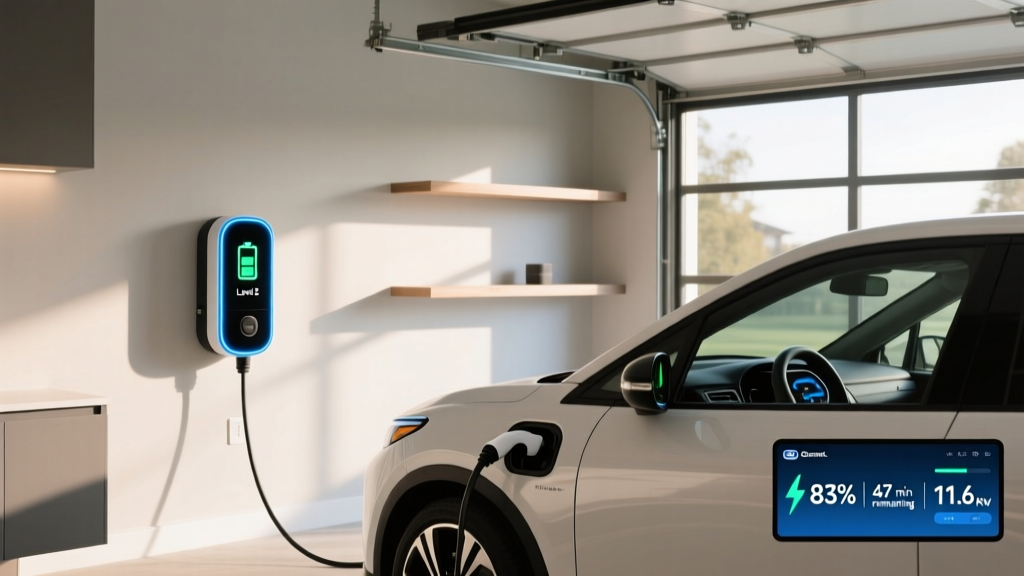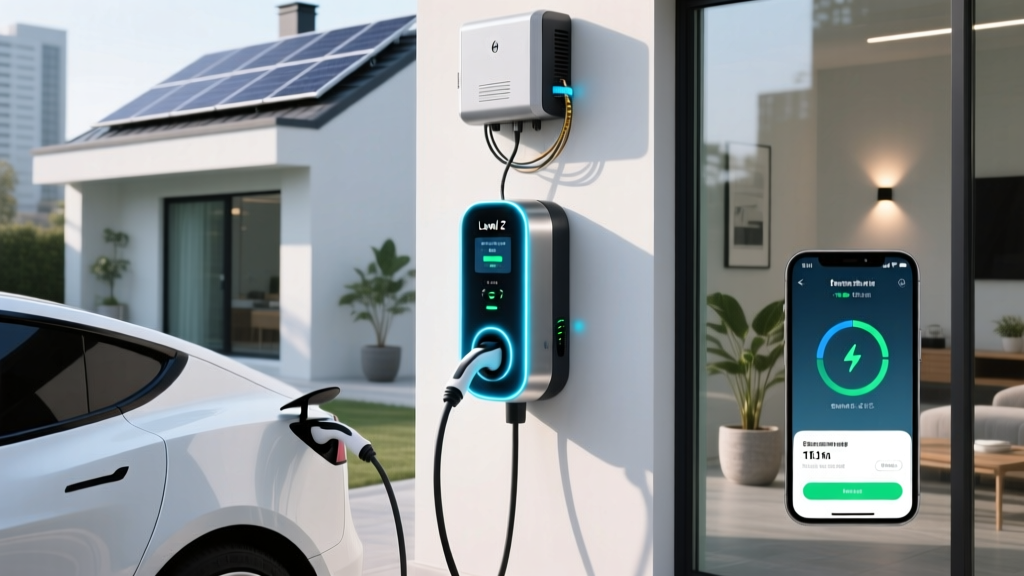
If you own a Rivian R1T or R1S—or are about to take delivery—you've likely spent time zooming in on the Rivian charger map in the app, planning road trips around Waypoints and third-party DC fast chargers. But for 80% or more of your actual charging, the map doesn't matter. What matters is the 240V circuit in your garage, the Level 2 wall connector on the wall, and whether your home's electrical panel can actually support it.
This guide is built for Rivian owners (and prospective buyers) who want to move beyond the app's map view and understand the real infrastructure: charging speeds in kW (power) versus kWh (energy), what a NACS adapter changes for 2026 road trips, how much a home install actually costs when you factor in electrician labor and permits, and how your cost per mile stacks up against a gas truck like the F-150 or Tacoma.
Charging Levels Explained: How Fast Will Each Add Range?
Before evaluating any charger—home or public—you need to understand the three tiers of EV charging and what they mean for a Rivian's large battery. Rivian offers two pack sizes for the 2026 R1T and R1S: the Standard battery (~106 kWh usable) and the Max battery (~141 kWh usable). The bigger the pack, the longer each level takes, which is why Rivian owners rely heavily on Level 2 at home.
| Level | Voltage / Typical Amps | Power (kW) | Miles of Range Added per Hour | Best Use Case |
|---|---|---|---|---|
| Level 1 | 120V / 12A | ~1.4 kW | ~3–4 mi/hr | Emergency / trickle only |
| Level 2 (Home/Public AC) | 240V / 32A–48A | 7.7–11.5 kW | ~20–33 mi/hr | Daily home charging |
| DC Fast Charging | 400V architecture | Up to 220 kW peak | ~140 mi in 20 min (10–80% ~30 min, Max pack) | Road trips |
Which Connector Does a Rivian Use? NACS, CCS, and the Adapter Reality
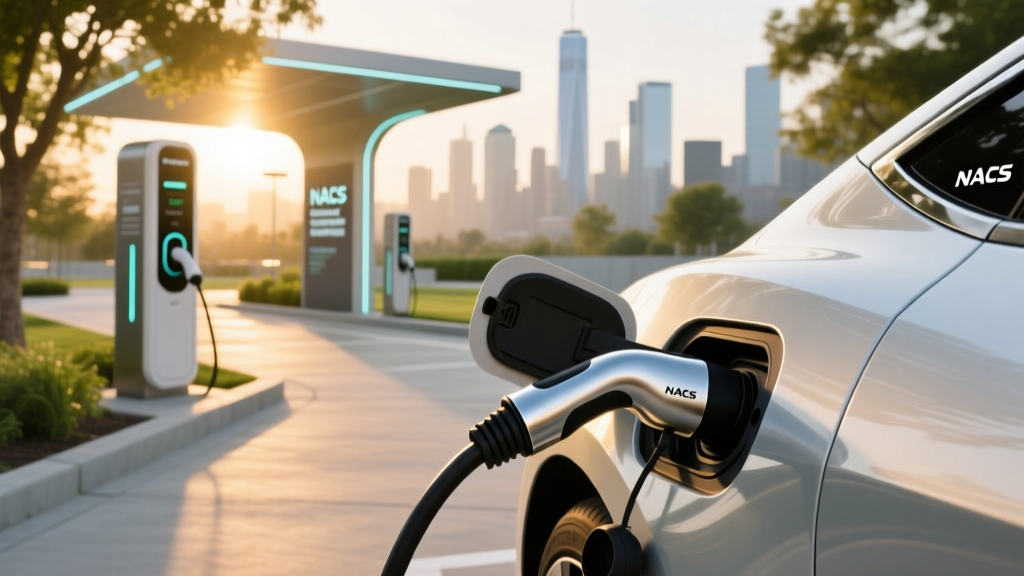
Rivian's connector story shifted significantly between 2024 and 2026. Early R1T and R1S vehicles shipped with a CCS1 (Combined Charging System) port. In 2024, Rivian announced its transition to the NACS (North American Charging Standard)—the Tesla-designed connector now adopted industry-wide. By the 2026 model year, new R1T and R1S vehicles roll off the factory line with a native NACS port.
This creates three distinct ownership situations:
- 2026 R1T/R1S (new): Native NACS port. Plug directly into Tesla Superchargers (V3 and V4), Rivian Waypoints with NACS, and any other NACS-equipped public charger. No adapter needed.
- 2022–2024 R1T/R1S (CCS1): Rivian now sells a NACS adapter (~$200–$250) that unlocks the Tesla Supercharger network. Keep it in the frunk for road trips.
- Home Level 2 charging: Regardless of vehicle port, most home chargers use a J1772 connector (for CCS vehicles) or NACS (for newer vehicles). Adapters exist in both directions.
| Connector | 2022–2024 R1 (CCS1 port) | 2025–2026 R1 (NACS port) | Notes |
|---|---|---|---|
| CCS1 (public DC) | Native | Via CCS-to-NACS adapter | Electrify America, EVgo still mostly CCS |
| NACS (Tesla Supercharger) | Via Rivian NACS adapter | Native | Verify V3/V4 stall availability in app |
| CHAdeMO | Not supported | Not supported | Legacy; largely retired in U.S. |
| J1772 (Level 2 AC) | Native (via CCS inlet) | Via NACS-to-J1772 adapter | Most public Level 2 and older home chargers |
For most Rivian owners in 2026, the Rivian charger map in-app now includes Supercharger locations alongside Rivian Waypoints and third-party networks—but always confirm the connector type before committing to a stop.
Home Charger Installation: Electrical Requirements and Real Costs
Level 2 home charging is the backbone of Rivian ownership. With a 106+ kWh battery, Level 1 (120V) is effectively useless—adding only ~35 miles overnight won't cover a typical day. A proper Level 2 install is non-negotiable.
What Your Electrician Will Evaluate
Rivian's Mobile Charger and Wall Charger both support up to 48A / 11.5 kW on a 240V, 60A dedicated circuit. The National Electrical Code (NEC) requires the circuit breaker to be rated at 125% of the continuous load, so a 48A charger requires a 60A breaker. Your electrician will assess:
- Panel capacity: Most modern 200A panels can accommodate a 60A EV circuit. Older 100A or 150A panels—common in pre-2000 homes—may require a panel upgrade ($1,500–$3,500) or a smart load-management device like the Emporia Vue with automatic derating.
- Run length: If your panel is far from the garage, wire gauge must increase (e.g., 4 AWG copper for short runs, 2 AWG for long runs), raising material cost.
- Permit: Nearly all jurisdictions require an electrical permit for a new 240V circuit. Permit fees typically range $50–$250, and an inspector will verify the work.
- GFCI protection: NEC 2020 and later require GFCI protection on 240V receptacles (NEMA 14-60). Hardwired chargers often bypass this requirement, which is why many electricians recommend hardwiring over plug-in.
| Component | Simple Install (panel near garage) | Complex Install (long run / panel upgrade) |
|---|---|---|
| Level 2 charger hardware | $400–$750 | $400–$750 |
| Electrician labor (2–4 hrs simple / 6–12 hrs complex) | $500–$1,200 | $1,500–$3,500 |
| Materials (wire, conduit, breaker) | $150–$400 | $400–$900 |
| Electrical permit | $50–$150 | $100–$250 |
| Panel upgrade (if needed) | $0 | $1,500–$3,500 |
| Total | $1,100–$2,500 | $3,900–$8,900 |
The IRS Residential Clean Energy Credit (as of 2026) does not cover EV charger hardware directly—the Alternative Fuel Vehicle Refueling Property Credit (§30C) was modified and has census-tract-based eligibility. Check irs.gov for current rules, as they vary by location and income.
Level 2 Charger Equipment Picks for Rivian Owners
Not all Level 2 chargers are equal. For a Rivian with a 106–141 kWh battery, you want the highest amperage your panel supports, a cable long enough to reach the charge port (located on the driver-side front fender), and smart features like scheduled charging to exploit off-peak electricity rates.
Rivian Wall Charger (2nd Gen)
- Power output: 11.5 kW (48A @ 240V)
- Connector: NACS (2025+), J1772 (older stock; adapter available)
- Cable length: 25 ft
- Smart features: Wi-Fi, OTA updates, Rivian app integration, scheduled charging
- Price: ~$550
- Best for: Rivian-only households wanting seamless app integration
ChargePoint Home Flex
- Power output: Up to 12 kW (50A @ 240V), configurable down to 16A
- Connector: J1772 (NACS adapter included in newer boxes)
- Cable length: 23 ft
- Smart features: Wi-Fi, app scheduling, Alexa, load-sharing for 2-unit installs
- Price: ~$650–$700
- Best for: Multi-EV households, flexible amperage for older panels
Tesla Universal Wall Connector
- Power output: 11.5 kW (48A @ 240V)
- Connector: Built-in NACS + integrated J1772 adapter
- Cable length: 24 ft
- Smart features: Wi-Fi, OTA updates, Power Sharing for multi-unit installs
- Price: ~$600
- Best for: Mixed fleets (Rivian NACS + Tesla), excellent build quality
Emporia Level 2 EV Charger
- Power output: 11.5 kW (48A @ 240V)
- Connector: J1772 (NACS version available)
- Cable length: 24 ft
- Smart features: Energy monitoring, solar integration, load management with Emporia Vue panel monitor
- Price: ~$400
- Best for: Budget-conscious installs, solar homes, panel-constrained homes needing smart load shedding
For Rivian's driver-side charge port location, 23–25 ft cables are generally sufficient if the charger is mounted near the parking spot. If you park in a driveway and the charger is inside the garage, consider the 25 ft Rivian Wall Charger or plan a mounting location close to the garage door.
Cost to Charge a Rivian: Home vs. Public vs. Gas
A Rivian's efficiency typically runs between 2.0 and 2.5 kWh per mile depending on configuration, driving style, and weather (the Max-pack R1T with 21" wheels is on the lower end; the tri-motor with all-terrain tires is on the higher end). That number is the key to comparing charging costs to gasoline.
| Scenario | Rate | Cost per Mile (at 2.2 kWh/mi) | Equivalent Gas Cost at 20 MPG |
|---|---|---|---|
| Home off-peak (utility TOU rate) | $0.10/kWh | $0.022/mi | $0.40/mi (gas at $3.60/gal) |
| Home standard rate | $0.16/kWh | $0.035/mi | $0.64/mi (gas at $3.60/gal) |
| Public Level 2 (ChargePoint, EVgo) | $0.30/kWh | $0.066/mi | — |
| DC Fast Charging (EA, Supercharger) | $0.40–$0.55/kWh | $0.088–$0.121/mi | — |
| Tesla Supercharger (member pricing) | $0.30–$0.40/kWh | $0.066–$0.088/mi | — |
At 12,000 miles per year, home charging at $0.16/kWh costs roughly $420 annually. The same mileage in a 20 MPG gas truck at $3.60/gallon costs $2,160. That's a $1,740 annual fuel savings—enough to recoup a home charger install in under two years.
DC fast charging is the exception: at $0.50/kWh, a Rivian's cost per mile approaches that of a fuel-efficient gas sedan. The economics of EV ownership depend overwhelmingly on home charging access. If you can't charge at home or at work, the savings proposition weakens considerably.
DC Fast Charging on the Road: Reading the Charge Curve
The Rivian charger map in-app shows Waypoints and partner chargers, but peak kW ratings on the map don't tell the full story. Understanding the charge curve is essential for planning efficient road trips.
Rivian's 2026 R1T and R1S support up to 220 kW peak DC fast charging on the Max pack and approximately 200 kW on the Standard pack. However, peak rate is sustained only in a narrow SoC window—typically between 10% and 35%. The curve tapers progressively:
- 10–35% SoC: Peak rate (up to 220 kW)
- 35–60% SoC: ~150–170 kW sustained
- 60–80% SoC: ~100–120 kW
- 80–100% SoC: ~50 kW or less (avoid charging past 80% on road trips)
Practical result: A 10–80% charge on a Max pack takes roughly 30–35 minutes at a capable 250+ kW charger. On the Standard pack, expect 25–30 minutes. These times assume battery preconditioning is active (the Rivian automatically initiates this when you navigate to a charger in the vehicle's nav system).
Always navigate to a charger using the truck's built-in navigation—this triggers thermal preconditioning of the battery, which can shave 5–10 minutes off your charge time, especially in cold weather.
Safety, Code, and Installation Best Practices
EV charging is a high-draw, continuous electrical load—more like running an electric oven for 8 hours than plugging in a phone. Safety and code compliance aren't optional.
- Dedicated circuit: Your Level 2 charger must be on its own dedicated circuit—no sharing with other appliances. A 48A charger on a 60A breaker is the standard configuration.
- Hardwired vs. plug-in: Hardwired installations are generally preferred for 48A+ chargers. They avoid the NEC GFCI requirement on receptacles, eliminate a failure point (loose plug), and often cost less in materials. Plug-in (NEMA 14-60) offers portability if you move.
- Outdoor rating: If your charger mounts outside, verify it carries a NEMA 4 or IP65 rating. The Rivian Wall Charger, ChargePoint Home Flex, and Tesla Universal Wall Connector are all outdoor-rated.
- GFCI breaker: If you use a receptacle (plug-in install), NEC 2020+ requires a GFCI breaker. These cost $50–$100 more than standard breakers and can nuisance-trip with some chargers—another reason to hardwire.
- Licensed electrician: Always use a licensed, insured electrician. DIY 240V work risks fire, voids homeowner insurance, and fails inspection. Ask for an itemized quote including permit.
Frequently Asked Questions
How much does it cost to install a home EV charger for my Rivian?
A straightforward Level 2 install (panel near garage, hardwired, 60A circuit) typically runs $1,100–$2,500 all-in. Complex installs with long wire runs or a panel upgrade can reach $3,900–$8,900. Get three quotes and confirm permit inclusion.
How fast will each charging level add range to a Rivian R1T?
Level 1 (120V): ~3–4 miles per hour—effectively useless for a 106+ kWh pack. Level 2 (240V, 48A): ~25–33 miles per hour, enough to fully recharge overnight. DC fast charging: up to 140 miles in 20 minutes at peak rate, tapering above 80%.
Which connector is compatible with my 2026 Rivian?
The 2026 R1T and R1S ship with a native NACS port. You can plug directly into Tesla Superchargers and NACS-equipped public chargers. For CCS1 chargers (Electrify America, some EVgo stations), you'll need a CCS-to-NACS adapter. Home Level 2 chargers are available in both NACS and J1772—adapters work in both directions.
How much does charging a Rivian cost per mile compared to gas?
At home on a standard $0.16/kWh rate, a Rivian costs roughly $0.035/mile—about 5× cheaper than a 20 MPG gas truck at $3.60/gallon ($0.18/mile). DC fast charging at $0.50/kWh raises the cost to ~$0.11/mile, still below most gas vehicles.
What electrical upgrades might I need before installing a charger?
If your home has a 200A electrical panel with available capacity, you likely need no upgrade—just a new 60A breaker and wire run. Homes with 100A or 150A panels, or panels already near capacity (electric heat, hot tub, etc.), may need a panel upgrade ($1,500–$3,500) or a smart load-management system to share capacity dynamically.
Can I use the Rivian charger map to find Superchargers?
Yes. As of 2025–2026, Rivian's in-app charger map includes Tesla Supercharger locations (V3 and V4 stalls) alongside Rivian Adventure Network Waypoints and third-party networks. Filter by connector type and verify real-time availability before routing.
Does my Rivian qualify for a home charger tax credit?
The federal Alternative Fuel Vehicle Refueling Property Credit (§30C) was modified under the Inflation Reduction Act and is now limited to eligible census tracts (typically low-income or rural areas). Check IRS §30C guidance for your ZIP code. Some states and utilities also offer rebates—check your local provider.
The Rivian charger map is a useful trip-planning tool, but the real charging infrastructure that defines your ownership experience is the one you build at home. Budget for a proper 48A Level 2 install, understand your connector needs based on your model year, and exploit off-peak utility rates—and the R1T or R1S will deliver the lowest cost-per-mile driving you've ever experienced in a full-size truck or SUV.