Rivian Bi-Directional Charging: What It Actually Does
Rivian's R1T and R1S are among the few consumer electric vehicles in the U.S. that support bi-directional charging — the ability to push energy out of the vehicle's large battery pack to power external devices, your home, or even feed electricity back to the grid. For owners of the R1T (with up to 149 kWh of usable battery in the Max Pack configuration) and R1S, this transforms the truck or SUV from a vehicle into a mobile power station capable of backing up a home for days during an outage.
But bi-directional charging isn't a single feature. It encompasses several distinct capabilities — Vehicle-to-Load (V2L), Vehicle-to-Home (V2H), and Vehicle-to-Grid (V2G) — each with different hardware requirements, cost implications, and availability timelines. This guide breaks down exactly what Rivian bi-directional charging can do in 2026, what equipment you need, and what the full home installation looks like.
Bi-directional charging involves two different measurements. kW (kilowatts) measures power — how fast energy flows in or out. kWh (kilowatt-hours) measures energy — the total capacity stored in your battery. A Rivian R1T Max Pack has ~149 kWh of usable energy and can discharge at up to 11.5 kW via V2H. At that rate, it could theoretically power a home drawing 2 kW average for over 3 days.
Types of Bi-Directional Charging Rivian Supports
Rivian has rolled out bi-directional capability in phases. Understanding which type you can actually use today is critical before investing in equipment.
Vehicle-to-Load (V2L)
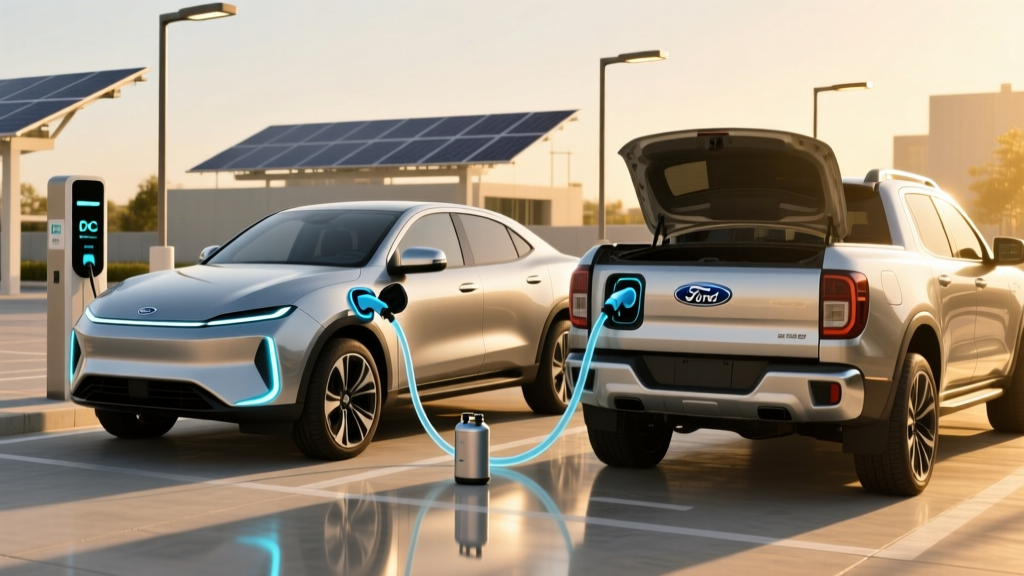
V2L allows you to plug standard 120V or 240V appliances directly into your Rivian using an adapter. Think of it as a massive portable generator — but silent and emissions-free. The R1T's bed outlet and available V2L adapter can supply up to 3.6 kW of continuous power, enough to run power tools at a job site, a portable fridge and lights while camping, or a welder for light fabrication work.
Vehicle-to-Home (V2H)
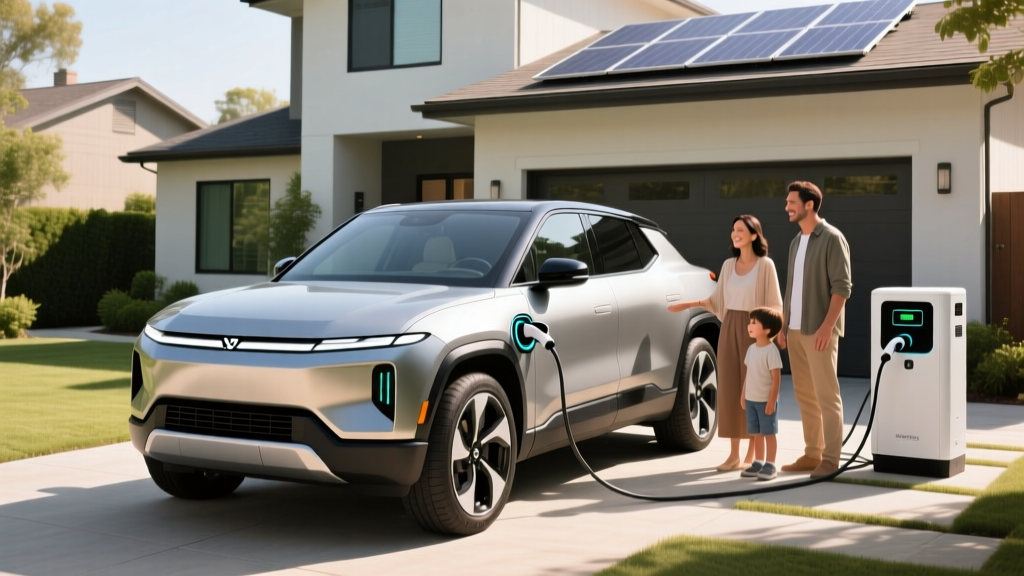
V2H is the headline feature: your Rivian connects to a compatible bi-directional home charger and a transfer switch (or smart electrical panel), allowing it to power your home's circuits during an outage. Rivian partnered with Wallbox to offer the Quasar 2 charger, which supports up to 11.5 kW of bi-directional power flow. With the R1T Max Pack's 149 kWh battery, that's enough to sustain an average U.S. home (which uses roughly 30 kWh/day according to the U.S. Energy Information Administration) for approximately 4-5 days.
Vehicle-to-Grid (V2G)
V2G — sending power back to the utility grid for compensation — is technically possible with the same hardware but requires utility cooperation, regulatory approval, and specific rate programs. As of 2026, V2G availability is limited to select utility pilot programs. Most Rivian owners will use V2H and V2L long before V2G becomes mainstream.
Charging Levels and Speeds: What You Need to Know
Before setting up bi-directional charging, you need to understand the three charging levels that apply to your Rivian. Each level uses different voltage, amperage, and connector types — and only specific Level 2 equipment supports bi-directional power flow.
| Level | Voltage / Amps | Power (kW) | Miles of Range Added per Hour | Typical Use |
|---|---|---|---|---|
| Level 1 | 120V / 12A | ~1.4 kW | ~3-4 mi/hr | Emergency/trickle (standard outlet) |
| Level 2 | 240V / 40-48A | 9.6-11.5 kW | ~22-28 mi/hr | Daily home charging & V2H |
| DC Fast | 400V+ / up to 500A | Up to 220 kW (peak) | ~250+ mi in 20 min | Road trips (public stations) |
Charging time examples for Rivian battery packs (Level 2, 11.5 kW):
- Standard Pack (~106 kWh usable): 10-80% in approximately 6.5 hours
- Large Pack (~128 kWh usable): 10-80% in approximately 7.8 hours
- Max Pack (~149 kWh usable): 10-80% in approximately 9 hours
At a DC fast charger, the R1T with the Large Pack peaks at approximately 220 kW and can charge from 10-80% in about 30 minutes, though the charge curve tapers significantly above 80% SoC to protect the NMC battery cells. Expect sustained rates closer to 100-130 kW through the middle of the curve.
Connector Compatibility and Adapter Requirements
Rivian vehicles sold in 2025 and later come equipped with the NACS (North American Charging Standard) port, aligning with Tesla's connector and the broader industry shift. Earlier model-year Rivians (2022-2024) shipped with CCS1 ports, and Rivian provides or sells a CCS-to-NACS adapter for those owners.
| Connector | Rivian Model Years | Adapter Needed? | Bi-Directional Support |
|---|---|---|---|
| NACS | 2025+ R1T, R1S | No (native) | Yes (with compatible charger) |
| CCS1 | 2022-2024 R1T, R1S | CCS-to-NACS for Tesla Superchargers | Yes (with CCS-compatible bi-dir charger) |
| CHAdeMO | Not supported | N/A | N/A |
For bi-directional charging specifically, the Wallbox Quasar 2 is the primary home unit designed to work with Rivian vehicles. It uses a NACS connector for bi-directional power flow. Owners of CCS1-equipped Rivians should verify adapter compatibility with Wallbox before purchasing.
Home Installation: Electrical Requirements and Costs
Installing a bi-directional charger is significantly more complex than mounting a standard Level 2 EVSE. You're not just charging a vehicle — you're integrating it into your home's electrical system as a backup power source. This requires specific equipment, a transfer mechanism, and potentially a panel upgrade.
Electrical Requirements
- Circuit: Dedicated 60A breaker at 240V (for 48A continuous charging / 11.5 kW bi-directional flow)
- Wire gauge: 6 AWG copper (or 4 AWG aluminum) for the dedicated run
- Transfer switch or smart panel: Required for V2H to isolate your home from the grid during an outage (prevents backfeeding, which is dangerous and code-violating without proper isolation)
- Permit: Required in virtually all U.S. jurisdictions for any new 240V circuit and for transfer switch installation
Panel Upgrade Considerations
This is the cost variable most homeowners underestimate. A bi-directional charger drawing 48A continuous (requiring a 60A breaker) adds substantial load to your electrical panel. If your home has a 100A main panel — common in homes built before the 1990s — you will almost certainly need an upgrade to a 200A panel to accommodate the charger alongside existing loads like HVAC, electric range, and dryer.
Even some 200A panels may be at capacity if you have multiple large electric loads. A licensed electrician will perform a load calculation per NEC Article 220 to determine whether your panel can handle the additional circuit. Budget for this assessment upfront.
| Component | Low Estimate | High Estimate | Notes |
|---|---|---|---|
| Wallbox Quasar 2 (equipment) | $3,500 | $4,500 | Bi-directional charger unit |
| Transfer switch / smart panel | $1,000 | $3,000 | Span smart panel or manual transfer switch |
| Electrician labor (install) | $1,500 | $4,000 | Depends on wire run length, wall penetration |
| Electrical permit | $100 | $400 | Varies by municipality |
| Panel upgrade (if needed) | $2,000 | $5,000 | 100A to 200A service upgrade |
| TOTAL (no panel upgrade) | $6,100 | $11,900 | Typical install with adequate panel |
| TOTAL (with panel upgrade) | $8,100 | $16,900 | Older homes needing service upgrade |
Federal incentive note: The IRS residential clean energy credit (IRC §25D) may cover 30% of the cost of qualified energy storage and related equipment. Bi-directional chargers and associated battery-integration hardware may qualify — consult a tax professional to confirm eligibility for your specific installation, as rules around what constitutes eligible property are specific.
Cost to Charge: Home vs. Public vs. Gas
One of the strongest arguments for owning a Rivian — or any EV — is the per-mile fuel cost advantage. Here's how charging costs compare across scenarios, using the R1T Dual-Motor Large Pack (~128 kWh usable, EPA range approximately 352 miles) as our reference.
| Scenario | Rate ($/kWh) | Cost for Full Charge | Cost per Mile | Annual (12,000 mi) |
|---|---|---|---|---|
| Home off-peak (utility TOU) | $0.09 | $11.52 | $0.033 | $396 |
| Home standard rate | $0.16 | $20.48 | $0.058 | $696 |
| Public Level 2 (ChargePoint, etc.) | $0.30 | $38.40 | $0.109 | $1,308 |
| DC Fast (Electrify America) | $0.48 | $61.44 | $0.175 | $2,100 |
| Gas truck equivalent (18 MPG, $3.40/gal) | — | $66.49 (per tank equiv.) | $0.189 | $2,267 |
Home charging on an off-peak time-of-use (TOU) rate is dramatically cheaper than gasoline — roughly 82% less per mile. Even at standard residential rates, you're saving about 69% compared to a gas truck getting 18 MPG combined. The savings widen further when you factor in the R1T's reduced maintenance (no oil changes, fewer brake replacements due to regenerative braking, no transmission fluid).
However, if you rely exclusively on DC fast charging, the cost advantage narrows significantly. At $0.48/kWh, you're approaching gas-truck parity. This is why home charging access is the single most important factor in EV ownership economics.
Equipment Recommendations for Rivian Owners
Whether you need bi-directional capability or just a reliable daily Level 2 charger, here are the top options matched to Rivian's charging specifications.
🔋 Wallbox Quasar 2 (Bi-Directional)
- Power: 11.5 kW charge / 11.5 kW discharge
- Connector: NACS (bi-directional capable)
- Cable length: 25 ft
- Smart features: Wi-Fi, app scheduling, solar integration, V2H management
- Price: ~$3,500-$4,500
- Best for: Home backup power, solar self-consumption
⚡ ChargePoint Home Flex
- Power: Up to 11.5 kW (48A) / configurable down to 16A
- Connector: NACS (2025+ models) or J1772 with adapter
- Cable length: 23 ft
- Smart features: Wi-Fi, app scheduling, Alexa integration
- Price: ~$550-$650
- Best for: Daily charging without bi-directional needs
🔌 Tesla Wall Connector (Gen 4)
- Power: Up to 11.5 kW (48A)
- Connector: NACS native
- Cable length: 24 ft
- Smart features: Wi-Fi, OTA updates, Powerwall integration
- Price: ~$450-$550
- Best for: Rivian owners who also use Tesla Supercharger network
🏠 Emporia Vue + EV Charger
- Power: Up to 11.5 kW (48A)
- Connector: NACS or J1772
- Cable length: 24 ft
- Smart features: Whole-home energy monitoring, solar-aware scheduling, load management
- Price: ~$600-$800 (charger + monitoring)
- Best for: Solar homes wanting integrated energy management
For pure daily charging without V2H, the ChargePoint Home Flex remains a strong value pick — it's NHPA-listed, widely available, and its amperage configurability means you can dial it down to match a smaller circuit if your panel can't support a full 60A breaker. For bi-directional use, the Wallbox Quasar 2 is currently the only consumer-ready option validated for Rivian V2H.
Safety, Code, and Installation Best Practices
A bi-directional charger installation must comply with the National Electrical Code (NEC) and your local jurisdiction's amendments. Key requirements include:
- Dedicated circuit: The charger must have its own breaker — no sharing with other appliances. NEC 625.40 requires a dedicated branch circuit for EVSE.
- GFCI protection: NEC 2023 and later require GFCI protection for all EVSE outlets rated 150V or less to ground and 60A or less. Hardwired units may have GFCI built into the charger itself.
- Outdoor rating: If your charger is mounted outside or in an unconditioned garage, it must carry a NEMA 4 or NEMA 4X enclosure rating for weather resistance.
- Anti-islanding for V2H: Your transfer switch or smart panel must physically disconnect your home from the utility grid before the Rivian begins feeding power. Backfeeding an active grid is extremely dangerous to utility workers and is illegal without proper isolation. The NFPA NEC Article 702 governs standby power systems.
- Permit and inspection: Do not skip the permit. An unpermitted installation can void your homeowner's insurance coverage in the event of an electrical fire and will cause issues during a home sale.
Always hire a licensed electrician who has specific experience with EV charger installations and, ideally, bi-directional systems. Ask whether they've installed a Wallbox Quasar or equivalent V2H unit before — the transfer switch integration is not standard electrical work.
Frequently Asked Questions
How much does it cost to install a home EV charger for a Rivian?
For a standard Level 2 charger (non-bi-directional), expect $1,200-$3,500 total including equipment, electrician labor, and permit. For a full bi-directional V2H setup with a Wallbox Quasar 2, transfer switch, and labor, budget $6,100-$11,900 without a panel upgrade, or $8,100-$16,900 if your home needs a 200A service upgrade. The wide range reflects variability in wire run length, wall penetration complexity, and local labor rates.
How fast will each charging level add range to my Rivian?
Level 1 (120V) adds roughly 3-4 miles per hour — essentially overnight trickle charging. Level 2 at 11.5 kW adds approximately 22-28 miles per hour, sufficient for a full overnight charge on any Rivian battery pack. DC fast charging at peak rates (up to 220 kW) can add 140+ miles in 20 minutes, though the charge curve tapers substantially above 80% State of Charge.
Which connector and charger is compatible with my Rivian?
Model-year 2025 and later Rivians use the NACS connector natively. Model-year 2022-2024 Rivians use CCS1 and may require an adapter for Tesla Superchargers or NACS-equipped chargers. For bi-directional charging, the Wallbox Quasar 2 with NACS connector is the primary compatible home unit. Verify your model year and port type before ordering equipment.
How much does charging a Rivian cost per mile vs. a gas truck?
Charging at home on off-peak electricity ($0.09/kWh) costs approximately $0.033/mile — about 82% less than a comparable gas truck at 18 MPG and $3.40/gallon ($0.189/mile). Even at standard residential rates ($0.16/kWh), you save roughly 69%. Only exclusive reliance on expensive DC fast charging ($0.48/kWh) brings costs close to gasoline parity.
What electrical upgrades might I need for a bi-directional charger?
The most common upgrade is a panel service increase from 100A to 200A, which costs $2,000-$5,000. You'll also need a transfer switch or smart electrical panel (such as a Span panel) to enable safe V2H operation during outages. Your electrician will perform a load calculation to determine whether your existing panel can support a 60A dedicated circuit alongside your other household loads.
Can I use my Rivian to power my entire home during an outage?
With a properly installed V2H system (Wallbox Quasar 2 + transfer switch), yes — your Rivian can power your home's circuits during an outage. The R1T Max Pack's 149 kWh battery can sustain an average U.S. home (~30 kWh/day) for approximately 4-5 days. The Standard Pack (~106 kWh) would provide roughly 3 days. The system automatically disconnects from the grid (anti-islanding) before feeding power, keeping utility workers safe.
Does the Rivian bi-directional system work with solar panels?
Yes. The Wallbox Quasar 2 supports solar integration, allowing you to prioritize charging your Rivian with excess solar production during the day and then use the stored energy to power your home at night or during an outage. This "solar self-consumption" loop maximizes the value of your rooftop solar investment and reduces grid dependence.