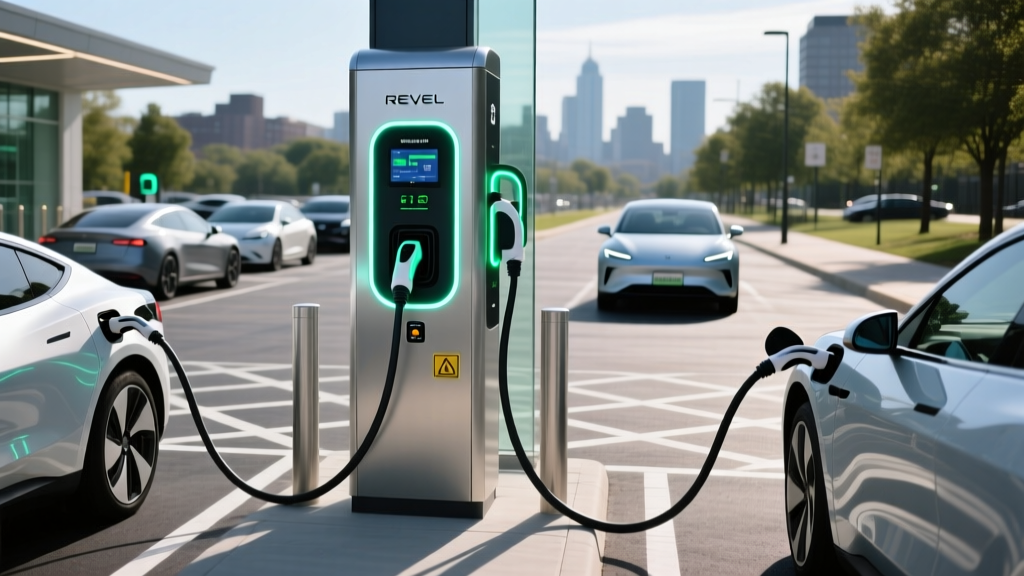
If you drive an electric vehicle in the New York City metro area, you have likely seen the teal-and-white Revel charging stations dotting parking lots and curbsides. Revel started as an all-electric ride-hail company operating Tesla Model Ys across Brooklyn, Queens, and Manhattan, and has since pivoted into building one of the densest urban DC fast-charging networks in the United States. As of early 2026, Revel operates dozens of public fast-charging stalls across New York City, with additional sites in the pipeline for New Jersey and other East Coast markets.
This guide breaks down exactly what a Revel charger delivers — power output, connector types, real-world charging times, and pricing — and puts the network in context alongside home Level 2 charging so you can decide whether to rely on Revel for daily top-ups or reserve it for quick highway-style pit stops.
What Is a Revel Charger?
A Revel charger is a publicly accessible DC fast-charging station owned and operated by Revel. The company deploys both ultra-fast stalls (up to 320 kW) and more moderate fast chargers (typically 150–180 kW) at sites across NYC. Many stations are paired with Revel's own ride-hail driver infrastructure — rest areas, restrooms, and on-site staff — which doubles as a convenient amenity for retail EV drivers.
Revel's stations primarily serve CCS1-equipped vehicles, though the company has been adding NACS (Tesla-style) connectors at newer sites following the industry-wide adoption of the North American Charging Standard. Some locations also offer Tesla Supercharger-style stalls accessible to non-Tesla EVs via the built-in NACS connector or a CCS-to-NACS adapter.
Charging Levels Explained: Where Revel Fits
To understand what a Revel charger offers, you need the full picture of EV charging levels. Here is how Level 1, Level 2, and DC Fast Charging compare in real-world terms:
| Level | Voltage / Amperage | Max Power (kW) | Miles of Range Added per Hour | Best Use Case |
|---|---|---|---|---|
| Level 1 (120V) | 120V / 12A | 1.4 kW | 3–5 miles/hr | Overnight trickle, PHEVs |
| Level 2 (240V) | 240V / 32–48A | 7.7–11.5 kW | 25–44 miles/hr | Home daily charging, workplace |
| DC Fast (CCS/NACS) | 400–800V DC | 50–350 kW | 150–800+ miles/hr (peak) | Road trips, urban fast top-ups |
Revel chargers sit firmly in the DC Fast category. A typical 180 kW Revel stall can add roughly 150–200 miles of range to a mid-size SUV like the Hyundai Ioniq 5 in a 20-minute session, assuming the battery is preconditioned and starting at a low state of charge (around 10–15% SoC).
Revel Charger Speeds: Real-World 10–80% Times
Peak kW ratings are marketing headlines. What actually matters is the charge curve — how fast the charger sustains power as the battery fills up. Most EVs taper charge speed significantly above 50–60% SoC to protect battery health. Here is what to expect at a Revel station on a 180 kW stall:
| Vehicle | Usable Battery (kWh) | Max DC Charge Rate (kW) | Est. 10–80% Time |
|---|---|---|---|
| Tesla Model Y Long Range (2025) | ~75 kWh | 250 kW | ~22–25 min |
| Hyundai Ioniq 5 (2025) | ~77.4 kWh | 240 kW (800V) | ~18–22 min |
| Ford Mustang Mach-E Ext. Range (2025) | ~91 kWh | 150 kW | ~38–45 min |
| Chevrolet Equinox EV (2025) | ~85 kWh | 150 kW | ~35–42 min |
Connector Compatibility: Will a Revel Charger Work With Your EV?
Revel stations primarily deploy CCS1 connectors, the standard used by most non-Tesla EVs sold in the US through 2024. As the industry shifts to NACS (the Tesla-style connector, now adopted by Ford, GM, Hyundai, Rivian, and others for 2025+ models), Revel has been retrofitting select stations with NACS cables and offering CCS-to-NACS adapters on-site at newer locations.
| Connector | Vehicles That Use It | Revel Availability | Adapter Needed? |
|---|---|---|---|
| CCS1 | Hyundai, Kia, VW, BMW, Ford (pre-2025), most non-Tesla EVs | All Revel stations | No |
| NACS (Tesla-style) | Tesla (all), Ford/GM/Hyundai/Rivian (2025+ models) | Select newer Revel sites | CCS-to-NACS adapter (~$150–$200) if station lacks NACS cable |
| CHAdeMO | Nissan Leaf (older), Mitsubishi Outlander PHEV | Not available at Revel | No adapter exists for CHAdeMO→CCS DC fast charging |
If you drive a 2025+ Ford F-150 Lightning or a new Hyundai Ioniq 5 with the native NACS port, check the Revel app before visiting to confirm whether the specific station has NACS cables or whether you need to bring your own CCS-to-NACS adapter.
How Much Does Charging at Revel Cost?
Revel's pricing varies by station and time of day, but as of early 2026, typical rates fall in the $0.39–$0.59 per kWh range for retail (non-ride-hail) users. Some locations offer off-peak discounts. Here is how that compares to home Level 2 charging and gasoline on a cost-per-mile basis:
| Scenario | Rate | Vehicle Efficiency | Cost Per Mile |
|---|---|---|---|
| Home Level 2 (off-peak, ConEd NY) | ~$0.18/kWh | 3.0 mi/kWh (Model Y) | $0.06/mi |
| Revel DC Fast (peak) | ~$0.49/kWh | 3.0 mi/kWh (Model Y) | $0.16/mi |
| Gas (25 MPG combined, $3.60/gal) | $3.60/gallon | 25 mi/gal (RAV4) | $0.14/mi |
| Gas (30 MPG combined, $3.60/gal) | $3.60/gallon | 30 mi/gal (Civic) | $0.12/mi |
The takeaway is clear: home Level 2 charging is roughly one-third the cost of using a Revel DC fast charger. Revel's peak rates can actually exceed the per-mile cost of a fuel-efficient gas car. This makes Revel an excellent option for urban drivers without home charging access or for quick top-ups, but it is not a cost-effective replacement for overnight home charging.
Home Level 2 Charging: The Better Daily Alternative
If you have access to a garage, driveway, or dedicated parking spot with electrical infrastructure, installing a Level 2 home charger will almost always be more convenient and cheaper per mile than relying on public DC fast charging. Here is what a typical home Level 2 installation requires and costs.
Electrical Requirements
- Voltage: 240V (same as a dryer or oven circuit)
- Amperage: 40A circuit for a 32A charger, or 60A circuit for a 48A charger (NEC requires circuits rated at 125% of continuous load)
- Dedicated circuit: Required — you cannot share with other appliances
- Panel capacity: Most modern 200A panels can accommodate a 40–60A EV circuit. Older 100A panels may require a panel upgrade to 200A, which adds $1,500–$3,500 to the project.
Installation Cost Breakdown
| Component | Simple Install (panel nearby) | Complex Install (long run, conduit) |
|---|---|---|
| Level 2 charger hardware | $350–$700 | $350–$700 |
| Electrician labor (licensed) | $500–$1,200 | $1,500–$3,000 |
| Electrical permit | $50–$200 | $50–$200 |
| Panel upgrade (if needed) | $0 | $1,500–$3,500 |
| Total estimated cost | $900–$2,100 | $3,400–$7,400 |
Safety and Code Considerations
- GFCI protection: NEC 2020 and later require GFCI protection for EV charging outlets. Hardwired chargers may bypass this requirement depending on local code — ask your electrician.
- Outdoor rating: If your charger is mounted outside, ensure it carries a NEMA 4 (weatherproof) rating. Most quality Level 2 chargers (ChargePoint, Emporia, Wallbox) are rated for outdoor use.
- Dedicated circuit: NEC Article 625 requires a dedicated branch circuit for EV supply equipment — no sharing with other loads.
- Permit: Nearly all jurisdictions require an electrical permit for EV charger installation. Skipping the permit risks insurance claim denial if a fire originates from unpermitted work.
Recommended Home Level 2 Chargers
If you are installing a home charger to complement occasional Revel fast-charging sessions, here are three proven Level 2 units that pair well with the EVs most commonly seen at Revel stations:
Emporia Vue Smart Charger
- Power output: 48A (11.5 kW on 240V/60A circuit)
- Connector: J1772 (NACS adapter included for 2025+ models)
- Cable length: 24 ft
- Smart features: Wi-Fi, energy monitoring via Emporia app, solar integration, scheduled charging
- Price: ~$399
- Best for: Budget-conscious buyers who want smart features and energy tracking
ChargePoint Home Flex
- Power output: Up to 50A (12 kW on 240V/60A circuit); configurable down to 16A
- Connector: J1772 (NACS version available)
- Cable length: 23 ft
- Smart features: Wi-Fi, ChargePoint app, Alexa integration, flexible amperage setting
- Price: ~$599
- Best for: Flexibility — adjustable amperage works with older panels that cannot support 60A
Tesla Wall Connector
- Power output: 48A (11.5 kW on 240V/60A circuit)
- Connector: NACS native (J1772 adapter available for non-Tesla EVs)
- Cable length: 24 ft
- Smart features: Wi-Fi, over-the-air updates, power sharing between multiple units, Tesla app integration
- Price: ~$475
- Best for: Tesla owners and 2025+ NACS-equipped vehicles; cleanest cable management
All three chargers deliver enough power to fully recharge a 75–90 kWh battery overnight (7–10 hours from 10% to 100%), making daily Revel visits unnecessary for most drivers.
When Should You Use a Revel Charger vs. Home Charging?
The decision framework is straightforward:
Choose Home Level 2 Charging If:
- You have a garage, driveway, or assigned parking spot with electrical access
- Your daily driving is under 60 miles (most commutes)
- You want the lowest cost per mile (~$0.05–$0.08/mi)
- You want to wake up to a full battery every morning
- You can invest $1,000–$3,000 in upfront installation
Choose Revel (or Public DC Fast Charging) If:
- You live in an apartment or street-park without charging access
- You need a quick 20-minute top-up mid-day or before a long trip
- Your EV supports fast DC charging (100+ kW) and you need speed
- You are a ride-hail or delivery driver who needs rapid turnarounds
- You are supplementing home charging for occasional heavy-use days
Frequently Asked Questions
How much does it cost to install a home EV charger?
A straightforward Level 2 home charger installation (panel nearby, no upgrade needed) typically costs $900–$2,100 including equipment, licensed electrician labor, and permit. Complex installations requiring long conduit runs or a 200A panel upgrade can reach $3,400–$7,400. Always get a load calculation and itemized quote from a licensed electrician before proceeding.
How fast will each charging level add range?
Level 1 (120V) adds 3–5 miles per hour — adequate for plug-in hybrids with small batteries. Level 2 (240V) adds 25–44 miles per hour, enough to fully recharge most EVs overnight. DC fast charging (Revel-class, 150–320 kW) adds 150–800+ miles per hour at peak, delivering a 10–80% charge in 18–45 minutes depending on the vehicle.
Which connector or charger is compatible with my EV?
Check your vehicle's charge port: CCS1 is standard on most non-Tesla EVs through 2024; NACS is used on all Teslas and most 2025+ models from Ford, GM, Hyundai, Kia, and Rivian. Revel stations offer CCS1 at all locations and NACS at select newer sites. CHAdeMO (older Nissan Leaf) is not supported at Revel. If your car has NACS and the Revel station only has CCS1, you will need a CCS-to-NACS adapter.
How much does charging cost per mile vs. gas?
Home Level 2 charging at $0.18/kWh costs roughly $0.06 per mile in a Tesla Model Y (3 mi/kWh). Revel DC fast charging at $0.49/kWh costs about $0.16 per mile. A 25 MPG gas car at $3.60/gallon costs $0.14 per mile. Home charging is the cheapest option; Revel at peak rates can be more expensive than gasoline per mile.
What electrical upgrades might I need?
Most modern homes with a 200A electrical panel can accommodate a 40–60A dedicated EV circuit without upgrades. Homes with older 100A panels, especially those running electric heat, dryers, and ovens, may need a panel upgrade to 200A ($1,500–$3,500). Some utilities offer managed-charging programs or secondary meter installations that can avoid a full panel upgrade — check with your local provider.
Is it safe to charge an EV in the rain at a Revel station?
Yes. All DC fast-charging equipment, including Revel stations, is rated for outdoor use and designed to operate safely in rain, snow, and humidity. The CCS and NACS connectors are sealed when mated to the vehicle's charge port. Never use a damaged cable or one with exposed wiring, but normal wet-weather charging is completely safe.