Supercharging a Tesla: What the Clock Actually Says
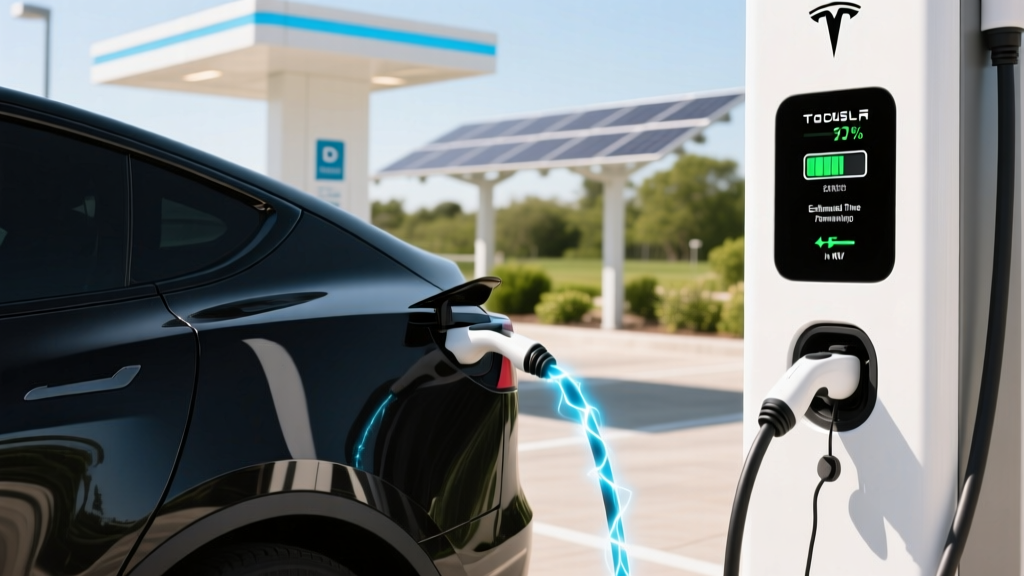
If you're shopping for a Tesla or just picked one up, the first question is usually some version of: how long to Supercharge a Tesla? The honest answer depends on which model you drive, the generation of Supercharger you're plugged into, and how much battery you actually need to refill. A Tesla Model Y Long Range arriving at a V4 Supercharger with 10% state of charge (SoC) can reach 80% in roughly 18–22 minutes under ideal conditions. A Model 3 Performance on the same stall? Closer to 15–18 minutes. But peak kilowatt (kW) ratings on the stall don't tell the whole story — the charge curve, battery temperature, and your starting SoC matter just as much.
This guide walks through every charging scenario a Tesla owner will face: Supercharger DC fast charging, Level 2 home and destination charging, and the rare Level 1 trickle. We'll cover the exact electrical requirements for a home install, what it costs, which connectors matter in 2026, and how charging costs stack up against gasoline per mile.
Charging Levels Explained: Speeds in kW and Miles Per Hour
Before timing a Supercharge session, you need to understand the three charging tiers available to any Tesla owner in 2026. The distinction between kW (power — the rate of energy flow) and kWh (energy — the battery's total capacity) is the single most important EV literacy point. A 250 kW Supercharger delivers power at that rate; your Model Y Long Range has roughly 75 kWh of usable battery capacity.
| Level | Voltage / Amps | Power (kW) | Miles of Range Added Per Hour | Typical Use Case |
|---|---|---|---|---|
| Level 1 (120V) | 120V / 12A | ~1.4 kW | 3–5 mi/hr | Emergency / overnight trickle |
| Level 2 (240V) | 240V / 32–48A | 7.7–11.5 kW | 25–44 mi/hr | Home, workplace, destination |
| DC Fast (Supercharger) | 400–800V DC | 150–350 kW | 500–1,000+ mi/hr (equivalent) | Road trips, rapid top-ups |
At Level 2 on a 48-amp circuit (11.5 kW), a Model Y Long Range with its ~75 kWh usable battery will go from 10% to 100% in roughly 7 hours — perfect for overnight charging. At a V3 Supercharger (250 kW peak), that same 10–80% refill takes about 20–25 minutes in real-world conditions.
How Long to Supercharge a Tesla: 10–80% Times by Model
Here's where the rubber meets the road. The table below reflects 2026 model-year Teslas at V3 (250 kW) and V4 (up to 350 kW) Supercharger stalls. Times assume a preconditioned battery (the car navigated to a Supercharger and warmed the pack), starting at 10% SoC, in moderate temperatures (60–80°F).
| Model (2026) | Battery (usable kWh) | Chemistry | Peak DC kW | 10–80% at V3 (250 kW) | 10–80% at V4 (350 kW) |
|---|---|---|---|---|---|
| Model 3 RWD | ~57 kWh | LFP | ~170 kW | ~25–28 min | ~25–28 min (limited by car) |
| Model 3 Long Range AWD | ~75 kWh | NMC | ~250 kW | ~22–25 min | ~18–20 min |
| Model 3 Performance | ~75 kWh | NMC | ~250 kW | ~22–25 min | ~18–20 min |
| Model Y Long Range AWD | ~75 kWh | NMC | ~250 kW | ~22–26 min | ~18–22 min |
| Model Y Performance | ~75 kWh | NMC | ~250 kW | ~22–26 min | ~18–22 min |
| Model S Long Range | ~95 kWh | NMC | ~250 kW | ~28–32 min | ~22–26 min |
| Model X Long Range | ~95 kWh | NMC | ~250 kW | ~30–35 min | ~24–28 min |
| Cybertruck AWD | ~123 kWh | NMC | ~350 kW | ~35–40 min | ~20–25 min |
Key takeaways: the Model 3 RWD with its LFP battery accepts a lower peak charge rate (~170 kW), so V4 stalls don't meaningfully speed it up. The Cybertruck's massive 123 kWh pack takes the longest in absolute time but can absorb the highest peak power. And the charge curve always tapers — most Teslas pull peak kW only between roughly 5–30% SoC, then step down progressively. By 80%, you're often at 40–60 kW regardless of the stall's rating.
Home Charger Installation: Electrical Requirements and Costs
Superchargers are for road trips. Daily charging happens at home, and a proper Level 2 setup is the single biggest quality-of-life upgrade a Tesla owner can make. Here's what's involved electrically.
Electrical Requirements
A full-speed home Level 2 charger for a Tesla requires a 240-volt dedicated circuit. The most common configurations:
- 40-amp circuit (delivers 32A continuous / 7.7 kW) — minimum recommended for daily charging
- 50-amp circuit (delivers 40A continuous / 9.6 kW) — the sweet spot for most homes
- 60-amp circuit (delivers 48A continuous / 11.5 kW) — maximum for Tesla Wall Connector; requires 200A+ service panel
The National Electrical Code (NEC) requires that continuous loads (like EV charging) not exceed 80% of a circuit's rated amperage. So a 50-amp breaker yields 40 amps of continuous charging. Your home's main electrical panel must have enough spare capacity — typically two adjacent breaker slots and sufficient remaining amperage on the panel's total rating.
Panel Upgrade Considerations
Homes built before 2000 often have 100-amp or 150-amp main panels that may already be near capacity. Adding a 50- or 60-amp EV circuit can push you over. A panel upgrade to 200 amps typically costs $1,500–$3,500 before any charger work begins. In some cases, a load-management device can avoid a full upgrade by dynamically limiting charger draw when other appliances are running.
Installation Cost Breakdown
| Component | Cost Range | Notes |
|---|---|---|
| Level 2 Charger (hardware) | $250–$600 | Tesla Wall Connector ~$420; third-party options vary |
| Electrician labor (simple install) | $500–$1,200 | Panel within 20 ft of garage, no conduit runs through walls |
| Electrician labor (complex install) | $1,200–$3,000+ | Long conduit runs, attic/crawlspace routing, detached garage |
| Electrical permit | $50–$250 | Varies by municipality; required in most jurisdictions |
| Panel upgrade (if needed) | $1,500–$3,500 | 100A → 200A upgrade; not always necessary |
| Total (no panel upgrade) | $800–$2,500 | Most common scenario for modern homes |
| Total (with panel upgrade) | $2,300–$6,000+ | Older homes with 100A service |
Always get at least two quotes from licensed electricians. Ask specifically about whether the quote includes the permit, any necessary conduit, and a post-install inspection. Some utilities offer rebates of $250–$500 for Level 2 installations — check with your local provider.
Connector Compatibility: NACS, CCS, and Adapters in 2026
Tesla's proprietary connector — now formally called the North American Charging Standard (NACS) — has become the dominant connector in North America. As of 2025–2026, nearly every major automaker (Ford, GM, Rivian, Volvo, Hyundai, and others) has adopted NACS on new vehicles or provides adapters. Here's how the landscape looks for a Tesla owner.
| Connector | Used By | Tesla Compatibility | Notes |
|---|---|---|---|
| NACS (Tesla) | All Teslas; Ford, GM, Rivian, Volvo, Hyundai (2025+ models) | Native on all Teslas | Standard at all Superchargers; increasingly at third-party DC stations |
| CCS1 | Most non-Tesla EVs (pre-2025); Electrify America stalls | Adapter available (~$175–$250) | Allows Teslas to charge at CCS stations; useful for road trips |
| CHAdeMO | Nissan Leaf (legacy); being phased out | Third-party adapter (~$300–$400) | Rarely needed; CHAdeMO infrastructure is declining |
| J1772 (Level 2) | All non-Tesla EVs for Level 2 AC charging | Tesla Mobile Connector includes J1772 adapter | Universal for public Level 2 stations |
For Tesla owners, the native NACS plug handles all Supercharger and most destination charging. The CCS1 adapter is worth carrying on road trips through areas where Electrify America or other CCS-only networks fill gaps in Supercharger coverage. According to Tesla's official adapter page, the CCS Combo 2 adapter (for North America, effectively CCS1 functionality) enables charging at up to 150 kW on compatible third-party stations.
Cost to Charge: Per-Mile Breakdown vs. Gasoline
One of the strongest arguments for going electric is the per-mile fuel cost. But the savings vary enormously depending on where and when you charge. Below is a realistic cost breakdown for a 2026 Tesla Model Y Long Range (approximately 3.5 miles per kWh, or ~28.5 kWh/100 mi EPA combined).
| Charging Scenario | Rate ($/kWh) | Cost per 100 Miles | Cost per Mile |
|---|---|---|---|
| Home (off-peak utility rate) | $0.08–$0.12 | $2.28–$3.42 | $0.023–$0.034 |
| Home (standard residential avg) | $0.16 | $4.56 | $0.046 |
| Solar (amortized system cost) | $0.04–$0.06 | $1.14–$1.71 | $0.011–$0.017 |
| Tesla Supercharger (avg 2026) | $0.28–$0.36 | $7.98–$10.26 | $0.080–$0.103 |
| Electrify America / third-party DC | $0.35–$0.48 | $9.98–$13.73 | $0.100–$0.137 |
| Gasoline comparison (28 MPG combined @ $3.40/gal) | — | $12.14 | $0.121 |
The takeaway: home charging at off-peak rates is 70–80% cheaper per mile than gasoline. Exclusive Supercharger use narrows the gap to roughly 15–30% savings. For a driver covering 12,000 miles per year, home charging saves approximately $900–$1,100 annually compared to a 28 MPG gas vehicle at $3.40/gallon. Exclusive Supercharger use still saves $200–$400 per year.
Recommended Home Charging Equipment for Teslas
The home charger (officially called Electric Vehicle Supply Equipment, or EVSE) you choose affects daily convenience, charge speed, and long-term reliability. Here are the top picks for Tesla owners in 2026.
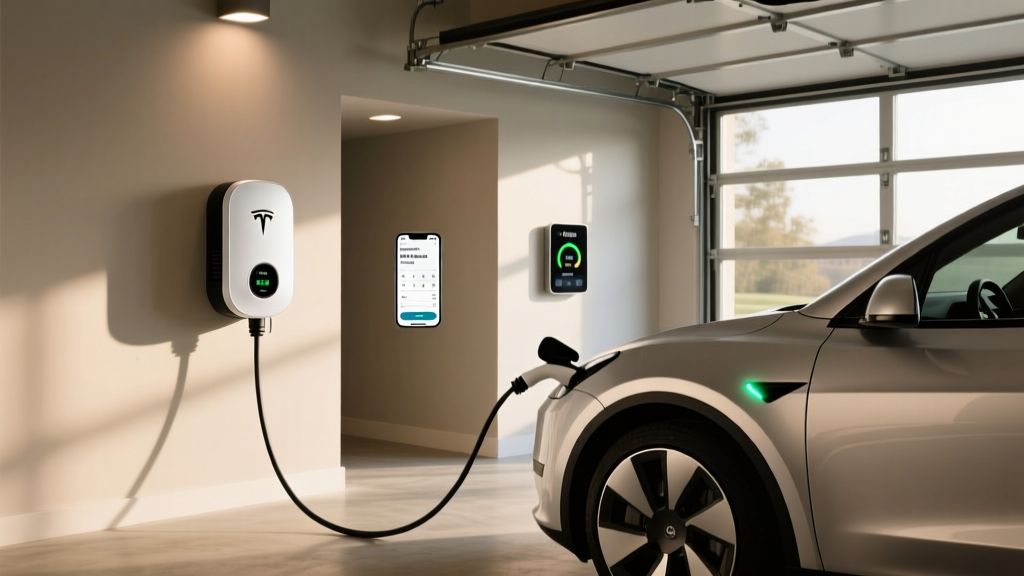
Tesla Wall Connector (Gen 4)
- Power Output: Up to 11.5 kW (48A on a 60A circuit)
- Connector: Native NACS — no adapter needed
- Cable Length: 24 ft
- Smart Features: Wi-Fi, over-the-air updates, Power Sharing (link two units on one circuit), Tesla app integration
- Price: ~$420
- Best For: Tesla-only households wanting maximum integration
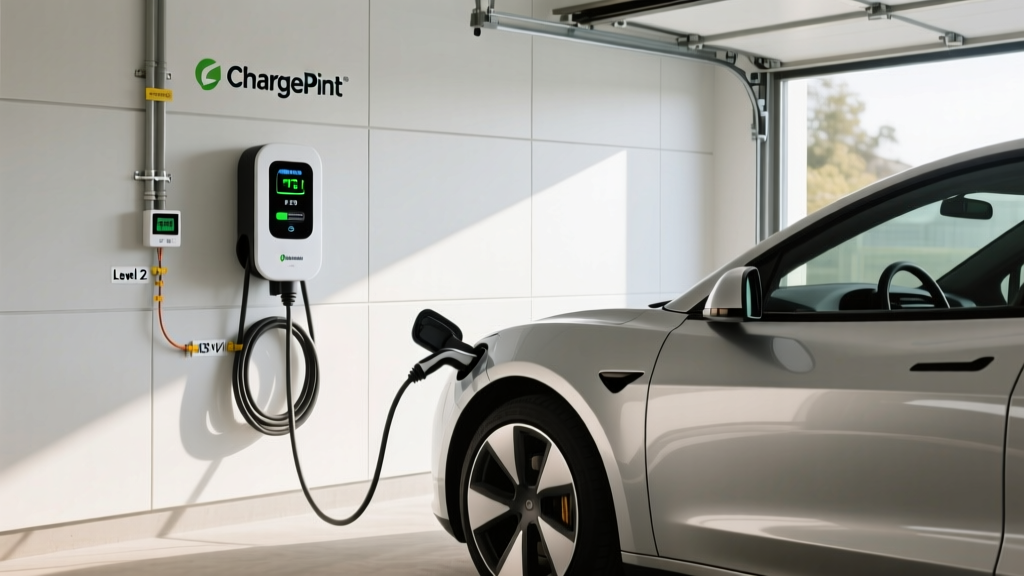
ChargePoint Home Flex (NACS version)
- Power Output: Up to 12 kW (50A on a 60A circuit, configurable down to 16A)
- Connector: NACS (2025+ models); J1772 with adapter for older stock
- Cable Length: 23 ft
- Smart Features: Wi-Fi, Alexa integration, detailed ChargePoint app with energy tracking, flexible amperage dip-switch settings
- Price: ~$550–$650
- Best For: Multi-EV households or those wanting platform flexibility
Emporia Level 2 EV Charger
- Power Output: Up to 11.5 kW (48A on a 60A circuit)
- Connector: J1772 (use included Tesla adapter) or NACS on newer versions
- Cable Length: 24 ft
- Smart Features: Wi-Fi, real-time energy monitoring via Emporia app, solar integration for solar-equipped homes, scheduled charging
- Price: ~$350–$400
- Best For: Budget-conscious buyers with solar panels who want energy visibility
All three units are hardwired (recommended for 48A+) or plug into a NEMA 14-50 outlet (max 40A / 9.6 kW). Hardwiring is preferable — it eliminates the outlet as a failure point and is required for circuits above 50 amps in most jurisdictions. Per the NEC, any outdoor installation should use a unit rated for wet locations (all three above qualify) and, where required by local code, a GFCI breaker — though some EVSE manufacturers recommend against GFCI breakers on hardwired units because the EVSE has its own ground-fault protection built in. Consult your electrician on local requirements.
Safety, Code, and Best Practices
EV charging draws significant current for hours at a time — more sustained load than almost any other household appliance. Cutting corners on installation creates fire risk. Non-negotiable requirements:
- Dedicated circuit: Your EV charger must be on its own breaker — never shared with other outlets or appliances.
- Proper wire gauge: 6 AWG copper for 50A circuits; 4 AWG for 60A. Your electrician will size this correctly.
- Permit and inspection: Most municipalities require an electrical permit and post-installation inspection. Skipping this can void homeowner's insurance coverage for electrical fires.
- Outdoor rating: If the charger is mounted outside (driveway, exterior wall), it must be NEMA 4 or NEMA 4X rated for weather resistance.
- Cable management: Use a holster or cable organizer to keep the cord off the ground and prevent trip hazards and connector damage.
According to the National Fire Protection Association's NEC guidelines, EV charging circuits fall under Article 625, which specifies requirements for wiring methods, disconnecting means, and ventilation. A licensed electrician familiar with Article 625 is essential — general handyman work is not appropriate for this installation.
Frequently Asked Questions
How much does it cost to install a home EV charger?
For most homes with a modern 200-amp electrical panel, expect $800–$2,500 all-in (charger hardware, electrician labor, and permit). If your home needs a panel upgrade from 100A to 200A service, add $1,500–$3,500, bringing the total to $2,300–$6,000+. Always get multiple quotes and verify the electrician is licensed and familiar with NEC Article 625.
How fast will each charging level add range to my Tesla?
Level 1 (120V) adds roughly 3–5 miles per hour — usable only for overnight trickle or emergencies. Level 2 (240V, 48A) adds approximately 30–44 miles per hour, fully recharging most Teslas overnight. DC Fast Charging at a Supercharger adds the equivalent of 500–1,000+ miles per hour at peak rate, though real sessions are measured in 10–80% time (15–35 minutes depending on model and stall generation).
Which connector and charger is compatible with my Tesla?
All Teslas use the native NACS connector. At home, the Tesla Wall Connector plugs directly in. For public Level 2 stations with J1772 connectors, Tesla includes a J1772 adapter with every vehicle. For non-Tesla DC fast chargers using CCS1, Tesla sells a CCS adapter (~$175–$250). CHAdeMO is largely obsolete and rarely needed.
How much does charging cost per mile compared to gas?
Home charging at off-peak rates costs approximately $0.02–$0.03 per mile — about 75% less than gasoline at $3.40/gallon and 28 MPG combined ($0.12/mile). Exclusive Supercharger use costs $0.08–$0.10 per mile, still roughly 15–30% cheaper than gas. The savings compound: a 12,000-mile-per-year driver saves $900–$1,100 annually with home charging.
What electrical upgrades might I need for a home charger?
If your home has a 200-amp main panel with spare breaker slots and capacity, you likely need no upgrade — just a new dedicated 50A or 60A circuit. Homes with 100A or 150A panels, or panels already near capacity (common in homes with electric ranges, dryers, and HVAC), may need a panel upgrade to 200A. An electrician can perform a load calculation to determine this. In some cases, a smart load-management device ($200–$400 additional) can avoid a full panel upgrade by throttling charger draw during peak household usage.
Does battery preconditioning actually affect Supercharging speed?
Yes, significantly. When you navigate to a Supercharger in the Tesla's built-in navigation, the car automatically begins preconditioning the battery — warming it to the optimal temperature for fast charging. In cold weather (below 40°F), preconditioning can reduce a 10–80% session by 5–10 minutes compared to arriving with a cold battery. Always navigate to the Supercharger rather than just driving there from memory.
Can I charge a non-Tesla EV at a Supercharger?
Yes, selectively. Tesla has opened a growing number of Supercharger stalls to non-Tesla NACS-equipped vehicles through its "Open Supercharger" program. Vehicles with native NACS (2025+ Ford, GM, Rivian, and others) can access participating stalls via the Tesla app. CCS-equipped non-Teslas can access select stalls using Tesla's Magic Dock adapter built into certain V3/V4 stalls. Availability varies by station — check the Tesla app for Open Supercharger locations.