If you've been browsing EV charging forums or Amazon listings, you've likely encountered the Red Eye Charger — a 48-amp Level 2 home charging unit that has gained attention among EV owners looking for a budget-friendly alternative to premium brands like ChargePoint, Emporia, and Wallbox. But does the Red Eye Charger deliver reliable, code-compliant home charging, or is it a corner-cutter waiting to trip your breaker?
In this guide, we break down the Red Eye Charger's specs, connector compatibility, installation requirements, and real-world performance — and compare it head-to-head with established Level 2 chargers. We'll also cover everything you need to know about home EV charging in general: electrical panel requirements, cost per mile versus gas, and the critical difference between kW (power) and kWh (energy).
What Is the Red Eye Charger? Specs at a Glance
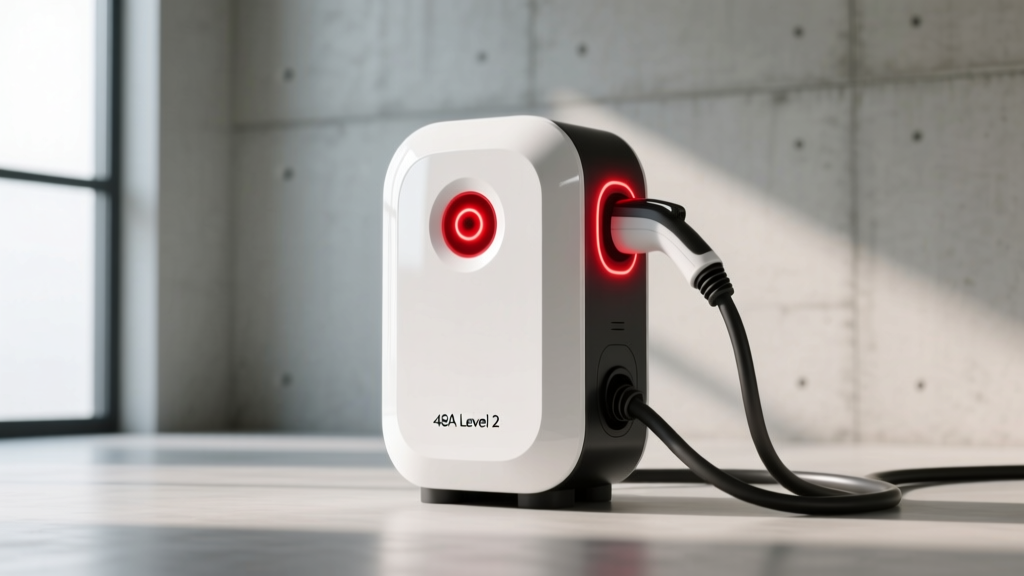
The Red Eye Charger is a 48-amp, 240-volt Level 2 home EV charger that delivers up to 11.5 kW of continuous power. It ships with a NACS (North American Charging Standard) connector as of its 2025 refresh, with CCS1 compatibility via adapter. Here's how the core specifications stack up:
| Specification | Red Eye Charger (2025+) |
|---|---|
| Max Output | 11.5 kW (48A @ 240V) |
| Input Voltage | 240V, single-phase, 60 Hz |
| Circuit Requirement | 60A dedicated breaker |
| Connector | NACS (native); CCS1 via J1772 adapter |
| Cable Length | 25 ft |
| Wi-Fi / Smart Features | Yes — app scheduling, energy tracking |
| Indoor/Outdoor Rating | NEMA 4 (indoor/outdoor) |
| MSRP | ~$349 |
| Warranty | 3 years |
A key point of EV literacy: kW (kilowatts) measures power — the rate at which energy flows into your battery. kWh (kilowatt-hours) measures energy — the total capacity of your battery. Think of kW as the width of a hose and kWh as the size of the bucket. The Red Eye Charger's 11.5 kW output means it can deliver 11.5 kWh of energy per hour under ideal conditions.
Charging Levels Explained: How Fast Will Each Add Range?
Before evaluating the Red Eye Charger specifically, you need to understand the three EV charging levels and what they mean for your daily routine.
| Level | Voltage | Power (kW) | Miles Added/Hour* | Typical Use Case |
|---|---|---|---|---|
| Level 1 | 120V (standard outlet) | 1.2–1.9 kW | 3–5 mi/hr | Overnight trickle, PHEV top-ups |
| Level 2 | 240V (dryer-style outlet) | 7.2–11.5 kW | 25–44 mi/hr | Daily home/work charging |
| DC Fast Charging | 400–800V DC | 50–350 kW | 150–1,000+ mi/hr | Road trips, highway corridors |
*Miles per hour vary by vehicle efficiency. A Tesla Model 3 (~25 kWh/100mi) gains range faster than a Ford F-150 Lightning (~48 kWh/100mi) at the same kW rate.
The Red Eye Charger operates at Level 2's upper tier. At 11.5 kW, it can add roughly 38–44 miles of range per hour to an efficient sedan like the Hyundai Ioniq 6, or about 22–25 miles per hour to a larger vehicle like the Rivian R1S. For most EV owners with a 75–100 kWh battery, a full overnight charge (10–12 hours) is easily achievable.
Home Installation: Electrical Requirements and Costs
This is where many EV buyers get blindsided. The charger itself is only part of the equation — the electrical work to support it often costs as much or more.
Electrical Requirements for the Red Eye Charger
The Red Eye Charger draws 48 amps continuously. Per the National Electrical Code (NEC), continuous loads must be on a circuit rated at 125% of the load. That means you need a 60-amp dedicated breaker on a 240V circuit. This is non-negotiable for code compliance and safety.
Key installation considerations:
- Panel capacity: Your main electrical panel must have enough spare capacity. A typical home has a 100A or 200A main panel. Adding a 60A circuit to an already-loaded 100A panel may require a panel upgrade to 200A, which adds significant cost.
- Wire gauge: 6 AWG copper wire is standard for a 60A circuit, though some electricians use 4 AWG for longer runs to reduce voltage drop.
- Conduit and run length: If your panel is in the basement and you want the charger in the garage or on an exterior wall, the wire run may require conduit through walls, crawlspaces, or along the foundation.
- GFCI protection: The 2023 NEC update requires GFCI protection for EV charging outlets. Hardwired installations (which the Red Eye Charger supports) may sidestep this requirement in some jurisdictions, but check with your local inspector.
- Permit: Nearly all jurisdictions require an electrical permit for EV charger installation. The permit ensures the work is inspected and meets code. Skipping this can void insurance coverage and create a fire hazard.
Installation Cost Breakdown
| Component | Typical Cost Range | Notes |
|---|---|---|
| Red Eye Charger unit | $349 | MSRP; sales tax additional |
| Electrician labor (standard install) | $500–$1,200 | Short run, panel has capacity |
| Electrician labor (complex install) | $1,200–$3,000 | Long wire run, conduit, drywall work |
| Electrical permit | $50–$200 | Varies by municipality |
| Panel upgrade (if needed) | $1,500–$3,500 | 100A → 200A; common in older homes |
| Total (no panel upgrade) | $900–$1,750 | Most newer homes with 200A panel |
| Total (with panel upgrade) | $2,400–$5,250 | Older homes or high-load panels |
Panel upgrade gotcha: If your home was built before 1990 and has a 100A service, you'll almost certainly need an upgrade. Some utility companies offer rebates of $200–$500 for panel upgrades tied to EV adoption — check with your local provider.
Connector Compatibility: NACS, CCS1, and CHAdeMO
The connector landscape has shifted dramatically. As of 2025–2026, the NACS (North American Charging Standard) — originally Tesla's proprietary connector — has become the dominant standard. Ford, GM, Rivian, Volvo, Hyundai, Kia, and most major automakers now ship EVs with NACS ports or provide CCS-to-NACS adapters.
| Connector | Compatible Vehicles (2026 Models) | Adapter Needed? |
|---|---|---|
| NACS | Tesla (all), Ford (F-150 Lightning, Mustang Mach-E), GM (Equinox EV, Blazer EV, Silverado EV), Rivian, Hyundai Ioniq 5/6, Kia EV6/EV9 | No — native on Red Eye Charger |
| CCS1 | VW ID.4, older BMW i4/iX, older Hyundai/Kia, Porsche Taycan (2025 and earlier) | Yes — NACS-to-CCS1 adapter (~$150–$250) |
| CHAdeMO | Nissan Leaf (discontinued 2025), Mitsubishi Outlander PHEV (older models) | Yes — requires CHAdeMO adapter (rare, ~$300+) |
The Red Eye Charger ships with a NACS plug. If you drive a vehicle with a CCS1 port, you'll need a NACS-to-CCS adapter. This works for Level 2 home charging without issue, but note that not all adapters are rated for DC fast charging — confirm the adapter's rating before using it at public DC stations.
Charging Time Examples: Real-World 10–80% Scenarios
Here's how long it takes to charge common EV batteries from 10% to 80% State of Charge (SoC) using the Red Eye Charger at 11.5 kW:
| Vehicle | Battery (kWh usable) | 10–80% Energy Needed | Time at 11.5 kW |
|---|---|---|---|
| Tesla Model 3 Long Range | 75 kWh | ~52.5 kWh | ~4.6 hours |
| Hyundai Ioniq 5 (Long Range) | 77.4 kWh | ~54.2 kWh | ~4.7 hours |
| Ford F-150 Lightning (Extended) | 131 kWh | ~91.7 kWh | ~8.0 hours |
| Chevrolet Equinox EV | 85 kWh | ~59.5 kWh | ~5.2 hours |
| Toyota bZ4X | 64 kWh | ~44.8 kWh | ~3.9 hours |
Charge curve reality check: Level 2 charging is relatively linear — unlike DC fast charging, where power tapers significantly above 80% SoC. At home, the Red Eye Charger will deliver close to its rated 11.5 kW throughout most of the charge cycle, with minor taper only in the final 5–10% as the battery management system balances cells.
Cost to Charge: Home vs. Public vs. Gas
One of the strongest arguments for home Level 2 charging is cost. Here's how charging at home with the Red Eye Charger compares to public charging and gasoline on a per-mile basis:
| Scenario | Rate | Cost per kWh | Cost per Mile* |
|---|---|---|---|
| Home (off-peak utility rate) | $0.09–$0.13/kWh | $0.11 avg | $0.03–$0.04 |
| Home (standard rate) | $0.14–$0.18/kWh | $0.16 avg | $0.04–$0.05 |
| Public Level 2 (ChargePoint, etc.) | $0.25–$0.49/kWh | $0.35 avg | $0.09–$0.12 |
| DC Fast Charging (Electrify America, Tesla Supercharger) | $0.30–$0.55/kWh | $0.42 avg | $0.11–$0.15 |
| Gasoline (30 MPG avg, $3.40/gal) | — | — | $0.11 |
| Gasoline (22 MPG truck, $3.40/gal) | — | — | $0.15 |
*EV cost per mile based on an average efficiency of 3.0 miles/kWh (approx. 33 kWh/100mi), representative of a mid-size crossover like the Tesla Model Y or Hyundai Ioniq 5. More efficient sedans will cost less; larger trucks/SUVs will cost more. Source: fueleconomy.gov.
At home with off-peak rates, the Red Eye Charger can fuel your EV for roughly $0.03–$0.04 per mile — about one-third the cost of gasoline. Over 12,000 miles per year, that's a savings of roughly $840–$960 annually compared to a 30 MPG gas car at $3.40/gallon.
However, if you rely exclusively on public DC fast charging, your per-mile cost can equal or exceed gasoline. This is why home charging access is the single biggest factor in EV ownership satisfaction and economics.
Red Eye Charger vs. Established Alternatives
How does the Red Eye Charger stack up against the Level 2 chargers we recommend most frequently?
| Feature | Red Eye Charger | Emporia Vue 2 | ChargePoint Home Flex | Wallbox Pulsar Plus |
|---|---|---|---|---|
| Max Output | 11.5 kW (48A) | 11.5 kW (48A) | 12.0 kW (50A) | 11.5 kW (48A) |
| Connector | NACS | NACS | NACS | NACS |
| Cable Length | 25 ft | 24 ft | 23 ft | 25 ft |
| Smart Features | App, scheduling | App, solar integration, load mgmt | App, Alexa, scheduling | App, scheduling, power sharing |
| Load Management | No | Yes (panel-level) | No (manual amp setting) | Yes (multi-charger sharing) |
| NEMA Rating | NEMA 4 | NEMA 4 | NEMA 4 | NEMA 4 |
| UL Listed | Reported pending | Yes (UL listed) | Yes (UL listed) | Yes (UL listed) |
| Warranty | 3 years | 3 years | 3 years | 3 years |
| Price | ~$349 | ~$399 | ~$599 | ~$449 |
Critical note on UL listing: As of early 2026, the Red Eye Charger's UL certification status has been reported as pending or in-process by some users. UL (Underwriters Laboratories) certification is essential for safety assurance and is often required by electrical inspectors and insurance companies. Before purchasing, verify current UL listing status directly with the manufacturer and your local permitting office. Non-UL-listed chargers may fail inspection or complicate insurance claims in the event of an electrical fire.
Who Should Consider the Red Eye Charger?
The Red Eye Charger's price point is attractive, and its 48A output matches chargers costing $100–$250 more. It's a reasonable option if:
- You've confirmed UL listing status is current for your purchase batch
- Your local inspector does not require UL listing specifically
- You want maximum kW output at minimum equipment cost
- You drive a NACS-equipped vehicle and don't need adapter ecosystems
Who Should Choose an Alternative?
Consider the Emporia Vue 2 or ChargePoint Home Flex if:
- You have solar panels and want integrated load management (Emporia)
- Your inspector requires UL-listed equipment (verify locally)
- You want a longer track record of firmware updates and app reliability
- You plan to install multiple chargers and need power sharing (Wallbox)
Safety and Code Considerations
Home EV charging involves sustained high-current draw — often for 6–10 hours at a time. This is fundamentally different from plugging in a dryer for 45 minutes. Safety is paramount.
Non-negotiable safety requirements:
- Dedicated circuit: The Red Eye Charger must be on its own dedicated 60A breaker. Never share the circuit with other appliances.
- Hardwired vs. plug: The Red Eye Charger supports both hardwired and NEMA 14-60 plug installation. Hardwired is generally preferred for reliability and may avoid the GFCI breaker requirement in some jurisdictions.
- GFCI protection: If using a receptacle (plug-in), NEC 2023+ requires a GFCI breaker. These cost $80–$150 and can be prone to nuisance tripping with some EV chargers — another reason many electricians recommend hardwiring.
- Outdoor rating: The NEMA 4 rating means the Red Eye Charger is suitable for outdoor installation and can withstand rain and splashing water. However, it is not rated for direct hose-down (NEMA 4X) or submersion.
- Cable management: The 25-foot cable should be kept off the ground when not in use. A wall-mounted cable organizer prevents tripping hazards and cable damage.
Always hire a licensed electrician for installation. Per the NEC, DIY electrical work on high-amperage circuits can create serious fire and shock hazards, and will likely fail inspection.
Frequently Asked Questions
How much does it cost to install a home EV charger?
Expect to pay $900–$1,750 total for a standard installation of the Red Eye Charger (equipment + electrician + permit) in a home with a 200A panel and a short wire run. If your home needs a panel upgrade from 100A to 200A, add $1,500–$3,500, bringing the total to $2,400–$5,250. Get at least three quotes from licensed electricians.
How fast will each charging level add range?
Level 1 (120V) adds 3–5 miles per hour — adequate only for PHEVs or very low daily mileage. Level 2 (240V, like the Red Eye Charger at 11.5 kW) adds 25–44 miles per hour depending on vehicle efficiency, fully recharging most EVs overnight. DC fast charging (50–350 kW) can add 150–1,000+ miles per hour, enabling 10–80% charges in 18–45 minutes on the road.
Which connector/charger is compatible with my EV?
As of 2026, most new EVs use the NACS connector, which the Red Eye Charger ships with natively. If your EV has a CCS1 port (common on VW ID.4, older BMW i4, and pre-2025 Hyundai/Kia models), you'll need a NACS-to-CCS adapter (~$150–$250). CHAdeMO is essentially discontinued for new vehicles. Check your vehicle's charge port before purchasing any charger.
How much does charging cost per mile vs gas?
Home charging with the Red Eye Charger at off-peak rates costs approximately $0.03–$0.04 per mile for an efficient EV. Gasoline at $3.40/gallon costs $0.11/mile at 30 MPG and $0.15/mile at 22 MPG. Over 12,000 annual miles, home EV charging saves $840–$1,440 compared to gasoline. Public DC fast charging, however, can cost $0.11–$0.15/mile — comparable to or exceeding gasoline.
What electrical upgrades might I need?
The most common upgrade is a panel capacity increase from 100A to 200A service, required when your existing panel lacks the spare capacity for a new 60A circuit. Other potential upgrades include: replacing outdated Federal Pacific or Zinsco panels (known fire hazards, $2,000–$4,000 to replace), running new conduit for long wire runs, or upgrading the utility service drop if your home's incoming supply is insufficient. A licensed electrician can perform a load calculation to determine your exact needs.
Is the Red Eye Charger eligible for the federal tax credit?
The Alternative Fuel Vehicle Refueling Property Credit (IRS §30C) covers up to 30% of home charger equipment and installation costs, capped at $1,000. However, eligibility depends on the charger being installed in a qualifying census tract (low-income or non-urban). The Red Eye Charger may qualify if installed in an eligible area — check the IRS guidance or consult a tax professional for your specific situation. This credit is separate from the §30D vehicle purchase credit.
Can I charge at 48A if my EV's onboard charger is limited to 32A or 40A?
Yes. The Red Eye Charger can supply up to 48A, but your EV's onboard charger determines how much it actually draws. A Tesla Model 3 Long Range (48A onboard charger) will use the full 11.5 kW. A vehicle with a 32A onboard charger (like some base-model EVs) will only draw 7.7 kW even though the charger can supply more. This is perfectly safe — the EV controls the draw.