The upcoming electric Range Rover Velar — expected to arrive for the 2027 model year on Land Rover's new EMA (Electric Modular Architecture) platform — represents the brand's push into the luxury midsize electric SUV segment. With an anticipated battery capacity north of 100 kWh and 800V-class architecture, getting your home charging infrastructure right is critical before the first deliveries arrive. This guide breaks down everything you need to know about charging the electric Range Rover Velar 2027 at home, on the road, and what it will cost you in both setup and daily use.
Note: As of early 2026, the electric Range Rover Velar has been announced but final EPA-certified specifications have not been released. Battery capacity, range, and charging figures referenced here are based on Land Rover's preliminary EMA platform disclosures and are subject to change. We will update this guide once official Land Rover specifications are published.
Understanding Charging Levels: What the Electric Range Rover Velar 2027 Supports
Before evaluating equipment, you need to understand the three charging tiers and what each delivers. The distinction between kW (kilowatts — the rate of power delivery) and kWh (kilowatt-hours — the total energy stored in the battery) is fundamental. Think of kW as how wide the pipe is; kWh is how much water fills the tank.
The electric Range Rover Velar's EMA platform is expected to support all three levels, with DC fast charging potentially reaching 200+ kW peak on compatible infrastructure.
| Level | Voltage | Max Power (kW) | Miles of Range Added per Hour | Best For |
|---|---|---|---|---|
| Level 1 (120V) | 120V AC | ~1.4 kW | ~3–5 mi/hr | Emergency / overnight trickle |
| Level 2 (240V) | 240V AC | ~11–19.2 kW | ~30–55 mi/hr | Daily home charging |
| DC Fast Charge | 400–800V DC | ~200+ kW (est. peak) | ~500–700 mi/hr (peak) | Road trips, rapid top-ups |
Real-world context: On Level 1, fully replenishing a ~100 kWh battery would take over 70 hours — essentially impractical for anything beyond maintaining charge between drives. Level 2 at 11.5 kW (48A circuit) would take roughly 9–10 hours from empty to full, making overnight charging viable. DC fast charging, at the anticipated 200 kW peak, should deliver a 10–80% charge in approximately 25–30 minutes, though charge speed tapers significantly above 80% SoC to protect battery longevity.
Home Level 2 Charger Installation: Electrical Requirements and Costs
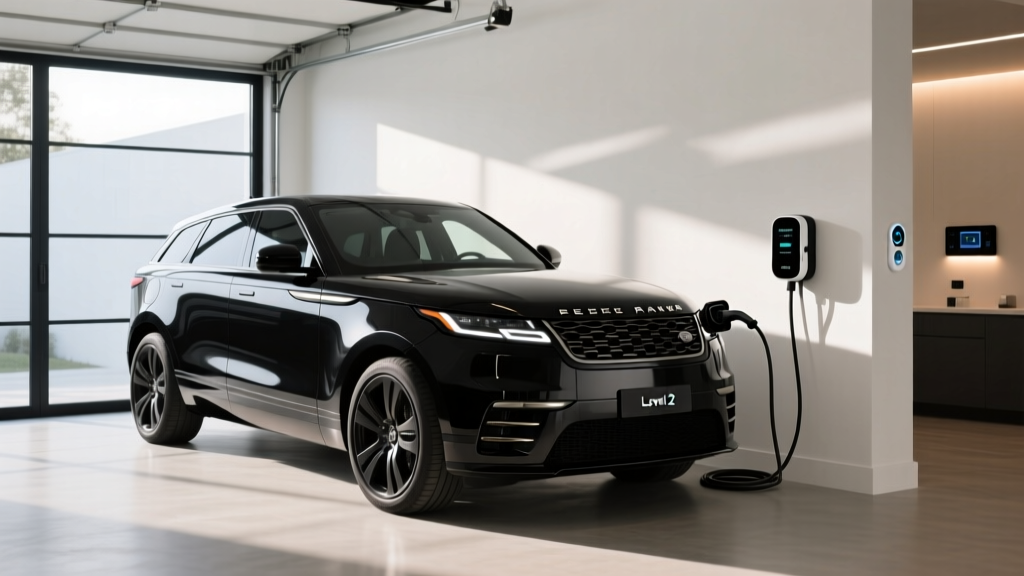
For a vehicle with an expected 100+ kWh battery, a robust Level 2 home charger is not optional — it's essential. Here's what the electrical side demands.
Electrical Specifications
- Circuit: Dedicated 60A breaker (for a 48A continuous-duty charger) or 50A breaker (for 40A charger)
- Voltage: 240V single-phase (standard residential split-phase)
- Wire gauge: 6 AWG copper (60A circuit) or 8 AWG (50A circuit) — run in conduit where required
- Outlet vs. hardwired: NEMA 14-50 outlet offers portability; hardwired avoids GFCI nuisance tripping common with high-amperage EV circuits under NEC 2023/2026 code
Panel Upgrade Considerations
This is where costs escalate for older homes. If your electrical panel is 100A service (common in homes built before 2000), adding a 60A EV circuit may exceed available capacity once existing loads are calculated. A NEC-compliant load calculation by a licensed electrician will determine if you need a panel upgrade to 200A service — a $1,500–$3,500 expense on top of the charger install.
| Component | Low Estimate | High Estimate | Notes |
|---|---|---|---|
| Level 2 Charger (Equipment) | $400 | $750 | 48A smart charger, 25ft cable |
| Electrician Labor (standard run) | $500 | $1,200 | Panel to garage, <50ft wire run |
| Permit & Inspection | $50 | $250 | Varies by municipality |
| Panel Upgrade (if needed) | $1,500 | $3,500 | 100A → 200A service upgrade |
| Conduit/Materials | $100 | $400 | Longer runs, outdoor routing |
| Total (no panel upgrade) | $1,050 | $2,600 | Most newer homes |
| Total (with panel upgrade) | $2,550 | $6,100 | Older homes with 100A service |
Connector Compatibility: NACS, CCS, and What the Velar Will Use
By the 2027 model year, the North American charging landscape will be predominantly NACS (North American Charging Standard, originally Tesla's connector). Land Rover has not yet confirmed which connector the electric Velar will ship with in the US market, but given that most automakers have committed to NACS adoption by 2025–2026, a NACS port is the most likely scenario.
| Connector | Used By | DC Fast Charge Support | Adapter Availability |
|---|---|---|---|
| NACS (J3400) | Tesla, Ford, GM, Rivian, Volvo, most by 2026+ | Yes — Supercharger + third-party | CCS-to-NACS adapters widely available |
| CCS1 | Legacy VW, Hyundai, BMW (pre-2025 models) | Yes — Electrify America, EVgo | NACS-to-CCS adapters available |
| CHAdeMO | Nissan Leaf (legacy/discontinued) | Yes — declining network | Limited adapter options |
Practical advice: If the Velar ships with NACS, you'll have direct access to Tesla Superchargers (over 25,000 stalls in North America) plus NACS-equipped Electrify America and EVgo stations. If it ships with CCS1, a CCS-to-NACS adapter (~$200–$300) will unlock the Supercharger network. Confirm your vehicle's connector before purchasing a home charger — most Level 2 chargers are now available with either connector type.
Charging Time Estimates for the Electric Range Rover Velar 2027
Assuming a usable battery capacity of approximately 100–110 kWh (based on EMA platform targets and the need to compete with the BMW iX and Mercedes EQE SUV), here's what charging looks like across scenarios:
| Charging Scenario | Power | 10–80% Time | 0–100% Time | Notes |
|---|---|---|---|---|
| Level 1 (120V/12A) | 1.4 kW | ~50 hours | ~71 hours | Emergency only |
| Level 2 (240V/32A) | 7.7 kW | ~9 hours | ~13 hours | Portable charger / low-amperage circuit |
| Level 2 (240V/48A) | 11.5 kW | ~6 hours | ~8.7 hours | Standard home wallbox |
| Level 2 (240V/80A) | 19.2 kW | ~3.6 hours | ~5.2 hours | Requires 100A circuit; vehicle must accept 19.2 kW AC |
| DC Fast (200 kW peak) | 200 kW | ~25–30 min | N/A (don't DC to 100%) | Peak rate; tapers above 80% |
Charge curve reality check: The "200 kW peak" figure applies only between roughly 10–40% SoC under ideal thermal conditions. Expect sustained rates of 150–170 kW through 60%, dropping to 50–80 kW above 80%. This is why 10–80% is the standard measurement — charging beyond 80% on DC adds time disproportionately. For daily driving, preconditioning the battery (a feature expected on the Velar via the Land Rover app) before arriving at a DC station is essential to hitting peak rates, especially in cold weather.
Cost to Charge: Home vs. Public vs. Gas Comparison
One of the strongest ownership arguments for the electric Velar over its mild-hybrid and PHEV predecessors is fuel cost. Here's how the numbers work based on a ~100 kWh battery and an estimated EPA efficiency of 2.8–3.0 kWh/mile (roughly 85–90 MPGe for a luxury SUV of this weight class).
| Scenario | Rate | Cost for Full Charge (~100 kWh) | Cost per Mile (est. 300 mi range) |
|---|---|---|---|
| Home (off-peak utility rate) | $0.12/kWh | $12.00 | $0.04/mi |
| Home (average US residential) | $0.17/kWh | $17.00 | $0.057/mi |
| Public Level 2 (ChargePoint, etc.) | $0.25–$0.35/kWh | $25–$35 | $0.08–$0.12/mi |
| DC Fast (Electrify America/Supercharger) | $0.35–$0.55/kWh | $35–$55 | $0.12–$0.18/mi |
| Gas equivalent (22 MPG, $3.60/gal) | $3.60/gallon | $49.09 (13.6 gal) | $0.164/mi |
Even at public DC fast-charging rates, the electric Velar undercuts premium gasoline on a per-mile basis. At home off-peak rates, the savings are dramatic — roughly 75% less per mile than a comparable gas-powered Range Rover Velar (which averaged 22 MPG combined). Over 15,000 miles annually, home charging at $0.12/kWh saves approximately $1,860/year versus gasoline at $3.60/gallon.
Source: Average US electricity rates from the EIA; fuel economy comparisons via fueleconomy.gov.
Recommended Level 2 Home Chargers for the Electric Range Rover Velar
Given the expected battery size, we recommend 48A chargers (requiring a 60A breaker) to maximize overnight charging speed. Here are three proven options suited to a luxury EV owner's needs:
ChargePoint Home Flex
- Power: Up to 12 kW (50A) — configurable down for smaller circuits
- Connector: Available in NACS or CCS1 (J1772 with adapter)
- Cable length: 23 feet
- Smart features: Wi-Fi, app scheduling, Alexa integration, energy reporting
- Price: ~$549
- Why it works: Amperage flexibility means it works on 40A or 60A circuits without hardware changes
Wallbox Pulsar Plus
- Power: Up to 11.5 kW (48A)
- Connector: J1772 (NACS adapter available); NACS-native version shipping 2026
- Cable length: 25 feet
- Smart features: Wi-Fi + Bluetooth, load balancing, solar integration, Power Sharing (daisy-chain two units on one circuit)
- Price: ~$449
- Why it works: Compact form factor, strong app, Power Sharing is ideal for two-EV garages
Tesla Wall Connector (Gen 3)
- Power: Up to 11.5 kW (48A)
- Connector: NACS native
- Cable length: 24 feet
- Smart features: Wi-Fi, OTA updates, load sharing between units, integrated cable management
- Price: ~$475
- Why it works: If the Velar ships with NACS, this is the most seamless plug-and-charge experience; excellent build quality
Safety, Code Compliance, and Outdoor Installation
Level 2 EV charging is a continuous high-amperage load — the NEC treats it differently from typical household circuits. Key requirements:
- Dedicated circuit: The charger must be on its own breaker — no shared circuits with other appliances
- GFCI protection: NEC 2023 and later require GFCI on 240V receptacles used for EV charging. Hardwired installations bypass this requirement and avoid nuisance tripping — most electricians now recommend hardwired for 48A+ circuits
- Outdoor rating: If installing outside or in an unsealed garage, the charger must carry a NEMA 4 (or IP65+) weather rating. All three chargers above meet this standard
- Permit and inspection: Most jurisdictions require an electrical permit for new 240V circuits. Your electrician should pull this — skip it and you risk insurance denial on any electrical fire claim
- Cable management: For garages, a holster or retractable reel prevents trip hazards and cable damage. Never let a charging cable rest on a concrete floor where vehicles can run over it
Frequently Asked Questions
How much does it cost to install a home EV charger for the electric Range Rover Velar?
Expect $1,050–$2,600 for a standard installation (equipment, electrician labor, permit) in a home with adequate 200A panel capacity. Homes needing a panel upgrade from 100A to 200A service should budget $2,550–$6,100 total. Get quotes from at least two licensed electricians and confirm they include permit and inspection in the bid.
How fast will each charging level add range to the Velar?
Level 1 (120V): approximately 3–5 miles per hour. Level 2 at 48A (11.5 kW): roughly 35–40 miles per hour. DC fast charging at 200 kW peak: up to 500+ miles per hour, though only sustained for short bursts at low SoC. For a 100 kWh battery, Level 2 at 48A will fully charge overnight in about 8–9 hours.
Which connector and charger is compatible with my EV?
Final connector specification for the 2027 Velar has not been confirmed by Land Rover. Given industry-wide NACS adoption, NACS is most likely. Before purchasing a charger, confirm your vehicle's port. If your Velar has NACS, the Tesla Wall Connector or ChargePoint Home Flex (NACS version) are optimal. If CCS1, the Wallbox Pulsar Plus or ChargePoint Home Flex with J1772 connector will work, with a CCS-to-NACS adapter for Supercharger access.
How much does charging cost per mile versus gas for the Range Rover Velar?
At average US residential electricity rates ($0.17/kWh), expect approximately $0.057/mile. A gasoline Range Rover Velar at 22 MPG and $3.60/gallon costs about $0.164/mile. That's a 65% per-mile savings on electricity, translating to roughly $1,600/year over 15,000 miles.
What electrical upgrades might I need for a Level 2 charger?
The most common upgrade is a panel capacity increase from 100A to 200A service ($1,500–$3,500). Some homes may need a sub-panel added near the garage to shorten wire runs. Older aluminum wiring may require replacement with copper. A licensed electrician's load calculation (per NEC Article 220) will determine your specific needs before any equipment is purchased.
Will the electric Range Rover Velar qualify for the federal EV tax credit?
Eligibility under IRS §30D depends on final battery sourcing, MSRP (must be under $80,000 for SUVs), and buyer income limits ($300,000 joint / $150,000 single). Given Land Rover's pricing history and the Velar's likely MSRP above $70,000, the credit may be available for base trims only. Battery critical-mineral and component sourcing requirements will determine final eligibility — consult a tax professional before relying on the credit in your purchase decision.