What Is a Supercharger — And Why the Term Gets Misused
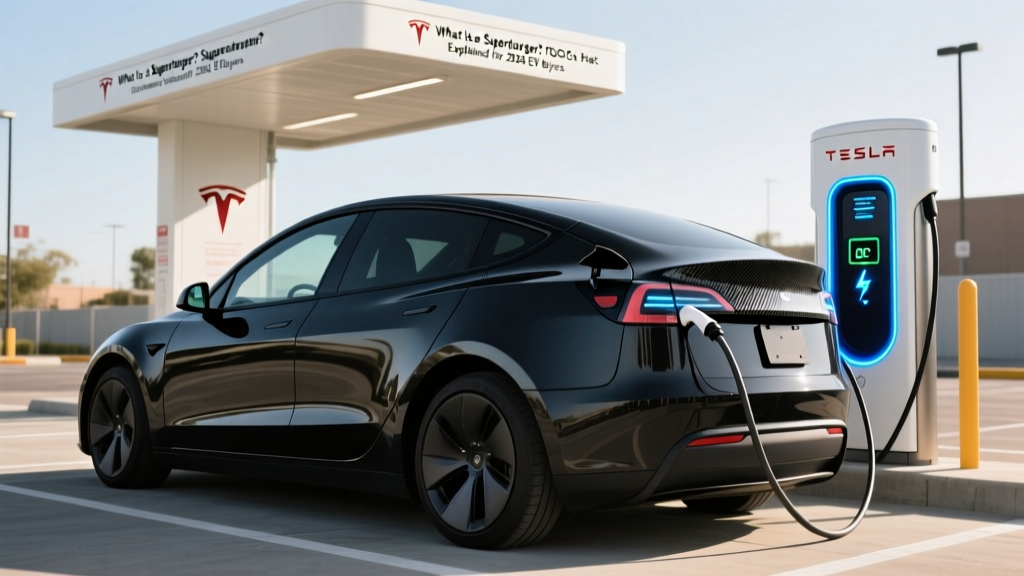
"Supercharger" is Tesla's brand name for its proprietary DC fast-charging network. It is not a generic term for any fast charger, though you'll hear it used that way at gas stations and in casual conversation. A Supercharger delivers direct current (DC) electricity at high power — typically 150 kW to 325 kW at current-generation V3 and V4 stalls — directly to an EV's battery, bypassing the car's onboard charger to refill a depleted pack in minutes rather than hours.
As of 2026, Tesla operates over 6,500 Supercharger stations and 60,000+ individual stalls across North America, making it the largest and most reliable DC fast-charging network on the continent. But with Tesla opening the network to non-Tesla EVs via the North American Charging Standard (NACS), understanding what a Supercharger actually is — and what it isn't — matters more than ever for EV shoppers.
This guide explains Supercharger technology, how it compares to other DC fast chargers, what you'll pay, and how to set up fast home charging so you only need Superchargers on road trips.
Charging Levels Explained: Level 1, Level 2, and DC Fast Charging
Before unpacking Superchargers specifically, you need the three-tier EV charging framework. The single most important distinction: kW (kilowatts) measures power — the rate electricity flows. kWh (kilowatt-hours) measures energy — the total amount stored in your battery. A 75 kWh battery charged at 150 kW doesn't take 75 hours; it theoretically takes 30 minutes (with real-world taper, more like 35-45 minutes from 10-80%).
| Level | Voltage | Power (kW) | Miles of Range Added per Hour | Typical Use Case |
|---|---|---|---|---|
| Level 1 (120V AC) | 120V | 1.2–1.9 kW | 3–5 mi/hr | Emergency / overnight trickle |
| Level 2 (240V AC) | 240V | 3.3–19.2 kW | 12–75 mi/hr | Daily home & workplace charging |
| DC Fast Charging | 400–800V DC | 50–350 kW | 150–1,000+ mi/hr (peak) | Road trips, rapid top-ups |
| Tesla Supercharger V3 | ~400V DC | Up to 250 kW | Up to ~1,000 mi/hr (peak) | Tesla & NACS-equipped EVs |
| Tesla Supercharger V4 | 400–800V DC | Up to 325 kW (current); 500 kW planned | Up to ~1,200+ mi/hr (peak) | Next-gen Tesla & NACS EVs |
A Supercharger is a DC fast charger — meaning it belongs in the same category as Electrify America's 350 kW stalls or EVgo's 150 kW chargers. The difference is network scale, uptime reliability (historically 99%+ for Tesla vs. the mid-80s for some competitors), and the NACS connector.
Supercharger Speeds: Real-World 10-80% Charge Times
Peak kW ratings grab headlines, but sustained charging power matters more. No EV maintains peak charge rate from 10% to 80%. As the battery fills, the battery management system (BMS) tapers power to protect cell health — this is the "charging curve."
Here's what 10-80% sessions look like on V3 Superchargers (250 kW peak) for common battery sizes:
| Vehicle (Example) | Battery (kWh usable) | Peak Charge Rate | 10-80% Time |
|---|---|---|---|
| Tesla Model 3 Long Range | 75 kWh (LFP/NMC) | ~250 kW | ~25–28 min |
| Tesla Model Y Long Range | 75 kWh | ~250 kW | ~25–28 min |
| Ford F-150 Lightning (Extended) | 131 kWh | ~170 kW (CCS w/ adapter) | ~45–50 min |
| Hyundai Ioniq 5 (NACS adapter) | 77.4 kWh | ~235 kW (800V arch) | ~18–22 min |
| Chevrolet Equinox EV | 85 kWh | ~190 kW | ~30–35 min |
Connector Compatibility: NACS, CCS1, CHAdeMO, and Adapters
The Supercharger network originally used Tesla's proprietary connector. In late 2022, Tesla published the connector specification as the North American Charging Standard (NACS), and by 2025, nearly every major automaker adopted it. As of 2026, new EVs from Ford, GM, Rivian, Hyundai/Kia, BMW, and others ship with native NACS charge ports. Older CCS1-equipped EVs can access Superchargers using a Tesla-approved CCS-to-NACS adapter (typically $200–$250).
| Connector | Brands Using It (2026 Models) | Supercharger Access |
|---|---|---|
| NACS (native) | Tesla (all), Ford, GM, Rivian, Hyundai/Kia, BMW, Mercedes, Volvo, Polestar | Direct — no adapter needed |
| CCS1 | Older model-year EVs (pre-NACS transition): VW ID.4 (pre-2025), some legacy models | Via CCS-to-NACS adapter (~$200–250) |
| CHAdeMO | Nissan Leaf (discontinued after 2025 MY), Mitsubishi Outlander PHEV | Not compatible with Superchargers |
| J1772 (AC only) | All EVs (Level 2 AC charging standard) | N/A — AC only, not DC fast |
Adapter warning: Not all CCS-to-NACS adapters support full Supercharger speeds. Tesla's official adapter and licensed third-party options (like the Lectron or A2Z adapters) support up to 250 kW. Cheap unlicensed adapters may cap at 50-150 kW or fail safety checks. Always verify the adapter's rated DC power and UL/ETL listing.
How Much Does Supercharger Charging Cost?
Supercharger pricing is per-kWh in most markets (some legacy stations still bill per-minute). Rates vary by station, time of day, and region. As of early 2026, typical Supercharger rates in the U.S. range from $0.25 to $0.55 per kWh, with an average around $0.35/kWh.
| Charging/Fueling Method | Cost per kWh or Gallon | Vehicle Efficiency | Cost per Mile |
|---|---|---|---|
| Home Level 2 (national avg electricity) | $0.16/kWh | 3.5 mi/kWh (e.g., Model Y) | $0.046/mi |
| Home Level 2 (off-peak utility rate) | $0.08/kWh | 3.5 mi/kWh | $0.023/mi |
| Tesla Supercharger (avg $0.35/kWh) | $0.35/kWh | 3.5 mi/kWh | $0.10/mi |
| Electrify America (avg $0.48/kWh) | $0.48/kWh | 3.5 mi/kWh | $0.137/mi |
| Gasoline (avg $3.40/gal, 28 MPG combined) | $3.40/gal | 28 MPG | $0.121/mi |
Even at peak Supercharger rates, EV charging typically undercuts gasoline on a per-mile basis. But the real savings come from home Level 2 charging, where off-peak utility rates can drop your fuel cost to 2-3 cents per mile — roughly 75-80% cheaper than gas.
Tesla also offers a membership program (~$12.99/month) that discounts Supercharger rates by 10-25% at select stations, worthwhile if you Supercharge more than 200 kWh per month.
Home Charging Setup: Electrical Requirements, Costs, and Equipment Picks
Over 80% of EV charging happens at home, according to the U.S. Department of Energy. A properly installed Level 2 home charger eliminates daily range anxiety and delivers the lowest per-mile cost. Here's what's involved.
Electrical Requirements
A Level 2 charger requires a dedicated 240V circuit, the same voltage as your electric dryer or oven. Common configurations:
- 40-amp circuit / 32-amp continuous charge (7.7 kW) — sufficient for most EVs, adds ~25-30 miles of range per hour
- 50-amp circuit / 40-amp continuous (9.6 kW) — faster, recommended for large-battery EVs like the F-150 Lightning or Rivian R1S
- 60-amp circuit / 48-amp continuous (11.5 kW) — maximum for most single-phase residential panels
The National Electrical Code (NEC) requires the circuit breaker to be rated at 125% of the continuous load. So a 48-amp charger needs a 60-amp breaker. Your charger's amperage must never exceed 80% of the circuit rating.
What Electrical Upgrades Might You Need?
Many homes built before 2000 have 100-amp electrical panels. Adding a 40-60 amp dedicated EV circuit to an already-loaded 100A panel may require a panel upgrade to 200 amps, which is the single biggest variable in installation cost. Signs you may need an upgrade:
- Your panel is at or near capacity (electrician will perform a load calculation)
- You already have electric heat, electric dryer, electric range, and electric water heater on a 100A panel
- Your panel uses fuses instead of breakers (pre-1960s wiring)
- You see rust, scorch marks, or a recalled panel brand (e.g., Federal Pacific, Zinsco)
Installation Cost Breakdown
| Component | Simple Install (panel has capacity, short run) | Complex Install (panel upgrade, long conduit run) |
|---|---|---|
| Level 2 Charger (hardware) | $400–$700 | $400–$700 |
| Electrical permit | $50–$150 | $50–$200 |
| Electrician labor (240V circuit, wiring, outlet or hardwire) | $500–$1,200 | $1,500–$3,000 |
| Panel upgrade (100A → 200A, if needed) | N/A | $1,800–$4,000 |
| Conduit and wiring materials | $100–$300 | $300–$800 |
| Total estimated cost | $1,050–$2,350 | $4,050–$8,700 |
The wide range is real. A homeowner with a 200-amp panel and a garage adjacent to the electrical box might spend $1,200 total. A homeowner needing a panel upgrade and a 60-foot conduit run to a detached garage could spend $7,000+. Always get at least two quotes from licensed electricians who will perform a proper NEC Article 220 load calculation.
Recommended Level 2 Home Chargers (2026)
ChargePoint Home Flex
- Power output: Up to 12 kW (50A) — configurable from 16A to 50A
- Connector: NACS (2026 model); J1772 available for legacy EVs
- Cable length: 23 feet
- Smart features: Wi-Fi, scheduling, energy tracking, Alexa/Google Home integration
- Price: ~$549 (hardware only)
- UL listed: Yes; indoor/outdoor rated (NEMA 4)
Tesla Wall Connector
- Power output: Up to 11.5 kW (48A)
- Connector: NACS native
- Cable length: 24 feet
- Smart features: Wi-Fi, over-the-air updates, power sharing (link multiple units on one circuit), Tesla app integration
- Price: ~$420
- UL listed: Yes; indoor/outdoor rated
Emporia Level 2 EV Charger
- Power output: Up to 11.5 kW (48A)
- Connector: NACS (2026 model); J1772 available
- Cable length: 24 feet
- Smart features: Wi-Fi, energy monitoring, solar integration (pairs with Emporia Vue home energy monitor), load management
- Price: ~$399
- UL listed: Yes; NEMA 4 outdoor rated
For Tesla owners, the Wall Connector is the natural pick at the lowest price point. For non-Tesla NACS EVs or households with mixed EV brands, the ChargePoint Home Flex offers the widest amperage configurability, which is useful if your panel has limited headroom.
Safety and Code Considerations for Home EV Charging
EV charging is a high-draw, long-duration electrical load — your charger may pull maximum current for 6-10 hours straight. This makes code compliance and safety non-negotiable:
- Dedicated circuit: Your Level 2 charger must have its own dedicated breaker — it cannot share a circuit with other appliances.
- GFCI protection: NEC 2020 and later require GFCI protection for all EV charging outlets. Hardwired installations may exempt you from this requirement in some jurisdictions, but GFCI is always safer for outdoor installs.
- Outdoor rating: If your charger is installed outside or in an unsealed garage, it must carry a NEMA 4 (weather-resistant) or NEMA 4X rating.
- Hardwired vs. plug: Hardwired chargers (no plug, directly connected to junction box) eliminate the failure point of a 14-50 or 6-50 receptacle and are required for circuits above 50 amps in many jurisdictions. A licensed electrician should make this call based on your local code.
- Permit and inspection: Virtually all jurisdictions require an electrical permit for new 240V circuits. The inspection ensures proper wire gauge, breaker sizing, grounding, and GFCI compliance. Skipping the permit risks fire, voided insurance, and code violations when you sell your home.
Never use an extension cord for EV charging. Never plug a Level 2 charger into a standard 120V outlet via an adapter. And never daisy-chain power strips or multi-outlet adapters on a 240V circuit.
Supercharger vs. Other DC Fast Networks: What's the Difference?
Superchargers are one DC fast-charging network among several. Here's how they compare to the major alternatives in 2026:
- Tesla Supercharger: 250-325 kW peak; NACS connector; ~$0.25-$0.55/kWh; 99%+ uptime; best reliability and geographic coverage
- Electrify America: 150-350 kW peak; CCS1 and NACS connectors; ~$0.35-$0.55/kWh; improving reliability but still inconsistent at older stations
- EVgo: 100-350 kW peak; CCS1 and NACS; ~$0.30-$0.50/kWh; strong urban coverage, partnerships with GM and Toyota
- ChargePoint (DC fast): 62.5-400 kW peak; CCS1 and NACS; variable pricing; network of independent operators
- Ionity (Europe): Not available in North America; CCS2 standard; up to 350 kW
The Supercharger network's primary advantage is not raw speed — Electrify America's 350 kW stalls technically outpace V3 Superchargers — but consistency, uptime, and seamless plug-and-charge authentication. You pull up, plug in, and charging begins. No app, no RFID card, no payment kiosk. This frictionless experience is what other networks are still working to match.
Frequently Asked Questions
Can non-Tesla EVs use Superchargers?
Yes. As of 2026, any EV with a native NACS charge port can use Tesla Superchargers directly. CCS1-equipped EVs can access a subset of Supercharger stations (those marked "open to non-Tesla vehicles" in the Tesla app) using an approved CCS-to-NACS adapter. Tesla has opened thousands of Supercharger stalls to non-Tesla EVs across the U.S., with more added monthly.
Is a Supercharger the same as a Level 2 charger?
No. A Supercharger is a DC fast charger (Level 3 equivalent) delivering 150-325 kW of direct current. A Level 2 charger delivers 3.3-19.2 kW of alternating current, which your car's onboard charger converts to DC. Level 2 is for daily home and workplace charging; Superchargers are for road trips and rapid top-ups.
How much does it cost to install a home EV charger?
A straightforward Level 2 home installation (panel has capacity, short wire run) typically costs $1,050-$2,350 including hardware, electrician labor, and permit. If your home needs a 200-amp panel upgrade, expect $4,050-$8,700 total. Always get a load calculation from a licensed electrician before committing.
How fast will each charging level add range?
Level 1 (120V): 3-5 miles per hour. Level 2 (240V, 48A): roughly 30-40 miles per hour for most EVs. DC fast charging at a V3 Supercharger (250 kW peak): up to ~200 miles in 15 minutes during the peak portion of the charge curve, tapering significantly above 80% SoC.
Does frequent Supercharging damage the battery?
Modern battery management systems actively manage heat and taper charge rates to minimize degradation. Tesla's own data shows vehicles that Supercharge frequently exhibit only marginally more degradation than those that primarily use Level 2. That said, daily DC fast charging combined with regularly charging to 100% will accelerate wear. For daily use, charge at home on Level 2 to 80% (or 100% for LFP batteries, which tolerate full charges better). Reserve Supercharging for road trips.
What's the difference between kW and kWh?
kW (kilowatts) is power — how fast electricity flows, like water pressure in a hose. kWh (kilowatt-hours) is energy — the total amount delivered over time, like gallons of water in a bucket. A 75 kWh battery charged at 75 kW would theoretically fill in one hour (real-world is longer due to charge-curve taper). Chargers are rated in kW; batteries are rated in kWh.