Why Owners Are Electrifying the 2013 Range Rover Sport Supercharged
The 2013 Range Rover Sport Supercharged is a landmark SUV — a 5.0L supercharged V8 producing 510 horsepower, 461 lb-ft of torque, and a 0-60 mph time of around 5.0 seconds. But with EPA fuel economy hovering near 12 city / 18 highway mpg (per fueleconomy.gov), annual fuel costs for a typical driver can exceed $3,500. That reality, combined with rising maintenance costs on the aging AJ133 V8 and supercharger assembly, has pushed a growing number of owners toward EV conversion.
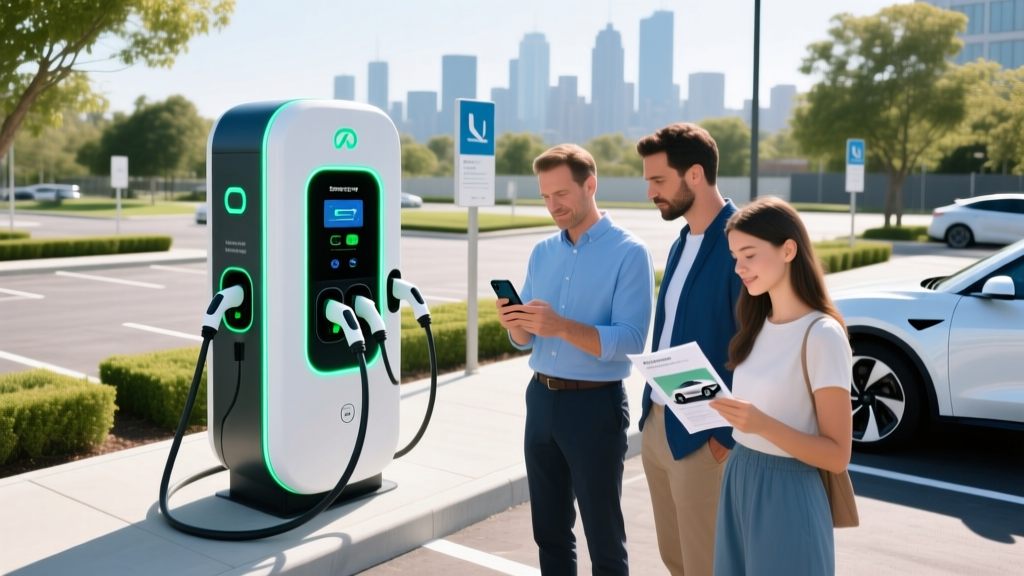
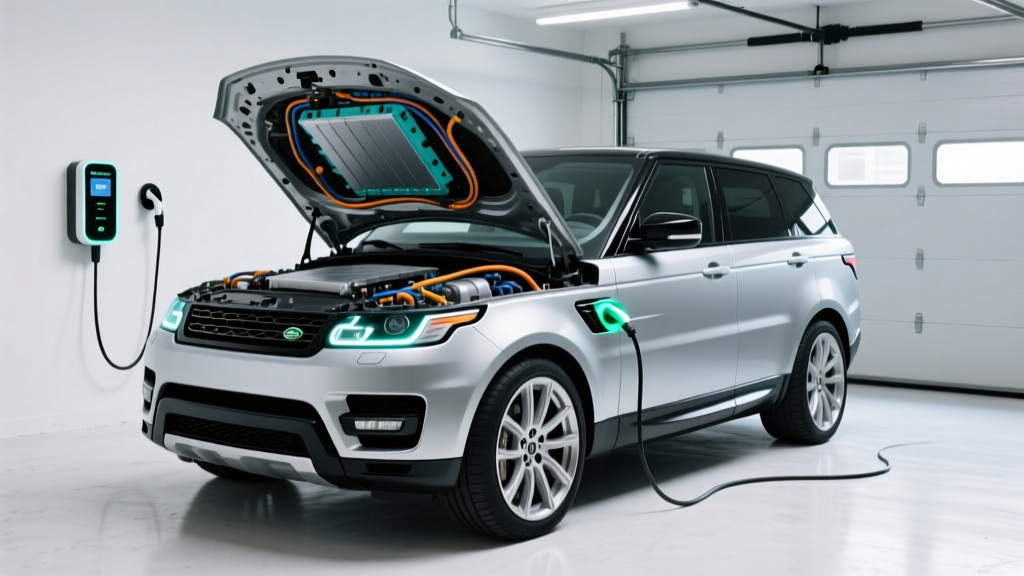
An electric powertrain swap transforms this 5,100-lb luxury hauler into a silent, instant-torque machine. But the success of any conversion hinges on one critical question: how will you charge it? This guide covers every charging decision you'll face — from Level 1 trickle charging to DC fast-charge capability, home installation costs, connector selection, and the exact equipment that works best for a converted heavy SUV.
Charging Levels Explained: Speeds, Power, and What They Mean for a Conversion
Understanding the three charging levels is essential before you spend a dollar on equipment. The critical distinction: kW (kilowatts) measures power — how fast energy flows into the battery. kWh (kilowatt-hours) measures energy — the total capacity of your battery pack. Think of kW as the width of a pipe and kWh as the size of the tank you're filling.
| Level | Voltage | Max Power (kW) | Miles of Range Added/Hour | Best For |
|---|---|---|---|---|
| Level 1 | 120V AC | 1.4-1.9 kW | 3-5 mi/hr | Overnight top-offs, PHEVs, emergencies |
| Level 2 | 240V AC | 3.3-19.2 kW | 12-75 mi/hr | Daily home charging, converted EVs |
| DC Fast Charge | 200-800V DC | 50-350 kW | 150-1,000+ mi/hr | Road trips, rapid top-ups (if equipped) |
For a converted 2013 Range Rover Sport Supercharged with an 80 kWh pack and roughly 2.5-3.0 mi/kWh efficiency (heavy vehicle, AWD conversion), expect approximately 200-240 miles of range. Here's how each level handles that:
- Level 1 (1.4 kW): Adds ~4 miles per hour. A 10-80% charge (56 kWh needed) takes roughly 40 hours. Not viable as primary charging.
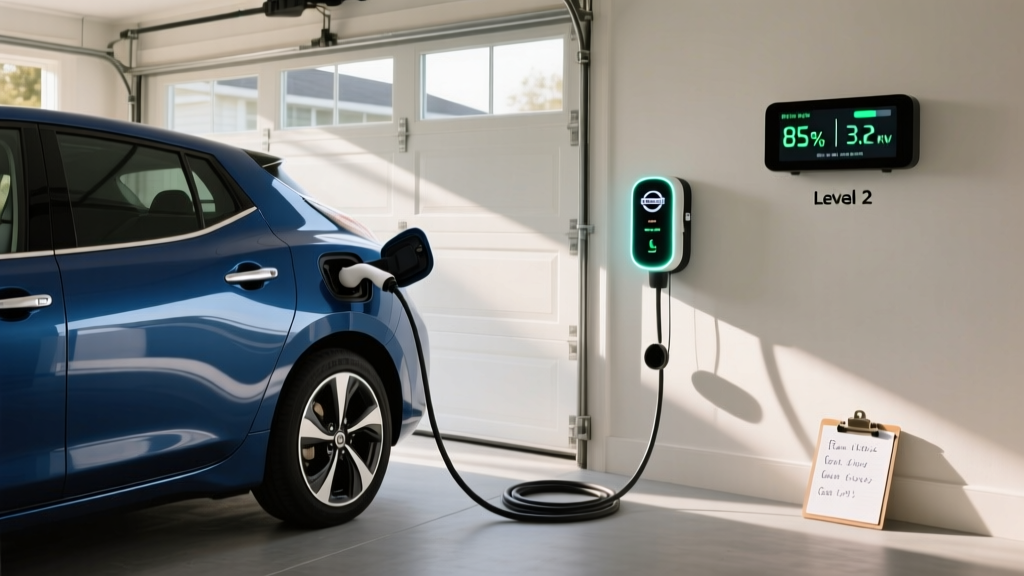
- Level 2 at 7.7 kW (32A/240V): Adds ~22 miles per hour. That same 10-80% charge completes in about 7.3 hours — perfect for overnight.
- Level 2 at 11.5 kW (48A/240V): Adds ~33 miles per hour. 10-80% in roughly 4.9 hours — ideal for heavier daily use.
- DC Fast Charge at 50 kW: Adds ~140 miles per hour. 10-80% in approximately 67 minutes — practical for road trips if your conversion includes a CCS or NACS inlet.
Home Charger Installation: Electrical Requirements, Costs, and Panel Upgrades
Installing a Level 2 charger at home is the single most impactful upgrade for any EV owner, conversion or factory-built. But the 2013 Range Rover Sport's likely garage — often in homes built between 1990 and 2010 — may require electrical work beyond simply plugging in a unit.
What Your Electrician Will Assess
A licensed electrician will evaluate three things: your panel's remaining capacity, the distance from panel to charger location, and whether your jurisdiction requires a permit (most do). For a 48A Level 2 charger, you need a dedicated 60A circuit (NEC code requires circuits rated at 125% of continuous load). For a 32A charger, a 40A dedicated circuit suffices.
Homes with 100A service panels — common in older construction — often lack the headroom for a 60A EV circuit alongside existing loads like electric ranges, dryers, and HVAC. A panel upgrade to 200A may be necessary, which is the single largest variable in installation cost.
| Component | Cost Range | Notes |
|---|---|---|
| Level 2 Charger Equipment | $350-$750 | Varies by power output, cable length, smart features |
| Electrician Labor (standard install) | $500-$1,500 | Assumes panel is nearby, no upgrade needed |
| Permit Fees | $50-$200 | Varies by municipality; some jurisdictions waive for EV |
| Panel Upgrade (if needed) | $1,500-$4,000 | 100A to 200A service; major cost variable |
| Conduit & Wiring (long runs) | $200-$800 | Adds $8-$15 per foot beyond 10 ft from panel |
| Total (no panel upgrade) | $900-$2,450 | Typical scenario for modern homes |
| Total (with panel upgrade) | $2,400-$6,450 | Common in homes with 100A service |
Smart Load Management: Avoiding a Panel Upgrade
If your panel is near capacity but you want to avoid a $2,000-$4,000 upgrade, consider a smart charger with load management. Devices like the Emporia Level 2 EV Charger or the Wallbox Pulsar Plus can monitor your home's total electrical draw and automatically reduce charging amperage when other loads spike. This lets you install a 48A charger on a panel that couldn't otherwise support it — though your charge times will vary based on household demand.
Connector Compatibility: NACS, CCS1, CHAdeMO, and Conversion Considerations
When converting a 2013 Range Rover Sport Supercharged, you choose your charging inlet. This is a decision that locks in your public charging compatibility for the life of the vehicle, so choose carefully based on your region and driving patterns.
| Connector | Type | Max DC Fast Power | Network Availability (2026) | Conversion Suitability |
|---|---|---|---|---|
| NACS (Tesla) | AC + DC combined | Up to 350 kW | Tesla Supercharger network (25,000+ stalls); growing third-party adoption | Excellent — largest reliable network |
| CCS1 | AC + DC combined | Up to 350 kW | Electrify America, EVgo, ChargePoint; variable reliability | Good — broad non-Tesla compatibility |
| CHAdeMO | DC only (separate AC inlet needed) | Up to 100 kW (typically 50 kW) | Declining; mostly legacy Nissan Leaf infrastructure | Poor — avoid for new conversions |
| J1772 | AC only | N/A (Level 2 only) | Universal for AC charging | Required for Level 2 regardless of DC choice |
Our recommendation for a Range Rover Sport conversion: Install a NACS inlet if your conversion shop supports it. The Tesla Supercharger network remains the most reliable DC fast-charging infrastructure in North America as of 2026, and NACS has become the de facto standard — Ford, GM, Rivian, Hyundai, and most major automakers have adopted it. CCS1 is a viable second choice if you primarily use Electrify America or EVgo corridors.
For AC home charging, your onboard charger (the component inside the vehicle that converts AC to DC) will accept J1772 or NACS. Most conversion kits ship with a J1772 inlet and include a J1772-to-NACS adapter if needed. Budget $150-$250 for a quality adapter rated for your charger's full amperage.
Charging Cost Per Mile: EV vs. the 5.0L Supercharged V8
The financial case for converting a Range Rover Sport hinges largely on fuel-cost savings. Let's compare the original supercharged V8 against an electric conversion across several charging scenarios.
| Scenario | Cost per kWh or Gallon | Cost per Mile | Annual Cost (12,000 mi) |
|---|---|---|---|
| 2013 RR Sport SC (15 mpg combined, $3.60/gal) | $3.60/gallon | $0.240 | $2,880 |
| Home Level 2 (off-peak, $0.13/kWh) | $0.13/kWh | $0.048 | $576 |
| Home Level 2 (standard rate, $0.18/kWh) | $0.18/kWh | $0.067 | $804 |
| Public Level 2 ($0.30/kWh) | $0.30/kWh | $0.111 | $1,332 |
| DC Fast Charge ($0.45/kWh) | $0.45/kWh | $0.167 | $2,004 |
Assumes 2.7 mi/kWh for the converted vehicle (a realistic figure for a 5,100-lb AWD SUV with a 75-85 kWh pack).
Even at standard residential electricity rates, the EV conversion cuts fuel cost by roughly 72% compared to the supercharged V8. Over five years and 60,000 miles, that's a savings of approximately $11,500 in fuel alone — enough to offset a significant portion of the conversion cost. The savings widen further if your utility offers time-of-use rates with off-peak pricing below $0.10/kWh.
The worst-case scenario — exclusive DC fast charging at $0.45/kWh — still undercuts the V8 by about 30%. However, relying entirely on public DC charging is neither economical nor practical for daily use. Home Level 2 charging is where the economics work.
Equipment Recommendations: Level 2 Chargers for a Heavy Conversion SUV
A converted Range Rover Sport with a 75-100 kWh battery demands a robust Level 2 charger. We recommend 48A units capable of delivering 11.5 kW — this is the sweet spot for overnight charging of large packs. Here are our top picks for 2026:
Emporia Vue Level 2 EV Charger
- Power Output: 48A / 11.5 kW (240V)
- Connector: J1772 (NACS adapter available)
- Cable Length: 24 ft
- Smart Features: Wi-Fi, energy monitoring, load management, scheduling via app, integrates with Emporia Vue home energy monitor
- Price: ~$399
- Why it works: Load management capability is critical for homes with limited panel capacity. The energy monitoring lets you track exactly how much your conversion costs to charge per session.
ChargePoint Home Flex
- Power Output: Configurable 16A-50A / 3.8-12 kW (240V)
- Connector: J1772 or NACS (select at purchase)
- Cable Length: 23 ft
- Smart Features: Wi-Fi, amperage adjustment via app, Alexa/Google Home integration, detailed session history
- Price: ~$549 (J1772) / ~$599 (NACS)
- Why it works: Adjustable amperage means you can dial down to 32A if your panel can't support 50A, then increase later after a panel upgrade. The NACS option eliminates adapter needs for Tesla-connector vehicles.
Tesla Wall Connector (Gen 4)
- Power Output: 48A / 11.5 kW (240V)
- Connector: NACS native; J1772 adapter included for non-Tesla EVs
- Cable Length: 24 ft
- Smart Features: Wi-Fi, over-the-air updates, power sharing (link multiple units on one circuit), Tesla app integration
- Price: ~$475
- Why it works: If your conversion uses a NACS inlet, this is the cleanest solution. Power sharing is useful if you also own a factory Tesla and want both vehicles on a single 60A circuit.
Wallbox Pulsar Plus
- Power Output: 48A / 11.5 kW (240V)
- Connector: J1772 (NACS version available)
- Cable Length: 25 ft
- Smart Features: Wi-Fi + Bluetooth, Eco-Smart mode (solar integration), Power Sharing, compact form factor
- Price: ~$499
- Why it works: The smallest 48A unit on the market — ideal for tight garages. Eco-Smart mode pairs with solar panels if you want to charge exclusively from renewable generation.
Hardwired vs. plug-in: Units rated above 40A should be hardwired (not plugged into a NEMA 14-50 outlet). A hardwired connection eliminates the receptacle as a failure point and is required by NEC for continuous loads above 40A on a plug. Your electrician will handle this during installation.
Safety, Code Compliance, and Outdoor Installation
EV charging involves sustained high-current draw — often 8-10 hours at a stretch. This is fundamentally different from the intermittent loads of a dryer or oven. Safety and code compliance aren't optional considerations.
Critical Safety Requirements
- Dedicated circuit: Your EV charger must be on its own dedicated breaker — no sharing with other outlets or appliances. This prevents overcurrent conditions that can cause breaker fatigue or, in worst cases, wire overheating.
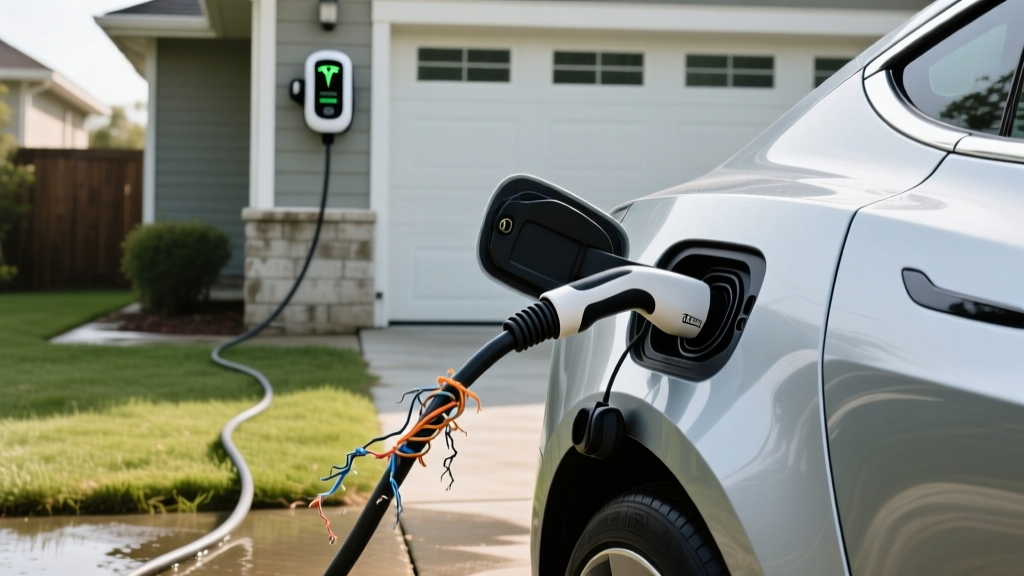
- GFCI protection: NEC 2020 and later require GFCI (Ground Fault Circuit Interrupter) protection for all EV supply equipment. Many modern chargers include built-in GFCI protection; if yours doesn't, your electrician must install a GFCI breaker. This is especially critical for outdoor installations.
- Outdoor rating: If your charger will be mounted outside (common for driveway parking), ensure it carries a NEMA 4 or IP65 rating for weather resistance. All four chargers recommended above meet outdoor installation standards, but the cable and connector must also be rated — look for UV-resistant cable jackets.
- Wire gauge: A 60A circuit requires 6 AWG copper wire (or 4 AWG aluminum). A 40A circuit requires 8 AWG copper. Your electrician will size this correctly, but verify it during inspection — undersized wire on a high-amperage circuit is a fire risk.
- Cable management: A 24-foot charging cable draped across a garage floor is a trip hazard and accelerates cable wear. Install a cable management hook or retractable reel ($30-$80) to keep the connector off the ground and protected.
Frequently Asked Questions
How much does it cost to install a home EV charger for a converted Range Rover Sport?
Expect $900-$2,450 for a standard installation (equipment, electrician labor, and permit) if your electrical panel has sufficient capacity. If your home has a 100A panel that needs upgrading to 200A, add $1,500-$4,000, bringing the total to $2,400-$6,450. The 2013 Range Rover Sport's typical owner demographic — homes built in the 1990s-2000s — often falls in the panel-upgrade scenario.
How fast will each charging level add range to my EV conversion?
For a converted Range Rover Sport with approximately 2.7 mi/kWh efficiency: Level 1 (120V) adds 3-5 miles per hour; Level 2 at 7.7 kW adds ~22 miles per hour; Level 2 at 11.5 kW adds ~33 miles per hour; DC fast charging at 50 kW adds ~140 miles per hour. For an 80 kWh pack yielding ~215 miles of range, Level 2 at 11.5 kW delivers a 10-80% charge in roughly 5 hours.
Which connector should I install on my EV conversion — NACS or CCS?
As of 2026, NACS is the recommended choice for new conversions. The Tesla Supercharger network offers the largest, most reliable DC fast-charging infrastructure in North America, and virtually all major automakers have adopted NACS for their 2025+ models. CCS1 remains viable if you primarily use Electrify America or EVgo, but CHAdeMO should be avoided — it's a declining standard with limited infrastructure investment. Consult your conversion shop about which inlets their battery management system (BMS) supports natively.
How much does charging cost per mile compared to the supercharged V8?
The 2013 Range Rover Sport Supercharged averages 15 mpg combined, costing roughly $0.24 per mile at $3.60/gallon. An EV conversion charged at home on off-peak electricity ($0.13/kWh) costs approximately $0.048 per mile — a 5x reduction. Even on standard residential rates ($0.18/kWh), you're looking at $0.067 per mile. Annual fuel savings for a 12,000-mile driver: $2,076-$2,304.
What electrical upgrades might my home need for a Level 2 charger?
The most common upgrade is a panel replacement from 100A to 200A service ($1,500-$4,000), necessary when your existing panel lacks capacity for a new 60A circuit. Other potential needs: replacing a Federal Pacific or Zinsco panel (known fire hazards common in 1970s-80s homes, $2,000-$3,500 to replace); running new conduit for long wire runs from panel to garage ($8-$15 per foot); or upgrading the meter base if your utility requires it for 200A service. A licensed electrician can assess your specific situation during a site visit — many offer free or low-cost estimates for EV charger installations.
Can I use the federal EV tax credit for my conversion and charger?
The IRS §30D clean vehicle credit applies to new and qualifying used EVs purchased from dealers, not to aftermarket conversions of existing vehicles. However, the Alternative Fuel Infrastructure Tax Credit (IRC §30C) may apply to your home charger installation — it covers up to 30% of equipment and installation costs (capped at $1,000 for residential). Check current eligibility on irs.gov, as rules and caps are subject to legislative changes. Consult a tax professional for your specific situation.