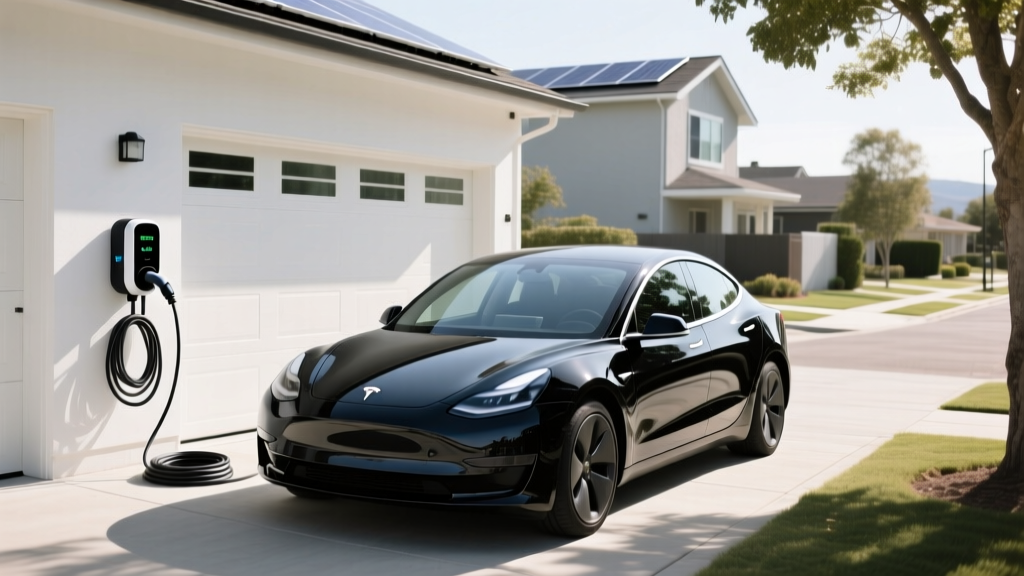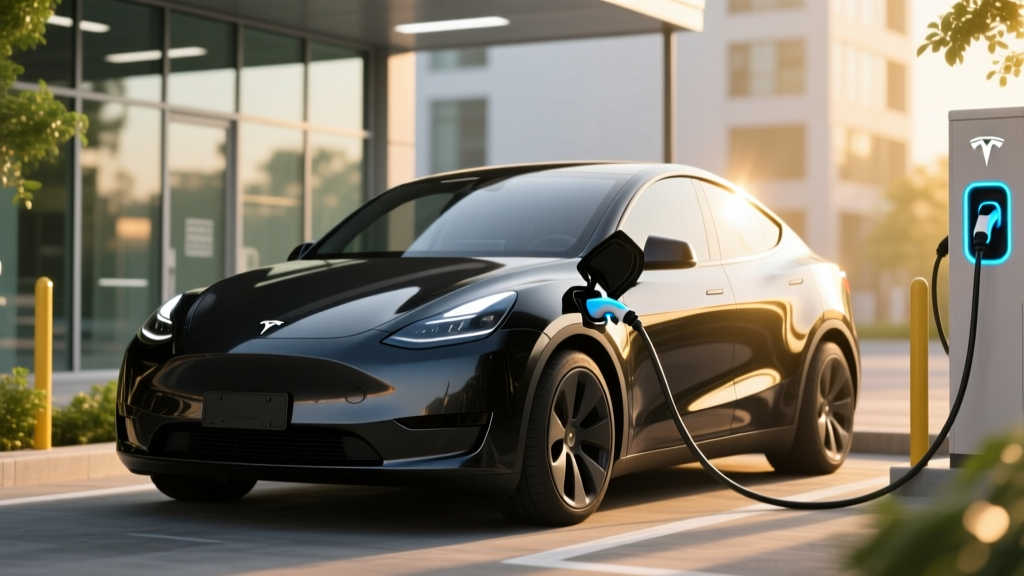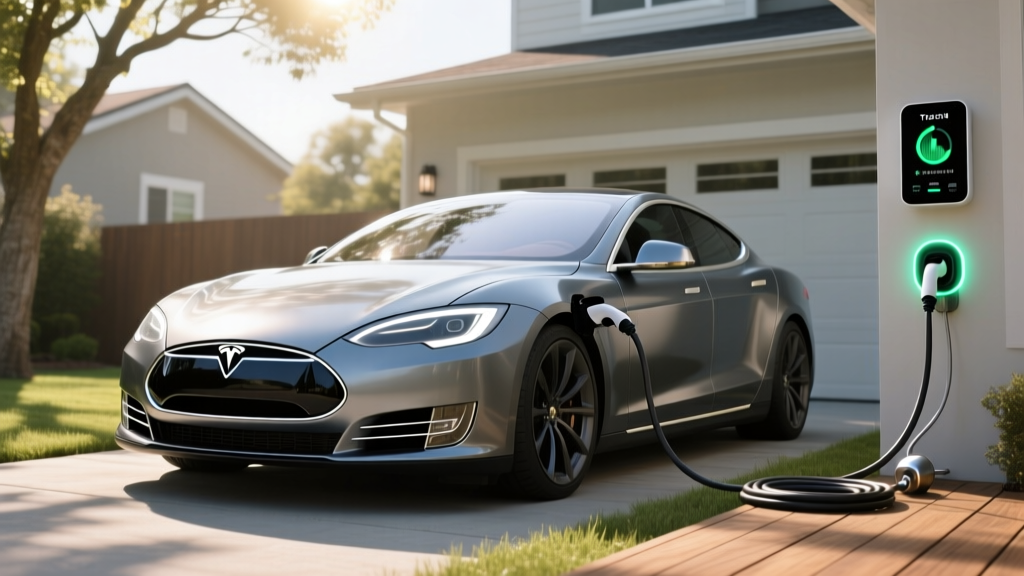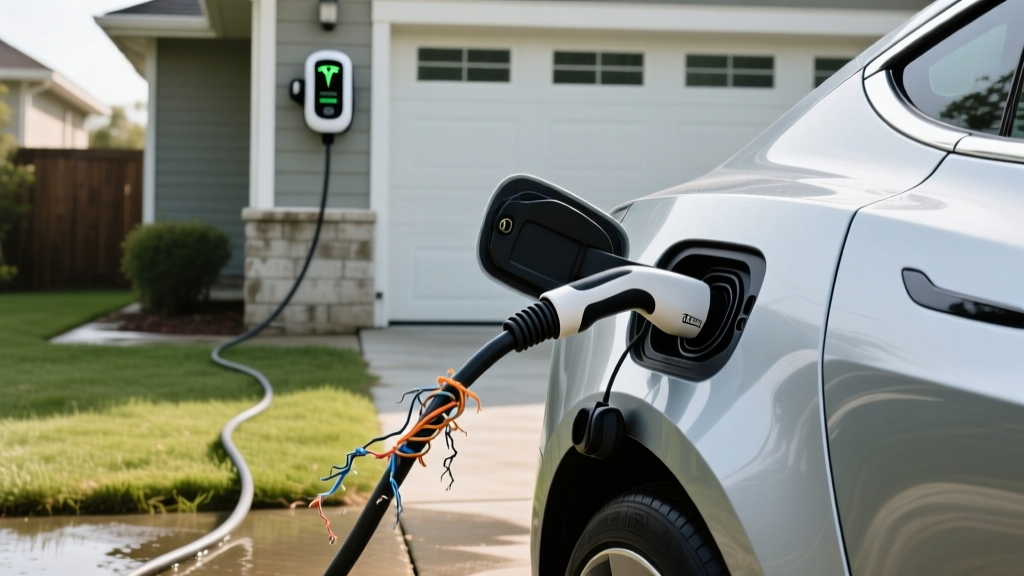
If you've just taken delivery of a Tesla Model 3 or Model Y and your nearest 120V outlet is 25 feet from where you park, the temptation is obvious: run an extension cord and plug in the Mobile Connector. It seems harmless—after all, you're only pulling about 12 amps from a standard household outlet. But this shortcut carries real fire risk, violates electrical code in most jurisdictions, and can void your charger's warranty. Here's exactly why, what the physics demand, and what you should do instead.
Why Extension Cords and EV Charging Don't Mix
Electric vehicle charging is fundamentally different from plugging in a lamp or a phone charger. A Tesla Mobile Connector on a standard 120V outlet draws a continuous 12-amp load for 8 to 20+ hours. That sustained draw generates heat—heat that standard household extension cords are not engineered to dissipate over long durations.
The core problems:
- Voltage drop. A 50-foot, 16-gauge extension cord can drop 3–5 volts under a 12A continuous load. That reduced voltage forces the charger to pull higher amperage to maintain power, compounding heat generation at both the plug and the cord.
- Thermal runaway at connections. The weakest point in any extension-cord setup is where the plug meets the socket. Under continuous high-amperage draw, these junctions can exceed 150°F, melting insulation and creating arc-fault conditions.
- NEC Article 625 compliance. The National Electrical Code (NEC) classifies EV charging equipment as a specific use case. Extension cords used as a substitute for fixed wiring violate NEC 625.40, which requires EV supply equipment to be connected via permanent wiring methods or listed cord-and-plug assemblies designed for the purpose.
- Insurance and liability. If a fire originates from an extension cord used for EV charging, your homeowner's insurance carrier may deny the claim on the basis of code violation and improper equipment use.
Understanding EV Charging Levels: Speeds in kW and Miles per Hour
Before choosing a proper charging setup, you need to understand the three charging tiers. The critical distinction: kW (kilowatts) measures power—the rate at which energy flows. kWh (kilowatt-hours) measures energy—the total capacity of your battery. Think of kW as the width of a pipe and kWh as the size of the tank you're filling.
| Level | Voltage | Power (kW) | Miles of Range Added per Hour | Typical Use Case |
|---|---|---|---|---|
| Level 1 | 120V AC | 1.2–1.9 kW | 3–5 mi/hr | Overnight top-up, low-mileage drivers |
| Level 2 | 240V AC | 3.3–19.2 kW | 12–75 mi/hr | Home daily charging, workplace, public |
| DC Fast Charging | 400–800V DC | 50–350+ kW | 150–1,000+ mi/hr | Road trips, rapid top-ups |
For a Tesla Model Y Long Range with an 81 kWh (usable) battery, a Level 1 outlet adds roughly 4 miles of range per hour—meaning a full charge from empty takes over 20 hours. A 48-amp Level 2 home charger (11.5 kW) fills that same battery in roughly 7 hours, making overnight charging practical.
The Right Solution: Proper Home Charger Installation
If you need to reach your Tesla from an outlet that's too far away, the answer is not an extension cord—it's installing a dedicated 240V circuit with a NEMA 14-50 outlet or hardwiring a Level 2 wall connector at the location where you park.
Electrical Requirements for Level 2 Home Charging
A typical Tesla Wall Connector or comparable Level 2 charger requires:
- Voltage: 240V (split-phase, standard US residential)
- Amperage: 40A to 60A dedicated circuit (breaker rated 125% of continuous load, so a 48A charger needs a 60A breaker)
- Wire gauge: 6 AWG copper for 48A; 4 AWG for 60A circuits
- Outlet type (if not hardwired): NEMA 14-50 (50A) or NEMA 6-50 (50A)
Does Your Electrical Panel Need an Upgrade?
This is the question that catches many homeowners off guard. A Level 2 charger pulling 48 amps continuously represents a significant new load. Homes with 100A main service panels—common in houses built before 1990—often cannot accommodate a 60A breaker without exceeding the panel's rated capacity, especially if you already have electric range, dryer, and HVAC loads.
Signs you may need a panel upgrade:
- Your main service is 100A or less
- Your panel has no available breaker slots
- A licensed electrician's load calculation shows you're near capacity
- You have a Federal Pacific or Zinsco panel (known safety hazards that should be replaced regardless)
A panel upgrade from 100A to 200A typically costs $1,500–$3,000 before the charger installation itself. It's a major line item, but it's also a home-value upgrade that supports future electrification (heat pumps, solar, etc.).
Home Charger Installation Cost Breakdown
Installation costs vary enormously depending on your home's electrical infrastructure, the distance from panel to parking spot, and local permit fees. Here's a realistic range based on 2025–2026 market data:
| Component | Low End | High End | Notes |
|---|---|---|---|
| Level 2 Charger Equipment | $250 | $700 | Tesla Wall Connector ~$420; ChargePoint Home Flex ~$550–$700 |
| Electrician Labor (standard install) | $400 | $1,200 | Short run from panel, accessible attic/crawlspace |
| Electrician Labor (complex install) | $1,200 | $3,000+ | Long wire run, conduit, trenching, wall penetrations |
| Permit Fees | $50 | $300 | Varies by municipality; some jurisdictions waive for EV |
| Panel Upgrade (if needed) | $1,500 | $3,500 | 100A → 200A service upgrade |
| Total (no panel upgrade) | $700 | $2,200 | Typical suburban home with 200A panel |
| Total (with panel upgrade) | $2,200 | $5,500+ | Older home needing service upgrade |
Federal incentive note: The Alternative Fuel Vehicle Refueling Property Credit (IRS §30C) covers 30% of home charger equipment and installation costs, up to $1,000, for installations in eligible census tracts. Check the IRS §30C page for current eligibility rules, as tract qualification varies by location.
Connector Compatibility: NACS, CCS, and Adapters
Tesla vehicles use the North American Charging Standard (NACS) connector—now adopted as the industry standard by Ford, GM, Rivian, Hyundai, and most other manufacturers through 2025–2026. Here's how connector compatibility breaks down:
| Connector | Used By | Home Charging? | DC Fast Charging? | Adapter Needed? |
|---|---|---|---|---|
| NACS (Tesla) | Tesla (all models), Ford, GM, Rivian, Hyundai, others (2025+) | Yes — native | Yes — Tesla Supercharger network | Non-Tesla EVs may need NACS adapter for Superchargers |
| CCS1 | Legacy VW, BMW, some older models | Yes — with adapter | Yes — Electrify America, EVgo | Tesla CCS adapter (~$175) for non-Tesla DCFC stations |
| CHAdeMO | Nissan Leaf (legacy) | Rare | Declining network | No adapter to NACS available; legacy standard |
| J1772 | All EVs (Level 1/2 AC standard) | Yes — Tesla includes J1772 adapter | N/A (AC only) | Tesla Mobile Connector includes J1772-to-NACS adapter |
For home Level 2 charging, the Tesla Wall Connector uses NACS natively. If you own a non-Tesla EV with a CCS port and want to use a Tesla Wall Connector, you'll need a third-party J1772-to-CCS adapter or choose a charger with a J1772 connector and use your vehicle's J1772-to-NACS adapter (if equipped).
Charging Time Examples: 10–80% by Battery Size
EV batteries charge fastest between roughly 10% and 50% State of Charge (SoC), then taper significantly to protect cell health. Here's what charging times look like for common Tesla configurations:
| Vehicle | Battery (usable kWh) | Level 1 (1.4 kW) | Level 2 (11.5 kW / 48A) | DC Fast (250 kW peak) |
|---|---|---|---|---|
| Tesla Model 3 RWD | 57.5 kWh (LFP) | ~38 hrs | ~5 hrs | ~25 min (peak 170 kW) |
| Tesla Model 3 Long Range | 75 kWh (NMC) | ~50 hrs | ~6.5 hrs | ~22 min (peak 250 kW) |
| Tesla Model Y Long Range | 81 kWh (NMC) | ~54 hrs | ~7 hrs | ~24 min (peak 250 kW) |
| Tesla Cybertruck AWD | 123 kWh (NMC) | ~82 hrs | ~10.7 hrs | ~30 min (peak 350 kW capable) |
Charge curve reality check: The "peak 250 kW" figure applies only in the 10–30% SoC range under ideal thermal conditions. Above 60% SoC, charge speed drops dramatically—often below 60 kW. This is why 10–80% time is the standard metric, and why Tesla's navigation system preconditions the battery (heats it to optimal temperature) when you navigate to a Supercharger. Without preconditioning, cold-weather DC charging speeds can be 40–60% slower.
Cost to Charge: Per-Mile Economics vs. Gasoline
One of the strongest arguments for home charging is cost. Here's how electricity pricing compares to gasoline on a per-mile basis, using a Tesla Model Y Long Range (averaging 28 kWh/100 mi in mixed driving) as the baseline:
| Scenario | Rate | Cost per Mile (Model Y) | Equivalent Gas Vehicle (28 MPG) |
|---|---|---|---|
| Home charging (off-peak utility rate) | $0.09/kWh | $0.025 | $0.125 at $3.50/gal |
| Home charging (national avg residential) | $0.17/kWh | $0.048 | $0.125 at $3.50/gal |
| Public Level 2 (ChargePoint, etc.) | $0.25–$0.49/kWh | $0.07–$0.14 | $0.125 at $3.50/gal |
| DC Fast Charging (Tesla Supercharger) | $0.28–$0.42/kWh | $0.08–$0.12 | $0.125 at $3.50/gal |
| DC Fast Charging (Electrify America) | $0.38–$0.58/kWh | $0.11–$0.16 | $0.125 at $3.50/gal |
The takeaway: home charging on an off-peak rate is roughly 5× cheaper per mile than gasoline. Even at national-average residential electricity rates, you're paying less than half the per-mile fuel cost. Public DC fast charging, however, can approach or exceed gasoline costs—making it best reserved for road trips rather than daily use.
Recommended Level 2 Chargers for Tesla Owners
Since you should not be using an extension cord, here are purpose-built Level 2 chargers that solve the reach problem with proper cable length and safe, code-compliant installation:
Tesla Wall Connector
Power: Up to 11.5 kW (48A)
Connector: NACS (native Tesla)
Cable Length: 24 feet
Smart Features: Wi-Fi updates, power sharing between units, access control
Price: ~$420
Best for: Tesla-only households; cleanest integration with vehicle app
ChargePoint Home Flex
Power: Up to 12 kW (50A, configurable)
Connector: J1772 (with NACS adapter included or purchased separately)
Cable Length: 23 feet
Smart Features: Wi-Fi, scheduling, Alexa integration, detailed energy reporting
Price: ~$550–$650
Best for: Multi-EV households with mixed connector types
Emporia Vue Level 2 Charger
Power: Up to 11.5 kW (48A)
Connector: J1772 or NACS (choose at purchase)
Cable Length: 24 feet
Smart Features: Energy monitoring, solar integration, load management
Price: ~$400
Best for: Budget-conscious buyers wanting smart features
All three chargers are hardwire-capable (preferred for outdoor installs and 60A circuits) and NEMA 14-50 plug-compatible (for 50A circuits). The 24-foot cables eliminate the need for any extension cord—if 24 feet won't reach your parking spot, the correct solution is relocating the charger or the outlet, not adding cord length.
Safety, Code, and Best Practices
Whether you're installing a NEMA 14-50 outlet or hardwiring a Wall Connector, these safety and code requirements are non-negotiable:
- Dedicated circuit. Your EV charger must be on its own dedicated breaker—never shared with other appliances. Continuous loads (defined by NEC as running 3+ hours) require the breaker to be rated at 125% of the actual draw.
- GFCI protection. NEC 2020 and later require GFCI protection for outdoor receptacles used for EV charging. Hardwired installations may not require a GFCI breaker depending on local code interpretation, but many inspectors now mandate it.
- Outdoor rating. If your charger or outlet is outside, all equipment must carry a NEMA 3R or 4 (weatherproof) rating. The Wall Connector itself is rated for outdoor use, but the junction box and conduit must also be rated.
- Permit and inspection. Virtually all jurisdictions require an electrical permit for a new 240V circuit. The inspection ensures wire gauge, breaker sizing, grounding, and bonding are correct. Skipping the permit risks insurance denial and code-enforcement fines.
- No daisy-chaining. Never plug a power strip, multi-outlet adapter, or extension cord between your charger and the wall outlet. The entire circuit from breaker to vehicle must be a single, continuous, code-compliant path.
Frequently Asked Questions
Can I use a heavy-duty extension cord to charge my Tesla occasionally?
Tesla explicitly prohibits extension cords in the Mobile Connector documentation. A heavy-duty, 10-gauge, 25-foot outdoor cord used briefly and monitored continuously poses less risk than a cheap indoor cord, but it still violates NEC Article 625 and creates thermal risk at the plug junction. If you need more reach, install a NEMA 14-50 outlet closer to your parking spot or use the Wall Connector's 24-foot cable.
How much does it cost to install a home EV charger?
A straightforward Level 2 installation (short wire run, existing 200A panel, NEMA 14-50 outlet or hardwired Wall Connector) typically costs $700–$2,200 including equipment, electrician labor, and permit. If your home needs a panel upgrade from 100A to 200A, add $1,500–$3,500. The IRS §30C credit may offset 30% (up to $1,000) if you're in an eligible census tract.
How fast will Level 1 (120V) charging add range to my Tesla?
Expect 3–5 miles of range per hour on a standard 120V/12A outlet. That's roughly 36–60 miles of range added during a 12-hour overnight session—adequate for drivers who travel under 40 miles daily but insufficient for higher-mileage commutes or road-trip recovery.
Which connector do I need for my Tesla at home?
All Tesla vehicles sold in North America use the NACS connector natively. The Tesla Wall Connector outputs NACS directly. For public Level 2 stations with J1772 connectors, Tesla includes a J1772-to-NACS adapter in the vehicle. For CCS DC fast chargers (non-Tesla networks), you'll need the Tesla CCS adapter ($175 from Tesla's shop).
What electrical upgrades might I need for a Level 2 charger?
Homes with 200A service and available breaker slots typically need no panel upgrade—just a new 60A breaker and wire run. Homes with 100A service, full panels, or outdated panel brands (Federal Pacific, Zinsco) will likely need a full service upgrade ($1,500–$3,500). A licensed electrician's load calculation is the definitive answer—don't guess based on panel age alone.
Is it cheaper to charge at home or at a Supercharger?
Home charging is dramatically cheaper. At the national average residential rate of ~$0.17/kWh, a full Model Y charge costs about $13.75. The same charge at a Supercharger ($0.28–$0.42/kWh) costs $22.70–$34.00. Over a year of 12,000 miles, home charging saves $600–$1,200 compared to exclusive Supercharger use, according to fueleconomy.gov efficiency data.