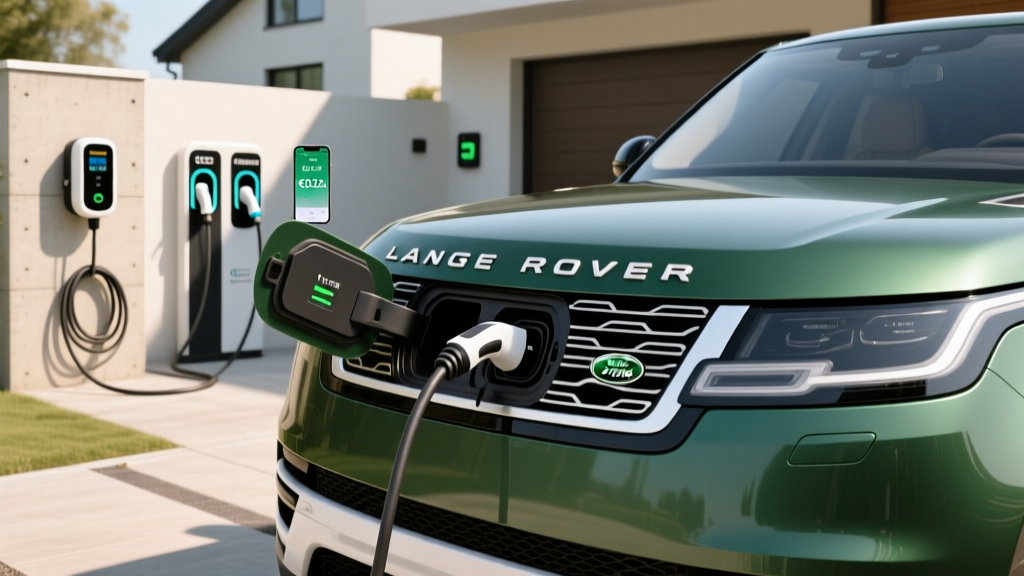
The 2024 Land Rover Range Rover plug-in hybrid (PHEV) pairs a 3.0-liter inline-six with a 38.2 kWh lithium-ion battery, delivering an EPA-rated 51 miles of electric-only range in the P550e variant. That is one of the largest batteries in any luxury PHEV on the market, and it fundamentally changes how you charge. Unlike a Toyota Prius Prime with an 11 kWh pack, the Range Rover PHEV demands serious Level 2 infrastructure to recharge overnight. Plug it into a standard 120V wall outlet and you will wait nearly two full days. Install a proper 240V home charger and you wake up to a full battery every morning.
This guide breaks down exactly how to charge the 2024 Range Rover PHEV — at home, in public, and on the road — with real numbers for kW speeds, installation costs, connector compatibility, and the cost-per-mile comparison against the gas-only Range Rover.
Understanding the 2024 Range Rover PHEV Battery and Charge Port
Before selecting a charger, you need the vehicle's specs. The 2024 Range Rover P550e SE and P550e Autobiography trims share the same powertrain and battery:
- Battery capacity: 38.2 kWh total / ~31.8 kWh usable (LGM battery, NMC chemistry)
- EPA electric-only range: 51 miles (P550e, per fueleconomy.gov)
- Combined MPGe: 42 MPGe (electric + gas combined)
- Gas-only MPG (battery depleted): 21 MPG combined
- Onboard AC charger: 7.2 kW maximum
- DC fast charging: Not available — the Range Rover PHEV accepts AC charging only via its J1772 port
- Charge port location: Rear quarter panel, passenger side
- 0-60 mph: 5.2 seconds (combined 542 hp / 553 lb-ft torque)
The absence of DC fast charging is the single most important spec for your charging strategy. It means the Range Rover PHEV relies entirely on Level 1 and Level 2 AC charging. Public DC fast chargers (the 150-350 kW stations along highways) cannot charge this vehicle. You need a different approach for road trips, which we cover below.
Charging Levels Explained: How Fast Each Adds Range
The 2024 Range Rover PHEV charges at three practical speeds depending on your equipment. Here is how each level performs with this specific vehicle:
| Level | Voltage / Amperage | Power (kW) | Miles of Range Added per Hour | 0-100% Time (31.8 kWh usable) |
|---|---|---|---|---|
| Level 1 (120V outlet) | 120V / 12A | ~1.4 kW | ~2 mi/hr | ~23 hours |
| Level 2 (240V, 32A circuit) | 240V / 32A | ~7.2 kW (vehicle max) | ~10 mi/hr | ~4.5 hours |
| Level 2 (240V, 40A circuit) | 240V / 40A | ~7.2 kW (vehicle caps) | ~10 mi/hr | ~4.5 hours |
| DC Fast | N/A | Not supported | N/A | N/A |
At 7.2 kW, a Level 2 charger fills the Range Rover PHEV's usable battery from empty in roughly 4.5 hours. Because the onboard charger maxes at 7.2 kW, installing a 48-amp (11.5 kW) charger will not charge this vehicle any faster than a 32-amp (7.7 kW) unit. However, a higher-amperage charger provides headroom if you add a second EV later or upgrade to a full BEV.
Home Charger Installation: Electrical Requirements, Costs, and Panel Upgrades
The 2024 Range Rover PHEV's 7.2 kW onboard charger requires a 240V, 40-amp dedicated circuit (which delivers 32 amps continuous, per NEC 80% rule). This is the sweet spot — sufficient to max out the vehicle's charging capability without overspending on infrastructure you cannot use.
Electrical Specifications Needed
- Circuit: 240V, 40-amp double-pole breaker (dedicated, no shared loads)
- Wire gauge: 6 AWG copper (THHN in conduit or 6/2 NM-B Romex for indoor runs)
- Outlet type: NEMA 14-50 (if using a plug-in charger) or hardwired connection
- GFCI protection: Required by NEC 2020/2023 for outdoor receptacles; many jurisdictions also require it indoors for EV circuits
- Permit: Required in virtually all US jurisdictions for new 240V circuits
Installation Cost Breakdown
Home charger installation costs vary dramatically based on your panel capacity, wiring distance, and local labor rates. Here is a realistic range for a typical single-family home:
| Item | Simple Install (panel nearby) | Complex Install (long run / panel upgrade) |
|---|---|---|
| Level 2 charger (32-40A, hardwired or NEMA 14-50) | $400 – $700 | $400 – $700 |
| Electrician labor (2-4 hrs simple / 6-12 hrs complex) | $300 – $600 | $900 – $2,000 |
| Permit and inspection | $50 – $150 | $50 – $200 |
| Panel upgrade (100A → 200A, if needed) | $0 (not needed) | $1,500 – $3,500 |
| Total estimated cost | $750 – $1,450 | $2,850 – $6,400 |
Connector Compatibility: J1772, NACS, and What the Range Rover PHEV Uses
The 2024 Range Rover PHEV uses a J1772 connector for AC charging. This is the standard plug for all non-Tesla plug-in hybrids and battery-electric vehicles in North America. However, the connector landscape is shifting rapidly as manufacturers adopt the North American Charging Standard (NACS), originally developed by Tesla.
| Connector Type | Native Support? | Adapter Needed? | Notes |
|---|---|---|---|
| J1772 (AC Level 1 & 2) | Yes — native | None | Standard plug included with all Level 2 chargers for non-Tesla vehicles |
| NACS / Tesla (AC & DC) | No | Tesla-to-J1772 adapter (~$150-$250) | Allows use of Tesla Wall Connector and Destination Chargers; DC Superchargers not applicable (no DC port on PHEV) |
| CCS1 (DC fast) | No — not applicable | N/A | Range Rover PHEV has no DC fast charge port |
| CHAdeMO (DC fast) | No — not applicable | N/A | Legacy DC standard; irrelevant for this vehicle |
For home charging, any J1772 Level 2 charger works natively. If you already own a Tesla Wall Connector (which uses NACS), you will need a Tesla-to-J1772 adapter such as the Lectron or Telcordia adapter ($150-$250) to charge the Range Rover. Note that this adapter only works for AC charging — you cannot use Tesla Superchargers with the Range Rover PHEV regardless of adapter, because the vehicle lacks a DC fast-charge port entirely.
Level 2 Charger Recommendations for the Range Rover PHEV
Since the Range Rover P550e caps at 7.2 kW, a 32-amp charger is technically sufficient. We recommend 40-amp or 48-amp units for future-proofing, smart features, and cable management. All chargers below use the J1772 connector natively.
Best Overall: ChargePoint Home Flex
- Power: Up to 11.5 kW (48A) — adjustable via dip switches
- Connector: J1772 (NACS version also available)
- Cable length: 23 feet
- Smart features: Wi-Fi, app scheduling, Alexa/Google integration, energy tracking
- Installation: Hardwired or NEMA 14-50 plug
- Price: ~$550 (charger only)
- Why for Range Rover: Adjustable amperage lets you set 32A if your panel is tight, or 48A for future BEVs
Best Value: Emporia Level 2 EV Charger
- Power: Up to 11.5 kW (48A)
- Connector: J1772
- Cable length: 24 feet
- Smart features: Wi-Fi, app with real-time energy monitoring, solar integration, load management
- Installation: Hardwired or NEMA 14-50
- Price: ~$400
- Why for Range Rover: Best energy-monitoring app; solar-aware scheduling can minimize grid draw
Premium Pick: Grizzl-E Smart
- Power: Up to 10 kW (40A)
- Connector: J1772
- Cable length: 24 feet
- Smart features: OCPP-compatible, works with utility demand-response programs
- Installation: Hardwired or NEMA 14-50
- Price: ~$500
- Why for Range Rover: Built in Canada, rated to -40°F; ideal for cold-climate garages and driveways
Budget Pick: Lectron V-BOX Pro
- Power: Up to 9.6 kW (40A)
- Connector: J1772
- Cable length: 20 feet
- Smart features: Basic app, scheduling
- Installation: NEMA 14-50 plug
- Price: ~$300
- Why for Range Rover: Lowest cost to get 7.2 kW charging; adequate for a single-PHEV household
Cost to Charge: Home Electricity vs Public Stations vs Gas
One of the strongest arguments for the Range Rover PHEV is the per-mile cost savings when driving on electricity. Here is a realistic breakdown using the vehicle's efficiency and 2026 electricity/fuel pricing:
| Scenario | Rate | Energy Used (per 51 mi) | Cost for 51 mi | Cost per Mile |
|---|---|---|---|---|
| Home charging (off-peak) | $0.13/kWh | ~31.8 kWh | $4.13 | $0.081/mi |
| Home charging (peak rate) | $0.25/kWh | ~31.8 kWh | $7.95 | $0.156/mi |
| Public Level 2 (workplace/retail) | $0.20-$0.35/kWh | ~31.8 kWh | $6.36 – $11.13 | $0.125 – $0.218/mi |
| Gas only (21 MPG combined) | $3.80/gallon | ~2.43 gallons (per 51 mi) | $9.23 | $0.181/mi |
| Gas only (premium, $4.40/gal) | $4.40/gallon | ~2.43 gallons | $10.69 | $0.210/mi |
The Range Rover PHEV requires premium unleaded (91 octane or higher), which pushes gas costs higher than regular-fuel vehicles. At home off-peak rates, electric driving costs roughly 55-60% less per mile than burning premium gas. Even at peak residential rates, electric is still cheaper. The savings compound: if you drive 12,000 miles per year and cover 80% on electricity, you save approximately $700-$1,100 annually on fuel compared to the gas-only Range Rover.
Public Charging Strategy for the Range Rover PHEV
The lack of DC fast charging means your public charging options are limited to Level 2 stations. Here is how to use them effectively:
- Workplace charging: The ideal public scenario. Plug in at arrival, and 8 hours at 7.2 kW adds roughly 80 miles of electric range — more than enough to fully replenish the battery. Many employers offer free or subsidized Level 2 charging.
- Retail and grocery destinations: A 45-minute grocery stop at a 7.2 kW Level 2 charger adds ~7-8 miles. Useful for topping off, not for full recharges.
- Hotels and overnight destinations: Many hotels now offer Level 2 chargers (often J1772). An overnight stay is effectively equivalent to home charging.
- DC fast chargers — skip them: Electrify America, EVgo, and Tesla Supercharger stations are irrelevant for this vehicle. Do not detour to a DC fast station; it cannot charge the Range Rover PHEV.
Use apps like PlugShare or ChargePoint to filter for Level 2 J1772 stations near your destinations. On road trips exceeding 51 miles, accept that the gas engine will handle highway segments — this is the PHEV compromise. The Range Rover's 21-gallon fuel tank gives roughly 440 miles of total range (electric + gas combined), so range is not a concern on long trips.
Safety, Code, and Installation Best Practices
EV charger installation involves high-amperage 240V circuits. Follow these safety and code requirements:
- Dedicated circuit: Your EV charger must be on its own breaker — never shared with a dryer, oven, or HVAC system.
- GFCI protection: NEC 2020 (Section 625.54) requires GFCI protection for all EV receptacles rated 150V to ground or less and 60A or less. Hardwired chargers may be exempt in some jurisdictions, but GFCI breakers add $50-$120 to the panel cost.
- Outdoor rating: If your charger is installed outdoors or in an unenclosed carport, ensure the unit carries a NEMA 4 (weatherproof) rating. All chargers recommended above are outdoor-rated.
- Wire sizing: Oversizing wire (e.g., 6 AWG on a 40A circuit instead of the minimum 8 AWG) reduces voltage drop on long runs (over 50 feet from panel to charger) and is a best practice.
- Load management: If your panel is tight but you want to avoid a costly upgrade, consider a smart load-management system like the Emporia or Wallbox Power Sharing feature, which dynamically throttles the charger when other household loads spike.
Federal Tax Credit for Home Charger Installation
Under the Inflation Reduction Act, the Alternative Fuel Vehicle Refueling Property Credit (IRS Form 8911) covers 30% of the cost of home EV charger equipment and installation, up to a maximum of $1,000. This credit is available through 2032 but has geographic restrictions: the charger must be installed in a qualifying census tract (low-income or non-urban area per IRS guidelines). Consult a tax professional to confirm eligibility based on your address.
Frequently Asked Questions
How much does it cost to install a home charger for the Range Rover PHEV?
Expect $750-$1,450 for a straightforward installation (panel has capacity, short wire run). If your home needs a panel upgrade from 100A to 200A, total costs can reach $2,850-$6,400. The charger itself costs $300-$700; the rest is electrician labor, wire, conduit, permits, and potentially a panel upgrade.
How fast will a Level 2 charger add range to the Range Rover PHEV?
At the vehicle's 7.2 kW maximum, a Level 2 charger adds approximately 10 miles of electric range per hour. A full charge from empty to 100% takes about 4.5 hours. Level 1 (120V) adds only about 2 miles per hour, making it impractical for daily use with this vehicle's large battery.
Can I use a Tesla charger with the 2024 Range Rover PHEV?
Only with an adapter, and only for AC charging. A Tesla-to-J1772 adapter ($150-$250) lets you use a Tesla Wall Connector or Destination Charger at home or at hotels. You cannot use Tesla Superchargers because the Range Rover PHEV has no DC fast-charge port.
How does the Range Rover PHEV charging cost compare to the gas-only model?
At home off-peak rates (~$0.13/kWh), electric driving costs about $0.08 per mile. The gas-only Range Rover on premium fuel ($4.40/gal, ~18 MPG combined) costs about $0.24 per mile. If you charge at home and drive most miles on electricity, you save $0.12-$0.16 per mile — roughly $960-$1,280 per year at 8,000 electric miles.
What electrical upgrades might my home need?
The most common upgrade is a panel increase from 100A to 200A ($1,500-$3,500) if your existing panel lacks capacity for a 40-amp dedicated circuit. Older homes may also need new conduit runs, a sub-panel addition (if the garage is far from the main panel), or a utility service upgrade. A licensed electrician's load calculation will determine exactly what is needed — always get this assessment before purchasing a charger.
Does the Range Rover PHEV support DC fast charging?
No. The 2024 Range Rover P550e PHEV only supports AC charging up to 7.2 kW via its J1772 port. There is no CCS1, CHAdeMO, or NACS DC fast-charge capability. This is typical for plug-in hybrids — the battery is small enough that overnight Level 2 charging is considered sufficient by the manufacturer. If DC fast charging is a priority, you would need to look at a battery-electric vehicle instead.