If you're researching BYD car ranges to decide which model fits your commute, the battery capacity is only half the story. How quickly you can replenish that battery — at home overnight or on a highway road trip — determines whether an EV genuinely works for your lifestyle. BYD's 2026 lineup uses its proprietary Blade Battery (lithium iron phosphate, or LFP) across every model, which changes the charging calculus compared to NMC-based competitors.
This guide walks through each current BYD model's range and charging profile, then covers exactly what you need to install a home charger, what public charging costs, and which equipment to buy.
2026 BYD Lineup: Range, Battery, and Charging Specs at a Glance
BYD's global 2026 lineup spans compact hatchbacks to full-size SUVs. Note that US availability remains limited as of early 2026 — most of these models are sold in Europe, Australia, Southeast Asia, and Latin America. Ranges below reflect WLTP figures (the standard outside the US); expect roughly 10-15% lower numbers if EPA-rated in the future.
| Model | Battery (kWh usable) | Chemistry | WLTP Range | Max DC Charge (kW) | 10-80% DC Time | AC Level 2 (kW) | Base MSRP (global equiv.) |
|---|---|---|---|---|---|---|---|
| Dolphin | 60.4 | LFP Blade | 265 mi | 88 | ~29 min | 11 | ~$30,000 |
| Atto 3 (Yuan Plus) | 60.5 | LFP Blade | 260 mi | 88 | ~29 min | 11 | ~$35,000 |
| Seal | 82.5 | LFP Blade | 355 mi | 150 | ~26 min | 11 | ~$45,000 |
| Seal U | 87.0 | LFP Blade | 310 mi | 140 | ~28 min | 11 | ~$48,000 |
| Tang | 108.8 | LFP Blade | 330 mi | 170 | ~30 min | 7 (some markets 11) | ~$65,000 |
| Han | 85.4 | LFP Blade | 325 mi | 120 | ~30 min | 11 | ~$55,000 |
Charging Levels Explained: How Fast Will Each Add Range?
Understanding the difference between kW (power — how fast energy flows) and kWh (energy — how much the battery holds) is essential. A 60 kWh battery charged at 10 kW takes roughly 6 hours from empty. Here's how each level performs with typical BYD models:
| Level | Voltage / Amps | Power (kW) | Miles Added per Hour | Best For |
|---|---|---|---|---|
| Level 1 (120V outlet) | 120V / 12A | 1.4 kW | 3-5 mi/hr | Emergency / low-mileage drivers |
| Level 2 (240V home/public) | 240V / 32-48A | 7.7-11.5 kW | 20-35 mi/hr | Daily home charging |
| DC Fast Charging | 400-800V DC | 50-170 kW | 150-400 mi/hr | Road trips, quick top-ups |
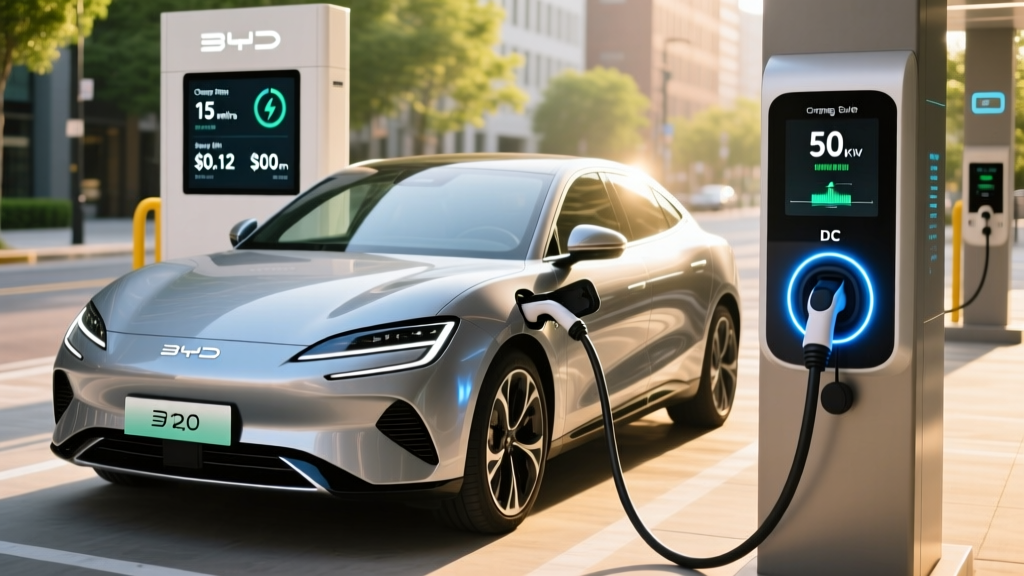
For a BYD Dolphin (60.4 kWh), Level 2 at 11 kW refills the battery from 10% to 80% in about 4 hours. The Seal with its 82.5 kWh pack takes roughly 5.5 hours on the same charger. DC fast charging is dramatically faster — the Seal peaks at 150 kW, adding roughly 180 miles of range in 26 minutes (10-80%).
Charging curve reality: Peak DC rates only apply at low states of charge. Most BYD models sustain their peak rate up to roughly 50-60% SoC, then taper. The final 80-100% can take as long as the 10-80% portion. For road trips, plan stops around 10-80% to minimize time at the charger.
Home Charger Installation: Requirements, Costs, and Gotchas
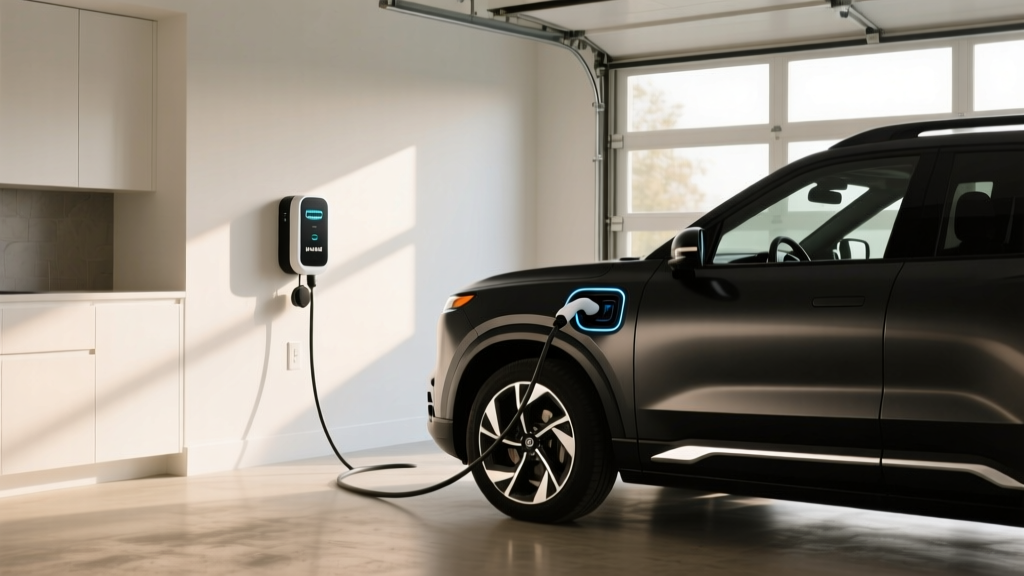
Installing a dedicated Level 2 home charger is the single biggest quality-of-life upgrade for any BYD owner. Here's what's involved electrically and financially.
Electrical Requirements
A standard Level 2 charger needs a 240V dedicated circuit. For a 48-amp charger (the sweet spot for most BYD models with 11 kW onboard chargers), you need a 60-amp breaker. The National Electrical Code (NEC) requires the circuit breaker to be rated at 125% of the continuous load, so 48A continuous draw requires a 60A breaker.
Your home's electrical panel must have enough spare capacity. Most modern 200-amp panels can accommodate a 60A EV circuit. Older homes with 100-amp service will likely need a panel upgrade — a significant added cost.
Installation Cost Breakdown
| Item | Typical Cost Range | Notes |
|---|---|---|
| Level 2 Charger (hardware) | $350 - $700 | Smart Wi-Fi-enabled units |
| Electrician labor (standard install) | $500 - $1,500 | Depends on run length from panel |
| Electrical permit | $50 - $200 | Required in most jurisdictions |
| Panel upgrade (if needed) | $1,500 - $3,500 | 100A to 200A service upgrade |
| Total (no panel upgrade) | $900 - $2,400 | Most common scenario |
| Total (with panel upgrade) | $2,400 - $5,900 | Older homes |
Always get a licensed electrician to assess your panel before purchasing hardware. Some utilities offer rebates of $250-$500 for Level 2 installation — check with your local provider. The IRS residential clean energy credit may cover 30% of installation costs (up to $1,000) through 2032, subject to specific requirements.
Safety and Code Considerations
- Dedicated circuit: Your EV charger must have its own breaker — never share with other appliances.
- GFCI protection: NEC 2020+ requires GFCI breakers for outdoor receptacles; hardwired chargers may bypass this requirement in some jurisdictions.
- Outdoor rating: If mounting outside, ensure the unit carries a NEMA 4 or IP65 rating for weather resistance.
- Cable management: Choose a charger with at least 18-25 feet of cable to reach your BYD's charge port regardless of parking orientation.
Connector Compatibility: What Plug Does a BYD Use?
BYD uses different connectors depending on the market. If you're in a region where BYD is available, here's what you'll encounter:
| Connector | Region | BYD Compatibility | Adapter Needed? |
|---|---|---|---|
| Type 2 (Mennekes) | Europe, most global markets | AC charging on all BYD models | No (native) |
| CCS2 | Europe, Australia, global | DC fast charging on all BYD models | No (native) |
| GB/T | China | AC and DC on Chinese-market BYDs | No (native) |
| CCS1 | North America | Not currently applicable (no US BYD sales) | N/A |
| NACS (Tesla) | North America | Not applicable | N/A |
Since BYD does not currently sell passenger vehicles in the US or Canada, the NACS/CCS1 connector war is irrelevant for BYD buyers. European and Australian BYD owners will charge natively on CCS2 at public stations and Type 2 at home. If you're importing a BYD or traveling with one across regions, CCS2-to-CCS1 adapters exist but are expensive ($200-$400) and not universally reliable.
Level 2 Charger Recommendations for BYD Models
Since most BYD models cap AC charging at 11 kW (roughly 48 amps at 240V), you want a charger that can deliver at least that. Here are three proven options for 2026:
Wallbox Pulsar Plus
Power: Up to 11.5 kW (48A)
Connector: Type 2 (J1772 variant available)
Cable: 25 ft
Smart features: Wi-Fi, app scheduling, solar integration, load balancing
Price: ~$599
Compact, reliable, and matches BYD's 11 kW onboard charger perfectly. Load-balancing feature is ideal for homes with limited panel capacity.
ChargePoint Home Flex
Power: Up to 12 kW (50A, configurable)
Connector: Type 2 / J1772
Cable: 23 ft
Smart features: Wi-Fi, Alexa integration, detailed energy reports, scheduled charging
Price: ~$649
Highly configurable amperage lets you dial down to match your panel's capacity without a separate unit. Excellent app and reliability track record.
Emporia Vue Level 2
Power: Up to 11.5 kW (48A)
Connector: Type 2 / J1772
Cable: 24 ft
Smart features: Wi-Fi, real-time energy monitoring, solar-aware scheduling, V2H-ready
Price: ~$399
Best value option. Pairs with the Emporia Vue home energy monitor for detailed whole-home electricity tracking. Ideal for budget-conscious BYD owners.
Cost to Charge a BYD: Home vs. Public vs. Gas Equivalent
One of the strongest arguments for BYD ownership is fuel cost savings, especially with LFP batteries that tolerate daily 100% charging better than NMC chemistries. Here's how the numbers break down for a BYD Seal (82.5 kWh battery, ~355 mi WLTP / ~300 mi real-world):
| Scenario | Rate ($/kWh) | Full Charge Cost | Cost per Mile | Equiv. Gas MPG (at $3.50/gal) |
|---|---|---|---|---|
| Home (off-peak utility rate) | $0.08 | $6.60 | $0.022 | ~159 MPG |
| Home (average US rate) | $0.16 | $13.20 | $0.044 | ~80 MPG |
| Public Level 2 (ChargePoint, etc.) | $0.25 | $20.63 | $0.069 | ~51 MPG |
| DC Fast Charger (Ionity/highway) | $0.40 | $33.00 | $0.110 | ~32 MPG |
| Gas car baseline (30 MPG combined) | $3.50/gal | $35.00 (300 mi) | $0.117 | 30 MPG |
At home on off-peak rates, a BYD Seal costs roughly $0.02 per mile — about one-sixth the cost of a 30 MPG gas car. Even on public DC fast chargers at premium rates, the BYD is cost-competitive with gasoline. Over 15,000 miles annually, home charging saves approximately $1,300-$1,650 per year versus gas.
Frequently Asked Questions
How much does it cost to install a home EV charger for a BYD?
Expect $900-$2,400 for a standard installation (charger + electrician + permit) if your panel has capacity. If you need a 100A-to-200A panel upgrade, add $1,500-$3,500. The federal Alternative Fuel Vehicle Refueling Property Credit may cover 30% of installation costs up to $1,000 — consult a tax professional and check IRS guidelines for eligibility.
How fast will each charging level add range to my BYD?
Level 1 (120V) adds roughly 3-5 miles per hour — adequate only for low-mileage drivers. Level 2 (240V, 48A) adds 20-35 miles per hour and will fully recharge any BYD overnight. DC fast charging adds 150-400 miles per hour at peak rates, with a 10-80% charge taking 26-30 minutes depending on the model.
Which connector and charger is compatible with my BYD?
In Europe and most global markets, BYD vehicles use Type 2 for AC charging and CCS2 for DC fast charging. Choose a Level 2 home charger with a Type 2 plug rated at 48A/11.5 kW to match BYD's onboard charger capacity. In China, BYD uses the GB/T standard.
How much does charging a BYD cost per mile versus gas?
Charging at home on average electricity rates costs $0.03-$0.05 per mile — roughly one-quarter to one-third the cost of a 30 MPG gas car at $3.50/gallon. On off-peak utility rates, the cost drops to around $0.02 per mile. Even expensive highway DC fast charging ($0.40/kWh) costs about $0.11 per mile, comparable to gas.
What electrical upgrades might I need for a BYD home charger?
If your home has a 200-amp electrical panel with spare breaker slots, you likely need no upgrades beyond the dedicated 60A circuit. Homes with 100-amp service will almost certainly need a panel upgrade ($1,500-$3,500). Some older homes also need service-line upgrades from the utility. Always have a licensed electrician perform a load calculation before purchasing equipment.
Sources: BYD global specification sheets (2026 model year), IRS Residential Clean Energy Credit, fueleconomy.gov for efficiency comparisons.