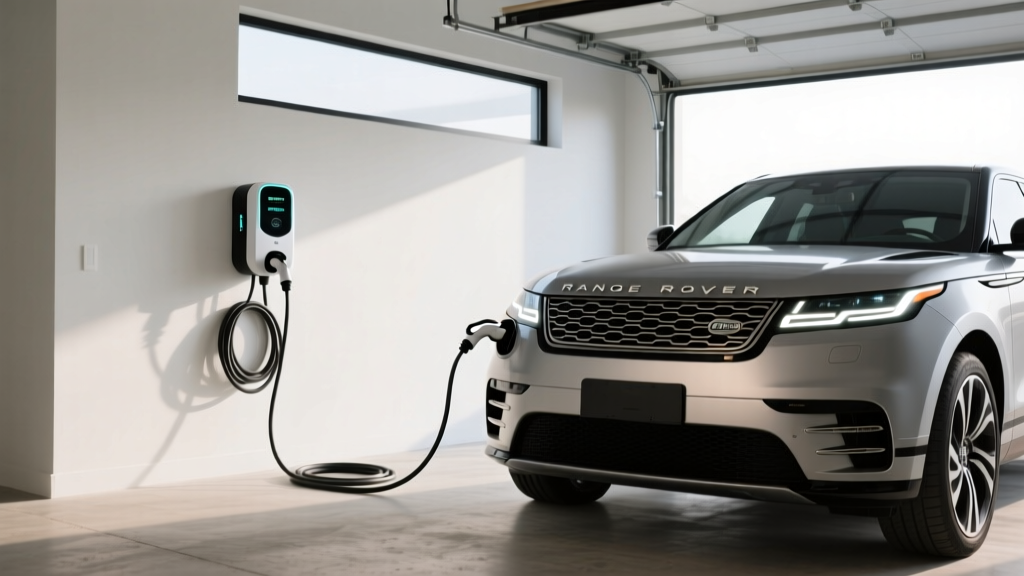
If you are considering a Range Rover Electric Velar replacement for your aging gasoline or mild-hybrid Land Rover, the single most important ownership decision you will make happens before the car even arrives in your driveway: how you will charge it at home. The upcoming all-electric Velar — built on Jaguar Land Rover's modular Longitudinal Architecture (MLA) platform with an estimated 100+ kWh battery pack — will demand a robust Level 2 home charging setup to deliver practical daily usability. Relying solely on public DC fast charging is expensive, inconvenient, and unnecessary for most owners.
This guide breaks down exactly what electrical infrastructure you need, what it will cost, how fast each charging level replenishes the Velar's battery, and which Level 2 chargers are worth your money in 2026. We will also address the Range Rover Electric Velar's anticipated charging specs so you can plan your installation before delivery day.
Understanding Charging Levels: What Speeds to Expect
Electric vehicle charging operates on three tiers, each defined by power output measured in kilowatts (kW) — the rate of energy delivery. The battery capacity itself is measured in kilowatt-hours (kWh), representing total energy stored. Think of kW as the width of a hose and kWh as the size of the bucket. Confusing these two is the most common EV literacy mistake new buyers make.
| Level | Voltage / Amperage | Max Power (kW) | Miles of Range Added per Hour | Best Use Case |
|---|---|---|---|---|
| Level 1 | 120V / 12A | ~1.4 kW | 3–5 miles | Overnight trickle; PHEVs with small batteries |
| Level 2 | 240V / 32–48A | 7.7–11.5 kW | 22–44 miles | Daily home charging; essential for large-battery BEVs |
| DC Fast Charging | 400–800V DC | 50–350 kW | 150–800+ miles (theoretical peak) | Road trips; 10–80% top-ups in 20–40 minutes |
Range Rover Electric Velar: Anticipated Charging Specs
The Range Rover Electric Velar is expected to share its powertrain architecture with the Range Rover Electric, which JLR has confirmed will support DC fast charging at up to 200+ kW on its 800V-capable MLA platform. Here is what we know from JLR's published preliminary specifications and platform data:
| Specification | Estimated Value |
|---|---|
| Battery Capacity (usable) | ~100–117 kWh (NMC chemistry) |
| EPA Range (est.) | ~270–310 miles |
| Max DC Fast Charge Rate | ~200–220 kW peak |
| 10–80% DC Fast Charge Time | ~28–35 minutes (estimated) |
| Level 2 AC Onboard Charger | 11 kW (single-phase) / up to 22 kW (three-phase, market-dependent) |
| Charge Port Connector (US) | CCS1 (with NACS adapter expected) |
| Battery/Powertrain Warranty | 8 years / 100,000 miles (min. 70% capacity retention) |
Note: The Range Rover Electric Velar is an announced/upcoming model. Final EPA range, pricing, and charging specifications are subject to change. JLR has not published a firm on-sale date for the Velar EV variant as of early 2026.
Home Charger Installation: Electrical Requirements and Costs
To properly charge a large-battery luxury EV like the Electric Velar overnight, you need a hardwired Level 2 charger on a dedicated 240V circuit, ideally at 48 amps (delivering up to 11.5 kW). This is non-negotiable for practical daily ownership of a 100+ kWh vehicle. A 120V Level 1 outlet would take over 70 hours to fully charge this battery — essentially useless.
What Your Electrical Panel Needs
- Dedicated 60-amp breaker (to support continuous 48A draw, per NEC 80% rule)
- 240V circuit run from your main panel to the charger location (garage or exterior wall)
- Panel capacity check: Most homes need a 200-amp main panel to accommodate a 60A EV circuit alongside existing loads. Homes with 100A or 150A panels may require a panel upgrade — a significant added cost
- GFCI protection: Required by NEC 2020+ for outdoor receptacles; hardwired units may not require a GFCI breaker depending on local code, but your electrician will confirm
- Permit: Nearly all jurisdictions require an electrical permit for a new 240V circuit, with inspection upon completion
Installation Cost Breakdown
| Item | Cost Range |
|---|---|
| Level 2 Charger Equipment (40A–48A smart charger) | $400–$750 |
| Electrician Labor (240V circuit, 20–50 ft run) | $600–$2,000 |
| Electrical Permit | $50–$250 |
| Panel Upgrade (if needed: 100A → 200A) | $1,500–$3,500 |
| Total (no panel upgrade) | $1,050–$3,000 |
| Total (with panel upgrade) | $2,550–$6,500 |
These figures assume a straightforward conduit run in an attached garage or on an exterior wall near the panel. Long wire runs (100+ feet), trenching for detached garages, or complex conduit routing through finished walls can push labor costs higher. Always get at least two quotes from licensed electricians.
Connector Compatibility: Will Your Charger Fit the Electric Velar?
The US charging connector landscape has shifted dramatically. As of 2026, most new EVs sold in North America use either the NACS (North American Charging Standard) port pioneered by Tesla or the legacy CCS1 (Combined Charging System) connector. JLR has historically used CCS1 for its EVs, but the industry-wide shift toward NACS means an adapter strategy is likely for the Electric Velar.
| Connector | Brands Using It (Native) | AC Level 2 | DC Fast | Adapter Available? |
|---|---|---|---|---|
| NACS (Tesla) | Tesla, Ford, GM, Rivian, Volvo, Polestar, Hyundai/Kia (2025+) | Yes | Yes | CCS→NACS adapters ($150–$250) |
| CCS1 | BMW, VW, JLR/Land Rover, Stellantis, legacy models | Yes | Yes | NACS→CCS adapters available |
| CHAdeMO | Nissan Leaf (legacy); discontinued on new models | No | Yes (declining) | Limited |
For the Electric Velar: Expect a CCS1 native port with a JLR-supplied or approved NACS-to-CCS adapter for Tesla Supercharger access. When purchasing a home Level 2 charger, choose a unit with a J1772 connector (the universal AC standard) — this will plug directly into the Velar's CCS1 AC inlet without any adapter. If you install a NACS-terminated home charger, you will need the adapter at the vehicle end.
Level 2 Charger Recommendations for a Large-Battery EV
Charging a ~100+ kWh battery demands a charger that can sustain high power output for 8–12 hours without thermal throttling. Here are three proven units well-suited to the Electric Velar's needs:
ChargePoint Home Flex
- Power Output: Up to 11.5 kW (48A on 60A circuit) or 9.6 kW (40A on 50A circuit) — adjustable via DIP switch
- Connector: J1772 (25-ft cable)
- Smart Features: Wi-Fi, app scheduling, energy tracking, Alexa integration
- Indoor/Outdoor: NEMA 4 rated (outdoor-safe)
- Price: ~$550–$650
Emporia Level 2 EV Charger
- Power Output: Up to 11.5 kW (48A)
- Connector: J1772 (24-ft cable)
- Smart Features: Wi-Fi, real-time energy monitoring, solar integration, load management with Emporia Vue panel monitor
- Indoor/Outdoor: NEMA 4 rated
- Price: ~$400–$500 (best value for smart features)
Tesla Wall Connector (Universal)
- Power Output: Up to 11.5 kW (48A)
- Connector: NACS native + integrated J1772 adapter (Magic Dock style)
- Smart Features: Wi-Fi, OTA updates, power sharing (link multiple units), load management
- Indoor/Outdoor: NEMA 4 rated, 24-ft cable
- Price: ~$450–$600
For a Range Rover Electric Velar replacement, the ChargePoint Home Flex or Emporia units are the strongest choices because of their native J1772 connectors, eliminating adapter dependency for daily home charging. The Tesla Universal Wall Connector is ideal if you also own a Tesla or plan to transition to NACS-native vehicles in the future.
Charging Cost Per Mile: Electric Velar vs. Gasoline Velar
One of the most compelling arguments for the Electric Velar replacement is the per-mile fuel cost reduction. Here is how charging costs compare to the gasoline Velar's fuel consumption, using realistic 2026 energy prices:
| Scenario | Cost per kWh or Gallon | Cost Per Mile | Annual Cost (12,000 mi) |
|---|---|---|---|
| Home Charging (off-peak utility rate) | $0.12/kWh | ~$0.04 | ~$480 |
| Home Charging (average US residential) | $0.17/kWh | ~$0.057 | ~$684 |
| Public Level 2 (network average) | $0.30/kWh | ~$0.10 | ~$1,200 |
| DC Fast Charging (Electrify America / EVgo) | $0.40–$0.55/kWh | ~$0.15–$0.18 | ~$1,800–$2,160 |
| Gasoline Velar P250 (23 MPG combined, $3.60/gal) | $3.60/gallon | ~$0.157 | ~$1,884 |
The Electric Velar is estimated to consume approximately 3.0–3.4 kWh per mile (roughly 98–112 MPGe) based on the Range Rover Electric's efficiency data. Even at average residential electricity rates, home charging cuts your per-mile cost to roughly one-third of the gasoline Velar's fuel expense. The savings widen further if your utility offers time-of-use (TOU) rates with cheap overnight charging windows.
However, relying exclusively on DC fast charging at $0.45+/kWh actually exceeds the gasoline Velar's fuel cost. This is why a home Level 2 installation is not optional — it is the economic foundation of EV ownership.
Charging Time Examples: What to Expect with a ~110 kWh Battery
The Electric Velar's large battery means charging times are longer than compact EVs. Here are realistic timeframes for common scenarios:
- Level 1 (120V, 1.4 kW): 10% → 80% in approximately 55–65 hours — impractical for daily use; only useful as a last-resort trickle
- Level 2 (240V, 11.5 kW / 48A): 10% → 80% in approximately 7–8 hours — ideal for overnight charging; wake up to a full battery every morning
- Level 2 (240V, 7.7 kW / 32A): 10% → 80% in approximately 10–11 hours — still viable overnight but tighter margin for high-mileage days
- DC Fast Charging (~200 kW peak): 10% → 80% in approximately 28–35 minutes — note that charge speed tapers significantly above 80% SoC to protect battery health; the final 20% can take as long as the first 70%
Safety, Code, and Smart Charging Practices
Installing a high-amperage 240V circuit is serious electrical work. Key safety and code considerations:
- Dedicated circuit only: Your Level 2 charger must be on its own breaker — never shared with other appliances
- Hardwired vs. plug-in: Hardwired installations (no plug) are preferred for 48A chargers because NEMA 14-50 receptacles are rated for 50A but continuous EV loads at 40A can cause thermal fatigue on the receptacle over years of use. Many electricians now recommend hardwiring for any circuit above 40A
- Outdoor rating: If your charger is mounted outside, ensure it carries a NEMA 4 or NEMA 4X rating for weather resistance
- Utility load management: Some utilities offer rebates for smart chargers that can throttle power during peak grid demand — this can offset installation costs
- Preconditioning: The Electric Velar will likely support battery preconditioning — warming the pack before a DC fast charge session to maximize charge speed. Enable this in the vehicle's navigation settings when routing to a fast charger
For detailed federal incentive information on home charging equipment, consult the IRS Alternative Fuel Vehicle Refueling Property Credit (IRC §30C), which offers up to $1,000 in tax credit for home charger installation in eligible census tracts.
Frequently Asked Questions
How much does it cost to install a home EV charger for the Range Rover Electric Velar?
Expect $1,050–$3,000 for a standard installation (equipment + electrician + permit) if your electrical panel has sufficient capacity. If a panel upgrade from 100A to 200A is required, total costs rise to $2,550–$6,500. Always get a load calculation from a licensed electrician first.
How fast will each charging level add range to the Electric Velar?
Level 1 (120V) adds roughly 3–5 miles per hour — essentially useless for a 100+ kWh battery. Level 2 (240V, 48A) adds approximately 35–40 miles per hour, enough for a full overnight charge. DC fast charging at 200 kW can add 150+ miles in 15–20 minutes during the peak portion of the charge curve.
Which connector and charger is compatible with the Range Rover Electric Velar?
The Electric Velar is expected to use a CCS1 charge port. Any Level 2 home charger with a standard J1772 connector will be directly compatible. For Tesla Supercharger access, you will need a NACS-to-CCS adapter, which JLR is expected to provide or approve.
How much does charging cost per mile compared to gasoline?
At average US residential electricity rates (~$0.17/kWh), home charging costs approximately $0.05–$0.06 per mile. The gasoline Velar P250 costs roughly $0.16 per mile at $3.60/gallon. Home charging saves approximately $1,200–$1,400 annually over 12,000 miles of driving.
What electrical upgrades might I need?
The most common upgrade is a panel capacity increase from 100A to 200A ($1,500–$3,500). You may also need conduit routing for long wire runs, a new breaker slot, or — in older homes — rewiring of the service entrance. A licensed electrician's load calculation will determine exactly what is required. Check with your local utility for available rebates that can offset panel upgrade costs.
Sources: EPA fuel economy data via fueleconomy.gov; IRS tax credit rules via irs.gov; JLR platform specifications via Land Rover USA press materials.