The 2025 Land Rover Range Rover Electric marks the first battery-electric flagship from Jaguar Land Rover, riding the MLA-Flex architecture with an estimated 117 kWh usable battery pack and targeting roughly 300 miles of EPA range. For buyers transitioning from a supercharged V8 to a silent, torque-rich EV, the charging logistics are the biggest unknown. Can your home electrical panel handle a 48-amp Level 2 charger? How long does a DC fast-charge stop actually take on a road trip? And what will you really pay per mile compared to premium unleaded?
This guide walks through every charging scenario you'll face as a Range Rover Electric owner — from the home wall connector you'll use 90% of the time to the public DC fast chargers you'll rely on for road trips. We'll use the Range Rover Electric as our reference vehicle, but the infrastructure principles apply broadly to any large-battery luxury EV.
Range Rover Electric 2025: Key Charging Specs at a Glance
| Specification | Value |
|---|---|
| Battery Capacity (usable, estimated) | ~117 kWh (NMC chemistry) |
| EPA Range (estimated) | ~300 miles |
| Max DC Fast Charge Rate | ~200 kW (peak) |
| 10–80% DC Fast Charge Time (est.) | ~34 minutes |
| Onboard AC Charger | 11 kW (single-phase) / 22 kW (three-phase, market-dependent) |
| Level 2 Charge Time (10–80% at 11 kW) | ~7.5 hours |
| Charging Port | CCS1 (North America) |
| Base MSRP (estimated) | ~$120,000+ |
| §30D Federal Tax Credit Eligibility | Exceeds MSRP cap — not eligible |
Charging Levels Explained: How Fast Will Each Add Range?
Before diving into hardware, it's essential to distinguish between kW (kilowatts — the rate of power flow, like water pressure from a hose) and kWh (kilowatt-hours — the total energy stored or delivered, like gallons in a tank). A 200 kW DC fast charger delivers energy at a rate of 200 kilowatts; the Range Rover Electric's battery stores roughly 117 kWh of energy total. Confusing these two is the single most common EV literacy mistake.
| Level | Voltage / Amperage | Power Output | Miles of Range Added per Hour | Best Use Case |
|---|---|---|---|---|
| Level 1 | 120V / 12A | ~1.4 kW | ~3–5 miles/hr | Overnight trickle for PHEVs; emergency use for BEVs |
| Level 2 (Home/Public) | 240V / 32–48A | 7.7–11.5 kW | ~22–35 miles/hr | Daily home charging; overnight full recharge |
| DC Fast Charging | 400–800V DC | 50–350 kW | ~150–600+ miles/hr | Road trips; quick top-ups away from home |
For a vehicle with the Range Rover Electric's ~117 kWh battery, Level 1 charging is impractical as a daily strategy — it would take roughly 80+ hours to fill from empty. Level 2 at 11 kW is the workhorse: an overnight session of 8–10 hours restores the bulk of the battery. DC fast charging is your road-trip solution, with the charge curve tapering significantly above 80% state of charge to protect battery health.
Home Charger Installation: Electrical Requirements and Costs
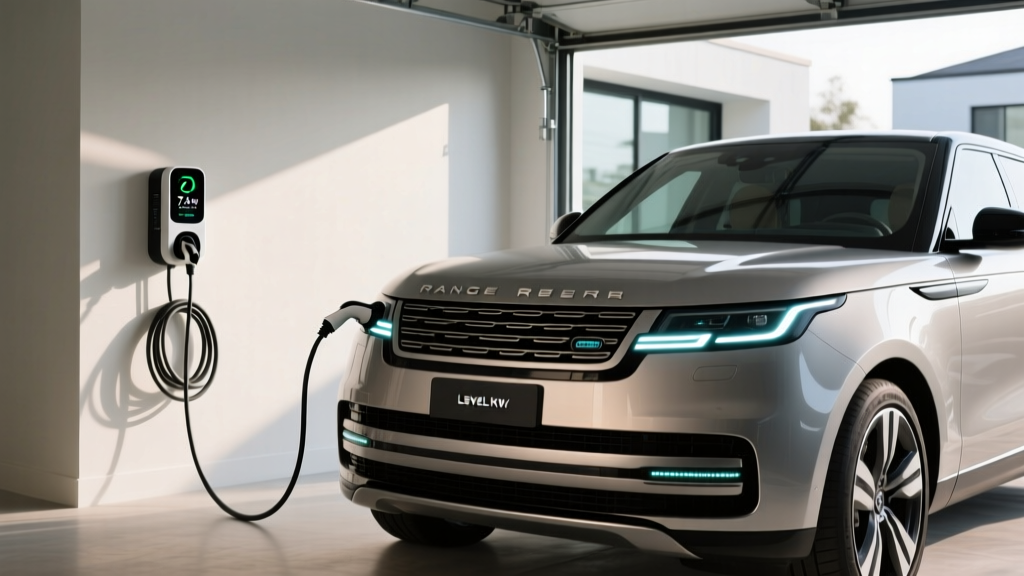
Most Range Rover Electric owners will install a hardwired Level 2 wall connector in their garage. Here's what that involves electrically and financially.
Electrical Requirements
- Circuit: A dedicated 60-amp breaker is recommended for a 48-amp continuous charger (NEC requires circuits rated at 125% of continuous load: 48A × 1.25 = 60A).
- Wire: 6 AWG copper (or 4 AWG aluminum) THHN in conduit, or equivalent NM-B cable.
- Voltage: 240V split-phase (standard US residential).
- Panel capacity: Your main service panel must have sufficient spare amperage. A 200-amp panel with existing loads near capacity may need a upgrade to 300–400 amps or a load-management device.
Panel Upgrade: The Hidden Cost
Homes built before 2000 often have 100-amp or 150-amp main panels. Adding a 60-amp EV circuit to an already loaded panel can require a service upgrade to 200 amps — a significant expense. Even some 200-amp panels lack physical breaker spaces. A licensed electrician will perform a load calculation per NEC Article 220 to determine if your panel can accommodate the new circuit.
Installation Cost Breakdown
| Component | Low Estimate | High Estimate |
|---|---|---|
| Level 2 Charger (Equipment) | $500 | $800 |
| Electrician Labor (standard run, <50 ft) | $500 | $1,500 |
| Electrical Permit | $50 | $250 |
| Wire, Conduit, Breaker, Misc. | $150 | $400 |
| Total (No Panel Upgrade) | $1,200 | $2,950 |
| Panel Upgrade (if needed: 200A service) | $2,000 | $5,000+ |
| Total (With Panel Upgrade) | $3,200 | $7,950+ |
Costs vary significantly by region, wall penetration complexity, and distance from panel to charger location. A garage install with the panel on the same wall is at the low end; running conduit 80 feet through an attic to a detached garage is at the high end.
Connector Compatibility: NACS, CCS, and the Adapter Question
The Range Rover Electric is expected to ship with a CCS1 (Combined Charging System) port for the North American market. However, the charging landscape is shifting rapidly toward the NACS (North American Charging Standard, originally Tesla's connector). Here's where each network stands:
| Network / Standard | Connector | Native Compatibility? | Adapter Needed? |
|---|---|---|---|
| Electrify America | CCS1 | Yes | No |
| EVgo | CCS1 | Yes | No |
| ChargePoint (DC) | CCS1 | Yes | No |
| Tesla Supercharger | NACS | No (without adapter) | Yes — CCS-to-NACS adapter (e.g., Tesla Magic Dock or third-party) |
| Home Level 2 (J1772) | J1772 / NACS | Yes (J1772) | Depends on charger; J1772 is universal for AC |
Jaguar Land Rover has not confirmed NACS adoption for the Range Rover Electric at launch. If you rely on Tesla Superchargers for road trips, budget for a quality CCS-to-NACS adapter ($200–$400) and verify compatibility once JLR makes a formal announcement. The Electrify America network remains the most accessible CCS-native option for long-distance travel.
Charging Cost Per Mile: EV vs. Premium Gasoline
The Range Rover Electric replaces a vehicle that averages roughly 16–19 MPG combined on premium unleaded. Here's what the economics look like across charging scenarios, using a 3.0 mi/kWh efficiency estimate (roughly 110 MPGe):
| Scenario | Rate | Cost per Mile | Annual Cost (12,000 mi) |
|---|---|---|---|
| Home Charging (off-peak utility rate) | $0.13/kWh | $0.043 | $520 |
| Home Charging (standard rate) | $0.18/kWh | $0.060 | $720 |
| Public Level 2 (e.g., ChargePoint) | $0.30/kWh | $0.100 | $1,200 |
| DC Fast Charging (e.g., Electrify America) | $0.48/kWh | $0.160 | $1,920 |
| Gas Range Rover (17 MPG, $4.50/gal premium) | — | $0.265 | $3,176 |
Even at the most expensive DC fast-charging rates, the Range Rover Electric costs roughly 40% less per mile than its gasoline counterpart. Home charging delivers the most dramatic savings — roughly 84% less per mile than premium gas. For a luxury-vehicle buyer driving 12,000 miles annually, that's $2,400–$2,600 in annual fuel savings when charging primarily at home.
Recommended Home Chargers for the Range Rover Electric
With an 11 kW onboard AC charger, the Range Rover Electric can accept up to 48 amps on a 240V circuit. Here are three Level 2 chargers that match that capability:
ChargePoint Home Flex
- Power Output: Up to 12 kW (50A adjustable)
- Connector: J1772 (NACS version available)
- Cable Length: 23 feet
- Smart Features: Wi-Fi, app scheduling, Alexa integration, utility rate optimization
- Price: ~$550–$650
- Best For: Flexible amperage settings to match panel capacity
Wallbox Pulsar Plus
- Power Output: Up to 11.5 kW (48A)
- Connector: J1772
- Cable Length: 25 feet
- Smart Features: Wi-Fi + Bluetooth, app control, Power Sharing for dual-charger setups
- Price: ~$550–$650
- Best For: Compact form factor; excellent for tight garages
Emporia Level 2 EV Charger
- Power Output: Up to 11.5 kW (48A)
- Connector: J1772
- Cable Length: 24 feet
- Smart Features: Wi-Fi, energy monitoring, integrates with Emporia Vue home energy panel
- Price: ~$400–$500
- Best For: Budget-conscious buyers who want energy tracking
All three support hardwired installation (preferred for 48A continuous draw) and NEMA 14-50 plug-in installation (limited to 40A/9.6 kW per NEC plug-in rules). Hardwiring eliminates the GFCI breaker requirement that a 14-50 receptacle demands, saving $80–$150 on the breaker alone.
Safety, Code, and Installation Best Practices
EV charger installation is governed by the National Electrical Code (NEC) and local amendments. Key requirements to discuss with your electrician:
- Dedicated circuit: The charger must be on its own breaker — no shared loads with appliances or lighting.
- GFCI protection: Required for receptacle-based installations (NEMA 14-50). Hardwired chargers are exempt from GFCI requirements under NEC 2020/2023 in most jurisdictions, and many EV charger manufacturers recommend hardwiring specifically to avoid nuisance GFCI trips.
- Outdoor rating: If installing outside, the charger must carry a NEMA 4 (weatherproof) rating. All three chargers above meet this standard.
- Permit and inspection: Most municipalities require an electrical permit and post-installation inspection. Skipping this can void homeowner's insurance coverage for electrical fires.
- Load management: If your panel is near capacity but you want to avoid a full upgrade, devices like the Emporia VUE or Span smart panel can dynamically limit charger draw based on real-time household consumption.
DC Fast Charging on Road Trips: What to Expect
The Range Rover Electric's estimated 200 kW peak DC charge rate means you can add roughly 150–170 miles of range in a 20-minute stop — enough for most highway driving segments. However, the charge curve matters more than peak rate:
- 10–30% SoC: Near-peak rate (~180–200 kW) — fastest charging window
- 30–60% SoC: Sustained high rate (~150–180 kW)
- 60–80% SoC: Progressive taper (~100–130 kW)
- 80–100% SoC: Sharp taper (~30–50 kW) — avoid charging past 80% on road trips unless necessary
This taper is a battery-protection feature, not a malfunction. The 10–80% time of roughly 34 minutes reflects this curve. Plan road-trip stops around the 20–80% window for maximum time efficiency, and precondition the battery (if the Range Rover Electric's navigation system supports it) by entering a charger as your destination — this warms the pack for faster charge acceptance.
Frequently Asked Questions
How much does it cost to install a home EV charger for the Range Rover Electric?
Expect $1,200–$2,950 for a standard installation on an existing 200-amp panel, including equipment, electrician labor, wire, and permit. If your home needs a panel upgrade (common in pre-2000 homes with 100A or 150A service), add $2,000–$5,000+, bringing the total to $3,200–$7,950+.
How fast will each charging level add range to the Range Rover Electric?
Level 1 (120V) adds roughly 3–5 miles per hour — impractical for a 117 kWh battery. Level 2 at 11 kW adds approximately 25–30 miles per hour, fully replenishing the battery overnight. DC fast charging at 200 kW peak can add 150+ miles in 20 minutes during the optimal 20–80% state-of-charge window.
Which connector and charger is compatible with the Range Rover Electric?
The Range Rover Electric uses a CCS1 port for DC fast charging and a J1772 inlet for Level 2 AC charging. It is natively compatible with Electrify America, EVgo, and ChargePoint DC chargers. Tesla Supercharger access requires a CCS-to-NACS adapter. Any J1772 Level 2 home charger will work for daily charging.
How much does charging cost per mile compared to gas?
Home charging at $0.13/kWh costs roughly $0.043 per mile — about 84% less than a gas Range Rover burning premium at $4.50/gallon ($0.265/mile at 17 MPG). Even public DC fast charging at $0.48/kWh ($0.16/mile) saves about 40% per mile.
What electrical upgrades might I need for a Level 2 charger?
You'll need a dedicated 60-amp, 240V circuit. If your panel lacks capacity (determined by an NEC Article 220 load calculation), a service upgrade from 100A/150A to 200A or higher may be required. Homes with 200A panels that are near full breaker-space capacity may benefit from a smart load-management device instead of a full panel replacement.
Is the Range Rover Electric eligible for the federal EV tax credit?
No. Under current IRS §30D rules, the federal clean vehicle credit caps eligible SUVs at an $80,000 MSRP. The Range Rover Electric's estimated starting price well above $120,000 disqualifies it. Always verify current rules with a tax professional, as legislation can change.
Can I use a NACS/Tesla Supercharger with the Range Rover Electric?
Not natively. The Range Rover Electric has a CCS1 port. To access Tesla Superchargers, you'll need a CCS-to-NACS adapter. Check for JLR's official adapter compatibility announcement before purchasing third-party adapters, as firmware handshake requirements vary.