The 2026 Toyota Prius Prime (the plug-in hybrid variant) continues to offer one of the most practical bridges between electric commuting and gas-powered road trips. With an EPA-estimated 44 miles of electric-only range and a combined 150 MPGe, it's a compelling choice for drivers who want daily EV driving without range anxiety. But getting the most out of that electric range means understanding how to charge it efficiently — at home and on the go.
This guide covers everything Prius Prime owners and prospective buyers need: real-world range expectations, charging speeds across every level, home installation costs with a full breakdown, connector compatibility, and what you'll actually spend per mile compared to a gas-only car.
2026 Prius Prime Range: EPA vs. Real World
The 2026 Prius Prime carries a 13.6 kWh lithium-ion battery pack (usable capacity approximately 11.3 kWh) paired with Toyota's 2.0L four-cylinder plug-in hybrid powertrain producing a combined 220 horsepower. Here's what the EPA says — and what you should actually expect.
EPA Electric-Only Range: 44 miles
Real-World Expectation: 36–42 miles in mixed driving; 30–35 miles in cold weather (below 40°F) or sustained highway speeds above 70 mph.
Gas-Only Range After Depletion: ~460 additional miles (EPA 48 MPG combined)
Total System Range: ~500+ miles
Source: fueleconomy.gov
Why the gap? The EPA's test cycle includes low-speed urban driving with frequent regenerative braking opportunities — ideal conditions for a PHEV. In practice, highway driving at 75 mph increases aerodynamic drag substantially, and cold temperatures reduce battery efficiency by 15–25% because the battery management system uses energy for thermal conditioning. Expect to see the full 44 miles on moderate-temperature commutes under 50 mph with regen braking engaged.
Charging Levels Explained: How Fast Can a Prius Prime Charge?
The Prius Prime uses a relatively modest battery, which means charging times are shorter than a full BEV — but choosing the right charging level still matters for convenience and cost.
| Level | Power (kW) | Voltage / Amperage | Miles of Range Added/Hour | 0–100% Charge Time |
|---|---|---|---|---|
| Level 1 (120V household outlet) | 1.4 kW | 120V / 12A | ~4–5 miles/hr | ~9–11 hours |
| Level 2 (240V home/public) | 3.3 kW (vehicle-limited) | 240V / 16A | ~12–14 miles/hr | ~4 hours |
| DC Fast Charging | N/A | — | — | Not supported |
Critical detail: The Prius Prime's onboard charger maxes out at 3.3 kW. Even if you plug into a 48-amp Level 2 station delivering 11.5 kW, the car will only draw 3.3 kW. This means investing in a high-amperage home charger won't speed up your Prius Prime — but a standard 16-amp, 240V circuit will fully utilize its capability.
The Prius Prime does not support DC fast charging. For a PHEV with a small battery, this is standard — the use case assumes overnight home charging covers your daily electric commute, and the gas engine handles longer trips.
Home Charger Installation: Costs, Electrical Requirements & Gotchas
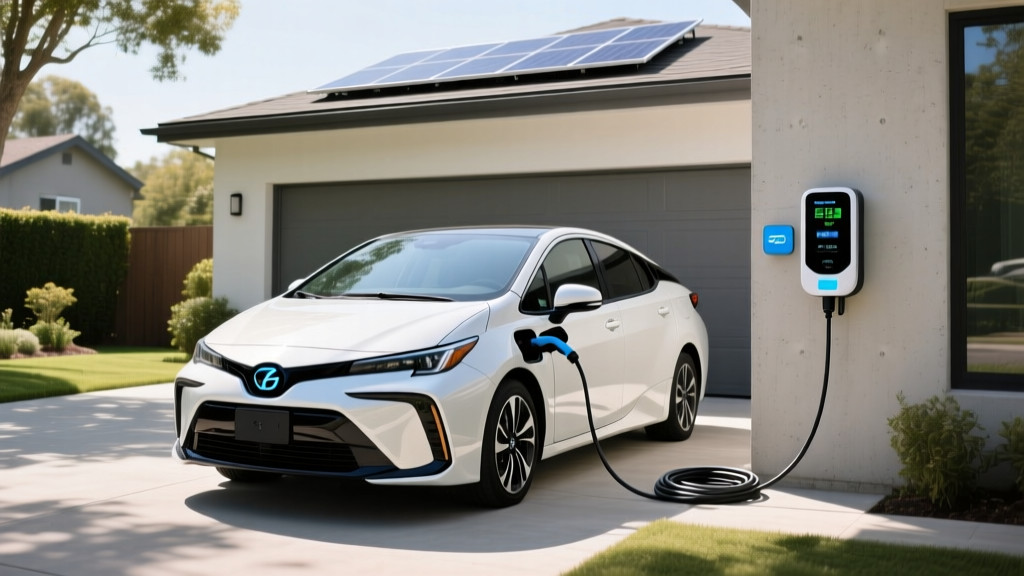
Most Prius Prime owners will find Level 1 charging (plugging into a standard 120V outlet using the included Toyota charging cable) adequate if they drive under 40 miles daily and can charge overnight. But Level 2 at home offers faster top-ups, flexibility for unexpected trips, and future-proofing if you add a BEV later.
Electrical Requirements for a Prius Prime Level 2 Charger
- Circuit: Dedicated 20-amp, 240V circuit (minimum); 30-amp recommended for future-proofing
- Outlet: NEMA 14-50 (if using a plug-in charger) or hardwired connection
- Wire gauge: 10 AWG copper for 20A; 8 AWG for 30A
- GFCI protection: Required by NEC 2020+ for all EV charging circuits (built into most modern chargers)
- Outdoor rating: NEMA 4 enclosure required if installed outside
Installation Cost Breakdown
| Component | Simple Install (Near Panel) | Complex Install (Long Run / Upgrades) |
|---|---|---|
| Level 2 Charger Equipment | $250–$500 | $400–$700 |
| Electrician Labor (2–6 hrs @ $75–$150/hr) | $150–$450 | $450–$900 |
| Permit & Inspection | $50–$150 | $100–$250 |
| Electrical Panel Upgrade (if needed: 100A → 200A) | $0 (not needed) | $1,500–$3,500 |
| Conduit, Wire, Misc. Materials | $50–$100 | $200–$500 |
| TOTAL | $500–$1,200 | $2,650–$5,850 |
The panel upgrade variable: Homes built before the 1990s often have 100-amp electrical panels. Adding a 240V EV circuit may push total load beyond safe capacity, requiring a panel upgrade to 200 amps. This is the single largest cost driver. Ask your electrician to perform a load calculation before committing to a quote. The federal Residential Clean Energy Credit (IRS §25D) covers 30% of charger equipment and installation costs (up to $1,000 annually) through 2032 — confirm eligibility with a tax professional.
Connector Compatibility: What Plugs Into a Prius Prime?
The 2026 Prius Prime uses a J1772 connector for AC charging — the universal standard for non-Tesla plug-in vehicles in North America. Here's how that maps to the charging ecosystem.
| Connector Type | Compatible? | Notes |
|---|---|---|
| J1772 (Level 1 & 2) | ✅ Native | Standard connector on all Prius Prime models; included cable works with 120V outlets |
| NACS (Tesla) | ❌ Not compatible | No adapter available for AC charging; irrelevant for this PHEV |
| CCS1 (DC Fast) | ❌ Not applicable | Prius Prime does not support DC fast charging |
| CHAdeMO (DC Fast) | ❌ Not applicable | Legacy standard; Prius Prime does not support DC fast charging |
Bottom line: Any Level 2 home charger with a J1772 connector will work. This is the most common connector type, so you have broad equipment choices. If you also own a Tesla, you'll need a separate Tesla Wall Connector or use a J1772-to-Tesla adapter for the Tesla vehicle — not the other way around.
Recommended Level 2 Chargers for the Prius Prime
Since the Prius Prime caps at 3.3 kW, you don't need a 48-amp charger. A 16-amp or 32-amp unit covers the Prime's needs and leaves headroom for a future BEV. Here are three proven options:
Emporia Level 2 EV Charger
- Power Output: Up to 11.5 kW (48A) — Prime will draw 3.3 kW
- Connector: J1772
- Cable Length: 24 feet
- Smart Features: Wi-Fi, energy monitoring, scheduling via app, solar integration
- Price: ~$399
- Best for: Budget-conscious buyers who want smart scheduling for off-peak utility rates
ChargePoint Home Flex
- Power Output: Up to 12 kW (50A) — adjustable via DIP switch
- Connector: J1772
- Cable Length: 23 feet
- Smart Features: Wi-Fi, Alexa integration, ChargePoint app, detailed session logs
- Price: ~$549
- Best for: Owners who want a proven brand with robust app features and future BEV-proofing
Grizzl-E Smart
- Power Output: Up to 10 kW (40A)
- Connector: J1772
- Cable Length: 24 feet
- Smart Features: Wi-Fi, OCPP-compatible, over-the-air updates
- Price: ~$499
- Best for: Cold-climate owners — rated to -40°F, built in Canada with heavy-duty enclosure
Pro tip: All three chargers exceed the Prius Prime's 3.3 kW draw. That's intentional — if you add a second EV with a larger battery (say, a Hyundai Ioniq 5 that charges at 10.9 kW AC), the same charger will serve both without an electrical upgrade, provided your circuit supports the higher amperage.
Charging Cost: Prius Prime per Mile vs. Gas
The financial case for the Prius Prime hinges on how often you drive on electricity versus gas. Let's break down real costs.
| Scenario | Rate | Cost per Mile |
|---|---|---|
| Home charging (off-peak utility rate) | $0.10/kWh | $0.031/mile |
| Home charging (average US rate) | $0.17/kWh | $0.052/mile |
| Public Level 2 (network pricing) | $0.25–$0.40/kWh | $0.077–$0.12/mile |
| Gas mode (EPA 48 MPG combined) | $3.40/gallon | $0.071/mile |
| Gas-only car (30 MPG combined) | $3.40/gallon | $0.113/mile |
The math: The Prius Prime achieves approximately 3.3 miles per kWh in EV mode (44 miles ÷ 13.6 kWh ≈ 3.24 mi/kWh, adjusted for usable capacity). If you charge at home at the national average of $0.17/kWh, you're paying roughly $0.05/mile on electricity — about 30% less than the same car running on gas, and less than half what a conventional 30-MPG sedan costs per mile.
Over a 15,000-mile year with 10,000 miles on electricity (plausible if your commute is under 40 miles round-trip), annual fuel savings vs. a gas-only car can reach $800–$1,200, depending on local rates. The Prius Prime's advantage is that even when you exceed electric range, 48 MPG gas mode keeps costs low.
Safety, Code & Installation Best Practices
EV charger installation is electrical work that must comply with the National Electrical Code (NEC Article 625). Here's what to verify with your licensed electrician:
- Dedicated circuit: Your Level 2 charger must be on its own dedicated breaker — never shared with other appliances. For a Prius Prime drawing 3.3 kW (16A), a 20-amp breaker is the minimum; a 30-amp breaker provides margin and future-proofing.
- GFCI protection: NEC 2020 and later requires ground-fault circuit interrupter protection for EV charging outlets. Most modern Level 2 chargers have GFCI built in; if yours doesn't, your electrician will install a GFCI breaker.
- Outdoor installations: Must use a NEMA 4-rated (weatherproof) enclosure and in-use cover for the outlet. All outdoor wiring must be in conduit.
- Permit and inspection: Most jurisdictions require an electrical permit for new 240V circuits. The inspection ensures proper grounding, wire gauge, and breaker sizing. Skipping this can void home insurance coverage for electrical fires.
- Cable management: Avoid running charging cables across walkways or driveways where they create trip hazards or can be driven over. Wall-mounted cord organizers cost $20–$40 and prevent cable damage.
Frequently Asked Questions
How much does it cost to install a home EV charger for a Prius Prime?
For a straightforward installation near your electrical panel with no panel upgrade needed, expect $500–$1,200 total (charger + electrician + permit). If your home needs a panel upgrade from 100A to 200A, total costs can reach $2,650–$5,850. Always get a load calculation from your electrician first.
Can I just use the included Level 1 cable with a regular outlet?
Yes. The Prius Prime includes a 120V Level 1 charging cable. At 1.4 kW, it adds roughly 4–5 miles of range per hour, fully recharging the battery in 9–11 hours. For most Prius Prime owners who drive under 40 miles daily and charge overnight, Level 1 is sufficient and costs nothing to install.
Does the Prius Prime support DC fast charging?
No. The 2026 Prius Prime does not have a DC fast charging port. This is standard for plug-in hybrids — the small battery (13.6 kWh) is designed for overnight AC charging. If you need fast public charging, you'd need a full BEV.
How far can the Prius Prime really go on electric power?
The EPA rates it at 44 miles. In real-world mixed driving at moderate temperatures, expect 36–42 miles. Highway driving above 70 mph and cold weather (below 40°F) can reduce that to 30–35 miles. Once the battery depletes, the gas engine provides an additional ~460 miles at 48 MPG combined.
Is a Level 2 charger worth it if the Prius Prime only charges at 3.3 kW?
It depends on your routine. If you drive 40+ miles daily and need to recharge quickly between trips (e.g., a midday top-up), Level 2 cuts charge time from ~10 hours to ~4 hours. It also future-proofs your garage for a BEV. But if you consistently charge overnight and stay within electric range, Level 1 works fine.
What's the Prius Prime's total cost advantage over a gas-only Prius?
The 2026 Prius Prime starts at approximately $33,445 MSRP (SE trim), roughly $4,500 more than a gas-only Prius LE. However, if you charge primarily at home, annual fuel savings of $800–$1,200 can close that gap in 4–5 years. The §30D federal tax credit may apply depending on battery sourcing, your income, and MSRP caps — consult a tax professional for current-year eligibility.
Sources: EPA fueleconomy.gov, Toyota Prius Prime specifications, IRS §30D Clean Vehicle Credits