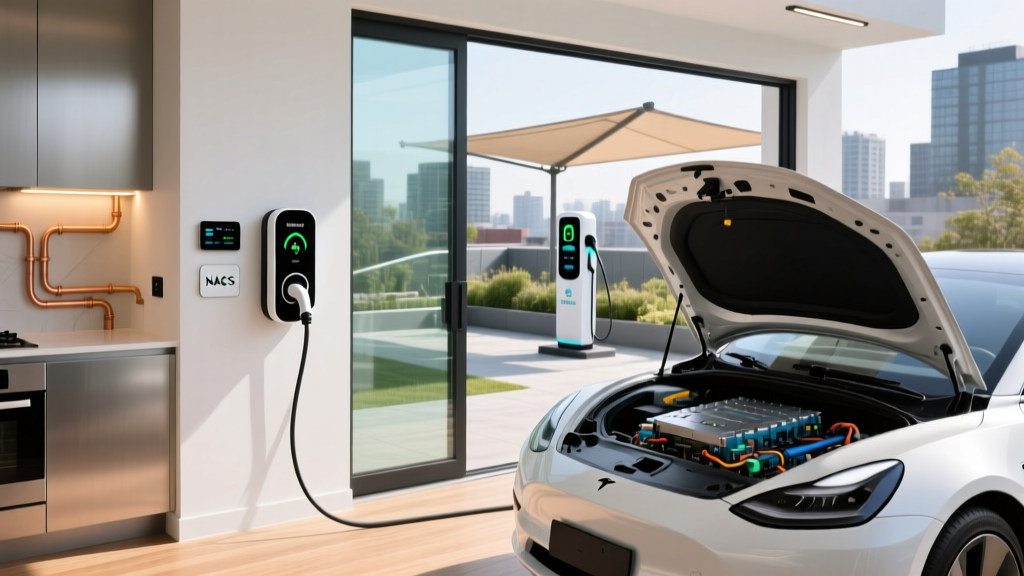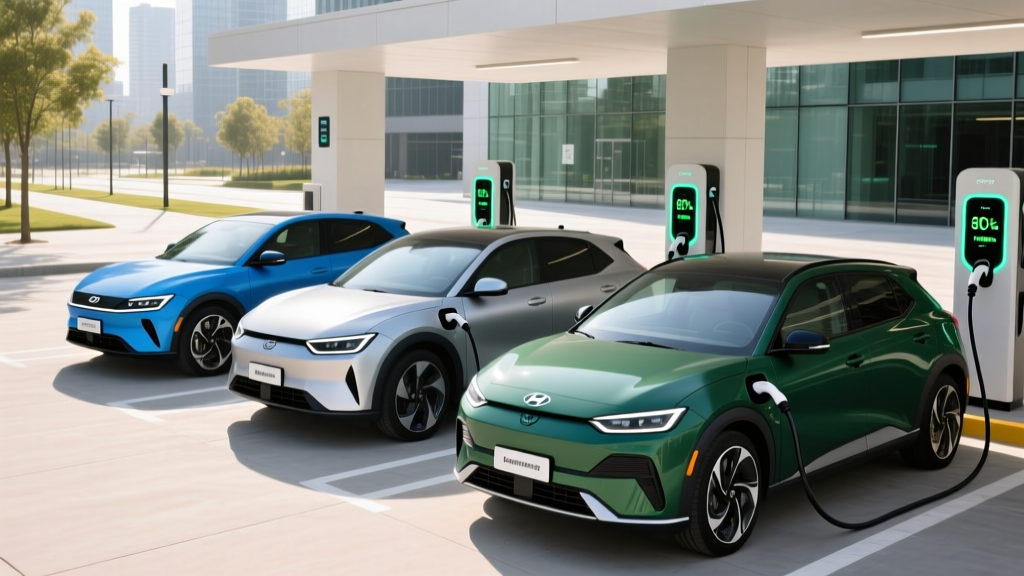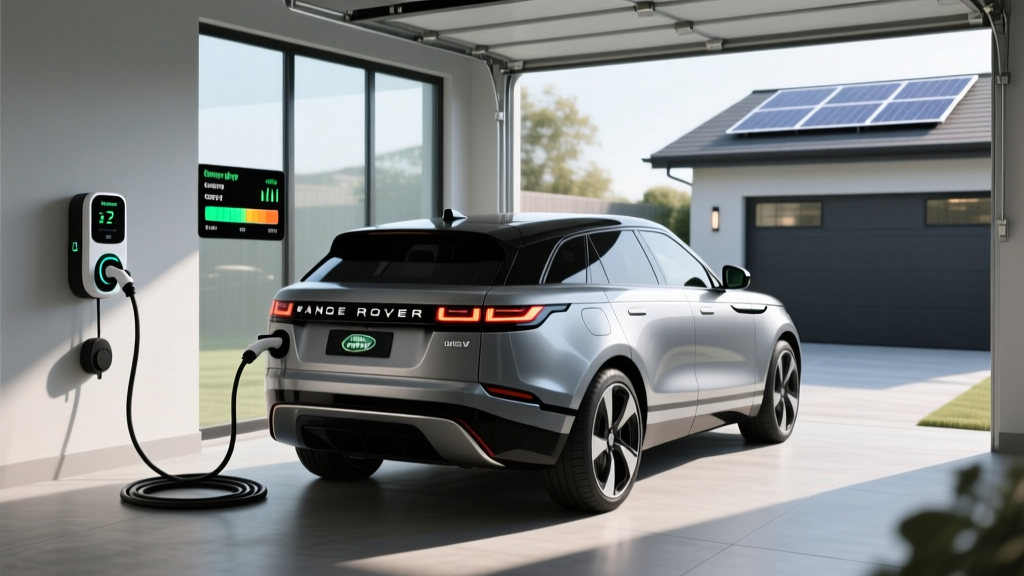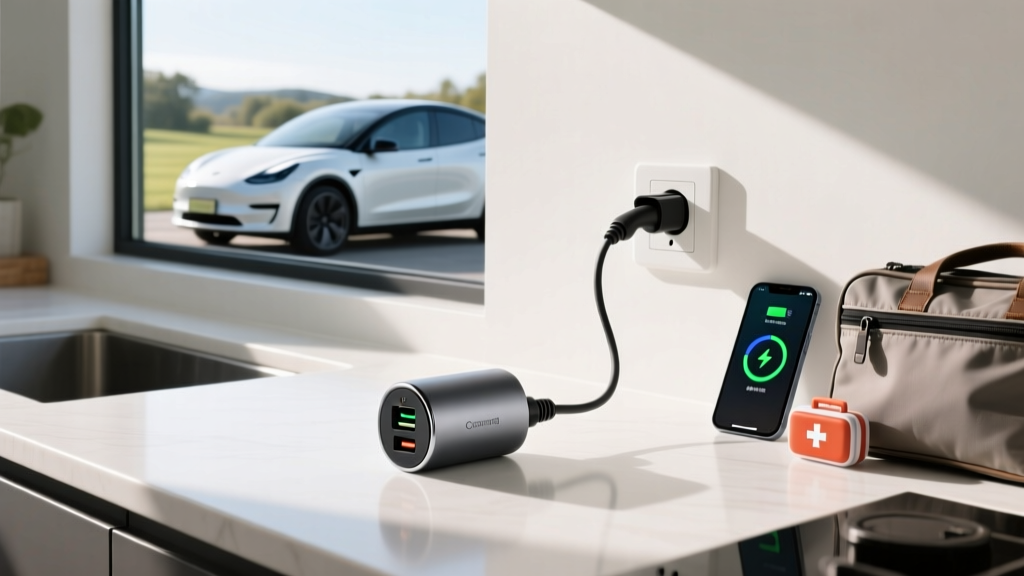
If you own an electric vehicle, you already know that charging infrastructure doesn't always meet you where you are. A portable car charger for electric car use bridges the gap between fixed home stations and sparse public DC fast chargers. These compact units plug into standard 120V outlets for trickle charging or into 240V dryer and RV outlets for meaningful Level 2 speeds — making them indispensable for apartment dwellers, road trippers, and anyone whose daily routine doesn't align with a hardwired wall unit.
This guide covers exactly what portable EV chargers can and can't do, how fast they'll add range at each voltage, what your home electrical system needs to support them, and which 2026 models deliver the best balance of power, safety, and price.
Charging Levels Explained: Speeds in kW and Miles Per Hour
Before comparing portable chargers, you need clarity on the three charging tiers. Power is measured in kW (kilowatts) — the rate at which energy flows. Energy is measured in kWh (kilowatt-hours) — the total capacity of your battery. A 75 kWh battery charged at 7.2 kW takes roughly 10.4 hours from empty to full. Confusing these two units is the single most common EV mistake.
| Level | Voltage / Amps | Power (kW) | Miles of Range Added Per Hour | Typical Use Case |
|---|---|---|---|---|
| Level 1 | 120V / 12A | 1.4 kW | 3–5 mi/hr | Overnight top-ups, emergency trickle |
| Level 2 (portable) | 240V / 24–40A | 5.8–9.6 kW | 18–35 mi/hr | Daily home charging, RV parks, dryer outlets |
| Level 2 (wall unit) | 240V / 40–48A | 9.6–11.5 kW | 30–44 mi/hr | Permanent garage installation |
| DC Fast Charge | 400–800V DC | 50–350 kW | 150–1,200+ mi/hr | Highway road trips, public stations |
Most portable chargers sold today are dual-voltage: they ship with a 120V plug for Level 1 and an interchangeable or included 240V plug (typically NEMA 14-50 or 6-50) for Level 2. At Level 2 on a 240V/32A circuit, you'll recover roughly 25 miles of range per hour — enough to refill a 75 kWh battery from 10–80% in about 6–7 hours, depending on the vehicle's onboard charger acceptance rate.
- Tesla Model 3 (60 kWh usable, LFP): ~5.5 hrs at 7.2 kW portable Level 2; ~38 hrs at Level 1
- Hyundai Ioniq 5 (77.4 kWh usable, NMC): ~7 hrs at 9.6 kW portable Level 2; ~18 min at 240 kW DC fast charger
- Ford F-150 Lightning (131 kWh extended range): ~12 hrs at 9.6 kW portable Level 2; impractical on Level 1 alone
- Chevrolet Equinox EV (85 kWh usable): ~8 hrs at 9.6 kW portable Level 2; ~20 min at 150 kW DCFC
Note: Charging slows significantly above 80% SoC to protect battery health. DC fast charging curves taper from peak kW — a charger rated at 240 kW may only sustain that rate between 10–50% SoC.
Home Electrical Requirements: What Your Panel Can Handle
Running a portable charger at Level 2 demands a dedicated 240V circuit. The most common outlet for portable EV use is the NEMA 14-50, rated for 50 amps but limited to 40 amps continuous draw (the National Electrical Code requires circuits to operate at no more than 80% of their rated capacity for loads lasting three hours or more). That gives you a maximum of 9.6 kW.
Here's what to verify before plugging in:
- Panel capacity: Most modern homes have a 200-amp main panel. Adding a 40A/50A circuit is usually fine if you have spare breaker slots and headroom. Older homes with 100A panels may need an upgrade — a $2,000–$5,000 project.
- Dedicated circuit: EV chargers must have their own breaker. Sharing a circuit with a dryer or oven is a code violation and a fire risk.
- Outlet condition: Many existing dryer outlets are decades old with worn contacts. An electrician should inspect and, if needed, replace the receptacle with an EV-rated unit (Hubbell or Bryant industrial-grade 14-50).
- GFCI protection: The 2020 NEC and later require GFCI protection for 14-50 outlets in garages. Some portable chargers have built-in GFCI, which can conflict with a GFCI breaker and cause nuisance tripping — discuss this with your electrician.
- Outdoor rating: If you're charging in a carport or driveway, the outlet must be in a weatherproof box with an in-use cover rated for wet locations.
Installation Cost Breakdown
Costs vary enormously based on panel-to-outlet distance, local labor rates, and whether your panel needs upgrading. Based on national averages and Department of Energy guidance:
| Item | Simple Install (panel nearby) | Complex Install (long run / sub-panel) | Panel Upgrade Required |
|---|---|---|---|
| Portable charger unit | $200–$600 | $200–$600 | $200–$600 |
| Electrician labor | $300–$600 | $800–$2,000 | $1,200–$2,500 |
| Materials (wire, breaker, conduit) | $100–$300 | $300–$800 | $300–$800 |
| Permit | $50–$150 | $50–$200 | $50–$200 |
| Panel upgrade (100A → 200A) | N/A | N/A | $2,000–$5,000 |
| Total estimated cost | $650–$1,650 | $1,350–$3,600 | $3,750–$9,100 |
The key advantage of a portable charger: if you move, you take it with you. A hardwired wall unit adds resale value to the home but stays behind. For renters or those planning to relocate within a few years, the portable route is economically smarter.
Connector Compatibility: NACS, CCS1, and CHAdeMO
The connector landscape has consolidated significantly. As of the 2025–2026 model years, nearly all new EVs sold in North America use the NACS (North American Charging Standard) connector, originally developed by Tesla. Legacy CCS1 vehicles remain on the road and many portable chargers still ship with CCS1 or offer adapters.
| Connector | Brands Using It (New Vehicles) | Portable Charger Availability | Adapter Needed? |
|---|---|---|---|
| NACS (Tesla standard) | Tesla, Ford, GM, Rivian, Volvo, Polestar, Hyundai, Kia, BMW, Mercedes, Nissan (2025+) | Growing — several models available | CCS1→NACS adapters for older portable units ($100–$200) |
| CCS1 | Legacy models (pre-2025 Ford, GM, VW ID.4, Hyundai Ioniq 5 early years) | Widely available | NACS→CCS1 adapter for newer NACS vehicles (~$150) |
| CHAdeMO | Nissan Leaf (discontinued), Mitsubishi Outlander PHEV | Limited and declining | No practical adapter to NACS/CCS |
When buying a portable charger in 2026, choose the connector that matches your current vehicle. If you own a NACS-equipped EV, buy a NACS portable charger natively rather than relying on adapters, which add bulk and a potential failure point. For CCS1 vehicles, adapter options from Lectron and A2Z are well-reviewed and enable NACS portable chargers to work with your car.
Note: Portable chargers only provide AC Level 1 and Level 2 charging. DC fast charging uses a different protocol and requires large, fixed public stations — no portable DC fast charger exists for consumer use.
Cost to Charge: Portable Charger vs. Public vs. Gas
Charging at home with a portable Level 2 unit is the cheapest way to fuel an EV. Here's how costs stack up across scenarios, using a national average electricity rate and EPA efficiency data:
| Scenario | Rate ($/kWh) | Vehicle Efficiency | Cost Per Mile |
|---|---|---|---|
| Home Level 2 (national avg.) | $0.17/kWh | 3.5 mi/kWh (typical sedan) | $0.049 |
| Home Level 2 (off-peak TOU rate) | $0.08/kWh | 3.5 mi/kWh | $0.023 |
| Home Level 1 (portable, 120V) | $0.17/kWh | 3.5 mi/kWh | $0.049 (slower, same cost) |
| Public Level 2 (ChargePoint, EVgo) | $0.25–$0.49/kWh | 3.5 mi/kWh | $0.071–$0.140 |
| DC Fast Charge (Electrify America, Tesla Supercharger) | $0.35–$0.56/kWh | 3.5 mi/kWh | $0.100–$0.160 |
| Gasoline vehicle (28 MPG combined, $3.40/gal) | — | 28 MPG | $0.121 |
Home charging with a portable Level 2 unit costs roughly one-third to one-half what you'd spend on gasoline per mile. Even DC fast charging on the road is often comparable to or cheaper than gas — though frequent DCFC use erodes the savings advantage. Off-peak time-of-use (TOU) electricity plans from your utility can drop home charging costs to under 3 cents per mile.
Level 1 charging on a portable unit at 120V costs the same per kWh as Level 2 — it just takes dramatically longer. The economics are identical; only the speed differs.
Top Portable EV Chargers for 2026: Equipment Picks
These recommendations prioritize real-world reliability, safety certifications (UL or ETL listed), correct power ratings, and connector availability. All prices are approximate MSRP as of early 2026.
Best Overall: Emporia Level 2 Portable Charger
- Power: Up to 9.6 kW (240V / 40A)
- Connector: NACS or J1772 (CCS1 adapter available)
- Cable length: 24 ft
- Smart features: Wi-Fi, app scheduling, energy monitoring, solar integration
- Plug types: NEMA 14-50 and 5-15 (120V) included
- Safety: UL listed, built-in GFCI
- Price: ~$350
Why it wins: Full 40A output matches most portable use cases, app control for TOU scheduling, and Emporia's ecosystem integrates with their home energy monitor.
Best for Travel: Lectron V-BOX Pro
- Power: Up to 9.6 kW (240V / 40A)
- Connector: NACS native, J1772 with adapter
- Cable length: 21 ft
- Smart features: LCD screen, basic timer, no Wi-Fi
- Plug types: NEMA 14-50 and 5-15 included
- Safety: ETL listed, IP65 outdoor rating
- Price: ~$280
Why it wins: Compact, rugged, and affordable. The IP65 rating means you can safely use it outdoors in rain. No app dependency — just plug and charge.
Best Budget: Tesla Mobile Connector (Gen 2)
- Power: Up to 7.2 kW (240V / 30A) with 14-50 adapter; 1.4 kW on 120V
- Connector: NACS (native Tesla)
- Cable length: 20 ft
- Smart features: None (basic unit); vehicle handles scheduling
- Plug types: 5-15 included; 14-50 adapter sold separately (~$35)
- Safety: UL listed
- Price: ~$200 (unit) + $35 (14-50 adapter) = ~$235
Why it wins: If you drive a Tesla or any NACS-equipped vehicle, this is the cheapest UL-listed option. Limited to 30A / 7.2 kW, which is still ~22 miles of range per hour — adequate for overnight charging.
Safety, Code, and the Panel-Upgrade Reality
Portable chargers are inherently safer than DIY wiring projects — they plug into existing outlets and include built-in ground fault protection. But safety still depends on the outlet and circuit behind the wall.
Critical safety checklist:
- Never use an extension cord with a portable EV charger. The continuous high-amperage draw can overheat undersized cords.
- Verify the outlet is on a dedicated breaker — no shared circuits.
- Check that the receptacle is industrial-grade (Hubbell/Bryant) if it will see daily use. Consumer-grade 14-50 outlets develop loose contacts from repeated plugging and unplugging.
- If charging outdoors, the outlet must be in a NEMA 3R-rated weatherproof enclosure with an in-use cover.
- Inspect the charger's cable regularly for abrasion, cracking, or discoloration at the plug.
- Ensure your charger carries a UL or ETL listing mark — unlisted chargers sold on marketplace sites may lack proper overcurrent and thermal protection.
The panel-upgrade question deserves honesty: if your home has a 100A service and you already run electric heat, an electric dryer, and an electric range, adding a 40A EV circuit may exceed your panel's capacity. A licensed electrician will perform a load calculation per NEC Article 220 to determine if an upgrade is required. Don't skip this step — an overloaded panel is a fire hazard, and your insurance company may deny a claim if unpermitted electrical work caused damage.
For homes that can't accommodate a 40A circuit, many portable chargers allow you to dial down the amperage via a DIP switch or app setting. Running a 32A charger on a 40A breaker (which supports 32A continuous) is a common workaround that still delivers ~7.7 kW — roughly 23 miles of range per hour.
Frequently Asked Questions
How much does it cost to install a home outlet for a portable EV charger?
For a straightforward NEMA 14-50 installation with the panel nearby, expect $650–$1,650 total (electrician, materials, permit, and the charger itself). Complex runs with long wire distances or sub-panel additions push costs to $1,350–$3,600. If your home needs a full panel upgrade from 100A to 200A, total project costs can reach $3,750–$9,100. Always get a licensed electrician's quote — never estimate panel capacity yourself.
How fast will a portable charger add range to my EV?
On a standard 120V outlet (Level 1), a portable charger adds 3–5 miles of range per hour. On a 240V NEMA 14-50 outlet at 40A (Level 2), it adds 25–35 miles per hour depending on the vehicle's efficiency. That means a typical overnight session of 8–10 hours on Level 2 recovers 200–350 miles — more than enough for nearly all daily driving.
Which portable charger connector is compatible with my EV?
For 2025–2026 model-year vehicles from Tesla, Ford, GM, Rivian, Hyundai, Kia, BMW, Volvo, and others, the NACS connector is standard. Older CCS1 vehicles (pre-2025 VW ID.4, early Ioniq 5, Chevy Bolt) need a CCS1 portable charger or a NACS-to-CCS1 adapter. CHAdeMO vehicles (Nissan Leaf) have limited portable charger options. Check your vehicle's charge port or consult fueleconomy.gov for your specific model's connector type.
How much does charging cost per mile compared to gas?
Home Level 2 charging at the national average electricity rate of $0.17/kWh costs about $0.049 per mile for a typical EV getting 3.5 miles per kWh. Gasoline at $3.40/gallon in a 28 MPG vehicle costs $0.121 per mile. Home EV charging is roughly 60% cheaper per mile. Off-peak TOU rates can drop the cost to under $0.03/mile. Public DC fast charging at $0.40–$0.56/kWh narrows the gap to $0.11–$0.16 per mile — comparable to gas.
What electrical upgrades might I need for a portable Level 2 charger?
At minimum, you need a dedicated 240V circuit with a NEMA 14-50 or 6-50 outlet, installed by a licensed electrician with a permit. If your panel lacks spare breaker slots or capacity (common in 100A panels), you may need a panel upgrade to 200A or a load-management device that throttles the charger when other high-draw appliances are running. Homes with existing 240V dryer or RV outlets may be able to use them directly — but have the outlet inspected for wear and proper grounding first.
Can I use a portable charger as my only home charging solution?
Yes — thousands of EV owners do. A portable Level 2 charger on a NEMA 14-50 outlet delivers the same charging speed as many hardwired wall units. The trade-off is that you must plug and unplug each session, and the outlet sees more mechanical wear than a permanently mounted connector. If you own your home and plan to stay, a hardwired wall unit is more convenient. If you rent or may move, portable is the pragmatic choice.
Are portable EV chargers safe for outdoor use?
Units rated IP65 or higher can withstand rain and dust. However, the 240V outlet itself must be in a weatherproof enclosure with an in-use cover. Never leave a charger plugged into an unprotected outdoor outlet during a storm. In cold climates, cables become stiff below freezing — store the unit indoors when not in use to prevent jacket cracking.