Porsche vs Tesla Wireless Charging: Where Things Stand in 2026
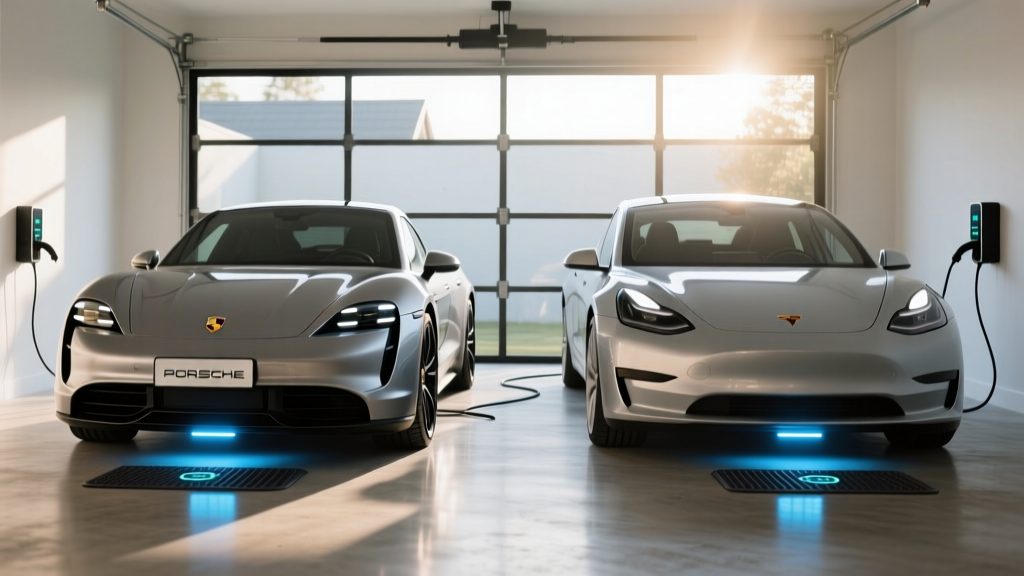
The idea of parking over a pad and walking away — no cables, no connectors, no cold-weather fumbling — has been the EV industry's most persistent "just around the corner" promise. In 2026, that corner is finally being turned, but unevenly. Porsche has begun offering its Wireless Charging System for the Taycan (initially in select European and Asian markets, with a U.S. rollout still pending regulatory approval), while Tesla continues to prioritize its NACS (North American Charging Standard) wired ecosystem and Supercharger network over inductive solutions.
For U.S. buyers weighing a Taycan against a Model S, Model 3, Model Y, or Model X, this creates an asymmetry: Porsche is investing in wireless as a premium convenience feature, while Tesla is doubling down on wired charging speed and network reliability. Neither approach is wrong — they reflect different philosophies about what EV owners actually need.
Porsche's inductive system delivers approximately 11 kW of power transfer with an efficiency rate of roughly 90% — meaning for every 10 kWh pulled from your panel, about 9 kWh reach the Taycan's battery. Tesla's wired Level 2 Wall Connector delivers up to 11.5 kW at ~97% efficiency. That 7-percentage-point gap translates to roughly $15–$25 more per year in electricity for a typical wireless user charging 12,000 miles at home.
How Wireless Charging Actually Works (and Why kW Still Matters)
Inductive EV charging uses two electromagnetic coils — one in a ground-mounted pad, one in a receiver mounted to the vehicle's underside. Alternating current in the ground pad creates a magnetic field that induces current in the vehicle coil, which is then rectified and fed into the traction battery. The physics are identical to a Qi phone charger, just scaled to handle 80–100 kWh battery packs.
The critical metric is power transfer rate in kW (kilowatts), not to be confused with kWh (kilowatt-hours), which measures total energy stored. A higher kW rating means faster charging. Here's the current landscape:
| Level | Power (kW) | Voltage / Amps | Miles of Range Added Per Hour | Typical Use Case |
|---|---|---|---|---|
| Level 1 | 1.4–1.9 kW | 120V / 12–16A | 3–5 mi/hr | Overnight trickle, PHEVs |
| Level 2 (Wired) | 7.2–19.2 kW | 240V / 30–80A | 20–60 mi/hr | Home daily charging |
| Level 2 (Wireless) | 3.6–11 kW | 240V / varies | 12–35 mi/hr | Home convenience (Porsche Taycan) |
| DC Fast Charge | 50–350 kW | 200–800V DC | 150–1,000+ mi/hr | Road trips, public stations |
Porsche's wireless pad operates at the upper end of Level 2 wireless — roughly 11 kW — which adds about 30–35 miles of range per hour to a Taycan (EPA-rated at ~2.8–3.0 mi/kWh depending on trim). For a Taycan 4S with a 93.4 kWh gross battery (~83.7 kWh usable), a full 10–80% wireless session takes approximately 5.5–6 hours. The same session on a wired 11.5 kW Tesla Wall Connector takes about 5 hours.
Neither wireless nor wired Level 2 is suitable for road-trip recovery — that's what DC fast charging is for. The Taycan's 800-volt architecture allows peak DC charging at up to 270 kW, achieving a 10–80% charge in approximately 22–23 minutes under ideal conditions (battery preconditioned, ambient temperature 65–80°F). Tesla's Model Y on V3/V4 Superchargers peaks at 250 kW with a 10–80% time of roughly 20–25 minutes, though real-world sessions often taper earlier due to battery temperature and state-of-charge management.
Home Installation: What Each System Requires
Whether you're installing a Porsche wireless pad or a Tesla Wall Connector, the electrical fundamentals are similar — but the physical installation diverges significantly.
Electrical Requirements
Both systems require a dedicated 240V circuit. The Porsche wireless pad typically draws 40–48 amps, requiring a 50–60 amp dedicated breaker. The Tesla Wall Connector is configurable from 16A to 48A (hardwired) or up to 40A (NEMA 14-50 plug), with most installations using a 60A breaker for 48A continuous draw.
Your home's electrical panel must have sufficient spare capacity. A typical modern home with a 200-amp service panel can usually accommodate a 60A EV circuit without issue. Older homes with 100-amp panels — common in pre-1990 construction — almost always require a panel upgrade to 200A before adding a Level 2 charger, especially if you also run electric heat, an electric dryer, or an electric oven.
Installation Cost Breakdown
| Component | Wired (Tesla Wall Connector) | Wireless (Porsche Pad) |
|---|---|---|
| Equipment | $400–$500 | $3,000–$4,500 (pad + vehicle receiver retrofit if needed) |
| Electrician labor | $500–$1,500 | $800–$2,000 |
| Permit & inspection | $50–$300 | $100–$400 |
| Concrete cutting / pad embedment | N/A | $500–$1,500 |
| Panel upgrade (if needed) | $1,500–$3,500 | $1,500–$3,500 |
| Total (no panel upgrade) | $950–$2,300 | $4,400–$8,400 |
| Total (with panel upgrade) | $2,450–$5,800 | $5,900–$11,900 |
The wireless system's cost premium is substantial — roughly 3–5x more expensive to install than a wired equivalent. That premium buys you convenience (no plug handling) and a cleaner garage aesthetic, but not faster charging.
According to U.S. Department of Energy guidance, approximately 20–30% of older U.S. homes require a panel upgrade before adding a Level 2 charger. This is a $1,500–$3,500 cost that many buyers overlook during purchase planning. Always get an electrician's load calculation before committing to equipment.
Connector Compatibility: NACS, CCS, and the Wireless Wildcard
Wireless charging sidesteps the connector debate entirely — there's no plug to match. But for DC fast charging and backup wired Level 2, connector compatibility remains essential.
| Connector | Brands Using It | Notes |
|---|---|---|
| NACS (Tesla) | Tesla, Ford, GM, Rivian, Volvo, Polestar, Mercedes, BMW, Hyundai, Kia (2025+) | Industry standard as of 2025; native Supercharger access |
| CCS1 | Legacy VW ID.4 (pre-2025), some older BMW, Mini, Jaguar I-PACE | Adapters to NACS widely available (~$200–$250) |
| CHAdeMO | Nissan LEAF (discontinued), Mitsubishi Outlander PHEV (older) | Declining infrastructure; avoid for new purchases |
| Wireless (Inductive) | Porsche Taycan (select markets), BMW iX (pilot programs) | No U.S. standard yet; SAE J2954 governs interoperability |
Porsche's Taycan sold in the U.S. currently uses a CCS1 port for wired charging, though Porsche has signaled a transition to NACS for future model years. If you buy a 2026 Taycan, expect CCS1 with a NACS adapter included or available. Tesla vehicles use NACS natively — no adapter needed for Superchargers or Tesla Wall Connectors.
For wireless charging, the SAE J2954 standard defines interoperability requirements for light-duty vehicle inductive charging. Porsche's system is compliant with J2954 WPT/Z-Class 3 (up to 11 kW), meaning future third-party pads should theoretically work with J2954-equipped vehicles — but the ecosystem is still nascent.
Cost to Charge: Wireless, Wired, and Gas Compared
The economics of EV charging depend heavily on where and when you charge. Here's a realistic cost-per-mile breakdown using a Tesla Model Y Long Range (EPA 310 mi, ~3.5 mi/kWh) and a Porsche Taycan 4S (EPA 246 mi, ~2.8 mi/kWh) as benchmarks:
| Scenario | Price per kWh | Model Y Cost/Mile | Taycan 4S Cost/Mile | Gas Equivalent (30 MPG @ $3.40/gal) |
|---|---|---|---|---|
| Home Level 2 (off-peak TOU) | $0.08–$0.12 | $0.025–$0.037 | $0.031–$0.046 | $0.113 |
| Home Level 2 (standard rate) | $0.14–$0.18 | $0.044–$0.057 | $0.054–$0.070 | $0.113 |
| Home Wireless (10% efficiency loss) | $0.09–$0.13 (effective) | $0.028–$0.041 | $0.035–$0.051 | $0.113 |
| Public Level 2 (ChargePoint, EVgo) | $0.25–$0.49 | $0.079–$0.154 | $0.097–$0.189 | $0.113 |
| DC Fast (Electrify America, Tesla) | $0.30–$0.55 | $0.095–$0.174 | $0.116–$0.213 | $0.113 |
Key takeaways: Home off-peak charging is 3–4x cheaper per mile than gas, even with wireless efficiency losses. Public DC fast charging, however, can exceed the cost of gasoline on a per-mile basis — it's a convenience premium for road trips, not a daily strategy.
The wireless efficiency penalty is real but modest. At national average residential electricity rates of ~$0.16/kWh (per EIA data), the ~10% energy loss in wireless transfer adds roughly $0.003–$0.005 per mile compared to wired charging — about $36–$60 per year for a 12,000-mile driver.
Equipment Recommendations: What to Buy in 2026
Whether you're going wired or wireless, here are the top options by category:
Best Wired: Tesla Wall Connector
- Power: Up to 11.5 kW (48A, 240V hardwired)
- Connector: NACS native; CCS adapter available
- Cable length: 24 ft
- Smart features: Wi-Fi, OTA updates, load sharing (pair two on one circuit), Power Sharing
- Price: ~$475
- Best for: Tesla owners, NACS-equipped vehicles, multi-EV households
Best Universal Wired: ChargePoint Home Flex
- Power: Up to 12 kW (50A, 240V) — configurable down to 16A
- Connector: NACS (J3400) or CCS1 (configurable at purchase)
- Cable length: 23 ft
- Smart features: Wi-Fi, app scheduling, Alexa integration, energy tracking
- Price: ~$550–$650
- Best for: Mixed-brand households, renters who may move
Best Wireless: Porsche Wireless Charging System
- Power: 11 kW (inductive, SAE J2954 compliant)
- Connector: None (pad-to-vehicle inductive coupling)
- Installation: Floor-mounted or embedded pad; requires vehicle receiver
- Smart features: Automatic alignment assist via app, foreign object detection, scheduled charging
- Price: ~$3,000–$4,500 (equipment only; vehicle receiver may be factory-installed or retrofit)
- Best for: Taycan owners prioritizing convenience; garage-only use
- Availability: Limited markets in 2026; U.S. availability TBD
For most U.S. buyers in 2026, a wired Level 2 charger remains the pragmatic choice. The Tesla Wall Connector is the best value if you drive a Tesla or any NACS-equipped vehicle. The ChargePoint Home Flex is the most versatile for multi-brand garages. Wireless charging is a premium add-on that makes sense only if your vehicle supports it natively and you're willing to pay the 3–5x installation premium for daily plug-free convenience.
Safety, Code, and Installation Best Practices
Level 2 EV charging is a continuous high-draw load — the National Electrical Code (NEC) treats it as a continuous load requiring a circuit rated at 125% of the charger's maximum draw. A 48A charger needs a 60A breaker; a 40A charger needs a 50A breaker.
- Dedicated circuit: Your EV charger must be on its own breaker — never share a circuit with other high-draw appliances.
- GFCI protection: NEC 2023 and later require GFCI protection for all EV charging outlets (NEMA 14-50 or similar). Hardwired installations may be exempt depending on local code interpretation — your electrician will advise.
- Outdoor rating: If installing outside, ensure the charger carries a NEMA 4 or NEMA 4X rating for weather resistance. The Tesla Wall Connector and ChargePoint Home Flex are both rated for outdoor use.
- Wire gauge: 6 AWG copper for 50A circuits; 4 AWG for 60A. Aluminum wire requires upsizing. Your electrician handles this, but verify it on the invoice.
- Permit and inspection: Required in virtually all U.S. jurisdictions for new 240V circuits. Permits typically cost $50–$300; inspection ensures the work meets code and protects your home insurance coverage.
- Wireless pad safety: Porsche's system includes foreign object detection (FOD) that shuts down power transfer if metal debris or a living creature is detected between pad and vehicle. The pad surface remains safe to touch and walk on when idle.
Frequently Asked Questions
How much does it cost to install a home EV charger?
A wired Level 2 charger (Tesla Wall Connector or ChargePoint Home Flex) typically costs $950–$2,300 fully installed in a home with adequate panel capacity. If your panel needs upgrading from 100A to 200A, add $1,500–$3,500. A Porsche wireless charging pad installation runs $4,400–$8,400 without a panel upgrade, or $5,900–$11,900 with one.
How fast will each charging level add range?
Level 1 (120V) adds 3–5 miles per hour — adequate only for PHEVs or very low-mileage drivers. Level 2 wired (240V, 48A) adds 30–45 miles per hour for most EVs. Level 2 wireless (11 kW) adds roughly 30–35 miles per hour. DC fast charging (150–350 kW) can add 150–300+ miles in 15–25 minutes, depending on vehicle architecture and battery preconditioning.
Which connector or charger is compatible with my EV?
As of 2026, NACS is the dominant standard in North America, adopted by Tesla, Ford, GM, Rivian, Hyundai, Kia, BMW, Mercedes, and Volvo. CCS1 persists on some legacy models (older VW, Jaguar). CHAdeMO is effectively discontinued. Porsche's Taycan currently uses CCS1 with a NACS adapter available. Wireless charging (SAE J2954) is compatible only with equipped vehicles — currently the Porsche Taycan in select markets and BMW pilot programs.
How much does charging cost per mile vs. gas?
Home off-peak charging costs $0.025–$0.05 per mile for most EVs — roughly 3–4x cheaper than a 30 MPG gas car at $3.40/gallon ($0.113/mile). Standard-rate home charging is still 2–3x cheaper. Public DC fast charging ($0.30–$0.55/kWh) can approach or exceed gas costs per mile, making it a road-trip expense rather than a daily strategy.
What electrical upgrades might I need?
The most common upgrade is a panel replacement from 100A to 200A service, needed in roughly 20–30% of older homes. This costs $1,500–$3,500 and requires a utility disconnect/reconnect. Less commonly, you may need a service drop upgrade (the wire from the utility pole to your meter) if your utility's transformer cannot support the additional load — your electrician will identify this during a load calculation. Some utilities offer make-ready programs that cover panel upgrade costs for EV adopters — check with your local provider.
Is wireless charging safe in rain, snow, or if a pet walks over the pad?
Yes. SAE J2954-compliant pads like Porsche's are sealed to IP68 standards (submersible) and include foreign object detection that halts power transfer if metal objects or living creatures are detected between the pad and vehicle receiver. The pad surface does not become energized or hot during standby. Snow or standing water between pad and vehicle may reduce efficiency slightly but does not create a safety hazard.
Can I use the federal tax credit for a home charger installation?
The IRS §30C Alternative Fuel Vehicle Refueling Property Credit covers 30% of home charging equipment and installation costs, up to $1,000. This applies to both wired and wireless chargers. Eligibility depends on your census tract meeting certain low-income or non-urban criteria — check the IRS website or consult a tax professional for your specific situation. This credit is separate from the §30D vehicle purchase credit.