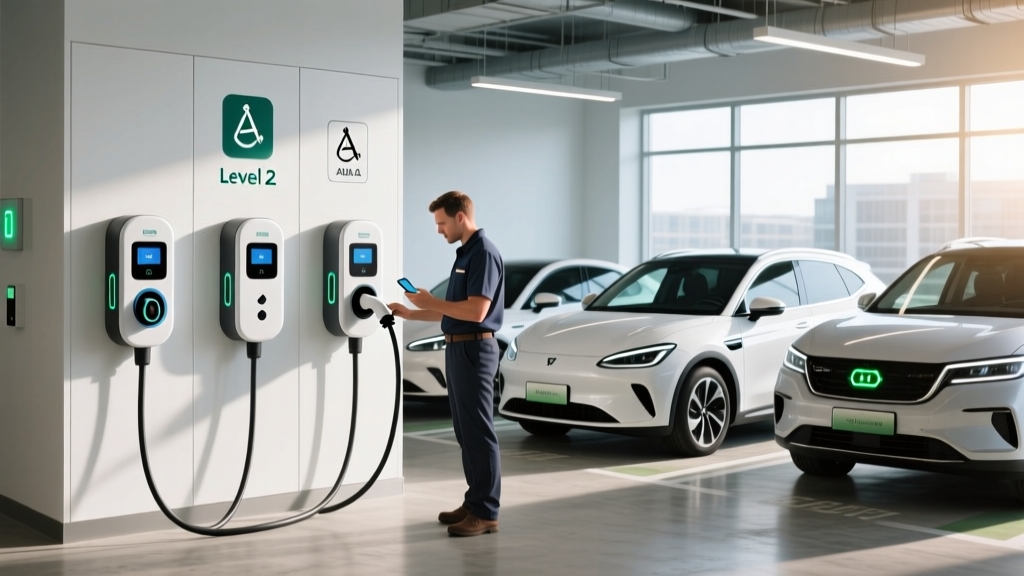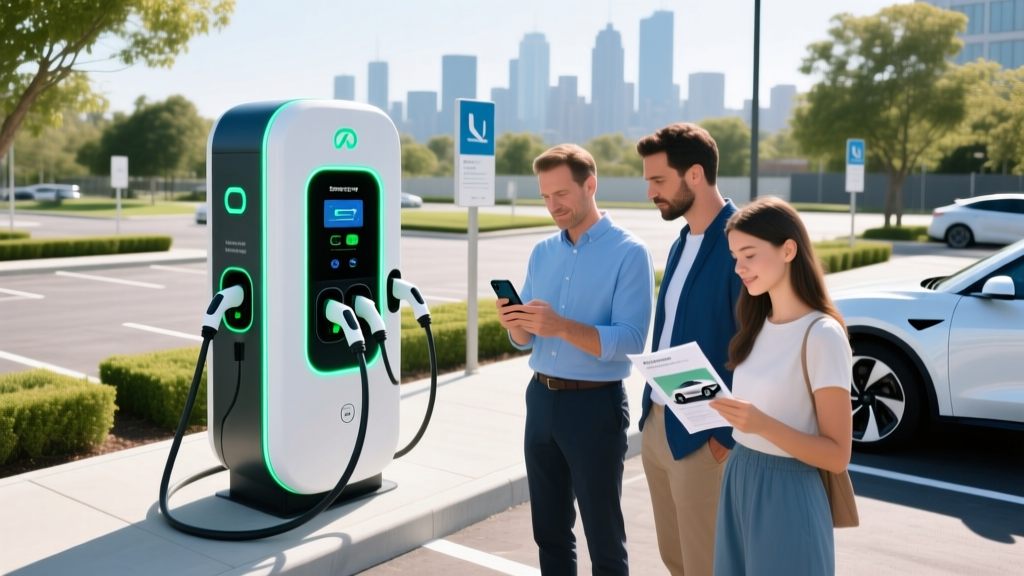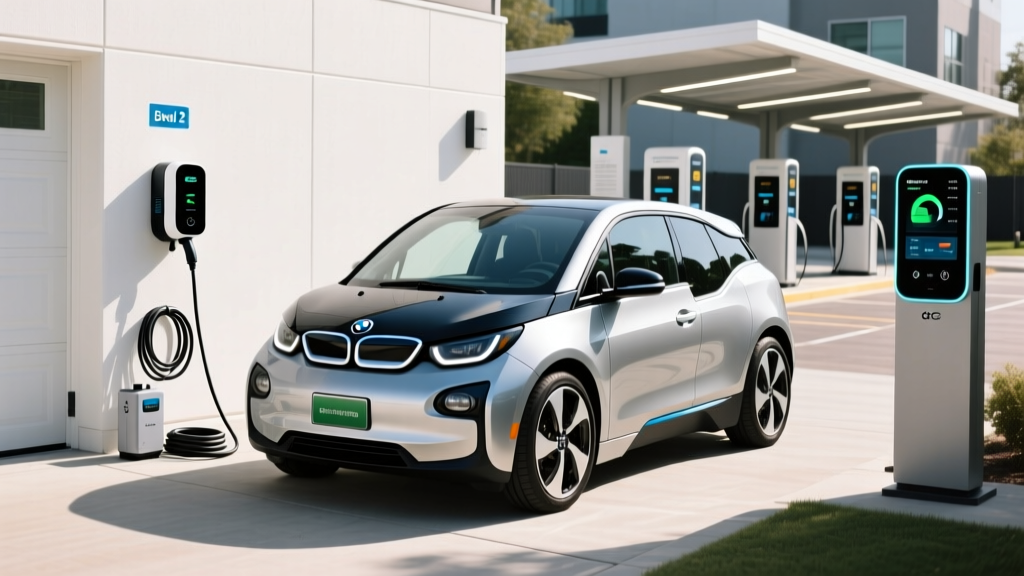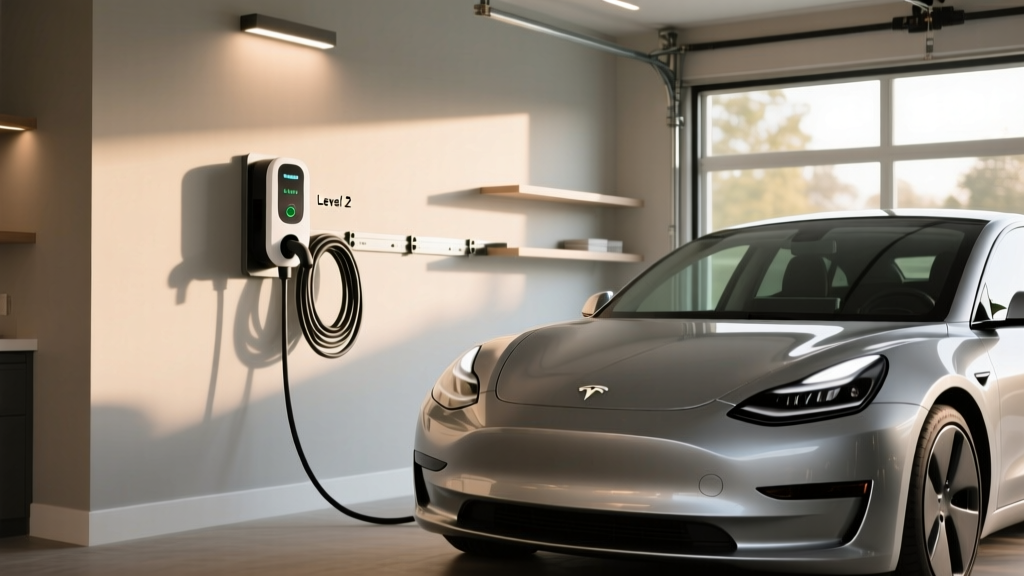
If you've been shopping for a home Level 2 EV charger, you've likely encountered the term "charger drop top" — a cable-management design where the charging connector docks into a top-mounted holster, letting the cable drop naturally into a coiled resting position below. It sounds like a minor detail, but when you're plugging in nightly in a cramped garage or an exposed carport, the difference between a well-managed drop-top system and a cable slung over a hook is enormous. This guide walks through every layer of home EV charging — from the electrical panel to the plug in your car's charge port — with the exact numbers, costs, and equipment you need to make a sound decision in 2026.
Charging Levels Explained: Speeds, Power, and Real-World Range Added
The first thing every EV owner must internalize: kW (kilowatts) measures power — the rate at which energy flows — while kWh (kilowatt-hours) measures energy — the total amount stored in your battery. A charger's kW rating tells you how fast it can deliver energy; your battery's kWh capacity tells you how much it holds. Confusing the two is the single most common EV literacy mistake.
Here's how the three charging levels break down in real-world terms:
| Level | Voltage | Power (kW) | Miles of Range Added Per Hour | Best For |
|---|---|---|---|---|
| Level 1 | 120V AC | 1.0–1.4 kW | 3–5 miles | Overnight top-ups, PHEVs, low-mileage drivers |
| Level 2 | 240V AC | 3.3–19.2 kW | 12–75 miles | Daily home charging, most BEV owners |
| DC Fast Charge | 400–900V DC | 50–350 kW | 150–1,000+ miles (equivalent rate) | Road trips, quick top-ups away from home |
A few real-world caveats: those "miles per hour" figures assume average efficiency (~3–4 mi/kWh for a mid-size crossover like the Hyundai Ioniq 5 or Tesla Model Y). Heavier vehicles like the Ford F-150 Lightning or Rivian R1T will see fewer miles per kWh. And DC fast-charging rates represent peak power — the charge curve tapers significantly above 80% state of charge to protect battery health, so a 250 kW peak rarely averages above 120–150 kW across a full 10–80% session.
- 60 kWh battery (e.g., Chevrolet Equinox EV): ~8 hrs at 7.2 kW Level 2; ~25 min at 150 kW DCFC
- 82 kWh battery (e.g., Tesla Model Y Long Range): ~11 hrs at 7.2 kW; ~10 hrs at 11.5 kW; ~22 min at 250 kW DCFC
- 100 kWh battery (e.g., Ford F-150 Lightning Extended): ~14 hrs at 7.2 kW; ~5.5 hrs at 19.2 kW; ~28 min at 350 kW DCFC (with preconditioning)
Home Electrical Requirements: What Your Panel Needs to Support
Most Level 2 home chargers run on a 240-volt dedicated circuit — the same voltage as your electric dryer or oven. The amperage determines how fast you can charge:
- 20A circuit → 16A continuous draw → ~3.8 kW → ~15 mi/hr
- 30A circuit → 24A continuous → ~5.8 kW → ~22 mi/hr
- 40A circuit → 32A continuous → ~7.7 kW → ~30 mi/hr
- 50A circuit → 40A continuous → ~9.6 kW → ~37 mi/hr
- 60A circuit → 48A continuous → ~11.5 kW → ~44 mi/hr
- 100A circuit → 80A continuous → ~19.2 kW → ~75 mi/hr (requires significant panel capacity)
The National Electrical Code (NEC) requires that continuous loads (anything running 3+ hours, which includes EV charging) use only 80% of a circuit's rated capacity. So a 40A breaker supports 32A of continuous charging. This isn't optional — it's code, and your inspector will check.
Panel capacity check: Most homes built after 1990 have a 200A main service panel. A 60A EV circuit consumes a meaningful chunk of that. If your panel is already loaded with electric HVAC, a tankless water heater, an electric range, and a dryer, adding a 60A EV circuit may push you over the safe 80% continuous-load threshold for the whole panel. A licensed electrician will perform a load calculation per NEC Article 220 to determine if your panel can handle it or if you need an upgrade.
Panel upgrade reality: Upgrading from a 100A or 150A service to a 200A panel typically costs $1,500–$4,000 depending on your utility, local labor rates, and whether new service conductors are needed. In older homes (pre-1980), this is a common surprise cost. Some homeowners opt for a smart load-management device like the Emporia Smart Load Center or a charger with built-in load sharing (e.g., Enel X JuiceBox with EMS), which dynamically reduces charging amperage when other heavy loads are running — potentially avoiding a panel upgrade entirely.
Installation Cost Breakdown: Equipment, Electrician, and Permits
The single most common question from new EV buyers: How much does it cost to install a home EV charger? The honest answer spans a wide range depending on your home's electrical infrastructure, the charger you choose, and local labor rates.
| Component | Simple Install (Panel Nearby) | Complex Install (Long Run / Panel Upgrade) |
|---|---|---|
| Level 2 Charger (hardware) | $350–$700 | $500–$1,200 |
| Electrician labor (2–4 hrs simple; 6–12 hrs complex) | $300–$800 | $1,000–$3,000 |
| Electrical materials (conduit, wire, breaker) | $50–$200 | $200–$800 |
| Permit and inspection | $50–$200 | $50–$300 |
| Panel upgrade (if needed) | $0 | $1,500–$4,000 |
| Total Range | $700–$1,900 | $3,250–$9,300 |
The biggest cost variables are wire run length (how far the charger is from your panel — longer runs mean thicker, more expensive copper and more conduit) and panel capacity. If your garage is directly adjacent to your main panel and you have spare capacity, a simple install with a 40A or 50A circuit can be completed in under half a day for well under $1,500 total.
Federal incentive note: The §30C Alternative Fuel Vehicle Refueling Property Credit offers up to $1,000 for home charging equipment and installation costs (30% of cost, capped at $1,000 for residential). Eligibility depends on your census tract meeting certain criteria. Check current rules at irs.gov and consult a tax professional — eligibility varies by location and income.
Connector Compatibility: NACS, CCS, and CHAdeMO in 2026
The connector landscape has shifted dramatically. As of 2026, the North American Charging Standard (NACS) — originally developed by Tesla — has become the dominant connector for new EVs in North America. Here's where things stand:
| Connector | Brands Using It (New Vehicles) | Notes |
|---|---|---|
| NACS (native) | Tesla (all), Ford (2025+), GM (2025+), Rivian, Volvo, Polestar, Nissan (2025+), Fisker, Lucid | Access to Tesla Supercharger network natively; smaller, lighter connector |
| CCS1 | Hyundai/Kia (transitioning), Stellantis brands, some legacy VW/Audi models | Still widely supported at public DCFC; adapters available for Supercharger access |
| CHAdeMO | Nissan Leaf (legacy), Mitsubishi Outlander PHEV (legacy) | Being phased out; very few new vehicles use it |
For home Level 2 charging, the situation is simpler: all Level 2 chargers sold in North America use a J1772 connector for non-Tesla vehicles. Tesla vehicles use a proprietary connector (now standardized as NACS) but include a J1772-to-Tesla adapter in the glovebox, or you can buy a Tesla Wall Connector with the native NACS plug.
Adapter considerations: If you drive a CCS-equipped vehicle but want access to the Tesla Supercharger network (now open to non-Tesla EVs at many locations), you'll need a CCS-to-NACS adapter — typically $150–$250 from Tesla or third-party suppliers like Lectron or A2Z. For home charging, the included J1772 adapter is usually sufficient.
The Charger Drop-Top Design: Why Cable Management Matters
Now to the feature that gives this guide its name. A charger drop-top (or top-dock holster) design mounts the connector holster at the top of the charger unit or on a wall bracket above the unit. When you unplug from your car, the connector slots into the top holster, and the cable hangs down in a controlled loop — usually guided by a cable-management arm or channel below.
Why does this matter?
- Safety: A cable draped across a garage floor is a tripping hazard, can be run over, and collects dirt and moisture that degrade the connector pins over time.
- Connector longevity: The J1772/NACS connector is rated for 10,000+ mating cycles, but physical damage from being stepped on or crushed is the most common failure mode — not electrical wear.
- Ease of use: A drop-top holster positions the connector at chest height, so you grab it, plug in, and release — no bending, no untangling.
- Aesthetics: In a visible carport or attached garage, clean cable management keeps the installation looking intentional rather than improvised.
Several leading chargers incorporate drop-top or top-dock holster designs. When choosing, look for a holster that securely retains the connector (magnetic or friction-lock), positions the cable exit downward, and includes an integrated cable-management channel or wrap post below the unit.
Equipment Picks: Recommended Level 2 Chargers with Drop-Top or Clean Cable Management
Here are five chargers that pair strong electrical performance with thoughtful cable management — including drop-top holster designs and integrated cable organizers. All prices reflect typical 2026 retail.
ChargePoint Home Flex (NACS or J1772)
- Power: Up to 12 kW (50A) — adjustable via dip switches down to 16A
- Connector: Available in J1772 or native NACS (2025+ refresh)
- Cable length: 23 feet
- Smart features: Wi-Fi, app scheduling, Alexa/Google integration, energy tracking
- Cable management: Top-mount holster with integrated cable wrap channel
- Price: ~$550–$700
- UL listed: Yes; NEMA 4 outdoor rated
Tesla Wall Connector (NACS native)
- Power: Up to 11.5 kW (48A)
- Connector: Native NACS — no adapter needed for Tesla or NACS-equipped vehicles
- Cable length: 24 feet
- Smart features: Wi-Fi, OTA updates, Power Sharing (link up to 6 units on one circuit), access control
- Cable management: Slim integrated holster with cable organizer clip
- Price: ~$425–$475
- UL listed: Yes; indoor/outdoor rated
Emporia Level 2 Smart Charger
- Power: Up to 11.5 kW (48A)
- Connector: J1772 (NACS adapter available)
- Cable length: 24 feet
- Smart features: Wi-Fi, real-time energy monitoring (pairs with Emporia Vue panel monitor), solar-aware charging, load management
- Cable management: Top-dock holster with lower cable wrap post
- Price: ~$400–$500
- UL listed: Yes; NEMA 4 outdoor rated
Enel X JuiceBox 48 (Discontinued) / JuiceBox Pro (2025+)
- Power: Up to 11.5 kW (48A)
- Connector: J1772 or NACS
- Cable length: 25 feet
- Smart features: Wi-Fi, app control, built-in load management for multi-charger setups
- Cable management: Side holster with integrated cable-management arm
- Price: ~$450–$650
- UL listed: Yes
Grizzl-E Smart (United Chargers)
- Power: Up to 10 kW (40A)
- Connector: J1772 (NACS version available)
- Cable length: 24 feet (premium cable rated to -40°F)
- Smart features: Wi-Fi, OCPP compatibility, adjustable amperage
- Cable management: Top-mount holster; rugged aluminum enclosure
- Price: ~$400–$550
- UL listed: Yes; NEMA 4X (extreme outdoor rated, -40°F to +122°F)
Cost to Charge: Home vs. Public vs. Gas — The Per-Mile Math
The economic case for home charging is overwhelming when you run the numbers. Here's how charging costs compare across scenarios, using a mid-size EV averaging 3.5 miles per kWh (representative of a Model Y or Ioniq 5):
| Charging Scenario | Cost per kWh | Cost per Mile (at 3.5 mi/kWh) | Annual Cost (12,000 mi) |
|---|---|---|---|
| Home (national avg electricity, ~$0.16/kWh) | $0.16 | $0.046 | $552 |
| Home (off-peak TOU rate, ~$0.08/kWh) | $0.08 | $0.023 | $276 |
| Public Level 2 (network pricing) | $0.25–$0.49 | $0.07–$0.14 | $840–$1,680 |
| DC Fast Charge (public, ~$0.40–$0.60/kWh) | $0.48 (avg) | $0.137 | $1,644 |
| Gas car (28 MPG combined, $3.40/gal) | — | $0.121 | $1,457 |
The takeaway: home charging on an off-peak rate saves roughly $1,100–$1,200 per year compared to a comparable gas vehicle. Even at standard residential rates, you save ~$900/year. Public DC fast charging, however, can actually exceed the cost of gasoline — which is why exclusive reliance on public fast charging erodes the EV cost advantage. For the best economics, home Level 2 charging should cover 90%+ of your charging needs.
Time-of-use (TOU) tip: Many utilities offer EV-specific TOU rates that drop electricity to $0.05–$0.10/kWh overnight (typically 11 PM–6 AM). Pair this with your charger's scheduled-charging feature to maximize savings. Some utilities (PG&E, SCE, Xcel Energy) offer dedicated EV rate plans with super-off-peak rates as low as $0.05/kWh.
Safety, Code, and Installation Best Practices
A proper home EV charger installation isn't just about getting power to the plug — it must meet electrical code and safety standards. Here's what your electrician should address:
- Dedicated circuit: Your Level 2 charger must be on its own dedicated breaker — no sharing with other outlets or appliances. This prevents overloads and nuisance tripping.
- GFCI protection: NEC 2020 and later require GFCI (ground-fault circuit interrupter) protection for all EV charging outlets. Hardwired chargers often include built-in GFCI; receptacle-based installs need a GFCI breaker. Note: some jurisdictions have issued clarifications on GFCI requirements for hardwired EVSE — your electrician will know local amendments.
- NEMA rating: If your charger is installed outdoors or in an unconditioned garage, it should be rated at least NEMA 4 (weatherproof, protects against splashing water and ice). NEMA 4X adds corrosion resistance for coastal or salted-road environments.
- Wire gauge: Proper wire sizing is critical. A 60A circuit typically requires 6 AWG copper (or 4 AWG aluminum); a 40A circuit needs 8 AWG copper. Undersized wire creates a fire hazard. Your electrician sizes this per NEC Table 310.16.
- Permit and inspection: Virtually all jurisdictions require a permit for a new 240V circuit. The inspection verifies wire gauge, breaker sizing, grounding, GFCI, and mounting. Skipping the permit risks insurance denial if a fire occurs and can complicate home resale.
- Surge protection: While not universally required by code, a whole-panel surge protective device (SPD) is increasingly recommended — especially in areas with frequent lightning or unstable grid power. Cost: $150–$300 installed.
Hardwired vs. plug-in: Many Level 2 chargers are available in both hardwired and NEMA 14-50 plug-in versions. Hardwired installs eliminate the receptacle as a potential failure point (loose 14-50 outlets are a known fire risk if not installed to commercial-grade torque specs), allow higher amperage (above 50A requires hardwiring per code), and provide a cleaner look. Plug-in offers portability — useful if you may move or want to take the charger to a new home. If you choose plug-in, specify a commercial-grade NEMA 14-50R receptacle (Hubbell, Bryant) rather than a residential-grade unit.
Frequently Asked Questions
How much does it cost to install a home EV charger?
A straightforward Level 2 installation (panel has capacity, short wire run, no panel upgrade) typically costs $700–$1,900 including the charger, electrician, materials, and permit. Complex installs requiring long conduit runs or a panel upgrade can range from $3,200–$9,300+. The federal §30C credit may offset up to $1,000 of the cost if you're in an eligible census tract.
How fast will each charging level add range?
Level 1 (120V) adds roughly 3–5 miles per hour — adequate for PHEVs with small batteries. Level 2 (240V) adds 12–75 miles per hour depending on amperage (3.3–19.2 kW). DC fast charging adds the equivalent of 150–1,000+ miles per hour at peak rates, though real-world 10–80% sessions typically take 18–35 minutes depending on battery size and charger power.
Which connector is compatible with my EV?
For home Level 2 charging, all EVs accept a J1772 connector — Tesla vehicles use an included adapter. For DC fast charging, 2026 model-year vehicles use either NACS (Tesla, Ford, GM, Rivian, Volvo, Polestar, Nissan) or CCS1 (Hyundai, Kia, Stellantis, VW). CHAdeMO is limited to legacy Nissan Leaf and Mitsubishi models. Check your vehicle's charge port or owner's manual to confirm.
How much does EV charging cost per mile vs. gas?
At the national average residential electricity rate (~$0.16/kWh), an EV averaging 3.5 mi/kWh costs about $0.046/mile — roughly one-third the cost of a 28 MPG gas car at $3.40/gallon ($0.121/mile). Off-peak TOU rates can drop EV fueling to under $0.025/mile. Public DC fast charging ($0.40–$0.60/kWh) can approach or exceed gas costs.
What electrical upgrades might I need?
The most common upgrade is a panel capacity increase (from 100A or 150A to 200A), costing $1,500–$4,000. Other potential needs: replacing a Federal Pacific or Zinsco panel (known fire hazards, ~$2,000–$4,000 to replace), adding a sub-panel in a detached garage ($800–$2,000), or upgrading service conductors from the utility. A smart load-management system can sometimes avoid a panel upgrade by dynamically sharing capacity between the EV charger and other heavy loads.
Is a charger drop-top holster necessary?
It's not required by code, but it's strongly recommended for safety and equipment longevity. A top-dock holster keeps the connector off the floor, prevents tripping hazards, reduces connector damage from being stepped on or driven over, and makes nightly plug-in easier. Budget $0–$50 extra if your chosen charger doesn't include one — aftermarket universal holsters are widely available.
Can I install a Level 2 charger myself?
If you're experienced with electrical work, you can mount the unit and run conduit, but the final circuit connection and breaker installation should be done (or at minimum inspected) by a licensed electrician. Most jurisdictions require a permit and inspection, and DIY electrical work without a permit can void home insurance coverage in the event of a fire. The labor cost ($300–$800 for a simple install) is worth the liability protection and code compliance.