If you own a Porsche Taycan or are considering one, you've likely asked: can Porsche use Tesla Supercharger stations? The short answer is yes — but with important caveats around adapters, charging speeds, and connector compatibility that every Taycan owner needs to understand before plugging in.
Porsche's EV lineup, anchored by the Taycan (and the upcoming all-electric Macan EV), was originally built around the CCS1 connector standard. Tesla's Supercharger network, the largest and most reliable DC fast-charging network in North America, historically used a proprietary connector. But the industry-wide shift to the North American Charging Standard (NACS) has changed the landscape significantly for 2025 and 2026 model-year vehicles.
The Short Answer: Porsche and Tesla Supercharger Compatibility
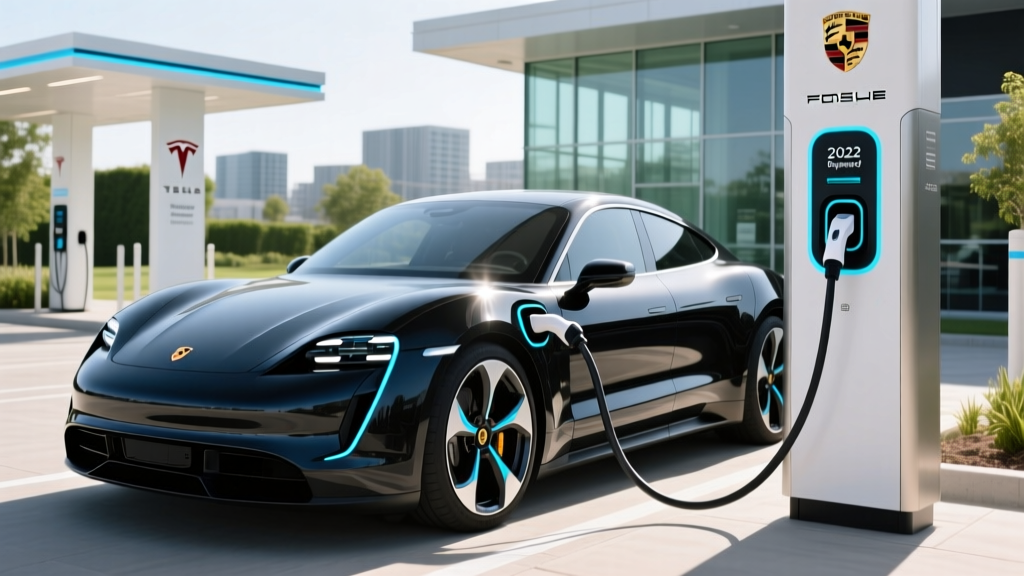
As of 2026, Porsche Taycan owners can access Tesla Supercharger stations using a CCS-to-NACS adapter. Porsche has officially supported NACS adapter compatibility, and Tesla has opened select Supercharger stalls to non-Tesla EVs through its "Magic Dock" integrated adapter system and through third-party adapter partnerships.
However, there are critical details that affect your actual charging experience:
- Adapter requirement: Model-year 2024 and earlier Taycans ship with a CCS1 port and require a NACS-to-CCS adapter (such as the official Porsche-approved adapter or a certified third-party option like the Lectron or A2Z NACS adapter, typically $150–$250).
- 2025+ Taycan models: Porsche began transitioning to the native NACS port starting with the 2025 model year refresh, meaning newer Taycans can plug directly into Superchargers without an adapter.
- Charging speed limitations: Even when connected, the Taycan's 800-volt architecture and the Supercharger's power delivery must align. The Taycan can accept up to 270 kW on compatible chargers, but many Supercharger V3 stalls peak at 250 kW, and the adapter adds a slight overhead that may reduce sustained throughput.
- Station access: Not every Supercharger location has been opened to non-Tesla vehicles. Use the Tesla app or in-car navigation to confirm a stall supports "Charge Other Vehicles" before routing there.
| Model / Year | Native Port | Tesla Supercharger (NACS) | CCS1 Stations | Adapter Needed? |
|---|---|---|---|---|
| Taycan 2020–2024 | CCS1 | Yes (via adapter) | Yes (native) | NACS-to-CCS adapter |
| Taycan 2025–2026 | NACS | Yes (native) | Yes (via CCS adapter) | CCS-to-NACS adapter (for non-Tesla DCFC) |
| Macan EV 2025–2026 | NACS | Yes (native) | Yes (via CCS adapter) | CCS-to-NACS adapter (for non-Tesla DCFC) |
Understanding EV Charging Levels: What Every Porsche Owner Needs
Before we get into costs and installation, it's essential to understand the three charging levels and how they translate to real-world range added. A common mistake is confusing kW (kilowatts), which measures the rate of power delivery, with kWh (kilowatt-hours), which measures total energy stored in the battery. Think of kW as the flow rate of a hose and kWh as the size of the bucket.
| Level | Voltage | Power (kW) | Miles of Range Added/Hour | Best For |
|---|---|---|---|---|
| Level 1 | 120V AC | 1.0–1.9 kW | 3–5 miles | Overnight trickle, PHEVs, emergencies |
| Level 2 | 240V AC | 3.3–19.2 kW | 12–75 miles | Daily home charging, workplace |
| DC Fast Charging | 400–900V DC | 50–350 kW | 150–600+ miles/hour equivalent | Road trips, rapid top-ups |
For the Taycan, which carries a usable battery of approximately 84 kWh (Performance Battery) or 105 kWh (Performance Battery Plus, 2025+ refresh), here's what charging times look like in practice:
- Level 1 (120V, 12A): A full 10–80% charge would take approximately 4–5 days. Effectively unusable for a daily-driver BEV.
- Level 2 (240V, 48A / 11.5 kW): 10–80% in roughly 5.5–7 hours, depending on battery size. Ideal for overnight charging.
- Level 2 (240V, 80A / 19.2 kW — Taycan's onboard charger max): 10–80% in approximately 3.5–4.5 hours. The Taycan's optional 19.2 kW onboard AC charger is among the fastest in the industry.
- DC Fast Charge (270 kW peak, CCS or NACS): 10–80% in approximately 22–23 minutes on a compatible 350 kW charger (e.g., Electrify America). On a Tesla V3 Supercharger (250 kW), expect 10–80% in roughly 24–28 minutes.
Real-world charging curve reality: The Taycan's 800-volt architecture delivers an impressively flat charge curve compared to 400V competitors. It can sustain above 200 kW well past 50% SoC, which is why its 10–80% time is competitive even though its peak kW isn't the industry's highest. However, charging slows significantly above 80% — plan your road-trip stops to 80%, not 100%.
Home Charger Installation: Electrical Requirements and Costs
Most Porsche owners will want a Level 2 home charger for daily use. The Taycan's large battery (84–105 kWh usable) makes Level 2 essential — Level 1 simply cannot replenish meaningful range overnight.
Electrical Requirements
A proper Level 2 installation for a Taycan requires:
- Circuit: A dedicated 240V circuit. For a 48A charger (most common), you need a 60A breaker (NEC code requires the circuit be rated 125% of the continuous load: 48A × 1.25 = 60A).
- For max-speed 80A charging: A 100A breaker and appropriately sized wire (typically 3 AWG copper or 1 AWG aluminum). This unlocks the Taycan's full 19.2 kW onboard charger capability.
- Wire gauge: 6 AWG copper for 48A circuits; 3 AWG copper for 80A circuits.
- Panel capacity: Your home's electrical panel must have sufficient spare amperage. Most modern 200A panels can accommodate a 60A EV circuit, but older 100A or 150A panels may require an upgrade.
Panel Upgrade: The Hidden Cost
If your home has a 100A main panel (common in pre-1990 construction), adding a 60A EV circuit may exceed your panel's capacity, especially if you have electric HVAC, an electric range, and an electric dryer. A panel upgrade to 200A typically costs $1,500–$3,500 including permits and utility coordination. In rare cases, a service upgrade from the utility (new transformer or drop) may add $500–$2,000.
Alternatives to a full panel upgrade include:
- Load management devices: Systems like the Emporia Smart Load Management or Span panel can dynamically share amperage between your EV charger and other appliances, avoiding a panel upgrade.
- Lower-amperage circuit: Installing a 32A or 40A charger on a smaller breaker reduces panel demand while still adding 20–30 miles of range per hour — sufficient for most daily driving.
| Component | Low Estimate | High Estimate | Notes |
|---|---|---|---|
| Level 2 Charger (hardware) | $350 | $750 | 48A smart charger; 80A units $600–$900 |
| Electrician labor (standard install) | $500 | $1,500 | Depends on run length from panel to garage |
| Permit and inspection | $50 | $250 | Varies by municipality |
| Conduit, wire, breaker | $100 | $400 | Longer runs and 80A circuits cost more |
| Panel upgrade (if needed) | $1,500 | $3,500 | 100A to 200A service upgrade |
| Total (no panel upgrade) | $1,000 | $2,900 | Most common scenario |
| Total (with panel upgrade) | $2,500 | $6,400 | Older homes |
Safety and Code Considerations
Every Level 2 installation must comply with the National Electrical Code (NEC) and local amendments:
- Dedicated circuit: Your EV charger must be on its own breaker — no sharing with other outlets or appliances.
- GFCI protection: NEC 2020 and later requires GFCI (Ground Fault Circuit Interrupter) protection for all EV charging outlets. Hardwired chargers typically have GFCI built in; receptacle-based installations need a GFCI breaker.
- Outdoor rating: If your charger is installed outdoors (driveway, carport), it must carry a NEMA 4 or IP65 weatherproof rating. All major chargers listed below meet this standard.
- Receptacle vs. hardwired: A NEMA 14-60 receptacle offers portability (take the charger when you move) but requires GFCI breaker and is limited to 48A. Hardwired installations support up to 80A and avoid GFCI nuisance trips.
Recommended Home Chargers for Porsche Taycan
Given the Taycan's available 19.2 kW onboard charger (standard on most 2022+ trims, optional on earlier models), investing in a high-amperage Level 2 unit maximizes your overnight charging speed. Here are top picks:
ChargePoint Home Flex
- Power: Up to 12 kW (50A) on 60A circuit; configurable down to 16A
- Connector: NACS (2025+ models) or J1772 (older stock)
- Cable length: 23 feet
- Smart features: Wi-Fi, app scheduling, Alexa integration, energy reporting
- Price: ~$450–$550
- Best for: Flexible amperage, strong app, widely available
Tesla Wall Connector (Gen 3)
- Power: Up to 11.5 kW (48A) on 60A circuit
- Connector: NACS native
- Cable length: 24 feet
- Smart features: Wi-Fi, OTA updates, power sharing (link multiple units), access control
- Price: ~$420
- Best for: NACS-native Porsches (2025+), Tesla households, clean design
FLO Home X8
- Power: Up to 19.2 kW (80A) on 100A circuit
- Connector: J1772 (NACS adapter available)
- Cable length: 25 feet
- Smart features: Wi-Fi, app, load sharing, rugged aluminum enclosure
- Price: ~$750–$850
- Best for: Taycan owners wanting max 19.2 kW AC charging speed
Emporia Vue EV Charger
- Power: Up to 11.5 kW (48A) on 60A circuit
- Connector: J1772 or NACS (select at purchase)
- Cable length: 24 feet
- Smart features: Integrated energy monitoring, solar integration, app scheduling
- Price: ~$400
- Best for: Budget-conscious buyers with solar panels, detailed energy tracking
Charging Cost Breakdown: Home vs. Public vs. Gas
One of the strongest arguments for EV ownership is the per-mile energy cost. Let's compare real scenarios for a 2026 Porsche Taycan (Performance Battery Plus, ~105 kWh usable, EPA efficiency of approximately 2.4 kWh/mile or roughly 87 MPGe combined, per fueleconomy.gov).
| Scenario | Rate | Cost per kWh or Gallon | Cost per Mile |
|---|---|---|---|
| Home charging (off-peak utility rate) | $0.11/kWh | $0.11/kWh | $0.026/mile |
| Home charging (average US rate) | $0.16/kWh | $0.16/kWh | $0.038/mile |
| Public Level 2 (e.g., ChargePoint) | $0.25–$0.49/kWh | $0.35/kWh avg | $0.084/mile |
| DC Fast Charging (Electrify America) | $0.35–$0.55/kWh | $0.45/kWh avg | $0.108/mile |
| Tesla Supercharger (non-Tesla rate) | $0.30–$0.50/kWh | $0.40/kWh avg | $0.096/mile |
| Porsche Panamera (gas, 22 MPG combined) | $3.50/gallon | $3.50/gal | $0.159/mile |
Even at the highest public DC fast-charging rates, the Taycan costs less per mile than a comparable gas-powered Porsche. At home on off-peak rates, you're paying roughly one-sixth the per-mile cost of gasoline. Over 15,000 miles/year, that translates to $1,000–$2,000 in annual fuel savings depending on your charging mix.
Pro tip: Many utilities offer time-of-use (TOU) plans that drop rates to $0.07–$0.11/kWh between midnight and 6 AM. Pair this with scheduled charging in your Level 2 charger's app to minimize costs.
Public Charging Networks: Where Else Can a Porsche Charge?
Beyond Tesla Superchargers, the Taycan's CCS1 (or NACS with adapter) compatibility gives it access to the broadest public charging ecosystem of any premium EV:
- Electrify America: Over 1,000 stations with 150–350 kW chargers. The Taycan's 800V architecture takes full advantage of 350 kW stalls. Expect 10–80% in ~22 minutes.
- EVgo: Growing network of 350 kW "Boost" stalls. Porsche has partnered with EVgo for complimentary charging credits on some model years.
- ChargePoint: Largest Level 2 network; useful for destination charging at hotels, shopping centers, and workplaces.
- Tesla Supercharger: 6,000+ North American stalls now open to non-Tesla EVs via Magic Dock or adapter. Speeds vary: V2 stalls (150 kW), V3 (250 kW), V4 (up to 350 kW, limited rollout).
For road-trip planning, we recommend the A Better Route Planner (ABRP) app, which accounts for the Taycan's specific charge curve, battery temperature preconditioning, and real-time charger availability.
Frequently Asked Questions
Can Porsche use Tesla Supercharger without an adapter?
Model-year 2025 and newer Porsche Taycans with a native NACS port can plug directly into Tesla Superchargers without an adapter. Model-year 2024 and earlier Taycans require a CCS-to-NACS adapter, which costs $150–$250. The upcoming electric Macan (2025+) also ships with NACS native.
How fast will a Porsche Taycan charge at a Tesla Supercharger?
On a V3 Supercharger (250 kW), the Taycan will charge from 10–80% in approximately 24–28 minutes. While the Taycan can accept up to 270 kW, V3 stalls cap at 250 kW, and the CCS adapter (on older models) may introduce minor throttling. On V4 Superchargers (rolling out through 2026), expect speeds closer to the Taycan's native 270 kW capability.
How much does it cost to install a home EV charger?
A standard Level 2 home installation (48A charger on a 60A circuit) typically costs $1,000–$2,900 including equipment, electrician labor, permits, and materials. If your home requires a panel upgrade from 100A to 200A service, add $1,500–$3,500. Always get 2–3 quotes from licensed electricians and confirm they hold a current EV charger installation certification.
Does charging at home cost less than gas?
Significantly less. At the US average residential rate of ~$0.16/kWh, the Taycan costs roughly $0.038/mile to drive. A comparable Porsche Panamera at 22 MPG and $3.50/gallon costs $0.159/mile — over four times more. Annual savings for a 15,000-mile driver: approximately $1,800.
What electrical upgrades might I need for a home charger?
Most homes with a 200A electrical panel can accommodate a 60A EV circuit without upgrades. Homes with 100A or 150A panels, or those already running multiple high-draw appliances (electric range, HVAC, dryer), may need a panel upgrade to 200A. Alternatives include installing a lower-amperage charger (32A on a 40A breaker) or using a smart load-management device that dynamically shares capacity.
Is the federal tax credit available for home charger installation?
The residential clean energy credit (IRS §25C/§25E, rules subject to change annually) may cover up to 30% of home EV charger equipment and installation costs, capped at $1,000. Eligibility depends on your tax liability, income, and whether you live in a qualifying census tract. Consult a tax professional and check current-year IRS guidelines before claiming.
Will using a CCS-to-NACS adapter void my Porsche warranty?
Using a certified, properly rated adapter does not void your Porsche warranty. Porsche has officially acknowledged NACS adapter use for Supercharger access. However, damage caused by a faulty or uncertified third-party adapter may not be covered under the Porsche new-vehicle limited warranty (4 years/50,000 miles bumper-to-bumper; 8 years/100,000 miles battery). Stick to Porsche-approved or UL-listed adapters.
Whether you're plugging into a Tesla Supercharger on a cross-country road trip or charging overnight at home on a 48A Level 2 unit, the Porsche Taycan's charging ecosystem in 2026 is more versatile than ever. The key is understanding your connector, investing in a proper home installation, and knowing the real-world numbers behind the specs.