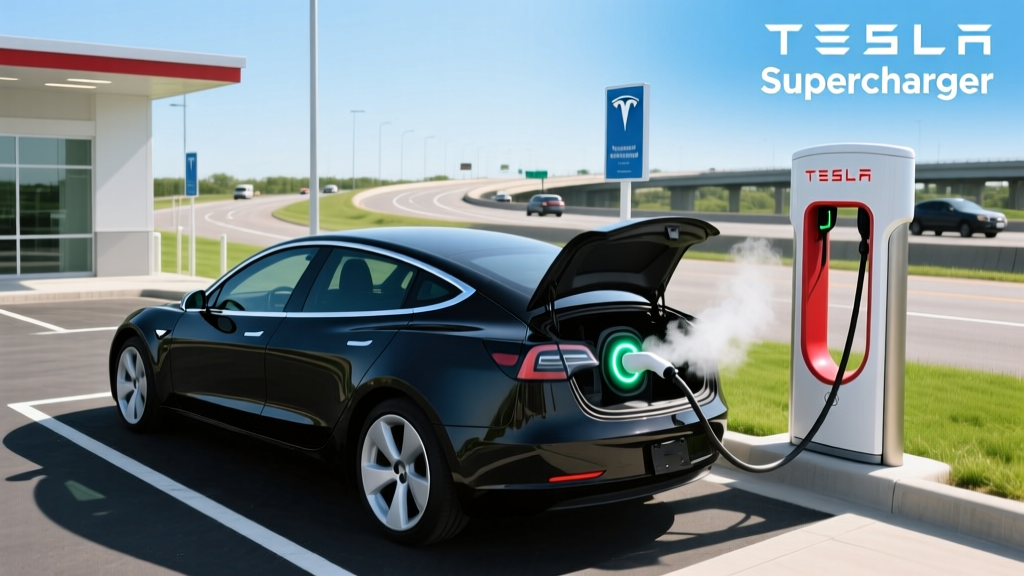
When reports surfaced of a multi-stall NJ Turnpike Tesla Supercharger shutdown at one of the corridor's busiest travel plazas, it sent a jolt through the EV community. Drivers who had planned their I-95 road trips around reliable Supercharger access suddenly found themselves rerouting, waiting, or scrambling for CCS adapters at third-party stations. The incident is a textbook case study in why no EV owner — Tesla or otherwise — should rely on a single charging network or a single corridor stop without a backup plan.
This guide breaks down what the NJ Turnpike Supercharger outage revealed about public-charging fragility, maps the alternate DC fast-charging infrastructure along the Garden State's busiest highway, and walks you through building a charging setup — at home and on the road — that keeps you moving even when a marquee station goes dark.
What Triggered the NJ Turnpike Tesla Supercharger Shutdown
Supercharger outages are rare but not unprecedented. Tesla's network historically posts uptime above 99%, but individual stations can go offline for several reasons: utility-side transformer work, grid curtailment during peak-demand events, physical damage to dispensers, or software faults in the site controller. The NJ Turnpike corridor carries some of the highest EV traffic density in the country, meaning any stall reduction at a travel-plaza station creates cascading wait times at adjacent Superchargers in Cranbury, Joyce Kilmer, and Forked River.
During the shutdown window, Tesla's in-app navigation rerouted drivers to nearby stations, but real-world stall availability often lagged behind what the app showed — a familiar frustration during peak travel periods. Non-Tesla EVs using the Supercharger network via Tesla's Magic Dock CCS adapter were hit harder, since fewer stalls at non-Tesla sites meant even longer queues.
Understanding Charging Levels: Speeds in kW and Miles Per Hour
Before we map alternatives, let's ground the conversation in the physics. EV charging is measured in kW (kilowatts) — the rate of power delivery — while your battery stores energy in kWh (kilowatt-hours). Confusing the two is the single most common EV literacy gap. Think of kW as how fast water flows from a hose, and kWh as the size of the bucket you're filling.
| Level | Voltage / Phase | Typical Power (kW) | Miles of Range Added Per Hour | Best Use Case |
|---|---|---|---|---|
| Level 1 | 120V / single | 1.0–1.4 kW | 3–5 mi/hr | Overnight top-up for PHEVs or low-mileage BEVs |
| Level 2 (Home/Public) | 240V / single | 3.3–19.2 kW | 12–75 mi/hr | Daily home charging; destination charging |
| DC Fast Charging | 400–800V DC | 50–350 kW | 150–1,200+ mi/hr (peak) | Road trips; rapid replenishment |
A critical nuance: the "miles per hour" figures above assume peak delivery. In practice, DC fast charging follows a charge curve — power peaks at a low state of charge (SoC), then tapers significantly above 80% to protect battery health. A 250 kW-rated Supercharger might deliver 250 kW from 10–40% SoC, drop to ~150 kW by 60%, and slow to under 50 kW past 85%. That's why manufacturers quote 10–80% charge times rather than 0–100%.
Charging Time Examples for Common Battery Sizes
Here's how long a 10–80% session takes across popular 2025–2026 EV platforms at different charger types:
| Vehicle (Usable Battery kWh) | Level 2 at 11.5 kW (48A) | DC Fast at 150 kW (Peak) | DC Fast at 250 kW (Peak) | DC Fast at 350 kW (Peak) |
|---|---|---|---|---|
| Tesla Model Y (75 kWh, NMC) | ~5.5 hours | ~28 min | ~22 min | N/A (vehicle caps ~250 kW) |
| Hyundai Ioniq 5 (77.4 kWh, NMC, 800V) | ~5.5 hours | ~26 min | ~18 min | ~18 min |
| Ford F-150 Lightning Ext. Range (131 kWh, NMC) | ~9.5 hours | ~45 min | ~41 min | N/A (vehicle caps ~210 kW) |
| Chevrolet Equinox EV (85 kWh, NMC) | ~6 hours | ~32 min | ~28 min | N/A (vehicle caps ~190 kW) |
Notice that plugging a vehicle capped at 250 kW into a 350 kW Electrify America station doesn't save time — the vehicle's onboard charge controller limits intake. Always match your destination charger to your vehicle's maximum DC charge rate.
Alternate DC Fast-Charging Along the NJ Turnpike Corridor
If the NJ Turnpike Tesla Supercharger shutdown taught us anything, it's that redundancy matters. Here are the DC fast-charging alternatives within a practical detour of the Turnpike (I-95 / NJTP):
- Electrify America — Cherry Hill, NJ: 4 stalls at up to 350 kW, CCS1 native. Located ~5 miles from Turnpike Exit 34A. Open 24/7. Typical pricing: $0.48–$0.64/kWh depending on time of day.
- EVgo — Edison, NJ: Multiple stalls at 62.5–350 kW, CCS1 and CHAdeMO available. Adjacent to Turnpike Exit 10. EVgo Plus+ membership reduces per-kWh cost by ~15%.
- Tesla Supercharger — Cranbury, NJ: If the affected station was further north or south, Cranbury (32 stalls, V3 at 250 kW) often serves as the overflow. NACS native; Magic Dock CCS available on select stalls.
- Tesla Supercharger — Forked River, NJ: 16 V3 stalls at 250 kW, near Exit 74 on the Garden State Parkway. Good southern alternative for Shore-bound travelers.
- ChargePoint Express — Princeton, NJ: 2 stalls at 125 kW, CCS1. Slower but reliable fallback near Exit 9. Check real-time status in the ChargePoint app before detouring.
For Tesla drivers, the built-in navigation will reroute automatically, but non-Tesla EV drivers using apps like PlugShare or A Better Route Planner (ABRP) should pre-load backup stations before entering the corridor.
Connector Compatibility: NACS, CCS1, CHAdeMO, and Adapters
The connector landscape has shifted dramatically since 2024, when Ford, GM, Rivian, Volvo, and most major automakers committed to adopting Tesla's North American Charging Standard (NACS) for their North American vehicles. By the 2026 model year, the majority of new EVs ship with a native NACS port. Legacy CCS1 vehicles can access Tesla Superchargers using an adapter.
| Connector | Native Vehicles | Adapter Needed For | Availability |
|---|---|---|---|
| NACS (Tesla) | Tesla (all), Ford (2025+), GM (2025+), Rivian (2025+), Volvo/Polestar (2025+), Hyundai/Kia (2026+) | CCS1 vehicles via Tesla NACS-to-CCS adapter (~$200–$250) | Tesla Superchargers (250–350 kW); growing third-party NACS stations |
| CCS1 | Hyundai/Kia (2025 and earlier), VW/ID.4 (2025 and earlier), BMW iX, legacy models | NACS vehicles via CCS-to-NACS adapter for non-Tesla DC stations | Electrify America, EVgo, ChargePoint, Ionity (EU) |
| CHAdeMO | Nissan Leaf (2025 and earlier), Mitsubishi Outlander PHEV (legacy) | No widely available adapter to NACS or CCS | Declining; limited to older EA/EVgo stations |
If you own a CCS1-native vehicle and want Supercharger access, the Tesla CCS adapter (officially sold by Tesla for ~$250) is essential. Third-party adapters from brands like Lectron and A2Z exist at lower prices, but verify UL listing and firmware compatibility before purchasing — a non-certified adapter can void your vehicle's charging-system warranty.
How Much Does Charging Cost Per Mile vs. Gas?
One of the strongest arguments for EV ownership is per-mile fuel cost — but the savings depend heavily on where and when you charge. Here's a realistic breakdown for a mid-size electric SUV averaging 3.0 miles per kWh (roughly 112 MPGe combined):
| Charging Scenario | Rate ($/kWh) | Cost Per Mile (at 3.0 mi/kWh) | Equivalent Gas MPG (at $3.40/gal) |
|---|---|---|---|
| Home — off-peak utility rate (NJ avg.) | $0.09–$0.12 | $0.030–$0.040 | 85–113 MPG |
| Home — standard residential rate (NJ avg.) | $0.17–$0.20 | $0.057–$0.067 | 51–60 MPG |
| Public Level 2 (ChargePoint, EVgo L2) | $0.25–$0.40 | $0.083–$0.133 | 25–41 MPG |
| DC Fast — Electrify America (peak) | $0.48–$0.64 | $0.160–$0.213 | 16–21 MPG |
| DC Fast — Tesla Supercharger (avg.) | $0.28–$0.36 | $0.093–$0.120 | 28–37 MPG |
| Gasoline vehicle (25 MPG combined, $3.40/gal) | — | $0.136 | 25 MPG (baseline) |
The math is clear: home charging at off-peak rates delivers the deepest savings — roughly one-quarter the per-mile cost of a 25 MPG gas vehicle. But if you rely exclusively on peak-rate DC fast charging, your per-mile cost can actually exceed gasoline. This is why a home Level 2 charger isn't just a convenience; it's the economic foundation of EV ownership.
Building a Resilient Home Charging Setup
The NJ Turnpike Supercharger outage underscores a simple truth: the most reliable charging station is the one in your garage. Here's what a proper home Level 2 installation requires.
Electrical Requirements
A standard home Level 2 charger runs on a 240V dedicated circuit, typically at 40A, 48A, or 60A depending on the charger's maximum output. The National Electrical Code (NEC) requires that continuous loads (which EV charging qualifies as) not exceed 80% of the circuit breaker rating. So a 48A charger requires a 60A breaker; a 40A charger requires a 50A breaker.
Your home's electrical panel must have sufficient spare capacity. Most modern 200A panels can accommodate a 60A EV circuit without issue. Older homes with 100A or 150A panels may need a panel upgrade — typically to 200A — which is the single largest variable in installation cost.
Installation Cost Breakdown
| Component | Simple Install (panel adjacent, no upgrade) | Complex Install (long run, panel upgrade) |
|---|---|---|
| Level 2 charger hardware (40A–48A) | $400–$700 | $400–$700 |
| Electrician labor (2–4 hrs simple / 6–10 hrs complex) | $500–$1,200 | $1,500–$3,500 |
| Electrical panel upgrade (if needed: 100A → 200A) | $0 (not needed) | $1,500–$3,000 |
| Permit and inspection (local jurisdiction) | $100–$300 | $100–$300 |
| Conduit, wiring (6 AWG copper for 60A circuit) | $100–$300 | $300–$800 |
| Total estimated cost | $1,100–$2,500 | $3,800–$8,300 |
Many utilities in New Jersey — including PSE&G and JCP&L — offer rebates of $500–$1,500 for home charger installation or make-ready infrastructure. Always check with your utility before scheduling work.
Safety and Code Considerations
- Dedicated circuit: Your EV charger must be on its own dedicated breaker — never shared with other appliances.
- GFCI protection: NEC 2023 and later require GFCI protection for all EV charging outlets (NEMA 14-50 or hardwired). Hardwired installations with built-in GFCI in the charger unit satisfy this requirement.
- Outdoor rating: If your charger is mounted outside, ensure it carries a NEMA 4 or IP65 weather-resistance rating. All recommended chargers below meet this standard.
- Permit requirement: Nearly all New Jersey municipalities require an electrical permit for EV charger installation. Skipping the permit risks voiding homeowner's insurance coverage for electrical-related claims.
Recommended Home Level 2 Chargers (2026)
Here are three proven Level 2 chargers suited to different needs, all NACS-compatible or available with NACS connectors for 2025–2026 vehicles:
Tesla Wall Connector (Gen 3) — Best for Tesla/NACS Owners
- Power output: Up to 11.5 kW (48A on a 60A circuit)
- Connector: Native NACS; 24-foot cable
- Smart features: Wi-Fi connectivity, OTA firmware updates, Power Sharing (link up to 6 units on one circuit), access control via Tesla app
- Price: ~$475 (direct from Tesla)
- Best for: Tesla owners and 2025+ NACS-native vehicles (Ford, GM, Rivian)
ChargePoint Home Flex — Most Versatile
- Power output: Up to 12 kW (50A adjustable via DIP switch; 12–50A range)
- Connector: Available in NACS or CCS1/J1772; 23-foot cable
- Smart features: Wi-Fi + Bluetooth, Alexa/Google Home integration, scheduled charging, energy tracking, UL-listed
- Price: ~$599–$649
- Best for: Multi-EV households, CCS1 legacy vehicles, smart-home enthusiasts
Emporia Vue Level 2 Charger — Best Budget Smart Charger
- Power output: Up to 11.5 kW (48A on 60A circuit)
- Connector: J1772 (CCS1 compatible); NACS adapter included in 2026 bundle
- Smart features: Wi-Fi, real-time energy monitoring via Emporia app, solar-integration mode (charge from excess solar), time-of-use scheduling
- Price: ~$399
- Best for: Budget-conscious buyers, solar-panel owners, energy-monitoring enthusiasts
Frequently Asked Questions
How much does it cost to install a home EV charger?
A straightforward Level 2 installation (panel has capacity, charger is close to the panel) typically costs $1,100–$2,500 all-in, including the charger hardware, electrician labor, wiring, and permit. If your home needs a panel upgrade from 100A to 200A, expect the total to rise to $3,800–$8,300. Utility rebates in New Jersey can offset $500–$1,500 of that cost.
How fast will each charging level add range?
Level 1 (120V) adds roughly 3–5 miles of range per hour — adequate for PHEVs with small batteries but impractical for full BEVs. Level 2 (240V at 48A) adds 25–35 miles per hour for a typical electric SUV, fully replenishing a 75 kWh battery overnight in about 5–6 hours. DC fast charging at 150–250 kW adds 150–400+ miles per hour at peak, delivering a 10–80% charge in 18–35 minutes depending on the vehicle.
Which connector/charger is compatible with my EV?
For 2025–2026 model-year vehicles, check your owner's manual or charging-port label. Most new vehicles from Tesla, Ford, GM, Rivian, Volvo, and Polestar now use NACS. Hyundai, Kia, Volkswagen, and BMW models from 2025 and earlier typically use CCS1. The Nissan Leaf uses the legacy CHAdeMO connector. If your vehicle has CCS1 and you want Supercharger access, you'll need a Tesla-approved CCS-to-NACS adapter (~$200–$250).
How much does charging cost per mile vs. gas?
At home on an off-peak New Jersey utility rate (~$0.10/kWh), a typical EV costs $0.03–$0.04 per mile — roughly one-quarter the cost of a 25 MPG gas car at $3.40/gallon ($0.136/mile). However, peak-rate DC fast charging at $0.48–$0.64/kWh pushes EV per-mile costs to $0.16–$0.21, which actually exceeds gasoline. Home charging is where the economics work best.
What electrical upgrades might I need?
The most common upgrade is a panel capacity increase from 100A or 150A to 200A, required when your existing panel doesn't have enough spare amperage for a dedicated 60A EV circuit. Other potential upgrades include: replacing a NEMA 10-50 outlet (no ground) with a NEMA 14-50 (grounded, code-compliant); upgrading wiring from aluminum to copper; or adding a sub-panel if the charger is far from the main panel (e.g., detached garage). A licensed electrician can assess your panel during a pre-installation site visit — many offer this for free or a nominal fee applied toward the job.
Building Your Backup Charging Plan
The NJ Turnpike Tesla Supercharger shutdown was an inconvenience, not a crisis — for drivers who had alternatives mapped out. Here's a practical framework for corridor-proofing your EV travel:
- Pre-load 2–3 backup stations in PlugShare or ABRP for every planned DC fast-charging stop. Filter by real-time status and recent user check-ins.
- Carry your adapter. If you drive a CCS1 vehicle, keep a NACS-to-CCS adapter in the frunk. If you drive NACS, carry a CCS adapter for Electrify America and EVgo stations.
- Arrive with a buffer. Never plan to arrive at a corridor charger below 15% SoC. If the station is down, you need enough charge to reach the backup — typically 20–40 miles away.
- Check utility demand-response events. Some DC fast-charging stations reduce power or shut down during grid-peak events, especially in summer. Charge earlier in the day when possible.
- Invest in home charging. The single most impactful decision you can make as an EV owner is installing a reliable Level 2 charger at home. It eliminates dependence on any public network for daily driving and ensures you start every road trip at 80–100% SoC.
Public charging infrastructure will continue to expand and occasionally stumble. The drivers who thrive are the ones who treat every network outage not as a reason to doubt EVs, but as a prompt to build more resilience into their own charging strategy.