The Nissan Leaf remains one of the most accessible used and new electric vehicles on the market, but getting the most from its battery depends almost entirely on how you charge it. Whether you drive the standard 40 kWh pack or the Leaf SV Plus with its 60 kWh battery, understanding charging speeds, connector quirks, and real-world efficiency is the difference between a stress-free commute and a stranded roadside call. This guide breaks down exactly how to charge a Leaf, what it costs, and how to maximize every mile of EPA-rated range.
Understanding the Range of a Nissan Leaf by Trim and Battery
Before plugging in, you need to know what you're working with. The 2025–2026 Nissan Leaf is offered in two primary configurations, each with a distinct EPA range profile and battery chemistry (both use NMC lithium-ion cells with passive air cooling):
| Trim | Battery (usable kWh) | EPA Range | Real-World Range (highway/cold) | MPGe (combined) | Base MSRP |
|---|---|---|---|---|---|
| Leaf S (40 kWh) | ~39 kWh | 149 mi | 110–130 mi | 111 MPGe | ~$28,140 |
| Leaf SV Plus (60 kWh) | ~59 kWh | 212 mi | 160–185 mi | 109 MPGe | ~$36,190 |
Charging Levels Explained: Speeds, kW, and Miles Per Hour
Electric vehicle charging is measured in kW (kilowatts), which represents power — the rate at which energy flows into the battery. The battery itself stores energy measured in kWh (kilowatt-hours). Think of kW as the speed of water flowing through a hose, and kWh as the total volume in the bucket. Confusing the two is the most common mistake new EV owners make.
| Level | Voltage / Amperage | Max Power (kW) | Miles of Range Added Per Hour | Best Use Case |
|---|---|---|---|---|
| Level 1 (120V) | 120V / 12A | ~1.4 kW | 3–5 mi/hr | Overnight trickle, PHEVs, low-mileage commutes |
| Level 2 (240V) | 240V / 32–48A | 7.7–11.5 kW | 22–35 mi/hr | Daily home charging, overnight full recharge |
| DC Fast Charging | 400V+ DC | 50–100 kW (Leaf max: 100 kW) | 150–250+ mi/hr (peak) | Road trips, quick top-ups |
For the Leaf SV Plus with its 60 kWh battery, a full Level 2 charge at 7.7 kW (the Leaf's onboard charger limit) takes approximately 8–9 hours from 0–100%. On a 50 kW CHAdeMO DC fast charger, you can expect a 10–80% charge in roughly 40–50 minutes, though the Leaf's passive cooling system causes the charge curve to taper significantly above 80% and in hot weather to protect the battery.
CHAdeMO, CCS, and NACS: Connector Compatibility for the Leaf
The Nissan Leaf uses the CHAdeMO connector for DC fast charging and the standard J1772 connector for Level 1 and Level 2 AC charging. This is a critical detail because the broader EV industry has shifted toward CCS1 and now NACS (the Tesla standard). Here's how the connector landscape affects Leaf owners:
| Connector | Used For | Leaf Compatible? | Adapter Available? | Network Availability |
|---|---|---|---|---|
| J1772 | Level 1 & 2 AC | Yes (native) | Not needed | Universal — all public AC stations |
| CHAdeMO | DC Fast | Yes (native) | Not needed | Declining — Electrify America, some EVgo stations |
| CCS1 | DC Fast | No (no adapter exists) | N/A | Widespread, growing |
| NACS (Tesla) | DC Fast / AC | No (no CHAdeMO-to-NACS adapter) | N/A | Tesla Supercharger network (largest) |
How Much Does It Cost to Install a Home EV Charger?
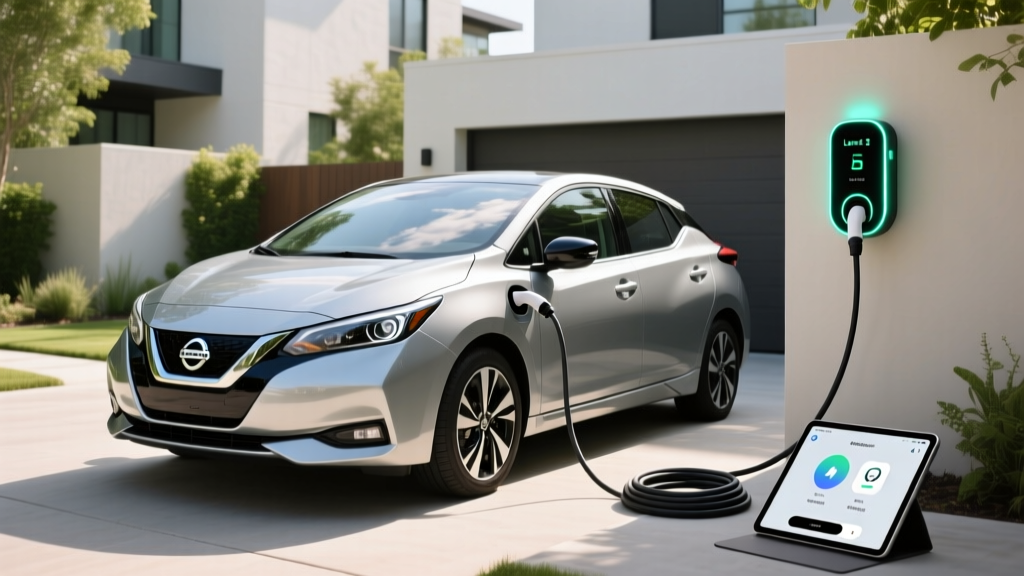
Home charging is where Leaf owners save the most money and time. A Level 2 home charger on a 240V circuit will fully replenish even the 60 kWh Leaf SV Plus overnight. But installation costs vary dramatically depending on your home's electrical panel.
| Cost Component | Simple Install (panel nearby) | Complex Install (long run / panel upgrade) |
|---|---|---|
| Level 2 Charger Equipment | $350–$600 | $350–$600 |
| Electrician Labor (240V/40A circuit) | $400–$800 | $1,000–$2,500 |
| Permit & Inspection | $50–$150 | $100–$300 |
| Electrical Panel Upgrade (100A → 200A) | N/A | $1,500–$3,500 |
| Total Estimated Cost | $800–$1,550 | $2,950–$6,900 |
What Electrical Upgrades Might You Need?
A Level 2 charger for the Leaf typically requires a 240V / 40-amp dedicated circuit (for a 32A charger) or a 240V / 50-amp circuit (for a 40–48A charger). Your licensed electrician will assess:
- Panel capacity: Most modern homes have 200A service, which can support a Level 2 charger. Older homes with 100A panels may need an upgrade — this is the single biggest cost variable.
- Circuit availability: A dedicated breaker with no shared loads is required by NEC code for EV charging circuits.
- Wire run distance: Longer runs from the panel to the garage or driveway require heavier-gauge (and more expensive) copper wire.
- GFCI protection: The 2020 NEC requires GFCI breakers for EV charging outlets in garages and outdoors, adding $50–$150 to material costs.
- Outdoor rating: If your charger is installed outside, it must carry a NEMA 4 or NEMA 4X weatherproof rating.
Always hire a licensed electrician and pull a permit. Unpermitted EV charger installations can void homeowner's insurance claims and create fire risk. Many utilities offer rebates of $250–$1,000 for Level 2 installations — check with your local provider.
Recommended Level 2 Chargers for the Nissan Leaf
Since the Leaf uses a standard J1772 inlet for AC charging, it is compatible with virtually every Level 2 charger on the market. The Leaf's onboard charger maxes out at 6.6 kW (27.5A at 240V) for the 40 kWh model and 7.7 kW (32A at 240V) for the SV Plus, so a 40A or 48A charger provides headroom without waste. Here are top picks:
ChargePoint Home Flex
- Power Output: Up to 12 kW (50A) — configurable down to 16A
- Connector: J1772 (native Leaf fit)
- Cable Length: 23 ft
- Smart Features: Wi-Fi, scheduling, Alexa, energy tracking
- Price: ~$549
Emporia Level 2 EV Charger
- Power Output: Up to 11.5 kW (48A)
- Connector: J1772
- Cable Length: 24 ft
- Smart Features: Wi-Fi, solar integration, app control
- Price: ~$399
Grizzl-E Smart
- Power Output: Up to 10 kW (40A)
- Connector: J1772
- Cable Length: 24 ft
- Smart Features: OCPP, adjustable amperage, rugged build
- Price: ~$499
Any of these chargers will fully replenish a Leaf SV Plus (60 kWh) overnight in approximately 8–9 hours. The ChargePoint Home Flex is the strongest pick for smart-home integration, while the Emporia offers the best value for budget-conscious Leaf owners.
How Much Does Charging a Nissan Leaf Cost Per Mile vs. Gas?
The Leaf SV Plus achieves approximately 109 MPGe combined, which translates to roughly 30 kWh per 100 miles (or 0.30 kWh/mile). Using that figure, here's what charging actually costs across different scenarios:
| Charging Scenario | $/kWh (avg) | Cost Per Mile | Cost for 200-Mile Trip |
|---|---|---|---|
| Home — Off-Peak (utility TOU rate) | $0.08–$0.12 | $0.024–$0.036 | $4.80–$7.20 |
| Home — Standard Residential Rate | $0.14–$0.18 | $0.042–$0.054 | $8.40–$10.80 |
| Public Level 2 (ChargePoint, EVgo) | $0.25–$0.40 | $0.075–$0.120 | $15.00–$24.00 |
| DC Fast Charging (CHAdeMO, 50 kW) | $0.35–$0.55 | $0.105–$0.165 | $21.00–$33.00 |
| Gas Equivalent (30 MPG at $3.50/gal) | — | $0.117 | $23.40 |
At home on off-peak rates, a Leaf costs roughly 3 cents per mile — less than one-quarter the cost of a 30 MPG gas car at $3.50/gallon. Even on DC fast chargers at peak pricing, the Leaf is generally cheaper or comparable to gasoline on a per-mile basis. Over 12,000 annual miles, home-charging a Leaf saves approximately $1,000–$1,400 per year compared to fueling a comparable gas vehicle. Source: fueleconomy.gov EV cost calculator.
Charging Time Examples for the Nissan Leaf
Here's how long it takes to charge each Leaf battery at common power levels, based on the 10–80% range most EV owners use for daily driving (charging above 80% slows dramatically due to battery management system taper):
| Charger Type | Leaf S (40 kWh) — 10–80% | Leaf SV Plus (60 kWh) — 10–80% |
|---|---|---|
| 120V Level 1 (1.4 kW) | ~20 hours | ~30 hours |
| 240V Level 2 (6.6 kW — S trim limit) | ~4.5 hours | ~7 hours (at 7.7 kW on SV Plus) |
| 50 kW CHAdeMO DC Fast | ~45 min | ~60 min |
| 100 kW CHAdeMO DC Fast | ~35 min | ~45 min |
Charge curve reality check: The Leaf's passive air-cooling system means sustained DC fast charging speeds drop noticeably in hot weather (above 85°F) and on repeated same-day fast charges. Nissan's battery management system aggressively tapers charge rate to prevent cell overheating — often called "Rapidgate" by Leaf enthusiasts. On a road trip with multiple fast-charge stops, expect subsequent charges to be 15–25% slower than the first.
Protecting Battery Health and Maximizing Range
The Leaf's battery warranty covers 8 years / 100,000 miles against defects and excessive capacity loss (below 9 bars on the 12-bar capacity gauge, roughly 70% state of health). To maximize long-term battery health:
- Daily charging: Set your Level 2 charger to stop at 80% for daily use. Reserve 100% charges for road trips.
- Avoid frequent DC fast charging: The Leaf's air-cooled battery runs hotter during fast charging, accelerating degradation. Use DC fast charging sparingly — rely on Level 2 for most charging.
- Minimize extreme heat exposure: Park in shade or a garage when possible. Battery degradation accelerates above 95°F ambient with high state of charge.
- Don't store at 0% or 100%: If leaving the Leaf parked for extended periods, aim for 50–60% state of charge.
- Precondition while plugged in: Use the Leaf's climate timer to warm or cool the cabin while connected to shore power, preserving battery energy for driving.
Frequently Asked Questions
Can I use a Tesla Supercharger with my Nissan Leaf?
No. Tesla Superchargers use the NACS connector (or the legacy Tesla proprietary connector). There is currently no CHAdeMO-to-NACS adapter available for passenger vehicles. The Leaf can only DC fast charge at stations equipped with CHAdeMO connectors. Use PlugShare or EVgo to locate CHAdeMO-compatible stations.
How fast will Level 1 charging add range to my Leaf?
Level 1 charging at 120V delivers approximately 1.4 kW, adding roughly 3–5 miles of range per hour. For the 40 kWh Leaf S, a full charge from empty takes approximately 29 hours on Level 1. It's practical only as a trickle charge for very low daily mileage or as a backup.
Does the Nissan Leaf qualify for the federal EV tax credit?
As of 2025–2026, the new Nissan Leaf's eligibility for the IRS §30D federal tax credit depends on battery sourcing, critical mineral requirements, MSRP caps ($55,000 for cars), and buyer income limits ($150K single / $300K joint). The Leaf's MSRP falls well under the cap, but battery component and critical mineral sourcing rules may limit or eliminate the credit. Check the IRS qualified vehicle list for the current month and consult a tax professional. A point-of-sale transfer option is available at participating dealers.
What happens if my Leaf battery degrades significantly?
Nissan's battery warranty covers 8 years/100,000 miles. If capacity drops below approximately 70% (indicated by fewer than 9 of 12 bars on the dashboard capacity gauge), Nissan will repair or replace the battery. Out-of-warranty replacement costs range from $6,500 to $9,000 depending on pack size and labor. Third-party refurbished battery options exist for $3,500–$5,500.
Is it worth installing a 48A charger if the Leaf only accepts 7.7 kW?
A 48A charger (11.5 kW) won't charge the Leaf any faster than a 32A charger (7.7 kW) because the Leaf's onboard charger is the bottleneck. However, installing a higher-amperage charger provides future-proofing if you later purchase a second EV with a larger onboard charger. The incremental equipment cost is typically $50–$150.