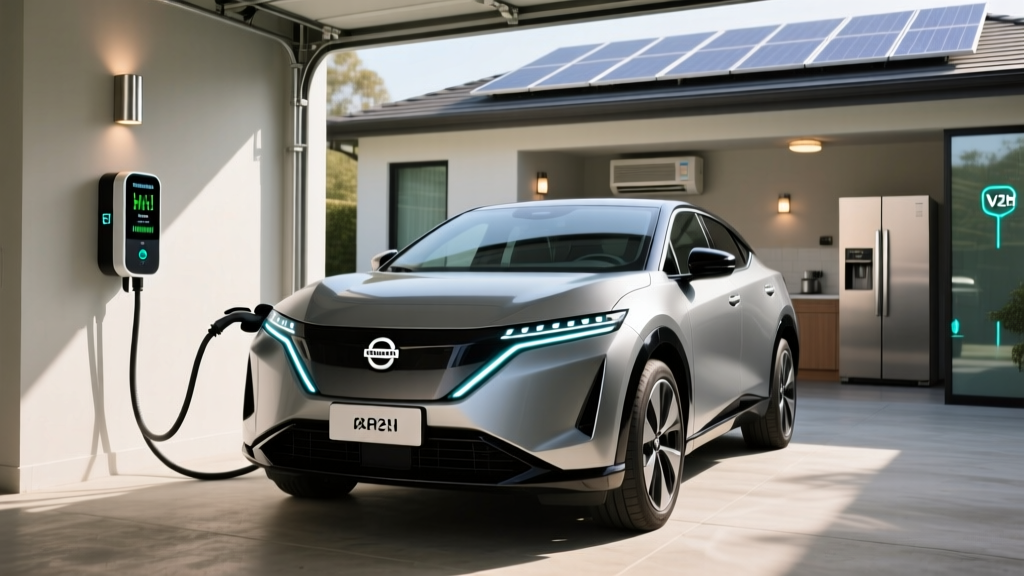
The Nissan Ariya has quietly become one of the few mainstream EVs in the U.S. market to offer genuine bidirectional charging capability. For 2026, Nissan continues to support Vehicle-to-Home (V2H) functionality on the Ariya, allowing the SUV's battery to power your house during outages or peak-rate windows. But turning that feature into a working home-energy system requires specific hardware, electrical upgrades, and a clear understanding of what bidirectional charging actually delivers.
This guide breaks down the Nissan Ariya bidirectional charging V2H ecosystem — the equipment you need, what installation really costs, how the Ariya's 87 kWh usable battery translates to home backup hours, and how conventional charging fits into the picture for daily driving.
What Is Bidirectional Charging on the Nissan Ariya?
Bidirectional charging means energy can flow in both directions: from the grid into the Ariya's battery (normal charging) and from the battery back out to an external load. Nissan offers this through a CCS1 connector using the ISO 15118 communication protocol, which enables the vehicle and charger to negotiate power flow direction.
There are two main bidirectional modes relevant to Ariya owners:
- Vehicle-to-Home (V2H): The Ariya powers your home's electrical panel during an outage or offsets grid draw during expensive peak hours. This requires a dedicated V2H-capable bidirectional charger hardwired to your home's main panel.
- Vehicle-to-Load (V2L): A simpler mode that powers individual appliances or tools via a portable outlet adapter plugged into the charge port or a cabin outlet. No special home wiring needed, but output is limited.
Ariya Battery Specs: How Much Backup Energy Do You Have?
The 2026 Nissan Ariya comes in two battery configurations. Understanding the difference matters because it directly determines how long your home can run on the car's battery.
| Spec | Standard Range (Venture+) | Extended Range (Evolve+, Empower+, Engage+, Platinum+) |
|---|---|---|
| Usable Battery Capacity | 63 kWh | 87 kWh |
| Battery Chemistry | NMC (Lithium Nickel Manganese Cobalt) | NMC |
| EPA Range | 216 mi | Up to 304 mi (FWD) |
| Max DC Fast Charge Rate | 130 kW peak | 130 kW peak |
| 10–80% DC Fast Charge Time | ~35 min | ~40 min |
| Level 2 Onboard Charger | 7.2 kW | 7.2 kW |
| Horsepower (FWD / e-4ORCE AWD) | 214 hp / 340 hp | 238 hp / 389 hp |
| Battery/Powertrain Warranty | 8 yr / 100,000 mi | 8 yr / 100,000 mi |
| Starting MSRP | ~$39,590 | ~$43,190 |
Real-world V2H runtime estimate: The average U.S. home consumes roughly 30 kWh per day (per EIA data). An 87 kWh Ariya battery at 90% state of charge holds about 78 kWh of usable energy. Accounting for inverter losses (typically 5–10%), that gives you roughly 2.3 days of full-home backup — or significantly longer if you run only essential circuits (refrigerator, lights, internet, sump pump) at maybe 10–15 kWh/day.
Charging Levels Explained: Speeds, kW, and What They Mean for the Ariya
A critical distinction for any EV owner: kW (kilowatts) measures power — how fast energy flows. kWh (kilowatt-hours) measures energy — how much the battery holds. Think of kW as the width of a pipe and kWh as the size of the tank you're filling. The Ariya's tank is either 63 kWh or 87 kWh; the pipe width varies by charging level.
| Level | Power (kW) | Voltage / Amperage | Miles of Range Added per Hour | Full Charge Time (87 kWh Battery) |
|---|---|---|---|---|
| Level 1 (Standard Outlet) | 1.0–1.4 kW | 120V / 12A | 3–5 mi/hr | 60–87 hours |
| Level 2 (Home / Public AC) | 3.3–19.2 kW | 240V / 16–80A | 12–70 mi/hr | 4.5–12 hours (at 7.2 kW onboard limit) |
| DC Fast Charging | 50–130 kW (Ariya peak) | 400–500V DC | 180–400+ mi/hr (at peak) | 10–80% in ~40 min |
Key Ariya constraint: The Ariya's onboard AC charger maxes out at 7.2 kW. Even if you install a 48A Level 2 charger capable of delivering 11.5 kW, the Ariya will only accept 7.2 kW (30A). This means your practical home charging speed caps at about 25 miles of range per hour — sufficient for overnight replenishment, but worth knowing before overspending on a high-amperage unit.
The V2H Equipment You Actually Need for the Ariya
Bidirectional V2H isn't as simple as plugging into a standard Level 2 wallbox. You need a bidirectional charger — sometimes called a V2H hub — that can both send AC power to the car and invert DC battery power back to AC for your home's electrical panel.
As of 2026, the primary V2H-capable charger compatible with CCS1-equipped vehicles like the Ariya is the Wallbox Quasar 2, rated at up to 11.5 kW bidirectional. Other systems like the Fermata Energy FE-15 target fleet/commercial V2H applications. The dcbel r16 is another home bidirectional unit gaining UL certification, though availability varies by region.
Important compatibility note: Nissan's V2H implementation requires CCS1 DC bidirectional communication (ISO 15118-20). Not all CCS1 chargers support this protocol. Verify with the charger manufacturer that their unit explicitly supports the Ariya's V2H handshake before purchasing.
Standard Level 2 Chargers for Daily Charging (Non-Bidirectional)
Most Ariya owners will also want a conventional Level 2 charger for everyday top-ups. Since the Ariya's onboard charger caps at 7.2 kW, a 32A (7.7 kW) or 40A (9.6 kW) unit is the sweet spot — you'll fully utilize the car's acceptance rate without overspending.
Emporia Vue / Level 2 EV Charger
- Power: Up to 48A (11.5 kW) — Ariya will draw 32A (7.2 kW)
- Connector: CCS1 (J1772 for AC)
- Cable Length: 24 ft
- Smart Features: Wi-Fi, app scheduling, energy monitoring, solar integration
- Price: ~$350–$400
ChargePoint Home Flex
- Power: Configurable 16–50A (up to 12 kW) — set to 32A for Ariya
- Connector: J1772 (CCS1 AC compatible); NACS adapter available
- Cable Length: 23 ft
- Smart Features: Wi-Fi, app, Alexa, scheduled charging
- Price: ~$550–$650
Tesla Wall Connector (with J1772 adapter)
- Power: Up to 48A (11.5 kW)
- Connector: NACS — requires J1772 adapter for Ariya
- Cable Length: 24 ft
- Smart Features: Wi-Fi, OTA updates, load sharing
- Price: ~$425 + adapter (~$45)
Home Charger Installation: Electrical Requirements & Real Costs
Installing a Level 2 charger — and especially a bidirectional V2H unit — is a significant electrical project. Here's what's involved and what it costs.
Electrical Requirements
- Standard Level 2 (32–40A): Requires a dedicated 240V circuit at 40–50A. The National Electrical Code (NEC) requires circuits to be rated at 125% of the continuous load, so a 32A charger needs a 40A breaker; a 40A charger needs a 50A breaker.
- Bidirectional V2H unit (Wallbox Quasar 2 at 48A): Requires a dedicated 240V/60A circuit, plus hardwired connection to your main electrical panel with an automatic transfer switch or critical-loads subpanel.
- Panel capacity: Your main service panel must have enough spare capacity. A 200A panel is standard in newer homes and usually sufficient. Older homes with 100A or 150A service may need a panel upgrade — this is the single biggest cost variable.
| Component | Standard Level 2 Install | Bidirectional V2H Install |
|---|---|---|
| Charger Equipment | $350–$650 | $2,500–$5,000 |
| Electrician Labor (2–8 hrs) | $400–$1,500 | $2,000–$5,000 |
| Permit & Inspection | $100–$350 | $200–$600 |
| Transfer Switch / Subpanel (V2H) | N/A | $800–$2,500 |
| Panel Upgrade (if needed, 100A→200A) | $1,500–$3,500 | $1,500–$3,500 |
| Total (no panel upgrade) | $850–$2,500 | $5,500–$13,100 |
| Total (with panel upgrade) | $2,350–$6,000 | $7,000–$16,600 |
Connector Compatibility: What Plugs Into the Ariya?
The 2026 Nissan Ariya uses the CCS1 (Combined Charging System) connector for both AC Level 2 charging and DC fast charging. It does not natively use the NACS (Tesla-style) connector, though adapters are available.
| Connector Type | Native Compatibility | Adapter Needed? | Notes |
|---|---|---|---|
| CCS1 | ✅ Yes — native | No | Standard for Ariya AC & DC charging; used by Electrify America, EVgo |
| J1772 (AC only) | ✅ Yes — upper portion of CCS1 | No | All Level 2 public AC chargers work directly |
| NACS (Tesla) | ❌ No | Yes — CCS1-to-NACS adapter (~$150–$250) | Required for Tesla Supercharger access; several third-party adapters now UL-listed |
| CHAdeMO | ❌ No | Not available | Legacy Nissan Leaf standard; not compatible with Ariya; network is largely retired |
Supercharger access: With a UL-listed CCS1-to-NACS adapter, the Ariya can charge at Tesla Superchargers (V3 stalls at up to 130 kW, matching the Ariya's peak acceptance). Confirm your adapter is rated for DC fast charging — some cheaper adapters only support AC Level 2.
Cost to Charge the Ariya: Home vs. Public vs. Gas
One of the strongest arguments for the Ariya — and for EVs in general — is fuel cost savings. Here's what charging actually costs in 2026, based on the Extended Range Ariya's 87 kWh battery and EPA-rated efficiency of approximately 3.5 mi/kWh (98 MPGe combined, per fueleconomy.gov).
| Scenario | Rate ($/kWh) | Cost per Full Charge (87 kWh) | Cost per Mile (at 3.5 mi/kWh) |
|---|---|---|---|
| Home Off-Peak (utility time-of-use) | $0.09–$0.13 | $7.83–$11.31 | $0.026–$0.037 |
| Home Standard Rate (national avg) | $0.16 | $13.92 | $0.046 |
| Public Level 2 (ChargePoint, etc.) | $0.20–$0.35 | $17.40–$30.45 | $0.057–$0.087 |
| DC Fast Charging (Electrify America, EVgo) | $0.35–$0.55 | $30.45–$47.85 | $0.087–$0.137 |
| Gas SUV (25 MPG combined, $3.40/gal) | $3.40/gal | — | $0.136 |
The bottom line: Charging at home on off-peak rates costs roughly one-quarter what gasoline does per mile. Even DC fast charging at the most expensive public stations is comparable to or slightly cheaper than gas. Over 15,000 miles per year, home charging saves approximately $1,500–$1,650 annually versus a 25 MPG gas SUV.
Safety, Electrical Code & Smart Charging Practices
Whether you're installing a basic Level 2 charger or a full V2H bidirectional system, electrical safety and code compliance are non-negotiable.
Code Requirements
- Dedicated circuit: NEC Article 625 requires EV chargers to be on a dedicated circuit — no sharing with other appliances.
- GFCI protection: Outdoor installations and garage outlets require GFCI (Ground Fault Circuit Interrupter) protection. Most hardwired Level 2 chargers have built-in GFCI; receptacle-based setups need a GFCI breaker.
- Outdoor rating: If your charger is mounted outside, it must carry a NEMA 4 or NEMA 4X rating for weather resistance. All major chargers listed above meet this standard.
- Permit and inspection: Virtually all jurisdictions require an electrical permit for a new 240V circuit. Your electrician pulls the permit; the city/county inspects after installation. Never skip this — unpermitted work can void insurance claims.
V2H-Specific Safety
- Automatic transfer switch: V2H systems must include a transfer switch that physically disconnects your home from the grid before feeding power back. This prevents "backfeeding" into utility lines, which is extremely dangerous for line workers during outages.
- Anti-islanding protection: UL 1741-certified inverters (built into V2H chargers) automatically shut down if grid conditions are abnormal.
- Battery management: The Ariya's battery management system (BMS) prevents V2H discharge below a minimum state of charge (typically ~10–15%), preserving battery health and ensuring you can still drive.
Smart Charging Tips for the Ariya
- Set charge limits: For daily driving, charge to 80% to reduce NMC battery stress. Charge to 100% only before long trips or when you need maximum V2H backup reserve.
- Use scheduled charging: Program your charger to start during off-peak utility hours (typically 10 PM–6 AM) for the lowest rates.
- Precondition the battery: If your Ariya supports navigation-based preconditioning, set a DC fast charger as your destination. The car will warm the battery for faster charging — especially important in cold weather where charge rates can drop 30–50% without preconditioning.
Federal Tax Credits & Incentives for Home Charging Equipment
The IRS §30D Clean Vehicle Credit applies to the Ariya itself (up to $7,500, subject to MSRP caps, buyer income limits, and battery-sourcing requirements — see IRS guidance for current eligibility). But there's also a separate credit for home charging infrastructure.
The Alternative Fuel Vehicle Refueling Property Credit (IRC §30C) was reinstated and covers up to 30% of the cost of home EV charging equipment and installation, capped at $1,000. This applies to both standard Level 2 chargers and bidirectional V2H equipment, provided your home is in an eligible census tract (typically rural or low-income communities as defined by the Treasury Department).
Check with a tax professional to confirm your eligibility for both credits. Many states and utilities also offer additional rebates — often $250–$1,000 for Level 2 charger equipment or installation — but these vary widely by jurisdiction.
Frequently Asked Questions
How much does it cost to install a home EV charger for the Nissan Ariya?
A standard Level 2 charger installation typically costs $850–$2,500 total (equipment + electrician + permit) if your electrical panel has sufficient capacity. A bidirectional V2H installation is significantly more expensive at $5,500–$13,100, due to the higher cost of bidirectional equipment, transfer switch, and more complex wiring. If your home needs a panel upgrade from 100A to 200A, add $1,500–$3,500 to either scenario.
How fast will each charging level add range to the Ariya?
Level 1 (120V outlet) adds roughly 3–5 miles per hour — essentially overnight trickle charging. Level 2 at the Ariya's 7.2 kW onboard limit adds about 25 miles per hour, fully replenishing the 87 kWh battery in roughly 12 hours. DC fast charging at the Ariya's 130 kW peak can add 180+ miles in 15 minutes, with a 10–80% session taking approximately 40 minutes.
Which connector and charger are compatible with my Ariya?
The Ariya uses a CCS1 connector natively, which incorporates J1772 for AC charging. Any J1772 or CCS1 Level 2 charger works without adapters. For Tesla Supercharger access, you'll need a CCS1-to-NACS adapter ($150–$250). CHAdeMO is not compatible. For V2H bidirectional charging, you need a CCS1 bidirectional charger supporting ISO 15118-20, such as the Wallbox Quasar 2.
How much does charging the Ariya cost per mile vs. gasoline?
Home charging on off-peak rates costs roughly $0.03–$0.04 per mile. Standard home rates push that to about $0.05/mile. Public DC fast charging ranges from $0.09–$0.14/mile. A comparable 25 MPG gas SUV at $3.40/gallon costs about $0.14/mile. Annual savings for a driver covering 15,000 miles range from roughly $1,000 (mostly public charging) to $1,650 (mostly home off-peak).
What electrical upgrades might I need for a V2H system?
The most common upgrade is a panel capacity increase. If your home has a 100A or 150A main panel, adding a 60A V2H circuit plus the existing household loads may exceed the panel's rating, requiring an upgrade to 200A ($1,500–$3,500). You'll also need a critical-loads subpanel or automatic transfer switch ($800–$2,500) so the V2H system powers selected circuits rather than the entire home. Your licensed electrician will assess this during a site survey.
Can I use the Ariya's V2H while also charging from solar panels?
Yes, with the right setup. If you have rooftop solar and a compatible energy management system, the Ariya can charge from solar during the day and discharge back to the home in the evening. Smart chargers like the Wallbox Quasar 2 integrate with solar inverters to prioritize renewable energy for charging. This requires coordination between your solar inverter, home energy management system, and the V2H charger — discuss integration with both your solar installer and electrician.
Does using V2H degrade the Ariya's battery faster?
Every charge-discharge cycle contributes incrementally to battery wear, but the effect is modest with NMC chemistry at moderate depths of discharge. Nissan's battery warranty covers 8 years/100,000 miles against capacity loss below a specified threshold (typically ~66% of original capacity). Occasional V2H use during outages is unlikely to meaningfully accelerate degradation. Daily deep-cycle V2H use (e.g., arbitrage cycling every day) will consume more of the battery's cycle life over time. Monitor your battery's State of Health (SoH) through the Ariya's telematics or a third-party OBD-II reader.