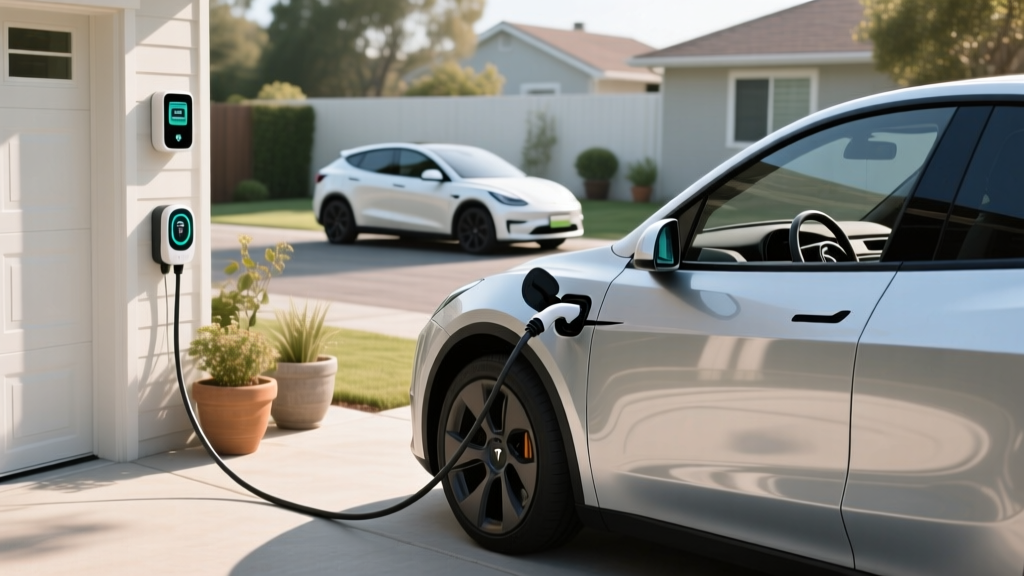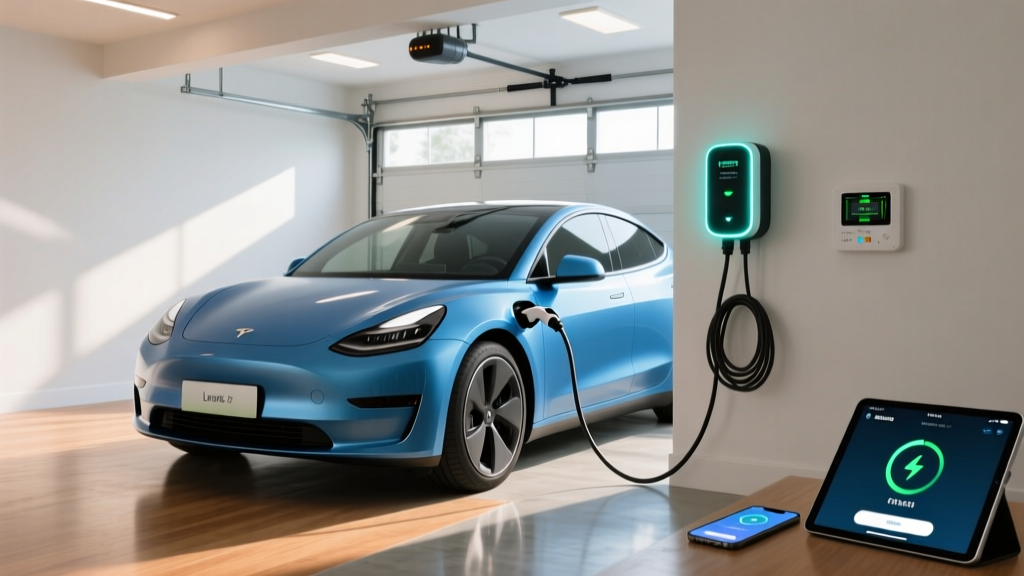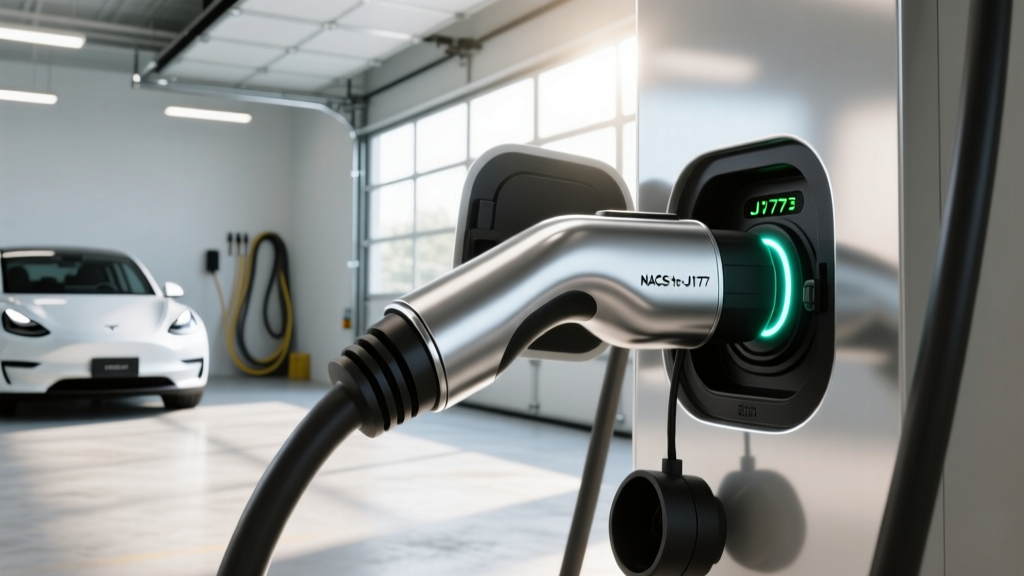
The North American Charging Standard (NACS) connector — originally Tesla's proprietary plug — has become the dominant EV charging connector in the United States. By 2026, nearly every major automaker has adopted NACS on new vehicles, and thousands of legacy J1772-equipped EVs still need a way to access the expanding Supercharger network and NACS-equipped home chargers. That's where a NACS-to-J1772 adapter becomes essential hardware for millions of EV owners.
This guide covers exactly which adapters work for Level 2 home charging versus DC fast charging, what home charger installation really costs (including panel upgrades), how fast each charging level adds range, and what you'll pay per mile compared to gasoline. Whether you drive a Chevy Bolt, a Hyundai Ioniq 5 with a CCS port, or a Rivian that already switched to NACS, you'll know exactly what to buy and what to budget.
Understanding Charging Levels: kW, kWh, and Miles Per Hour
Before choosing an adapter or charger, you need clarity on the three charging levels and how they differ in power delivery. The critical distinction: kW (kilowatts) measures power — the rate at which electricity flows into your car. kWh (kilowatt-hours) measures energy — the total capacity of your battery. Think of kW as how fast water flows from a hose, and kWh as the size of the bucket you're filling.
| Level | Voltage / Amps | Power (kW) | Miles of Range Per Hour | Typical Use Case |
|---|---|---|---|---|
| Level 1 | 120V / 12A | 1.4 kW | 3–5 mi/hr | Overnight trickle; emergency top-ups |
| Level 2 (Home) | 240V / 32–48A | 7.7–11.5 kW | 25–44 mi/hr | Daily home and workplace charging |
| Level 2 (Max) | 240V / 80A | 19.2 kW | 55–70 mi/hr | High-power home (Tesla Wall Connector on 100A circuit) |
| DC Fast (50 kW) | 400–800V DC | 50 kW | ~150 mi/hr | Older public DC stations, CHAdeMO |
| DC Fast (150 kW) | 400–800V DC | 150 kW | ~400–500 mi/hr | Typical Electrify America / EVgo stations |
| DC Fast (250–350 kW) | 400–900V DC | 250–350 kW | ~700–1,000+ mi/hr | Tesla V3/V4 Superchargers, EA 350 kW stalls |
Real-world caveat: Those "miles per hour" figures assume a vehicle averaging 3–4 mi/kWh (typical for a midsize crossover like the Tesla Model Y or Hyundai Ioniq 5). A heavier vehicle like the Ford F-150 Lightning (averaging ~2 mi/kWh) will add fewer miles per hour at the same kW rate. DC fast charging speeds also taper significantly above 80% state of charge — a 250 kW peak rate typically sustains only from 10–50% SoC before dropping to 100 kW or less.
NACS, J1772, CCS1, and CHAdeMO: Connector Compatibility Explained
The connector landscape in 2026 has simplified considerably, but adapter needs remain for millions of existing EVs. Here's the breakdown by connector type and what adapters exist:
| Connector | AC Level 2 | DC Fast | Vehicles Using It (2026) | Adapter Options |
|---|---|---|---|---|
| NACS (Tesla) | Yes | Yes (same plug) | Tesla (all), Ford, GM, Rivian, Volvo, Polestar, Hyundai/Kia (2025+ models) | NACS-to-J1772 (AC only); NACS-to-CCS1 (DC) |
| J1772 | Yes | No | Chevy Bolt, older Nissan Leaf, BMW i3, most pre-2025 non-Tesla EVs | J1772-to-NACS adapter for Tesla chargers |
| CCS1 | Via J1772 top | Yes (lower pins) | Pre-2025 VW ID.4, Hyundai Ioniq 5, Kia EV6, BMW i4/iX, Ford Mach-E (pre-NACS) | CCS1-to-NACS adapter for Superchargers |
| CHAdeMO | Via J1772 | Yes | Nissan Leaf (legacy), Mitsubishi Outlander PHEV (older) | Limited; CHAdeMO-to-NACS adapters rare/expensive |
Which NACS-to-J1772 Adapter Do You Actually Need?
There's a critical distinction that catches many buyers off guard:
- NACS-to-J1772 adapter (AC only, ~$100–$170): Lets a J1772-equipped EV plug into a NACS Level 2 charger (like a Tesla Wall Connector or a NACS destination charger). This handles home and workplace AC charging only. Brands like Lectron, A2Z, and Tesla's own adapter (for non-Tesla vehicles at Tesla destinations) are widely available.
- NACS-to-CCS1 adapter (DC fast, ~$200–$300): Required if your CCS1-equipped EV needs to use a Tesla Supercharger. These adapters handle high-power DC charging up to 250 kW. Tesla sells an official CCS-to-NACS adapter, and third-party options from Lectron and A2Z are also certified. Ford, GM, and Rivian owners who received OEM adapters with their vehicles should use those for guaranteed compatibility.
- J1772-to-NACS adapter: The reverse direction — lets a NACS-equipped EV (like a 2025+ Ford Mustang Mach-E or Hyundai Ioniq 5 NACS version) plug into a legacy J1772 Level 2 charger. Tesla includes this adapter with every new vehicle.
Important safety note: Never use an AC-only NACS-to-J1772 adapter at a DC fast charger. The adapter is not rated for DC voltage or the amperage involved, and doing so can damage your vehicle's onboard charger or create a fire hazard. Always verify whether your adapter is rated for AC (Level 2) or DC fast charging.
How Much Does It Cost to Install a Home EV Charger?
Home Level 2 charging is where most EV owners do 80–90% of their charging. Installation costs vary enormously depending on your electrical panel's capacity, the distance from the panel to the charger location, and local permit requirements.
| Component | Low-End Estimate | High-End Estimate | Notes |
|---|---|---|---|
| Level 2 charger (hardware) | $300 | $700 | 32A–48A smart chargers; 80A units up to $900 |
| Electrician labor (standard install) | $400 | $1,200 | Short run from panel, NEMA 14-50 outlet or hardwired |
| Electrician labor (long run / conduit) | $1,000 | $2,500 | Panel in basement, charger in detached garage, 50+ ft run |
| Permit and inspection | $50 | $300 | Varies by municipality; some jurisdictions waive EV permits |
| Electrical panel upgrade (if needed) | $1,500 | $4,000+ | Upgrading from 100A to 200A service; older homes most at risk |
| Total (no panel upgrade) | $750 | $2,500 | Most homes with 200A service and short wire runs |
| Total (with panel upgrade) | $2,250 | $6,500+ | Homes with 100A service or maxed-out panels |
What Electrical Upgrades Might You Need?
A 48-amp Level 2 charger requires a dedicated 60-amp circuit (NEC code requires circuits to be rated at 125% of continuous load). A 32-amp charger needs a 40-amp circuit. Here's when upgrades become necessary:
- 100-amp service panels: Common in homes built before 1990. Adding a 60-amp EV circuit may exceed your panel's capacity, especially if you have electric heating, an electric oven, and a dryer. A panel upgrade to 200A is likely required.
- 200-amp service panels: Most homes built after 2000. Usually sufficient for a 48A charger without upgrade, but if your panel is already near capacity (electric heat, pool, hot tub), an electrician may recommend a load-management device or subpanel.
- Smart load management: Devices like the Emporia Load Manager or Tesla's built-in load-sharing can dynamically reduce charger amperage when other household loads spike, potentially avoiding a panel upgrade. This is a $200–$400 add-on that can save thousands.
Always hire a licensed electrician familiar with NEC Article 625 (EV charging equipment). A proper installation includes a dedicated circuit, GFCI protection (required for outdoor outlets), and a permit with inspection. Skip the permit and you risk voiding your homeowner's insurance if an electrical fire occurs.
Recommended Home Chargers for 2026
Here are proven Level 2 chargers that work well with adapter-equipped setups, with exact specs and pricing:
Tesla Wall Connector (NACS)
- Power output: Up to 11.5 kW (48A) on a 60A circuit; up to 19.2 kW (80A) on a 100A circuit
- Connector: NACS native — J1772 vehicles need a NACS-to-J1772 adapter
- Cable length: 24 ft
- Smart features: Wi-Fi, OTA updates, load sharing between multiple units, access control
- Price: ~$475 (24 ft, NACS)
- Best for: Tesla owners or NACS-native EVs; J1772 EVs can use it with an adapter
ChargePoint Home Flex (J1772)
- Power output: Up to 12 kW (50A) on a 60A circuit; adjustable down to 16A
- Connector: J1772 native — NACS vehicles use J1772-to-NACS adapter
- Cable length: 23 ft
- Smart features: Wi-Fi, Alexa integration, scheduling, energy tracking via app
- Price: ~$550 (J1772)
- Best for: J1772-equipped EVs (Chevy Bolt, older Leafs); flexible amperage for limited panels
Emporia Vue Level 2 Charger (J1772)
- Power output: Up to 11.5 kW (48A) on a 60A circuit
- Connector: J1772 native
- Cable length: 24 ft
- Smart features: Integrated energy monitoring (pairs with Emporia Vue panel monitor), solar-aware charging, load management
- Price: ~$400
- Best for: Budget-conscious buyers who want energy monitoring; solar-home integration
Grizzl-E Smart (J1772 or NACS)
- Power output: Up to 10 kW (40A) on a 50A circuit
- Connector: Available in J1772 or NACS
- Cable length: 24 ft
- Smart features: Wi-Fi, OCPP compatibility, adjustable amperage (16A–40A)
- Price: ~$450
- Best for: Cold-climate durability (rated to -40°F); Canadian-built with 3-year warranty
How Much Does Charging Cost Per Mile vs. Gas?
One of the strongest arguments for home EV charging is the per-mile cost advantage. Here's a realistic comparison using 2026 electricity and fuel prices:
| Scenario | Cost per kWh | Vehicle Efficiency | Cost Per Mile | Annual Cost (12,000 mi) |
|---|---|---|---|---|
| Home Level 2 (off-peak, national avg) | $0.13/kWh | 3.5 mi/kWh | $0.037 | $444 |
| Home Level 2 (California, PG&E TOU) | $0.32/kWh (peak) / $0.14 (off-peak) | 3.5 mi/kWh | $0.04–$0.09 | $480–$1,080 |
| Public Level 2 (ChargePoint, EVgo) | $0.25–$0.49/kWh | 3.5 mi/kWh | $0.07–$0.14 | $840–$1,680 |
| DC Fast (Electrify America, Tesla Supercharger) | $0.35–$0.55/kWh | 3.5 mi/kWh | $0.10–$0.16 | $1,200–$1,920 |
| Gasoline (25 MPG combined, $3.40/gal) | — | 25 mi/gal | $0.136 | $1,632 |
| Gasoline (30 MPG combined, $3.40/gal) | — | 30 mi/gal | $0.113 | $1,356 |
The bottom line: Home off-peak charging at the national average of $0.13/kWh delivers fuel costs roughly 70–75% lower than a 25 MPG gas car. Even public DC fast charging at premium rates is often comparable to or cheaper than gasoline per mile. The savings widen further if you have rooftop solar — your effective cost per kWh can drop to $0.05–$0.08, making per-mile fuel costs under $0.02.
However, if you rely exclusively on public DC fast charging at $0.45–$0.55/kWh (common in urban areas without home charging access), your annual fuel cost can actually exceed that of an efficient 30 MPG hybrid. Home charging access is the single biggest factor in EV operating-cost advantage.
Charging Time Examples: How Long to Go From 10% to 80%?
Charging time depends on three variables: battery capacity (kWh), charger power (kW), and the vehicle's charge curve (how fast it can accept power at different states of charge). Here are real-world estimates for common battery sizes:
| Battery Size | Example Vehicles | Level 2 at 7.7 kW (32A) | Level 2 at 11.5 kW (48A) | DC Fast at 150 kW (peak) | DC Fast at 250 kW (peak) |
|---|---|---|---|---|---|
| 60 kWh usable | Chevy Bolt EV, base Model 3 RWD | ~5.5 hours | ~3.7 hours | ~28 min | ~22 min |
| 77 kWh usable | Ford Mach-E ER, VW ID.4 Pro S | ~7 hours | ~4.7 hours | ~33 min | ~25 min |
| 84 kWh usable | Hyundai Ioniq 5 (Long Range), Kia EV6 | ~7.6 hours | ~5.1 hours | ~28 min (800V architecture) | ~18 min (800V) |
| 100 kWh usable | Tesla Model S, Rivian R1S (Max Pack) | ~9 hours | ~6.1 hours | ~38 min | ~28 min |
| 131 kWh usable | Ford F-150 Lightning Extended, Hummer EV | ~12 hours | ~8 hours | ~50 min | ~38 min |
Charge curve reality check: The DC fast times above assume the vehicle can sustain its peak charge rate from 10% to roughly 50% SoC, after which charging speed tapers to protect the battery. A Hyundai Ioniq 5 with its 800V architecture can sustain ~230 kW from 10–55% before tapering, which is why its 10–80% time is exceptionally fast. A Chevy Bolt, limited to ~55 kW DC fast charging, will take considerably longer even at a 150 kW station because the car — not the charger — is the bottleneck.
For Level 2 home charging, most EVs charge overnight (8–10 hours) from near-empty to full, which covers virtually all daily driving needs. The U.S. average daily commute is roughly 35 miles round trip, requiring about 10 kWh of replenishment — easily handled in 1–2 hours on any Level 2 charger.
Safety, Code, and Best Practices
EV charging involves sustained high-current draw over many hours — more demanding on your electrical system than almost any other household appliance. Follow these requirements:
- Dedicated circuit: NEC Article 625 requires EV chargers to be on a dedicated circuit not shared with other outlets or appliances. A 48A charger needs a 60A breaker with appropriately sized wire (typically 6 AWG copper for runs under 50 ft, 4 AWG for longer runs).
- GFCI protection: Required for all outdoor receptacles. If installing a NEMA 14-50 outlet outdoors, the breaker must be GFCI type. Hardwired chargers (no plug) installed indoors typically don't require GFCI at the breaker since the charger has built-in ground-fault protection.
- NEMA 14-50 vs. hardwired: A NEMA 14-50 outlet gives you portability (take the charger when you move), but is limited to 40A continuous (50A breaker × 80%). Hardwired installations can deliver up to 48A continuous on a 60A breaker, or 80A on a 100A breaker, giving you faster charging. Hardwired also eliminates the GFCI nuisance-tripping issue some owners experience with 14-50 outlets.
- Outdoor rating: If your charger is installed outdoors, ensure it carries a NEMA 4 or IP65 rating for weather resistance. Most quality chargers (Tesla Wall Connector, ChargePoint Home Flex, Grizzl-E) are rated for outdoor use.
- Cable management: Use a wall-mounted cable organizer to prevent the charging cable from lying on the ground where it can be damaged, tripped over, or exposed to standing water.
Frequently Asked Questions
Can I use a NACS-to-J1772 adapter at a Tesla Supercharger?
No. A standard NACS-to-J1772 adapter only handles AC Level 2 charging (up to 19.2 kW / 80A). Tesla Superchargers deliver DC fast charging at up to 250 kW, which requires a DC-rated adapter. J1772-only vehicles (like the Chevy Bolt) cannot use Superchargers at all because J1772 lacks DC fast pins. CCS1-equipped vehicles need a CCS1-to-NACS DC adapter to access Superchargers, and only at stations Tesla has opened to non-Tesla vehicles via the "Charge with NACS" program.
How fast will a NACS-to-J1772 adapter charge my car at home?
The adapter itself doesn't limit charging speed — your car's onboard charger does. Most J1772 vehicles have onboard chargers rated at 7.2 kW (32A) or 11.5 kW (48A). A Chevy Bolt, for example, accepts up to 11.5 kW on Level 2, so it will charge at the same speed through a NACS-to-J1772 adapter on a Tesla Wall Connector as it would on a native J1772 charger. The adapter simply converts the physical connector; it does not step down power.
Do I need a permit to install a home EV charger?
In most U.S. jurisdictions, yes. Installing a new 240V circuit for EV charging requires an electrical permit and inspection. Permit fees typically range from $50 to $300 depending on your municipality. Some cities and utilities offer expedited or waived permits for EV charger installations to encourage adoption. Check with your local building department — skipping the permit risks insurance claim denial if an electrical fire occurs.
Is it cheaper to charge at home or at public stations?
Home charging is almost always cheaper. At the 2026 national average residential rate of ~$0.13/kWh, home Level 2 charging costs roughly $0.037 per mile for an average EV. Public DC fast chargers charge $0.35–$0.55/kWh, making per-mile costs $0.10–$0.16 — three to four times more expensive. Over 12,000 annual miles, the difference between home and exclusive DC fast charging can exceed $1,200 per year. If you can install a home charger, it's the single highest-ROI investment in EV ownership.
Will a NACS-to-J1772 adapter void my car's warranty?
Using a quality, properly rated adapter from a reputable manufacturer (Tesla, Lectron, A2Z) should not void your vehicle's warranty. The Magnuson-Moss Warranty Act prevents manufacturers from voiding warranties solely because you used a third-party accessory, unless they can prove the accessory caused the damage. That said, always keep the adapter's specifications and purchase receipt, and ensure it's UL-listed or certified to relevant safety standards.
Sources: U.S. Department of Energy Alternative Fuels Data Center for charging infrastructure data; fueleconomy.gov for vehicle efficiency ratings; National Electrical Code Article 625 for installation requirements.