By 2026, the North American Charging Standard (NACS) has decisively won the connector war. Every major automaker — Ford, GM, Rivian, Hyundai, BMW, and more — has either adopted NACS natively on new models or committed to it for upcoming platforms. But if you own a CCS1-equipped EV purchased before the transition, you're likely wondering how to access Tesla's expansive Supercharger network. The answer: a reliable NACS to CCS adapter for Tesla Supercharger access.
This guide covers exactly which adapters work, the real-world charging speeds you can expect, what the economics look like compared to gas, and how to set up a complete charging ecosystem at home. We'll also walk through the electrical realities of home charger installation — including the panel upgrades that catch many buyers off guard.
Why You Need a NACS to CCS Adapter in 2026
When Tesla opened its Supercharger network to non-Tesla vehicles under the "Magic Dock" program in 2023–2024, it used a built-in CCS adapter at select stalls. That approach has largely been superseded by the broader industry shift to NACS. Today, Tesla Superchargers with the native NACS connector outnumber Magic Dock-equipped stalls significantly. According to Tesla's Supercharger network page, there are over 60,000 Supercharger connectors across North America — and the vast majority are NACS.
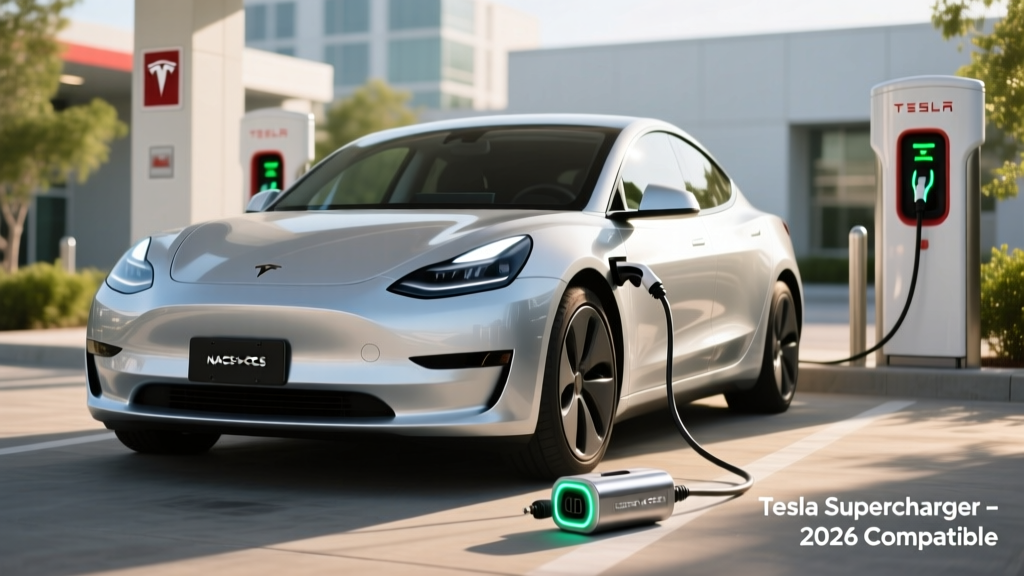
If your EV has a CCS1 charge port (which includes most non-Tesla EVs built before the 2025–2026 model year transition), you need a NACS-to-CCS1 adapter to plug into these stalls. The adapter converts the physical connector; your car still communicates via the CCS protocol over the adapter's pass-through wiring.
Connector Compatibility by Brand (2026 Models)
| Connector Type | Brands Using Natively (2026) | Brands Requiring Adapter for Superchargers |
|---|---|---|
| NACS (Tesla) | Tesla (all), Ford (2025+), GM (2025+), Rivian (2025+), BMW (2026+) | None — native access |
| CCS1 | Hyundai (pre-2026), Kia (pre-2026), VW (pre-2026), older BMW/Mercedes | Need NACS-to-CCS1 adapter for Supercharger access |
| CHAdeMO | Nissan Leaf (legacy only) | CHAdeMO-to-NACS adapters extremely limited; rely on Electrify America, EVgo |
Understanding Charging Levels: kW, Speeds, and What to Expect
Before evaluating adapters and Supercharger speeds, it's essential to understand the three charging levels — and critically, the difference between kW (kilowatts, a measure of power or charge rate) and kWh (kilowatt-hours, a measure of energy or battery capacity). Think of kW as how fast water flows from a hose, and kWh as the size of the bucket you're filling.
| Charging Level | Voltage | Max Power (kW) | Miles of Range Added per Hour | Typical Use Case |
|---|---|---|---|---|
| Level 1 | 120V AC | 1.2–1.9 kW | 3–5 miles/hr | Overnight top-ups, emergency, PHEVs |
| Level 2 | 240V AC | 3.3–19.2 kW | 12–75 miles/hr | Home daily charging, workplace, destinations |
| DC Fast Charging | 200–900V DC | 50–350 kW | 150–1,200+ miles/hr (peak) | Road trips, highway corridors, rapid top-ups |
Charging Time Examples for Common Battery Sizes
Here's how long typical 10–80% charges take at each level, assuming common battery capacities:
- 60 kWh battery (e.g., Chevy Equinox EV): Level 2 at 11.5 kW ≈ 4 hours; DC fast at 150 kW peak ≈ 25 minutes (10–80%)
- 77 kWh battery (e.g., Ford Mustang Mach-E Extended Range): Level 2 at 11.5 kW ≈ 5 hours; DC fast at 150 kW peak ≈ 32 minutes (10–80%)
- 84 kWh battery (e.g., Hyundai Ioniq 5 Long Range): Level 2 at 11.5 kW ≈ 5.5 hours; DC fast at 238 kW peak ≈ 18 minutes (10–80%)
- 100 kWh battery (e.g., GMC Sierra EV): Level 2 at 19.2 kW ≈ 4 hours; DC fast at 350 kW peak ≈ 22 minutes (10–80%)
Real-world caveat: DC fast charging speeds follow a curve, not a flat line. Your vehicle will hit peak kW only between roughly 10–30% state of charge. Above 50%, speed tapers significantly, and above 80%, it slows dramatically to protect battery health. A charger rated at 250 kW doesn't deliver 250 kW for the entire session. Cold batteries also charge slower — preconditioning your battery before arriving at the charger is critical in winter.
Tesla Supercharger Speeds with a NACS-to-CCS Adapter
Tesla Superchargers come in several generations, and your adapter-equipped charging speed will depend on which stall type you use:
- V2 Supercharger (150 kW max): Widely available. Expect 120–145 kW peak with a CCS adapter. 10–80% in roughly 30–40 minutes for a 75–80 kWh battery.
- V3 Supercharger (250 kW max): The current backbone. Expect 150–200 kW peak with a quality CCS adapter (adapter thermal limits and vehicle acceptance rate both play a role). 10–80% in roughly 20–30 minutes for a 75–80 kWh battery.
- V4 Supercharger (up to 350 kW for compatible vehicles): Newer installations with integrated cable management. CCS-adapted vehicles typically see 180–250 kW peak depending on vehicle architecture (800V vehicles like the Ioniq 5 benefit most).
Not every adapter handles the same power levels. Budget adapters may thermally throttle above 100 kW or lack proper temperature sensors. We recommend only adapters rated for at least 250 kW / 500A continuous DC to ensure you're not bottlenecked at V3 stalls.
Recommended NACS-to-CCS Adapters
Here are the adapters that have proven reliable in real-world testing and community reports as of 2026:
Lectron NACS to CCS1 Adapter
- Max Power: 250 kW / 500A DC
- Max Voltage: 1,000V DC
- Price: ~$179–$209
- Features: IP55 weather rating, built-in temperature monitoring, locking mechanism compatible with Tesla stall cable retention
- Best For: Everyday Supercharger access for CCS1 vehicles
Tesla Official CCS Adapter (for Tesla vehicles — reverse use note)
- Note: Tesla sells a CCS-to-NACS adapter designed for Tesla vehicles to use CCS stations. This does NOT work in reverse for CCS vehicles at NACS Superchargers. Do not purchase this for a non-Tesla EV.
- Price: ~$175 (for Tesla vehicles only)
A2Z EV NACS to CCS1 Adapter (Tyger Auto)
- Max Power: 250 kW / 400A DC
- Max Voltage: 1,000V DC
- Price: ~$159–$189
- Features: IP54 rated, compact form factor, 2-year warranty
- Best For: Budget-conscious owners who primarily use V2 Superchargers
Key buying advice: Always verify the adapter is rated for DC fast charging (not just Level 2 AC). Some cheap adapters online only support AC charging and will not pass DC current at Supercharger stalls. Look for explicit DC kW and amperage ratings, plus independent testing certifications (UL, TÜV, or CE at minimum).
Home Charging Setup: What It Really Costs
Public DC fast charging is essential for road trips, but 80–90% of EV charging happens at home. Installing a dedicated Level 2 home charger is the single most impactful upgrade for EV ownership convenience. Here's what the electrical requirements look like and what you should budget.
Electrical Requirements
A typical Level 2 home charger requires:
- Voltage: 240V (same as your electric dryer or oven)
- Amperage: 40A circuit for a 32A charger, or 50A circuit for a 40A charger, or 60A circuit for a 48A charger (the circuit must be rated at 125% of the continuous load per NEC code)
- Dedicated circuit: Your charger must have its own breaker — you cannot share a circuit with other high-draw appliances
- GFCI protection: Required by NEC 2023+ for EV charging outlets (some hardwired chargers have internal GFCI)
- Outdoor rating: If your charger is installed outdoors (garage or exterior wall), the unit and connector must carry an appropriate NEMA 4 or IP55+ rating
Panel Upgrade Reality
Many homes built before 2000 have 100A electrical panels. Adding a 40–60A dedicated EV circuit to an already-loaded 100A panel may exceed capacity. A panel upgrade to 200A typically costs $1,500–$3,500 depending on your utility, local labor rates, and whether new service lines are needed. Some utilities offer rebates that offset this cost.
An alternative: a smart panel load manager (like the Span panel or Emporia Smart Load Manager) can dynamically share capacity between your charger and other circuits, sometimes avoiding a full panel upgrade. These cost $300–$600 for the hardware plus installation.
Home Level 2 Charger Installation Cost Breakdown
| Component | Low Estimate | High Estimate | Notes |
|---|---|---|---|
| Level 2 Charger (hardware) | $350 | $700 | Varies by brand, power output, smart features |
| Electrician labor | $500 | $2,000 | Depends on run length, conduit, panel proximity |
| Electrical permit | $50 | $250 | Required in most jurisdictions; varies by locality |
| Panel upgrade (if needed) | $1,500 | $3,500 | 100A to 200A service upgrade; not always required |
| Total (no panel upgrade) | $900 | $2,950 | Most homes with 200A panels fall in $1,200–$2,000 |
| Total (with panel upgrade) | $2,400 | $6,450 | Older homes with 100A service |
Recommended Home Level 2 Chargers
Tesla Wall Connector (Universal)
- Power Output: Up to 48A / 11.5 kW (on 60A circuit)
- Connector: NACS native; includes J1772 adapter in box for CCS/J1772 vehicles
- Cable Length: 24 feet
- Smart Features: Wi-Fi, firmware updates, power sharing with multiple units, access control
- Price: ~$450
ChargePoint Home Flex
- Power Output: Configurable 16A–50A / up to 12 kW (on 60A circuit)
- Connector: J1772 (compatible with all CCS1 EVs natively; NACS vehicles need adapter)
- Cable Length: 23 feet
- Smart Features: Wi-Fi, app scheduling, Alexa integration, amperage dip-switch adjustable
- Price: ~$550–$650
Emporia Vue Level 2 EV Charger
- Power Output: Up to 48A / 11.5 kW (on 60A circuit)
- Connector: J1772 (CCS1 compatible); NACS version available
- Cable Length: 24 feet
- Smart Features: Integrates with Emporia energy monitoring, solar-aware scheduling, load management
- Price: ~$399
Charging Cost: Home vs. Public vs. Gas
One of the strongest economic arguments for EV ownership is the fuel cost differential. But the savings depend heavily on where you charge.
Cost Per Mile: EV Charging vs. Gasoline (2026 Averages)
| Scenario | Cost per kWh | Vehicle Efficiency (kWh/mi) | Cost per Mile | Equivalent Gas MPG at $3.40/gal |
|---|---|---|---|---|
| Home (off-peak TOU rate) | $0.09–$0.14 | 0.28–0.33 | $0.025–$0.046 | 74–136 MPG |
| Home (standard flat rate) | $0.14–$0.20 | 0.28–0.33 | $0.039–$0.066 | 52–87 MPG |
| Public Level 2 (ChargePoint, etc.) | $0.25–$0.49 | 0.28–0.33 | $0.070–$0.162 | 21–49 MPG |
| Tesla Supercharger (V3) | $0.28–$0.42 | 0.28–0.33 | $0.078–$0.139 | 24–44 MPG |
| Electrify America DC Fast | $0.36–$0.56 | 0.28–0.33 | $0.101–$0.185 | 18–34 MPG |
| Gasoline (28 MPG avg sedan) | — | — | $0.121 | 28 MPG (baseline) |
The bottom line: If you charge primarily at home on an off-peak rate, your fuel cost per mile is roughly one-quarter to one-third of a comparable gas vehicle. Even at public DC fast chargers, most scenarios still beat gasoline — but the margin narrows, especially on premium-priced networks. According to the U.S. Department of Energy's EV cost tools on fueleconomy.gov, the national average electricity rate for EV charging yields significant savings over gasoline in most states.
Safety, Code, and Installation Best Practices
EV charging draws significant current for extended periods — often 4–8 continuous hours. This makes proper installation non-negotiable.
- Dedicated circuit: Your Level 2 charger must be on its own breaker. Sharing with a dryer or HVAC circuit creates a fire risk.
- Wire gauge: 6 AWG copper for 50A circuits; 4 AWG for 60A circuits. Aluminum wire requires upsizing.
- Hardwired vs. plug-in: Hardwired chargers (no plug) eliminate the NEMA 14-50 receptacle as a failure point and are preferred for 48A+ chargers. If using a NEMA 14-50 outlet, use an industrial-grade receptacle (Hubbell, Bryant) — consumer-grade 14-50 outlets have been linked to overheating in sustained EV charging use.
- GFCI: NEC 2023 and later require GFCI protection on EV charging receptacles. Hardwired chargers with internal ground-fault protection may satisfy this requirement — check with your local inspector.
- Outdoor installation: Use a charger rated NEMA 4 or IP55 minimum. Ensure the connector holster shields the plug from rain and debris.
- Permit and inspection: Most jurisdictions require an electrical permit for new 240V circuits. The inspection verifies wire gauge, breaker sizing, grounding, and GFCI compliance. Skipping the permit can void home insurance coverage for electrical fires.
Always hire a licensed electrician familiar with EV charging installations. The National Electrical Code (NEC) governs these installations, and local amendments may add further requirements.
Using Your Adapter at Tesla Superchargers: Step-by-Step
- Open the Tesla app (create an account if you haven't). Tesla requires non-Tesla vehicles to use the app to initiate and monitor Supercharger sessions at NACS stalls.
- Locate a compatible Supercharger. In the Tesla app, filter for stalls that support non-Tesla vehicles. Not every Supercharger site is open to CCS-adapted cars — some remain Tesla-only due to congestion or layout constraints.
- Attach the NACS-to-CCS adapter to your vehicle's CCS1 charge port first, then connect the Supercharger cable to the adapter's NACS receptacle.
- Initiate the session via the Tesla app using the stall number displayed on the Supercharger post.
- Monitor your charge. Your vehicle's app or dashboard will display the charge rate. Expect the curve to taper above 50–60% SoC.
- Disconnect carefully. Release the session in the app, then unplug the Supercharger cable from the adapter, and remove the adapter from your vehicle. Store the adapter in a protective case to keep the contacts clean.
Pro tip: Some CCS vehicles (particularly older Hyundai/Kia models) occasionally fail to handshake with Tesla Superchargers through certain adapters. If a session fails to initiate, try disconnecting and reconnecting the adapter firmly, ensuring the CCS pins are fully seated. Firmware updates on your vehicle may also resolve compatibility issues.
Frequently Asked Questions
How much does it cost to install a home EV charger?
For a typical Level 2 charger installation in a home with an existing 200A electrical panel, expect to pay between $1,200 and $2,000 all-in (charger hardware, electrician labor, and permit). If your home has an older 100A panel that needs upgrading to 200A, total costs can reach $2,400–$6,450. Always get at least two quotes from licensed electricians and verify that a permit is included.
How fast will each charging level add range?
Level 1 (120V) adds roughly 3–5 miles per hour — fine for PHEVs with small batteries, inadequate for most BEVs. Level 2 (240V, 40–48A) adds 25–40 miles per hour, enough to fully recharge most EVs overnight. DC fast charging at 150+ kW can add 150–300+ miles in 20–30 minutes, but speed tapers significantly above 80% state of charge.
Which connector and charger is compatible with my EV?
If your EV was built in 2025 or later by Ford, GM, Rivian, or BMW, it likely has a native NACS port — no adapter needed for Tesla Superchargers. If your EV has a CCS1 port (most pre-2025 non-Tesla EVs), you'll need a NACS-to-CCS1 adapter for Supercharger access. CHAdeMO vehicles (Nissan Leaf) have very limited adapter options and should rely on Electrify America or EVgo networks. For home Level 2 charging, any J1772 or NACS-compatible charger will work with the appropriate plug or adapter.
How much does charging cost per mile vs. gas?
Charging at home on off-peak rates costs approximately $0.03–$0.05 per mile — equivalent to a gas car getting 70–130 MPG at $3.40/gallon. Public DC fast charging at $0.28–$0.56/kWh works out to $0.08–$0.19 per mile, which is still competitive with or cheaper than a 28 MPG gas car at $0.12 per mile. The biggest savings come from home charging; relying exclusively on public fast charging narrows the economic advantage.
What electrical upgrades might I need?
The most common upgrade is a panel capacity increase from 100A to 200A, costing $1,500–$3,500. You may also need new conduit runs if your panel is far from the desired charger location (adding $200–$800 in materials and labor). In some cases, a smart load management device ($300–$600) can avoid a panel upgrade entirely by dynamically sharing capacity between circuits. Your electrician will perform a load calculation to determine if your existing panel can support a new 40–60A circuit.
Can I use a NACS-to-CCS adapter at any Supercharger?
No. Tesla designates specific Supercharger sites (and sometimes specific stalls within a site) as open to non-Tesla vehicles. The Tesla app will show you which locations support non-Tesla charging. Availability has expanded significantly through 2025–2026 as part of Tesla's National Electric Vehicle Infrastructure (NEVI) commitments, but some urban and high-traffic sites remain Tesla-only.
Does the adapter affect charging speed?
A quality adapter rated for 250 kW should not meaningfully bottleneck your charge speed. However, cheap or under-rated adapters may thermally throttle above 100–150 kW. The bigger speed limitation is usually your vehicle's onboard charge acceptance rate — a vehicle that peaks at 150 kW won't benefit from a 250 kW stall regardless of adapter.
For current federal incentive information on home charger installation (the §30C alternative fuel infrastructure credit covers up to $1,000 for residential charger equipment and installation), consult the IRS alternative fuel refueling property credit page. Eligibility depends on location in qualifying census tracts and other requirements that vary by jurisdiction.