The NACS Connector Is Now the Standard — Here's What That Means for Your Garage
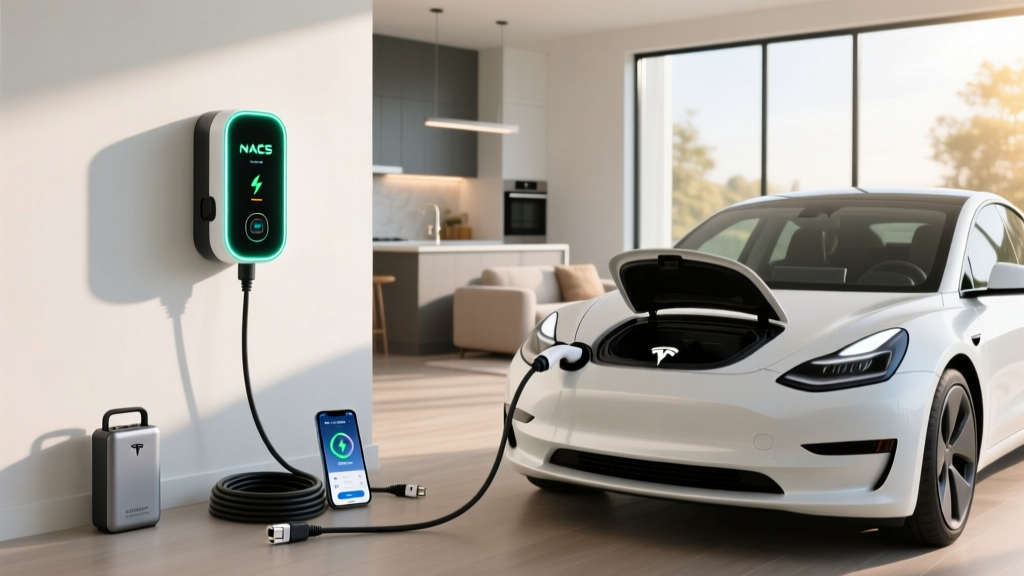
If you've shopped for an EV in the last two years, you've seen the shift. The North American Charging Standard (NACS) connector — originally developed by Tesla and opened to the industry in late 2022 — has become the dominant charging interface for new electric vehicles sold in the United States. By the 2026 model year, nearly every major automaker has adopted NACS as the native charge port on their EVs, from Ford and GM to Hyundai, Kia, and Rivian.
But adoption doesn't mean simplicity. If you own an older EV with a CCS1 port, or you're installing a home charger and trying to future-proof, the connector landscape still has real practical implications. This guide covers exactly what the NACS connector means for your home charging setup, what adapters you might need, how much installation actually costs, and which Level 2 chargers are worth buying right now.
First, let's clear up the single most common source of EV confusion: the difference between kW (kilowatts) and kWh (kilowatt-hours). A kW is a unit of power — think of it as the speed of electricity flowing into your car. A kWh is a unit of energy — the total amount stored in your battery, like gallons in a fuel tank. A 72 kWh battery charged at 11.5 kW takes roughly 6.3 hours from empty to full. Confusing the two leads to bad charger purchases and unrealistic expectations.
Charging Levels Explained: Speeds in kW and Miles Per Hour
Every EV charges at one of three levels. The connector type (NACS, CCS1, CHAdeMO) is separate from the charging level — NACS supports both Level 2 AC and DC fast charging on the same physical plug, which is one of its key design advantages.
| Level | Power Source | Typical kW Output | Miles of Range Added Per Hour | Best For |
|---|---|---|---|---|
| Level 1 | 120V AC (standard outlet) | 1.2–1.9 kW | 3–5 mi/hr | Overnight top-ups, PHEVs, emergencies |
| Level 2 | 240V AC (dryer-style outlet or hardwired) | 7.2–19.2 kW | 20–65 mi/hr | Daily home charging, workplace |
| DC Fast Charging | 480V+ DC (public stations) | 50–350 kW | 150–1,000+ mi/hr | Road trips, rapid top-ups |
For context, a typical commuter driving 35 miles round-trip needs roughly 10–12 kWh replenished daily. A Level 2 charger delivering 11.5 kW (48 amps on a 60-amp circuit) replaces that in under an hour. Level 1 can work for plug-in hybrids with smaller batteries (a Toyota RAV4 Prime's 18.1 kWh battery charges fully overnight on 120V), but full-size BEVs with 75–100 kWh batteries would take multiple days on Level 1 alone.
DC fast charging is for road trips, not daily use. Sustained DC fast charging accelerates battery degradation if used exclusively, and the charge curve tapers significantly above 80% State of Charge (SoC). A vehicle that peaks at 250 kW from 10–30% SoC might drop to 40 kW by the time it reaches 85%. That's why manufacturers quote 10–80% charge times — it's the useful, high-speed window.
Connector Compatibility: NACS, CCS1, and CHAdeMO in 2026
Here's where things get practical. The connector on your EV determines which chargers you can plug into without an adapter. As of 2026, the landscape looks like this:
| Connector | Automakers Using It (Native) | DC Fast Charging Access | Adapter Needed? |
|---|---|---|---|
| NACS (Tesla standard) | Tesla, Ford, GM, Rivian, Volvo, Polestar, Hyundai, Kia, BMW, Mercedes-Benz (newer models) | Tesla Supercharger network + NACS-equipped public stations | CCS1 vehicles need a NACS-to-CCS adapter for Supercharger access |
| CCS1 | Older VW ID.4, older Hyundai Ioniq 5/6, older Kia EV6, legacy models (pre-adoption) | Electrify America, EVgo, ChargePoint DC stations | Some CCS1 vehicles now have OEM-approved NACS adapters for Supercharger access |
| CHAdeMO | Nissan Leaf (discontinued in US), Mitsubishi Outlander PHEV | Limited — network shrinking | No practical adapter to NACS or CCS1 for DC charging |
The critical takeaway: if you're buying a new EV in 2026, it almost certainly has a NACS port. If you own a 2022–2024 model with CCS1, check with your automaker — Ford, GM, and Rivian have all issued NACS adapters that grant access to Tesla Superchargers (over 25,000 stalls in the US as of early 2026, per Tesla's Supercharger page). These adapters typically support up to 150–250 kW DC charging depending on the vehicle's onboard capability.
For home Level 2 charging, the connector matters less than you'd think. Most NACS wall connectors also work with CCS1 vehicles via adapter, and many third-party chargers now ship with NACS connectors as standard (with CCS1 adapters available). Universal J1772 connectors — the legacy Level 2 standard — still work everywhere with the appropriate adapter, since NACS and CCS1 both accept J1772 for AC charging with a simple plug adapter.
Home Level 2 Installation: Electrical Requirements, Costs, and Panel Gotchas
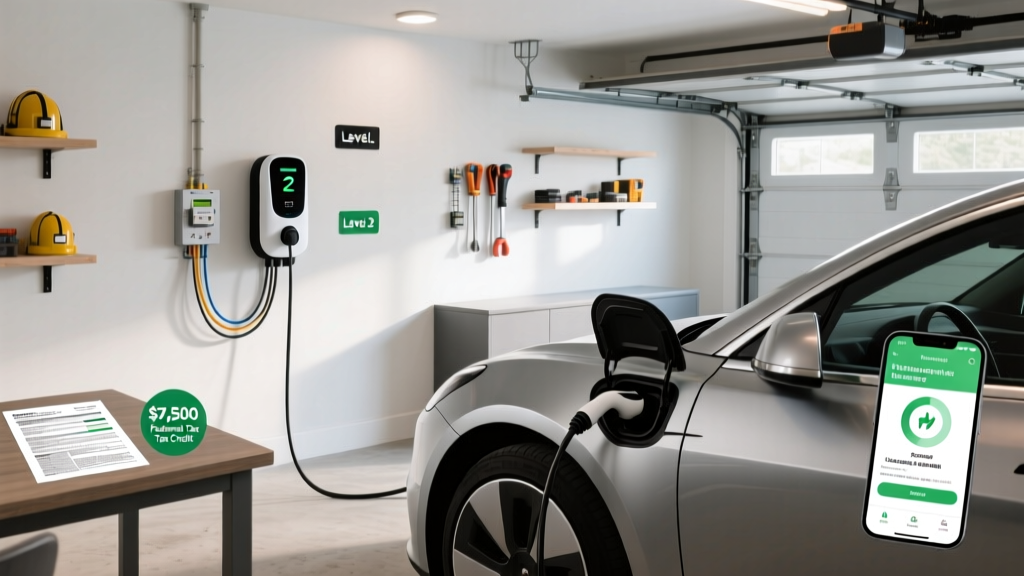
Installing a home Level 2 charger is the single most impactful upgrade for EV ownership. But costs vary enormously depending on your home's electrical panel, the distance from panel to charger location, and local permit requirements.
Electrical Requirements
A typical Level 2 charger runs on a 240-volt dedicated circuit, the same type of outlet used by an electric dryer or oven. The most common configurations:
- 40-amp circuit / 32-amp continuous draw: Delivers 7.7 kW. Sufficient for most overnight charging. Uses a NEMA 14-50 outlet or hardwired connection.
- 50-amp circuit / 40-amp continuous draw: Delivers 9.6 kW. A popular sweet spot. Uses a NEMA 14-50 outlet or hardwired.
- 60-amp circuit / 48-amp continuous draw: Delivers 11.5 kW. Common for higher-power chargers like the Tesla Wall Connector. Hardwired only (NEC code requires hardwiring for circuits above 50 amps in most jurisdictions).
- 80-amp circuit / 64-amp continuous draw: Delivers 15.4–19.2 kW. Requires significant panel capacity and heavy-gauge wire. Overkill for most homes but useful for vehicles with large batteries and high onboard charger acceptance rates (like the Ford F-150 Lightning Extended Range with its 19.2 kW onboard charger).
The National Electrical Code (NEC) requires that continuous loads (anything running 3+ hours, which includes EV charging) not exceed 80% of the circuit's rated amperage. That's why a 50-amp circuit delivers 40 amps of usable charging current.
Panel Upgrade Reality
This is where costs can spike. Many older homes have 100-amp electrical panels. Adding a 50-amp EV circuit to an already-loaded 100-amp panel may require a panel upgrade to 200 amps, which typically costs $1,500–$3,500 before permits. Some utilities offer rebates for panel upgrades tied to EV adoption — check with your local provider.
Newer homes (post-2010) often have 200-amp panels with spare capacity, making a Level 2 install straightforward. A licensed electrician will perform a load calculation before recommending a circuit size. Don't skip this step — overloading a panel is a fire hazard.
Installation Cost Breakdown
| Component | Simple Install (panel nearby, 200A service) | Complex Install (long wire run or panel upgrade) |
|---|---|---|
| Level 2 Charger (equipment) | $350–$700 | $350–$700 |
| Electrician labor | $300–$800 | $800–$2,500 |
| Electrical permit | $50–$200 | $50–$200 |
| Panel upgrade (if needed) | $0 | $1,500–$3,500 |
| Wire/conduit materials | $100–$300 | $300–$800 |
| Total estimated range | $800–$2,000 | $3,000–$7,700 |
Some states and utilities offer rebates of $250–$1,000 for home charger installation. The federal Alternative Fuel Vehicle Refueling Property Credit (IRC §30C) covers up to 30% of home charging equipment and installation costs, capped at $1,000, but only for installations in eligible census tracts — verify your eligibility with a tax professional before assuming you'll receive it.
Cost to Charge: Home vs. Public vs. Gas — The Real Per-Mile Numbers
One of the strongest economic arguments for EVs is the per-mile fuel cost. But the savings depend heavily on where and when you charge. Here's how the math works in 2026:
| Scenario | Typical $/kWh | Cost Per Mile (at 3.5 mi/kWh efficiency)* | Annual Cost (12,000 mi/yr) |
|---|---|---|---|
| Home, off-peak utility rate | $0.08–$0.14 | $0.023–$0.040 | $275–$480 |
| Home, standard rate (no TOU plan) | $0.14–$0.20 | $0.040–$0.057 | $480–$685 |
| Public Level 2 (ChargePoint, etc.) | $0.25–$0.49 | $0.071–$0.140 | $855–$1,680 |
| DC Fast Charging (Electrify America, Tesla) | $0.30–$0.55 | $0.086–$0.157 | $1,030–$1,885 |
| Gas vehicle (28 MPG combined, $3.40/gal) | — | $0.121 | $1,457 |
*3.5 miles per kWh is a realistic average for mid-size EVs like the Tesla Model Y or Hyundai Ioniq 5. Larger vehicles like the Ford F-150 Lightning average closer to 2.0–2.5 mi/kWh. Source: fueleconomy.gov EPA ratings.
The numbers make the case clear: home charging on an off-peak rate is dramatically cheaper than gasoline, saving $1,000–$1,200 per year for an average driver. But exclusive reliance on DC fast charging can actually cost more than gas in some markets. This is why home Level 2 access is so critical to EV economics.
Level 2 Charger Recommendations: What to Buy for a NACS-Equipped EV
With NACS now dominant, most major charger manufacturers offer NACS-connector models. Here are four well-regarded options spanning different budgets and feature sets. All are UL-listed and compatible with NACS-port vehicles:
Tesla Wall Connector (Gen 3)
- Power output: Up to 11.5 kW (48 amps, hardwired on 60A circuit)
- Connector: Native NACS
- Cable length: 24 feet
- Smart features: Wi-Fi for OTA updates, power sharing between multiple units, access control. No native app scheduling — relies on vehicle-side scheduling.
- Price: ~$475
- Verdict: Best value for Tesla and NACS owners. Clean design, reliable, but limited smart features compared to competitors.
ChargePoint Home Flex
- Power output: Up to 12 kW (50 amps, adjustable from 16–50A via DIP switches)
- Connector: Ships with NACS connector (J1772 also available)
- Cable length: 23 feet
- Smart features: ChargePoint app with scheduling, energy tracking, Alexa integration, utility demand-response programs
- Price: ~$649
- Verdict: Best smart charger for utility-program participants. Flexible amperage is useful for homes with limited panel capacity.
Emporia Vue Level 2 Charger
- Power output: Up to 11.5 kW (48 amps)
- Connector: NACS or J1772 options
- Cable length: 24 feet
- Smart features: Detailed energy monitoring via Emporia app, solar integration for homes with PV, scheduled charging, load management
- Price: ~$399
- Verdict: Budget pick with surprisingly robust energy monitoring. Good for solar-equipped homes wanting to charge on excess production.
Grizzl-E Smart
- Power output: Up to 9.6 kW (40 amps, adjustable)
- Connector: NACS available (also J1772)
- Cable length: 24 feet
- Smart features: OCPP-compatible, app scheduling, works with utility programs. Built in Canada with extreme cold-weather rating (-40°F).
- Price: ~$549
- Verdict: Rugged pick for cold climates and outdoor installs. Less polished app, but hardware is bulletproof.
Charging Time Examples: How Long Does 10–80% Actually Take?
Charge time depends on three variables: battery size (kWh), the charger's power output (kW), and the vehicle's onboard charger acceptance rate (for AC) or DC charge curve (for fast charging). Here are realistic estimates for common scenarios:
| Vehicle (Example) | Battery (kWh usable) | Level 2 at 11.5 kW | DC Fast (peak rate) |
|---|---|---|---|
| Tesla Model Y Long Range | 75 kWh | ~4.5 hours | ~25 min at 250 kW peak |
| Ford F-150 Lightning Extended Range | 131 kWh | ~8.0 hours (at 19.2 kW with 80A charger: ~4.8 hrs) | ~41 min at 150 kW peak |
| Hyundai Ioniq 5 (2026) | 84 kWh | ~5.1 hours | ~18 min at 240 kW peak (800V architecture) |
| Chevrolet Equinox EV | 85 kWh | ~5.2 hours | ~30 min at 190 kW peak |
Two things to note. First, the "peak" DC fast charge rate is just that — a peak, typically held only between 10–30% SoC before tapering. Sustained average rates are typically 60–75% of the peak figure. Second, Level 2 charging at home doesn't need to be fast. If your car sits for 10+ hours overnight, even a 7.7 kW charger fully replenishes a 75 kWh battery, which covers a week of commuting for most drivers.
Safety, Code, and Permit Requirements
EV charging draws sustained high current for hours — this is fundamentally different from intermittent loads like a microwave. The NEC (National Electrical Code, Article 625) has specific requirements:
- Dedicated circuit: Your EV charger must be on its own dedicated breaker. No sharing with other outlets or appliances.
- GFCI protection: The 2023 NEC update requires GFCI (Ground Fault Circuit Interrupter) protection for all EV charging outlets. Hardwired chargers may be exempt in some jurisdictions. Many modern chargers have built-in GFCI, which satisfies this requirement.
- Outdoor rating: If your charger is installed outdoors (garage-exterior wall, carport, driveway post), it must be rated NEMA 4 or NEMA 4X for weather resistance. All four chargers recommended above carry outdoor ratings.
- Permit requirement: Nearly all US jurisdictions require an electrical permit for a new 240V circuit. Permit costs range from $50–$200. Skipping the permit risks insurance claim denial if an electrical fire occurs and voids any equipment warranty.
- Wire gauge: A 50-amp circuit requires minimum 6 AWG copper wire; a 60-amp circuit requires 4 AWG. Longer wire runs may need thicker gauge to prevent voltage drop. Your electrician will calculate this.
One frequently overlooked detail: if you install a NEMA 14-50 outlet rather than hardwiring, the outlet itself must be rated for the continuous load. Standard residential dryer outlets are not always rated for 3+ hours of sustained 40-amp draw. Specify an "EV-rated" or "industrial-grade" 14-50 receptacle (Hubbell 9450A or equivalent, ~$75–$120) to your electrician.
Frequently Asked Questions
How much does it cost to install a home EV charger?
A straightforward Level 2 installation on an existing 200-amp panel typically costs $800–$2,000 all-in (charger + electrician + permit). If your home needs a panel upgrade from 100A to 200A, total costs can reach $3,000–$7,700. Get three quotes from licensed electricians — prices vary significantly by market.
How fast will each charging level add range?
Level 1 (120V) adds 3–5 miles per hour. Level 2 (240V) adds 20–65 miles per hour depending on the circuit amperage and your vehicle's onboard charger. DC fast charging adds 150–1,000+ miles per hour at peak rates, but sustained sessions typically fill a battery from 10–80% in 18–45 minutes depending on the vehicle and charger.
Which connector and charger is compatible with my EV?
Check your vehicle's charge port. If it's a 2025–2026 model from Ford, GM, Tesla, Rivian, Hyundai, Kia, or most others, it has a NACS port. Buy a NACS-connector Level 2 charger. If your EV has a CCS1 port (older models), you can use a J1772-to-CCS adapter with most chargers, or purchase a CCS1-native charger. For Tesla Supercharger access with a CCS1 vehicle, check if your automaker offers an approved NACS adapter.
How much does charging cost per mile vs. gas?
Home charging on off-peak rates costs roughly $0.03–$0.04 per mile for a typical mid-size EV — about one-third the cost of gasoline at $3.40/gallon in a 28 MPG vehicle ($0.12/mile). Public DC fast charging at $0.35–$0.55/kWh costs $0.09–$0.16 per mile, which is comparable to or slightly more than gas. The economic case for EVs depends heavily on reliable home charging access.
What electrical upgrades might I need?
The most common upgrade is a panel capacity increase from 100 amps to 200 amps ($1,500–$3,500), required if your existing panel lacks spare capacity for a 40–60 amp EV circuit. Some homes also need new conduit runs if the charger is far from the panel (added wire cost), or a utility service upgrade if the incoming supply line is undersized. A licensed electrician's load calculation will determine this before any work begins.