Access to Tesla's Supercharger network is the single biggest charging-infrastructure advantage an EV owner can have. With over 25,000 V3 and V4 stalls across North America, the network consistently delivers higher uptime and faster charge sessions than most third-party DC fast-charging providers. If you drive a non-Tesla EV with a CCS1 or CHAdeMO port, a NACS adapter is your bridge to that network — but not all adapters are created equal, and not every EV will see the same charging speeds through one.
This guide breaks down which NACS adapter you need based on your EV's connector, what charging speeds to expect at each level, how much home charger installation actually costs (including the panel-upgrade scenario), and what you'll pay per mile compared to gasoline. All figures reflect 2026 pricing and network conditions.
Charging Levels Explained: kW, Miles Per Hour, and Real Charge Times
Before evaluating adapters, you need clarity on the three charging levels and what they actually deliver. The unit kW (kilowatt) measures power — how fast energy flows into your battery. The unit kWh (kilowatt-hour) measures energy capacity — the size of your battery. A 75 kWh battery charged at 11.5 kW takes roughly 6.5 hours from empty to full. Confusing these two units is the most common EV literacy error; keep them separate.
| Level | Voltage / Phase | Power (kW) | Miles of Range Added Per Hour | Typical Use Case |
|---|---|---|---|---|
| Level 1 | 120V / Single | 1.0 – 1.9 kW | 3 – 5 mi/hr | Overnight top-up, PHEVs, low-mileage drivers |
| Level 2 | 240V / Single | 7.2 – 19.2 kW | 20 – 60 mi/hr | Home daily charging, workplace, destination |
| DC Fast (Level 3) | 400V–800V / DC | 50 – 350 kW | 150 – 1,000+ mi/hr (peak) | Road trips, rapid top-ups, commercial fleets |
Real charge-time examples (10–80% SoC):
- 60 kWh battery (e.g., base Nissan Ariya): ~28 min at a 150 kW DC fast charger; ~5.5 hours on an 11.5 kW Level 2 home charger.
- 82 kWh battery (e.g., Volkswagen ID.4 Pro): ~32 min at 175 kW; ~7 hours on 11.5 kW Level 2.
- 100 kWh battery (e.g., Ford F-150 Lightning Extended Range): ~40 min at 150 kW; ~9 hours on 11.5 kW Level 2.
Connector Compatibility: Which NACS Adapter Fits Your EV
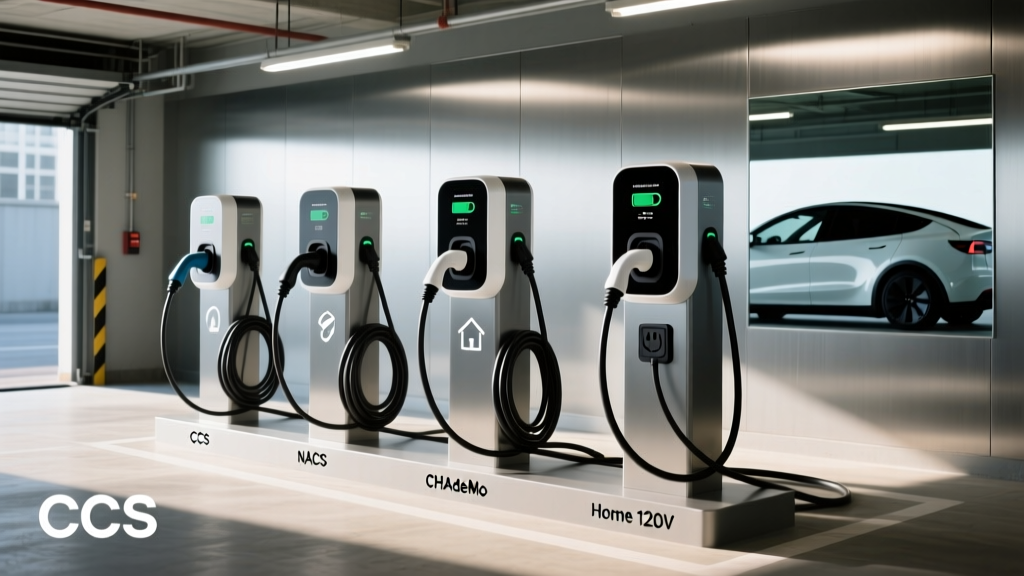
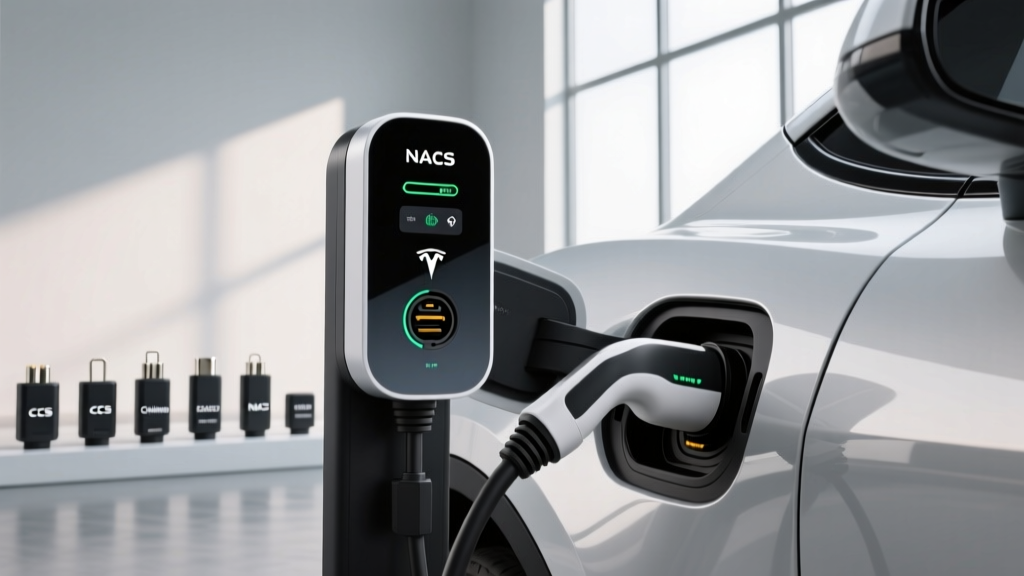
NACS (North American Charging Standard), originally Tesla's proprietary connector, became the de facto North American EV standard after Ford, GM, Rivian, Volvo, and most other automakers committed to adopting it. By the 2026 model year, most new EVs ship with a native NACS port. If you own a 2024 or earlier model with CCS1 or CHAdeMO, you need an adapter to access NACS chargers — including Tesla Superchargers.
| Your EV's Port | Adapter Needed | Max DC Fast Charge Speed via Adapter | Level 2 (AC) Charging via Adapter | Example Vehicles |
|---|---|---|---|---|
| NACS (native) | None | Up to 250 kW (V3 Supercharger) | Native NACS J1772-equivalent AC | 2025+ Tesla, Ford, GM, Rivian, Volvo, Polestar |
| CCS1 | NACS-to-CCS1 adapter | Up to 150–250 kW (vehicle-limited) | Yes, via adapter or J1772 inlet | Hyundai Ioniq 5 (pre-2025), VW ID.4, BMW i4, Kia EV6 (pre-2025) |
| CHAdeMO | NACS-to-CHAdeMO adapter | ~50 kW max (CHAdeMO protocol limit) | Requires separate J1772 adapter for AC | Nissan Leaf (all years), Mitsubishi Outlander PHEV (older) |
Adapter Options and What to Know Before Buying
OEM adapters (recommended): Automakers like Ford, GM, Rivian, and Hyundai sell or include branded NACS-to-CCS1 adapters for their customers. These are tested for safe communication protocols between your EV's battery management system (BMS) and the Supercharger stall. Ford's adapter (part number compatible with Mustang Mach-E and F-150 Lightning) retails around $230 and supports up to 150 kW DC charging at V3 Superchargers. GM offers a similar adapter for Bolt EUV and Cadillac Lyriq owners (pre-NACS trims) at approximately $225.
Aftermarket adapters: Brands like Lectron, A2Z, and TeslaTap produce NACS-to-CCS1 adapters ranging from $150–$350. Critical considerations: verify the adapter is UL-listed or TÜV-certified, supports the amperage your EV can accept (some cap at 200A, limiting you to ~75 kW even at a 250 kW stall), and includes a locking mechanism. Cheap, uncertified adapters risk overheating at high-current DC sessions.
CHAdeMO owners: NACS-to-CHAdeMO adapters are less common and more expensive ($300–$450) because CHAdeMO uses a different communication protocol. The Nissan Leaf, the most common CHAdeMO vehicle, is also limited to 50 kW DC fast charging (100 kW on the Ariya, which uses CCS1). Adapters exist but offer diminishing value given CHAdeMO's declining infrastructure.
- Most CCS1-to-NACS adapters cap at 200A or 250A — your peak kW will be lower than the stall's rated output.
- Some older Supercharger stalls (V2, 150 kW) may not handshake correctly with certain adapter/EV combinations. V3 and V4 stalls have better compatibility.
- Adapters add a physical connection point — inspect for heat, discoloration, or loose fit before every session.
- Level 2 AC charging through a NACS adapter works, but using a dedicated J1772-to-NACS adapter (cheaper, ~$40) for home/public Level 2 is more practical.
Home Charger Installation: Electrical Requirements and Real Costs
A NACS adapter gets you access to public Superchargers, but the majority of your charging (industry data suggests 80%+) will happen at home. For a 240V Level 2 home charger, here's what your electrical system needs to support.
Electrical Requirements
- Circuit: A dedicated 240V circuit, typically 40A, 50A, or 60A, depending on charger amperage.
- Charger amperage vs. circuit rating: The National Electrical Code (NEC) requires circuits to be rated at 125% of the continuous load. A 40A charger requires a 50A circuit; a 48A charger requires a 60A circuit.
- Wire gauge: 6 AWG copper for 50A circuits; 4 AWG for 60A. Longer wire runs may require thicker gauge to prevent voltage drop.
- Outlet vs. hardwired: NEMA 14-50 outlets offer portability (you can unplug and take the charger when you move). Hardwired installations support higher amperage (up to 48A–80A) and eliminate the outlet as a failure point.
- GFCI protection: NEC 2020 and later require GFCI breakers for receptacle-based EV charger installations in garages. Hardwired units are exempt from this requirement.
Panel Upgrade: The Cost That Catches Owners Off Guard
If your home has a 100A main electrical panel (common in homes built before 1990), adding a 50A or 60A dedicated EV circuit may exceed your panel's available capacity. A licensed electrician will perform a load calculation to determine if an upgrade is needed.
- 100A panel: Often requires upgrade to 200A to accommodate a Level 2 charger alongside existing loads (HVAC, electric range, dryer).
- 150A panel: May support a 40A charger circuit without upgrade, depending on existing loads.
- 200A panel: Typically sufficient for a 48A–60A charger circuit in most homes.
| Component | Simple Install (200A panel, short run) | Complex Install (panel upgrade, long run) |
|---|---|---|
| Level 2 Charger Equipment | $400 – $700 | $500 – $750 |
| Electrician Labor (permit, wiring, breaker) | $600 – $1,200 | $1,500 – $3,000 |
| Panel Upgrade (100A → 200A, if needed) | $0 | $1,500 – $3,500 |
| Permit & Inspection | $100 – $250 | $150 – $400 |
| Total Estimated Cost | $1,100 – $2,150 | $3,650 – $7,650 |
According to the U.S. Department of Energy, the national average for a basic Level 2 home installation ranges from $1,000 to $2,500, but panel upgrades and long conduit runs in condos or detached garages push costs significantly higher. Always get at least two quotes from licensed electricians and verify they have EV charger installation experience.
Cost to Charge: Home, Public, and Per-Mile vs. Gasoline
The economics of EV charging depend heavily on where and when you charge. Here are realistic 2026 cost scenarios:
| Charging Scenario | Cost per kWh | Cost per Mile (at 3.5 mi/kWh efficiency) | Annual Cost (12,000 mi/yr) |
|---|---|---|---|
| Home, off-peak utility rate | $0.08 – $0.14 | $0.023 – $0.040 | $275 – $480 |
| Home, standard residential rate | $0.14 – $0.22 | $0.040 – $0.063 | $480 – $755 |
| Public Level 2 (ChargePoint, EVgo) | $0.25 – $0.49 | $0.071 – $0.140 | $855 – $1,680 |
| DC Fast Charging (Electrify America, Tesla Supercharger) | $0.30 – $0.55 | $0.086 – $0.157 | $1,030 – $1,885 |
| Gasoline vehicle (27 MPG avg, $3.40/gal) | — | $0.126 | $1,511 |
The data is clear: home charging at off-peak rates delivers the lowest per-mile cost of any fueling method, at roughly one-fifth to one-third the cost of gasoline. Public DC fast charging, while convenient for road trips, narrows the savings gap considerably — and in some high-cost markets (California peak rates, urban Electrify America stations at $0.55/kWh), can briefly exceed gasoline per-mile cost.
To maximize savings, look for utility time-of-use (TOU) plans that offer off-peak rates between 10 PM and 6 AM. Most smart Level 2 chargers allow you to schedule charging windows to align with these rates automatically.
Recommended Home Chargers: Power, Features, and Pricing
Whether you use a NACS adapter at public Superchargers or charge at home, your Level 2 home charger is the workhorse of daily EV ownership. Here are top picks across categories for 2026:
Best Overall: ChargePoint Home Flex
- Power Output: Up to 12 kW (50A circuit) or 9.6 kW (40A circuit), configurable
- Connector: J1772 (NACS version available for 2025+ native-NACS EVs)
- Cable Length: 23 feet
- Smart Features: Wi-Fi, app scheduling, Alexa integration, energy tracking, utility TOU optimization
- Price: ~$550 (J1772), ~$600 (NACS)
- Best For: Most EVs, especially CCS1 owners using a J1772 inlet at home and a NACS adapter for road trips
Best for Native NACS EVs: Tesla Wall Connector
- Power Output: Up to 11.5 kW (48A on a 60A circuit)
- Connector: NACS (native)
- Cable Length: 24 feet
- Smart Features: Wi-Fi, over-the-air updates, power-sharing (link two units on one circuit), Tesla app integration
- Price: ~$475
- Best For: Tesla owners and 2025+ Ford/GM/Rivian/Volvo NACS-native EVs. CCS1 EVs need a NACS-to-CCS1 adapter to use this at home, or should use a J1772 charger instead.
Best Budget Pick: Emporia Level 2 EV Charger
- Power Output: Up to 11.5 kW (48A on a 60A circuit)
- Connector: J1772
- Cable Length: 24 feet
- Smart Features: Wi-Fi, app scheduling, solar integration (pairs with Emporia Vue energy monitor), load management
- Price: ~$399
- Best For: Budget-conscious buyers, solar-home owners, anyone wanting energy monitoring without premium pricing
Best High-Power: Grizzl-E Smart
- Power Output: Up to 9.6 kW (40A on a 50A circuit)
- Connector: J1772 or NACS (select at purchase)
- Cable Length: 24 feet
- Smart Features: Wi-Fi, OCPP protocol (compatible with utility demand-response programs), extreme cold rating (-40°F)
- Price: ~$549
- Best For: Cold-climate owners, utility program participants, those wanting a rugged outdoor-rated unit
Safety, Code Compliance, and Installation Best Practices
EV chargers draw sustained high current for hours — this is fundamentally different from intermittent loads like a dryer or oven. Proper installation is not optional.
- Dedicated circuit: Your EV charger must have its own dedicated circuit. Never share a circuit with other major appliances.
- GFCI protection: Required by NEC 2020+ for all receptacle-based (NEMA 14-50) EV charging installations in garages and outdoors. Hardwired installations are exempt but still recommended to have ground-fault protection built into the charger unit.
- Outdoor rating: If your charger is installed outdoors or in an unenclosed carport, verify the unit carries a NEMA 4 or IP65 rating for water and dust resistance.
- Permit and inspection: Virtually all jurisdictions require an electrical permit for EV charger installation. Skipping the permit risks voiding homeowner insurance coverage in the event of an electrical fire. Budget $100–$400 for permit and inspection fees.
- Cable management: Use a wall-mounted cable organizer or retractable reel to prevent tripping hazards and cable damage. Never run charging cables across walkways or under garage doors.
- Surge protection: Consider a whole-home surge protector ($200–$400 installed) to safeguard your charger and EV's onboard charger from grid voltage spikes, especially in areas with frequent lightning or unstable utility infrastructure.
The National Fire Protection Association's NEC guidelines are the baseline; your local jurisdiction may have additional requirements. Always hire a licensed electrician who pulls a permit — this protects your home, your warranty, and your insurance coverage.
Frequently Asked Questions About NACS Adapters and EV Charging
How much does it cost to install a home EV charger?
A straightforward Level 2 installation on an existing 200A panel typically costs $1,100–$2,150 including equipment, labor, and permits. If your home requires a panel upgrade (100A to 200A), total costs range from $3,650–$7,650. Always obtain multiple quotes from licensed electricians.
How fast will each charging level add range?
Level 1 (120V) adds 3–5 miles per hour. Level 2 (240V) adds 20–60 miles per hour depending on amperage and your EV's onboard charger capacity. DC fast charging adds 150–1,000+ miles per hour at peak speeds, but real sessions average lower due to charge-curve taper above 50% SoC.
Which connector and charger is compatible with my EV?
Check your EV's charge port: if it's NACS (2025+ models from most brands), you need no adapter for Superchargers and a NACS or J1772 home charger. If it's CCS1 (most 2024 and earlier non-Tesla EVs), you need a NACS-to-CCS1 adapter for Superchargers and a J1772 home charger. CHAdeMO vehicles (Nissan Leaf) need a NACS-to-CHAdeMO adapter, though options are limited and more expensive.
How much does EV charging cost per mile vs. gas?
Home off-peak charging costs $0.02–$0.04 per mile — about one-quarter the cost of gasoline at $0.13/mile. Public DC fast charging costs $0.09–$0.16 per mile, roughly comparable to or slightly above gasoline. The more you charge at home, the more you save.
What electrical upgrades might I need for a home charger?
Homes with a 100A main panel often need an upgrade to 200A ($1,500–$3,500) to support a Level 2 charger. Homes with 150A or 200A panels usually have sufficient capacity. A licensed electrician will perform a load calculation to determine your specific needs. Older homes may also need updated wiring, a new breaker box, or a sub-panel for a detached garage installation.
Can I use a NACS adapter for home Level 2 charging?
Yes, but it's not ideal. Using a NACS-to-CCS1 adapter for daily home Level 2 charging adds wear to both the adapter and your EV's charge port. Most CCS1 EVs also have a J1772 inlet for AC charging — use a standard J1772 Level 2 charger at home and reserve the NACS adapter for DC fast charging at Superchargers on road trips.
Will a NACS adapter slow down my DC fast charging?
Possibly. Most aftermarket NACS-to-CCS1 adapters are rated for 200A or 250A. At a 250 kW V3 Supercharger (which can deliver up to ~600A at low voltage), an adapter rated at 200A will cap your session at roughly 75–100 kW depending on your battery voltage. OEM adapters from Ford, GM, and Rivian tend to support higher amperage. Always check the adapter's rated amperage before purchase.
Are there any federal incentives for home charger installation?
The IRS §30C Alternative Fuel Vehicle Refueling Property Credit provides a tax credit of up to 30% of the cost of home EV charger equipment and installation, capped at $1,000 for residential installations. Eligibility depends on your census tract meeting certain income or rural-area criteria. Consult a tax professional and verify current-year rules at IRS.gov before claiming.